At a glance
- Solid red oak, walnut & maple — real hardwood, not plastic or veneer
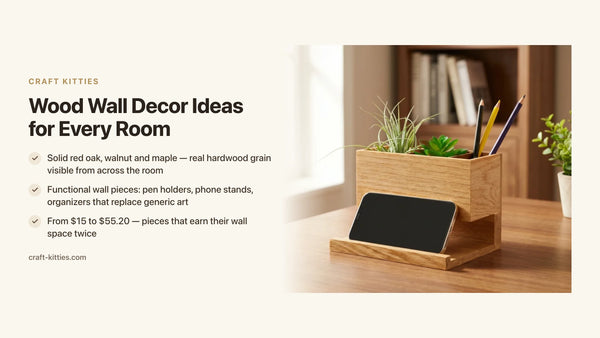
- All-in-One Plant Pod: pen cup, plant pod and phone stand in one footprint
- From $15.00 to $55.20, five designs for every desk and budget
The school year begins with the best intentions and a very specific problem: a desk that works against you. Chargers tangled under notebooks, pens missing when they're needed, a phone face-up and demanding attention every four minutes. The objects on the desk shape how the desk feels to work at — which is why the most effective back-to-school purchase is rarely another notebook or a new backpack. It is a desk organizer that actually organizes.
The catch, as always, is choosing well. The market for back to school desk organizers skews heavily toward cheap plastic: bright colors, low prices, broken by December. This guide takes a different position. Solid wood — red oak, walnut, maple — costs more at purchase and costs nothing afterward. A pen holder that holds its shape through four years of undergraduate life, through a move to a first apartment, through a graduate program, pays for itself several times over in the objects it replaces. It also looks considerably better the whole time.
What follows is a practical guide to choosing a solid wood desk organizer for back to school: the species that matter, the formats that work at a student desk, the features worth paying for, five specific products from our studio, a comparison table, and honest answers to the questions we hear most.
At a glance
- Solid red oak, walnut & maple — real hardwood, not plastic or veneer
- All-in-One Plant Pod: pen cup, plant pod and phone stand in one footprint
- From $15.00 to $55.20, five designs for every desk and budget
Why solid wood holds up where plastic and bamboo boards fail
The back-to-school organizer market is built around a quiet assumption: this object will be replaced next year. Bright-colored polypropylene cups, pressed-bamboo trays with paper-thin walls, MDF pencil cups covered in a decorative wrap — they look the part in the store, and they fail in predictable ways. The bamboo board cracks along the grain when it dries out in a heated dorm room. The MDF swells at the corners when a sweating coffee mug sits on the same surface. The plastic cup warps under a stack of textbooks.
Solid wood — specifically red oak, walnut and maple — does not behave that way. These are dense, structural hardwoods used in furniture and flooring precisely because they resist deformation under load, humidity cycling and daily contact. A red oak pen holder machined to 8 mm wall thickness has more structural integrity than a plastic mold twice as thick. A walnut piece finished with wax or oil develops a protective surface layer that takes scratches and knocks without exposing raw material underneath.
The distinction matters not just for longevity but for the daily sensory experience of working at the desk. A wooden pen holder that barely moves when you pull a pen from it is a different working environment from one that skids across the desk or tips with every reach. The weight and grain of hardwood make the desk feel settled rather than provisional — a minor thing in isolation, a meaningful thing across eight hours of study.
Red oak, walnut or maple: choosing the species for your desk

The three species present in our lineup differ primarily to the eye, not to the hand. All three are genuine solid hardwood finished to the same standard; what you are choosing is the visual relationship between the wood and the rest of the desk.
Red oak is the warmest of the three: a light honey tone with a bold, open grain that is readable from a distance. On a white or pale wood desk it provides the kind of contrast that makes the whole surface feel designed rather than assembled. It suits minimal, Scandi and warm-neutral aesthetics — the most versatile starting point if you are not sure what the desk will look like.
Walnut sits at the opposite end. Deep brown to almost chocolatey, with a fine and quiet grain, it reads as a serious material. Against a light desk surface it becomes the focal point of the workspace; in a darker or warmer setup it integrates seamlessly. Walnut traditionally commands a premium in home furnishings for exactly these visual properties — the same reason it has become the default material in high-end desk setups.
Maple is the neutral: pale blond with a tight, almost homogenous grain that reads as modern and clean. Alone it is the least assertive of the three; spliced with walnut in a contrasting design, it creates a strong two-tone effect that is more visually interesting than either species alone.
The reliable shortcut: contrast with the desk surface. Light desk — dark wood. Dark desk — light wood. Mixed — walnut, which reads well against both. When the answer still will not settle, several of our designs are available in multiple species, so the decision resolves at checkout rather than in front of an empty shelf.
The formats that work at a student desk
Not all desk organizer formats serve a student desk equally. The space constraints of a dorm room or a shared apartment desk are more acute than a home office, and the range of objects that need organizing is different — less cable management, more pens, markers, scissors, a ruler, a phone, maybe a plant.
The cylindrical pen cup is the baseline format for a reason: it organizes the most objects in the smallest footprint. A well-proportioned cup — 3 to 4 inches in diameter, 4 inches tall — holds 15 to 20 writing tools upright and accessible. Its limitation is that it does not distinguish between a pencil and a ruler: everything coexists in one shared pool.
Multi-compartment designs solve that problem. Two or three separate openings — one for pens, one for scissors and a ruler, one for erasers and clips — mean that each tool has a home. You do not have to excavate the cup to find the highlighter that sank to the bottom. For a desk that handles multiple subjects or projects simultaneously, the compartmentalized format recovers meaningful time over a semester.
The combined phone stand and pen holder is the format that adapts specifically to how students actually work. A phone on the desk is either a tool or a trap — the stand converts it from the latter to the former by giving it a fixed position and angle. The phone is present but not dominant, visible for a timer or a quick reference but not flat on the surface demanding to be unlocked.
The all-in-one desk organizer takes the logic further: pen storage, phone stand, and a small plant pod in a single piece. One object on the desk instead of three, with the added benefit of having live greenery within the working field of vision — a detail that sounds trivial but that consistent research links to reduced mental fatigue during sustained focus sessions.
The five organizers from our studio, in detail

Description
The Plant Pod is the piece we point to first for a student desk precisely because it consolidates. Solid red oak with a warm, open grain, it combines a deep cylindrical pen cup, a smaller adjacent pod sized for a succulent or air plant, and an angled phone stand built into the back. The footprint is compact; the function is comprehensive. At $55.20 it is the statement piece in the lineup — the one that makes the desk look like it was designed, not assembled from impulse purchases.

Description
Walnut and maple in a single piece — the spliced joint is not a decorative veneer but a structural bond between two solid hardwood sections. The result is a striking two-tone grain pattern that works as a desk object in its own right while still being a fully functional pen holder. At $36.00 it is the design-forward option: for a desk where the aesthetic matters as much as the organization.

Description
At $15.99 this is where solid wood becomes accessible. The Walnut & Red Oak pen holder pairs the deep brown of walnut with the warm tone of red oak in a handmade design that costs barely more than a plastic alternative. Nothing in the build is compromised to hit that price: real wood, real finish, real weight. The right pick for a first desk setup or a gift that needs to feel considered without being extravagant.

Description
The pen holder and phone stand combination solves the most common failure mode of the student desk: a phone that migrates from nightstand to desk to lap to lost. At $35.00 the integrated stand gives the phone a fixed home at the correct angle — present for a timer or a reference, not commanding the center of the workspace. Solid wood, oil finish, compact form. The sensible second step after the entry-level cup.

Description
The simplest piece in the lineup at $15.00: a solid wood geometric pencil cup that holds pens upright, does not move when you reach into it, and occupies minimal desk real estate. Not everything needs to be a statement — sometimes the right desk organizer is the one that disappears while doing its job. For a desk where space is the binding constraint, this is the pick.
Comparison table
| Model | Price | Wood | Key feature | Best for |
|---|---|---|---|---|
| Red Oak Plant Pod | $55.20 | Solid red oak | Pen cup + plant pod + phone stand | The all-in-one desk setup |
| Walnut & Maple Spliced | $36.00 | Solid walnut + maple | Two-tone spliced design | Design-forward desks |
| Pen Holder & Phone Stand | $35.00 | Solid wood | Integrated phone stand | Reducing phone distraction |
| Walnut & Red Oak | $15.99 | Solid walnut + red oak | Two-hardwood handmade build | First setup, thoughtful gift |
| Geometric Pencil Cup | $15.00 | Solid wood | Minimal footprint, clean geometry | Space-constrained desks |
Decision matrix — which desk organizer for which situation
| Your situation | The right pick |
|---|---|
| You want one object that replaces three on the desk | Red Oak Plant Pod — $55.20 |
| The desk aesthetic comes first and budget allows | Walnut & Maple Spliced — $36.00 |
| Phone distraction is the primary problem to solve | Pen Holder & Phone Stand — $35.00 |
| First setup, tight budget, solid wood matters | Walnut & Red Oak — $15.99 |
| Desk space is very limited and function is all that counts | Geometric Pencil Cup — $15.00 |
| Back-to-school gift that will not feel disposable | Red Oak Plant Pod — $55.20 |
What the wood species actually changes at a student desk

The honest answer is that red oak, walnut and maple are closer in daily performance than most marketing copy admits. All three are structural hardwoods with Janka hardness ratings between 1000 and 1450 lbf — well above the threshold for a desk object that will be touched hundreds of times a day. All three take a wax or oil finish that provides equivalent surface protection. All three are denser than any bamboo-pressed or MDF alternative at comparable wall thickness.
Where the species genuinely diverge is in their visual behavior on the desk, and that is not a trivial distinction — it determines whether the organizer becomes part of a coherent desk aesthetic or simply a functional object you stop noticing. Red oak's bold, open grain makes the wood itself the visual point of interest; it reads as warm and tactile even from a distance. Walnut's fine, close grain creates a smoother, more restrained surface — the darkness does the visual work rather than the grain pattern. Maple's pale, nearly uniform grain is the most neutral, which makes it both the most versatile background piece and the most dependent on form for its appeal.
One practical note: red oak and maple are both lighter in tone, which means scratches and scuffs are less visible than on darker walnut. For a desk that sees heavy use and does not get babied — which is the honest description of most student desks — the lighter species age with less visible wear.
Setting up the desk properly: five positions, one rule
The most common desk-setup mistake is buying the right organizer and putting it in the wrong place. A pen holder that lives at the far corner of the desk requires a 12-inch reach every time you pick up a pen — which sounds trivial and becomes quietly exhausting across a four-hour study session. The placement of each object should be determined by how often it is reached for, not by what fits where.
The rule: objects reached for several times per hour belong within a 12-inch radius of the dominant hand, resting at the desk surface. Objects referenced occasionally belong in a secondary zone up to 24 inches away. Objects rarely touched go on a shelf or in a drawer.
Applied to the desk: the pen holder lives immediately to the right or left of the keyboard or notebook — not behind the monitor, not in the far corner. The phone stand belongs at the edge of the primary zone, angled so the screen is visible in peripheral vision without requiring a head turn. The plant pod, if present, can sit at the boundary of the two zones: visible, but not competing for surface within the working area.
Five positions for a functional student desk:
- Keyboard or notebook center — the task itself, nothing else.
- Dominant-hand near zone — pen holder, with the most-used tools at the front.
- Non-dominant side — phone stand, angled slightly toward the eye line.
- Behind the keyboard — monitor or laptop stand at the back center.
- Far edge or shelf — plant, candle, or any decorative object that does not need to be touched.
Position the objects before buying extras. The desk that is already full at the start of the year will become impossible by November.
Mistakes that make a good organizer useless
Buying multiple single-function pieces when one multi-function piece fits the space. Three objects on a student desk — a plastic cup, a phone stand and a sticky-note tray — take up more space than a single Plant Pod, cost more combined, and produce a desk that looks accumulated rather than designed. The constraint of a small desk is an argument for fewer, more functional objects, not more cheap ones.
Choosing the grain from a product photo instead of your actual desk. A walnut organizer photographed against a white studio background looks one way; against a natural birch IKEA desk it looks another. Before ordering, look at the desk surface and the dominant objects already on it — the piece should contrast with the desk, not merge with it.
Overloading the pen cup until it tips. A cylindrical cup is stable when filled appropriately; load it with 30 items and add a heavy pair of scissors near the edge and it becomes a liability. The right fill is two-thirds capacity, with the heaviest tools at the center.
Keeping the organizer in place once it stops fitting the workflow. The setup that works for a literature student who uses mostly pens and highlighters is different from the one that works for an engineering student managing drafting tools, calipers and multiple pencil weights. The desk should change when the work changes — the organizer is a tool, not a permanent fixture.
Treating wood like plastic. Solid hardwood does not need special care, but it does not like extended contact with moisture. A mug of water sitting on the pen holder overnight is not a crisis; a wet surface left unwiped for a week is. The maintenance requirement is minimal — wipe when needed — but it is not zero.
Caring for solid wood at a busy desk
The maintenance schedule for a waxed or oiled hardwood organizer is genuinely simple: a dry cloth for daily dust, a slightly damp cloth for anything that needs more. No cleaning products with alcohol or ammonia; they strip the finish. No leaving objects that hold moisture — plants, wet mugs, damp cloths — resting on the wood for extended periods.
Once or twice a year, if the surface starts to look dry or matte in a way that seems dull rather than natural, a small amount of food-grade mineral oil or beeswax rubbed in with a cloth and buffed off after five minutes restores the finish. This is a ten-minute task that keeps the piece looking as good in year four as it did on day one of the school year.
The finish does not need to be stripped and reapplied; it builds up over time with each wax pass, becoming more protective rather than less. In practice, most owners go years between intentional maintenance and the piece continues to look fine throughout.
Where to go next
The pen holder is usually the first solid wood piece on a student desk, and rarely the last. Our pen holder collection gathers the full range in the same red oak, walnut and maple families — additional formats, sizes and configurations that answer different desk situations as the setup evolves over time. If you have found the right pen holder and want to extend the aesthetic, the Red Oak Plant Pod and the Wooden Pen Holder & Phone Stand are the natural next steps, each designed to integrate with the same visual language.
Those discovering our studio through Etsy — where we have 243 customer reviews from people who have lived with these pieces through real school years and real work lives — will find the same designs at the same quality, with the full collection available here.
The short version
The back to school desk organizer market defaults to cheap and temporary. The argument for going the other way — spending $15.99 to $55.20 on solid hardwood instead of $8 on injection-molded plastic — is not about luxury. It is about buying one object instead of three over four years, and working at a desk that feels settled rather than improvised from day one.
Choose the species by contrast: red oak on a light desk, walnut on a light desk that needs a darker anchor, maple paired with walnut for a two-tone visual. Choose the format by the actual problem: all-in-one if the desk needs to be simplified, phone stand if distraction is the issue, geometric cup if space is the binding constraint. The Red Oak Plant Pod answers the broadest brief; the Walnut & Red Oak at $15.99 answers the tightest budget without giving up solid wood. Either way, buy it once.
FAQ — back to school desk organizers
1 — What makes solid wood better than plastic for school? Solid wood — red oak, walnut, maple — does not crack or warp under the daily load of a student desk. It holds its shape through four years of textbooks stacked near it and backpacks knocking it aside. Plastic organizers look fine in August and are cracked or discolored by the end of sophomore year. A hardwood piece bought once is still on the desk at graduation.
2 — What is the difference between red oak, walnut and maple for a pen holder? Red oak is light, honey-toned and bold-grained — suits a bright, minimal desk. Walnut is deep brown with a fine, quiet grain — a darker presence that makes other objects pop against it. Maple is pale with a tight grain — the most neutral of the three, striking when spliced with walnut. Durability is comparable across all three.
3 — Can a wooden pen holder handle heavy use? Yes. Our holders are cut from solid hardwood — not veneer, not MDF, not pressed bamboo — and finished with a wax or oil coat. They take the weight of a full complement of pens, markers, scissors and rulers without flexing, and the finish resists the daily contact that accumulates on a desk that is actually worked at.
4 — How many pens and tools fit? A standard cup in our range holds 15 to 20 writing tools upright with room to pull any one out without toppling the rest. Multi-compartment models separate pens from scissors from clips so the right tool is always reachable in the first five seconds.
5 — Is a combined phone stand and pen holder worth it at a student desk? More useful than it sounds. A phone flat on the desk is a distraction the moment a message appears. Propped at a fixed angle in a stand that is already on the desk, it becomes peripheral: visible for a timer or a quick reference, not commanding full attention. The combination also collapses two objects into one footprint.
6 — What is the Plant Pod and what does the plant compartment do? The Plant Pod is a solid red oak organizer with a pen cup, a smaller pod for a succulent or air plant, and a built-in phone stand. The plant is not decorative filler — consistent research links live greenery in the field of vision to reduced cognitive fatigue during sustained focus sessions. Practical and visual at the same time.
7 — Are spliced two-wood designs structurally sound? Yes. A spliced design joins two species of solid hardwood along a glued seam using the same joinery used in quality furniture. The joint does not weaken the piece; it adds a visual contrast that makes the grain pattern the focal point of the desk. Under normal use the seam is effectively permanent.
8 — How do I care for a wooden desk organizer? A dry or slightly damp cloth removes dust and surface marks. No harsh cleaners, no standing water. Once or twice a year, a small amount of mineral oil or beeswax rubbed in and buffed off keeps the finish supple. That is the full maintenance routine — ten minutes per year for a piece that lasts through a degree and beyond.
9 — Does the weight of a solid wood holder matter? It matters in daily use more than in spec comparisons. A wooden pen holder that stays put when you pull a pen from it — rather than skidding across the desk or tipping — removes a small but persistent friction from the desk environment. The density of hardwood solves a problem that lighter materials create.
10 — Does a wooden desk organizer make a good back-to-school gift? It is one of the more considered options in the category precisely because it does not read as disposable. A solid wood pen holder says the object is expected to last — the right tone for a gift that accompanies someone through a degree. The Plant Pod model also carries a small ritual: choosing the plant, caring for it, which makes the object personal from the first week of the school year.