At a glance
- Solid red oak, walnut or beech — sealed hardwood that handles bathroom humidity without warping
- Wall-mounted bars free the floor; a double-layer bar solves two-person households in a single footprint
- From $22, with brass or black hardware, single or double rail
The bathroom is the room that accumulates the most without being asked. A cabinet that looked fine last year now holds half-empty tubes behind a stack of towels that drape over the door because the bar is full. The floor holds a basket that collects things that should hang. The wall above the sink is blank while a shelf somewhere else is crowded. None of these situations is hard to fix. What they share is the same root: the storage was placed where it fit at the time, not where it belongs in a system.
A system that keeps itself tidy does not require discipline. It requires that every item has exactly one place, that the place is reachable without thinking, and that putting something back takes less effort than leaving it somewhere else. In a bathroom, that means bringing storage off the floor and onto the wall, choosing pieces that work together, and starting with the highest-traffic item in the room: the towel.
This guide builds a wall-mounted bathroom organization system from the floor up — humidity-safe materials first, then the logic of bar placement, storage layers, and the pieces from our studio that make the system work without ongoing effort.
Why solid wood belongs in a bathroom (and which finishes make it last)

The reflex against wood in bathrooms comes from a real experience with the wrong wood. Veneered MDF — the material behind most budget bathroom furniture — absorbs humidity at its cut edges, swells, and delaminates. The printed-wood surface starts lifting within a season in a room that sees daily steam. That failure is so common that it has given solid hardwood an unfair reputation by association.
Sealed solid wood is a different material in every meaningful way. Red oak, walnut, and beech are dense hardwoods; they do not absorb ambient moisture when properly finished. Our bars are finished with a wax or oil-wax coat applied in our studio — the same family of finish used on quality hardwood furniture and kitchen utensils. The surface repels splashes, wipes dry in seconds, and does not require any special care beyond a cloth. The finish does the work so you do not have to.
Among the three species, beech is the most dimensionally stable: it expands and contracts least with the humidity swings that happen every time someone showers. It is the default choice in Scandinavian bathroom design for exactly that reason — fine, pale grain that reads clean against white or grey tile, and a structure that holds its shape year after year. Red oak brings a bolder, more specialementsive grain with a warm honey tone that warms up neutral bathrooms. Walnut is the quieter, darker option — tight fine grain, a deep brown that reads furniture-quality, understated against light walls.
The rule for choosing: sealed solid hardwood is not a compromise for a bathroom. It is the correct material. Veneer is the compromise.
The wall is the storage — why floor-free organization works
A bathroom organized at floor level is harder to clean, harder to scan, and harder to keep tidy. The things that live on the floor — baskets, freestanding racks, corner shelves — shift, accumulate, and make the room feel smaller than it is. The floor of a bathroom should be unobstructed: easier to mop, easier to see, and visually the lightest part of the room.
Moving storage to the wall solves three problems at once. First, items are visible from the doorway — nothing gets buried or forgotten. Second, the floor stays clear of contact with damp surfaces, which is where mold problems start. Third, each piece is fixed: it does not drift, does not tip, and does not end up somewhere else over time.
The system that follows is entirely wall-mounted. It works in bathrooms of any size because it expands vertically, not horizontally. The organizing principle is simple: anchor with the towel bar first, then add layers above and to the sides based on what you actually use daily.
Humidity safety first: what to check before buying any bathroom fixture
Before species, before hardware finish, before price — confirm the seal. An unsealed wood fixture in a bathroom will fail regardless of the species. The signs of an unsealed or poorly sealed piece are easy to read: if the product description does not mention a wax, oil, oil-wax or polyurethane coat, assume it is bare. If the bottom edge of the piece is raw and unfinished, it will wick moisture from condensation over time.
Our towel bars are finished on all surfaces, including edges and mounting brackets, with a wax or oil-wax coat applied before packaging. The bracket hardware — brass or black powder-coat depending on the model — is rustproof. You can run a wet towel across the bar surface immediately after a shower without concern. That is the standard the piece should meet before it enters a bathroom.
The maintenance obligation on your end is minimal: do not leave a soaking wet cloth resting on the bar for hours. Wipe the bar with a dry cloth weekly if you want to keep the finish looking new. Re-wax with a food-safe wax once a year. That is the entirety of it.
The anchor piece: choosing the right towel bar for your bathroom

The towel bar is the anchor of a bathroom wall system. Everything else — hook rails, shelves, small storage — takes its position relative to the bar. Getting the bar right first means the rest of the wall organizes itself around a fixed reference point.
The primary decision is format: single bar, double layer, or curved arc. A single bar is the cleanest footprint — one towel, maximum simplicity, best for a solo bathroom or a guest bathroom that sees light use. A double-layer bar adds a second rail below the first rail in the same mounting footprint, which doubles capacity without requiring a second set of wall anchors — the right choice for a couple sharing a bathroom where a second bar on an adjacent wall is not possible. An arc or curved design brings a softer silhouette to the wall, easier to grab in a quick motion, and visually lighter than a strict horizontal bar.
The secondary decision is hardware: brass or black. Brass reads warm, slightly luxurious, and pairs naturally with walnut and warm-toned tiles. Black powder-coat reads crisp and minimal, works equally well with red oak and beech, and suits cool-toned or white bathrooms.

Description
The wall-mounted square hardwood bar is the piece the rest of the system builds from. Cut from solid hardwood with a clean square profile, it installs with two screws and brings a structured, intentional look to a wall that had nothing but empty tile. The sealed surface wipes dry after contact with damp towels. At $24, it is the right starting point before adding any secondary storage.

Description
The wood and brass wall-mounted set solves the coordination problem in one step: bar and hook rail arrive together, cut from the same wood batch, with matching brass hardware. Hang the bar at towel height, mount the hook rail above or beside it, and the wall reads as a considered system rather than an accumulation of individual pieces. At $22, it is the lowest-cost entry into a cohesive wall organization.

Description
The arc-design bar trades the sharp geometry of a square profile for a gentle curve that is easier to grab quickly and lighter to look at on a tiled wall. The sealed solid wood and two-screw mount are identical to the square model — the difference is purely formal. Choose the arc when the bathroom already has a lot of straight lines (rectangular tiles, framed mirror, square sink) and you want one piece that reads differently.

Description
The double-layer bar is the answer for two people sharing one wall. It is not two bars stacked arbitrarily — the upper and lower rails are proportioned so that a standard bath towel hangs on each without the lower towel touching the wall or the upper towel bunching. Both towels dry without contact, which matters for hygiene in a humid room. At $24, it is the same price as the single-bar models and eliminates the need for a second installation.
Description
A guest bathroom rarely needs elaborate organization — it needs to look complete. The square hardwood bar, installed alone on the focal wall with a folded linen towel draped over it, achieves that in one gesture. Nothing to maintain, nothing to rearrange. The waxed wood surface tells guests the room was thought about. That is exactly the role a single well-chosen piece should play.
Comparison table — the four models
| Model | Price | Format | Hardware | Best for |
|---|---|---|---|---|
| Square hardwood bar | $24.00 | Single bar | — | Anchor piece, clean minimal look |
| Wood & brass set | $22.00 | Bar + hook rail | Brass | Coordinated system in one order |
| Arc design bar | $24.00 | Single bar, curved | — | Soft silhouette, easy grab |
| Double layer bar | $24.00 | Double rail | — | Two-person household, shared wall |
Decision matrix — which bar for which situation
| Your situation | The right pick |
|---|---|
| Solo bathroom, you want the cleanest possible wall | Square hardwood bar |
| You want bar + hook rail to coordinate in one step | Wood & brass set |
| The bathroom has a lot of straight lines — you want contrast | Arc design bar |
| Two people sharing the same wall, need two towels to dry | Double layer bar |
| Guest bathroom — you want one piece that makes the room look considered | Square hardwood bar, used solo |
| Gift for a housewarming or bathroom refresh | Wood & brass set — complete from the first day |
Where to mount it: the three placement rules
Placement is where most bathroom organization fails — not because the wrong piece was chosen, but because it was installed in the wrong spot. Three rules cover most situations.
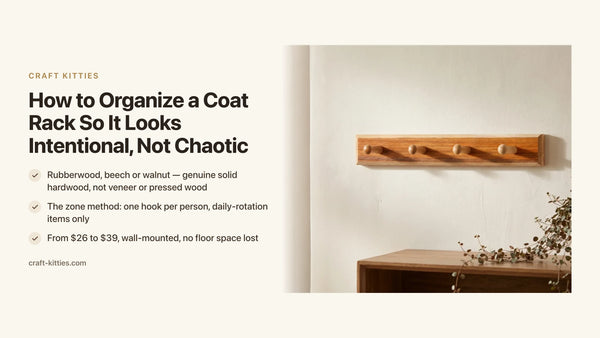
Rule one: side wall, dominant-hand side. The wall to the side of the toilet or sink, on the side you reach with your dominant hand, is the primary placement. You extend your arm naturally; the towel is there. A bar on the opposite wall means a full rotation every time you reach for it — a small friction, repeated thousands of times per year.
Rule two: height by use, not by convention. A hand-towel bar near the sink belongs between 48 and 54 inches from the floor — at hand level after washing. A bath towel bar near the shower sits lower, between 42 and 48 inches, so the towel clears the floor when it hangs at full length. These ranges are not arbitrary; they come from the actual reaching motion. Before drilling, hold a folded towel at the height where you would naturally grasp it and mark that point on the wall.
Rule three: the bar anchors the wall, then layers follow. Install the towel bar first. Once it is fixed, any additional storage — a hook rail above it, a small shelf to its side — positions itself relative to that fixed point. The bar is the reference. Everything else is spacing.
Adding layers: what comes after the bar
The towel bar solves the highest-traffic storage problem. What comes next depends on what currently lives on the counter.
Hook rail above the bar. A row of hooks four to six inches above the bar handles robes, bags, loofahs and the items that do not fold flat. A hook rail at this height is always accessible without reaching past the towel. The wood and brass set includes a matched hook rail so both pieces arrive already coordinated.
Small wall shelf at eye level. A shelf at eye level — roughly 60 to 65 inches from the floor — holds items you want visible: a candle, a plant, the one bottle you use daily. Keeping it to three or four items is the rule that prevents it from becoming a second flat surface that accumulates things.
Under-sink cabinet with pull-out trays. Wall organization handles what you reach for daily. The cabinet handles what you stock in quantity. The key is a pull-out tray or a set of bins rather than loose items dropped on the cabinet floor — you should be able to see everything in the cabinet at a glance without moving anything.
The system that keeps itself tidy is not elaborate. It is a bar where the towel goes every time, a hook where the robe goes every time, and a shelf where the daily items go every time. The repetition makes the tidiness automatic.
Mistakes that undo a good organization system
Buying more storage before you edit. A new basket or shelf does not make an overcrowded bathroom tidy; it makes it more crowded. Before adding any piece, remove everything from the room and put back only what you use in a week. What remains after that edit is what the system needs to hold.
Mixing materials with no thread. A bathroom where the towel bar is bamboo, the shelf is painted white MDF, and the hook rail is chrome reads as a room that accumulated rather than decided. Pick one material — in our case, sealed hardwood — and let everything from the same family answer it. The wood towel bar collection is built around that principle.
Mounting at the old bracket's height without checking. If you are replacing an existing bar, the old holes are at someone else's arm height, not yours. Fill the holes, test the seated or standing reach, and mark a new height. The ten minutes it takes is worth years of comfortable use.
Hanging too many towels on one bar. A single bar holding four bunched towels defeats the purpose: nothing dries, nothing looks tidy, and the bar carries weight it was not designed to hold. One towel per person, per bar rail. If you need more capacity, the double-layer bar or a second single bar on an adjacent wall is the right answer.
FAQ — bathroom cabinet organization and wood towel bars
1 — Can solid wood towel bars handle bathroom humidity? Yes, when the wood is properly sealed. Our bars are cut from solid red oak, walnut or beech and finished with a wax or oil-wax coat that makes the surface moisture-resistant and easy to wipe clean. That seal is what distinguishes solid hardwood from veneered particleboard, which swells and delaminates within months in a humid room. Sealed solid wood ages like furniture — it does not fall apart.
2 — What is the right height for a wall-mounted towel bar? Between 48 and 54 inches from the floor for a hand-towel bar at a sink; between 42 and 48 inches for a bath towel bar near the shower, so the towel clears the floor when hanging. The reliable method is empirical: reach naturally for the towel at the point where your hand lands, mark it, and drill there. No chart beats your own arm.
3 — How many towel bars do I actually need? One per person using the bathroom regularly, plus one for guests if the bathroom is shared. A double-layer bar solves the two-person scenario in a single wall footprint. Beyond that, a hook rail handles robes and secondary items without adding more horizontal bars.
4 — Red oak, walnut or beech — which is best for a humid bathroom? All three are suitable when sealed. Beech is the most dimensionally stable and expands least with humidity swings — the Scandinavian default for good reason. Red oak brings bold grain and warmth; walnut is darker and furniture-forward. Choose by contrast with your tile and wall color: the wood that reads most intentionally against your existing palette is the right one.
5 — Can I use a wall-mounted bar if I rent? Some models install with heavy-duty adhesive and require no drilling. The key to adhesive performance is surface prep: clean and degrease the tile or wall completely before pressing. Adhesive that fails is almost always adhesive that was applied to a dusty or greasy surface.
6 — How do I clean a sealed wood towel bar? A barely damp cloth for daily upkeep. The seal does the protective work — you do not need any special product. Avoid leaving standing water on the surface. A light re-wax once or twice a year keeps the finish looking new and extends its life indefinitely.
7 — What is the difference between a single bar, a double-layer bar and a hook rail? A single bar: one towel, minimal wall presence. A double-layer bar: two towels drying separately on the same mounting footprint — the right choice when you need more capacity without a second installation. A hook rail: faster to grab from than a bar, better suited to robes, bags and loose items than to flat-hung towels that need to dry fully.
8 — Should the towel bar match my sink hardware or the wood in the rest of the room? Both relationships matter. The wood-to-wood connection is usually the stronger visual anchor — a walnut bar beside a walnut vanity reads as intentional even if the metal hardware does not match perfectly. For the hardware finish, stay in the same family as the dominant fitting in the room: brushed brass with warm-toned rooms, matte black with cooler or Scandi palettes.
Where to go next
The towel bar is usually the first piece in a bathroom that moves from functional to considered — rarely the last. Our wood towel bar collection brings together the pieces that answer each other: single bars, double-layer bars, hook rails and sets, all in sealed solid hardwood with matching hardware. The wall mounted wood towel bar is the right starting point for most bathrooms; the wood and brass set solves the full wall in one order.
If you found this guide on Etsy where we have 243 reviews from customers who built the same kind of system, the full collection and the rest of the pieces are here on our site.
The system that keeps itself tidy
The bathroom does not stay organized because someone maintains it. It stays organized because every item has a place that is easier to return to than to leave somewhere else. That is the only discipline the system requires, and good placement removes even that.
Start with the bar — the square hardwood bar for a solo or guest bathroom, the double-layer bar for two people, the wood and brass set when you want the wall to read as a whole from day one. Mount it at your arm height, on the side wall where your hand reaches without thinking. Then add one layer at a time — a hook rail, a small shelf — only as you identify a real need. The system that works is the one that fits the actual habits of the people using the room, not the one that looks most complete in a before-and-after photo.