Small bedrooms have one reliable enemy: furniture that tries to do one thing. A dresser that only holds clothes. A nightstand that only holds a lamp. A shelf that only holds books until it doesn't, and everything spills onto the floor. The antidote is not more furniture — it is different furniture. Pieces that do more than one thing, placed where the room has unused capacity: vertical walls, the space under the bed, the surface above the headboard.
This guide works through the specific strategies that hold up in real small rooms — not in staged shoots where nothing actually needs to live anywhere. Vertical storage first, because the floor is already full. Hidden storage second, because it keeps the room looking open. Multifunctional pieces third, because they solve two problems with one purchase. And throughout: why material consistency is the thing that makes a room look intentional rather than improvised, and how even a pair of bookends earns its place in a system.
At a glance
- Go vertical: shelves and wall hooks above furniture, not next to it
- Go hidden: under-bed storage, ottomans with lids, floating shelves with no visible brackets
- Go solid wood: one material in red oak or walnut makes the whole room read as designed
- Bookends anchor surfaces and prevent spread — the smallest piece that does the most work
Why small bedrooms fail — and the three principles that fix them
The most common mistake in a small bedroom is trying to solve a storage problem with volume: adding another dresser, another set of shelving units, another bin on the floor. What happens instead is that the room shrinks. More objects at floor level make a room feel smaller, not more organized. More surfaces mean more places for things to land and spread.
The three principles that actually work run in the opposite direction.
Go vertical. The average bedroom wall runs eight feet high; the average piece of furniture tops out at five. Those three feet above every dresser, desk and nightstand represent the single most underused storage zone in the room. A floating shelf above the desk, hooks above the nightstand, a tall narrow bookcase instead of a low wide one — all of it trades floor footprint for vertical reach.
Go hidden. Every object in plain sight competes for visual attention. In a small room, that competition exhausts the eye quickly and reads as clutter even when everything is technically organized. Under-bed storage, cabinets with solid doors, ottomans with lids, and closed storage benches at the foot of the bed all remove objects from the visual field without removing them from the room. The room feels larger because there is less to process.
Go multifunctional. A nightstand with drawers does more than a table with a lamp. A bed frame with integrated storage does more than a platform bed. A pair of bookends that anchors books and serves as a design accent does more than either a bookend or a decorative object alone. When each piece does two things, the room needs fewer pieces total.
The vertical dimension: shelving and wall storage

Vertical storage in a bedroom works in three distinct tiers, and most people only use one of them — the furniture surface tier, roughly one to five feet off the ground. That tier is already occupied. The two productive tiers are above it and below it.
Above furniture (five to eight feet): Floating shelves above the headboard give you linear storage without adding a single piece of furniture. A shelf running the full width of the bed, mounted twelve to sixteen inches above the headboard, holds books, a small plant, and a pair of objects without crowding the sleeping surface. The same logic applies above the desk: a shelf at monitor-top height keeps reference books, notebooks and accessories within reach without competing for desk surface. The constraint is reaching safely — keep everyday items in the five-to-six-foot zone, seasonal or occasional items above that.
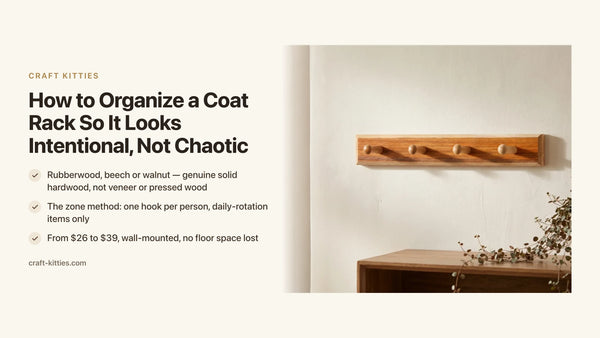
Wall hooks: The back of the door and the walls flanking the window are often blank. A row of solid wood hooks takes up zero floor space and handles everything from charging cables draped neatly to a robe, a bag, or tomorrow's outfit. In a room without a walk-in closet, a well-placed hook row replaces a chair that invariably becomes a clothes pile.
Tall over wide: When adding a bookcase or shelving unit, the instinct is to choose a wide, low piece that feels proportional to the room. The opposite choice — tall and narrow — stores as much or more while claiming a smaller floor footprint. A sixty-inch tall, twelve-inch deep bookcase stores considerably more than two thirty-inch wide, thirty-inch tall units, in half the floor area.
Under-bed storage: the most underused zone in the room
A standard queen bed frame sits approximately fourteen inches off the floor, which translates to roughly forty cubic feet of space. In most bedrooms, that space holds dust. Converting it to functional storage is one of the highest-return moves available, and it costs nothing in visual terms because the storage is invisible.
The two practical approaches are rolling bins and bed frames with integrated drawers. Rolling bins work with any existing bed frame: flat, low-profile containers on wheels that slide in and out without lifting. They are ideal for seasonal clothing, extra bedding, off-season shoes, and anything that is used infrequently enough that retrieval can take thirty seconds rather than three. Bed frames with integrated drawers take more budget but deliver more convenience — the drawers open without moving anything, which makes them viable for items accessed weekly.
One constraint matters: bed frame height. Some platform beds sit so low that even a flat bin will not clear. Before purchasing storage bins, measure the clearance with a tape — fourteen inches is comfortable for most under-bed systems; anything below ten inches limits options significantly.
Nightstand organization: making the surface work
The nightstand is the one surface in the bedroom that is almost always in arm's reach and almost always doing the most work. Phone, book, glass of water, charger, glasses, whatever else has migrated there since last week. In a small room where the nightstand is often also the only surface, that spread is the difference between a room that feels calm and one that does not.
The practical solution has two parts: contain the spread laterally, and remove from the surface what does not need to be there. A small tray or a pair of bookends does the first job — they create a visible boundary that the eye reads as intentional, and objects tend to stay within it because there is nowhere else to go. Charging cables, a small lamp and a glass can all live within a tray; everything else gets a drawer.
The second part — removing what does not need to be on the surface — means taking seriously what actually gets used nightly. A book actively being read earns its spot. A stack of three books waiting to be read does not; it belongs on the shelf with the bookends. One water glass earns its spot. A collection of half-empty cups from the past week does not.
Bookends as a bedroom storage tool
This is not a decorative argument. Bookends solve a specific organizational problem that surfaces in small bedrooms constantly: the book stack that does not stay a stack. Without a containment system, books on a shelf or nightstand develop a kind of entropy — they lean, they topple, they spread. One book becomes a three-book pile becomes a surface covered in things that were supposed to be organized.
A solid pair of bookends gives the stack an edge. The books stay vertical, stay grouped, and the surface on either side of them stays clear because the bookends make the boundary visible. On a floating shelf, this matters even more: a shelf without bookends is an invitation for spread; a shelf with bookends is a defined unit with a beginning and an end.
The material matters here too. In a bedroom where the dominant finish is wood, a pair of solid red oak or walnut bookends sits in the palette rather than fighting it. They do not read as accessories. They read as part of the furniture, which is exactly the effect that makes a small room look designed rather than assembled.

Description
Our Red Oak Wood Bookends are cut from solid red oak (Quercus rubra) — a hardwood with a warm honey tone and a bold, legible grain. The wax finish gives the wood a satin depth and keeps it easy to wipe clean. At 5.9" × 2" × 5.5", they are proportioned for a standard floating shelf or a nightstand without dominating either. The weight — real hardwood, not veneer over particleboard — keeps books vertical without drifting. They retail at $36 for the pair and work as well in a bedroom as they do on a desk.

Description
The Wooden Cat Bookends are handmade from solid black walnut (Juglans nigra) — one of the most sought-after hardwoods in home décor for its deep, even brown and fine grain. The cat silhouette gives them a personality that makes them a genuine accent piece; the solid walnut construction gives them the weight and permanence of real furniture. At $19, they are the lowest barrier to entry for adding walnut to a bedroom palette.
Floating shelves above the bed: the most visual upgrade per square inch
A floating shelf above the headboard does something that most storage solutions do not: it is visible from the bed, which means it shapes the feel of the room every morning and every night. The choice of what goes on that shelf, and how it is organized, has a disproportionate effect on how the room reads.
The formula that holds up consistently: a pair of solid bookends, three to five books spine-out between them, one small plant, one object with personal meaning. That is the shelf. Not more. The temptation in a small room is to make every available surface do maximum work, which ends up making it do nothing well. A shelf with six things on it, each contained and intentional, reads as calm. A shelf with twelve things on it reads as overflow.
The bracket is part of the decision too. Concealed brackets — no visible hardware — make the shelf appear to float and simplify the visual line of the wall. Bracket-visible shelving has a more industrial character; it works in rooms that already lean that way. Either works if chosen deliberately.
Installation height: in a bedroom with a standard pillow arrangement, a shelf mounted sixteen to twenty inches above the headboard sits comfortably above the eye line when lying down and below the risk zone for sitting up. For rooms with high ceilings, going higher creates drama without encroaching on the sleeping zone.
The furniture surface problem: containing the spread
Every horizontal surface in a small bedroom will, if left uncontrolled, become a landing zone. Dresser top, nightstand, desk corner, the bench at the foot of the bed — they all accumulate. The containment strategy is the same for all of them: give each surface a defined purpose with a visible boundary, and limit the number of objects permitted within that boundary.
Trays are the most efficient tool for this. A tray on a dresser top creates an instant defined zone: jewelry, keys, the few items that genuinely need to live on that surface go inside the tray, and nothing goes outside it. When the tray is full, the overflow gets a home somewhere else rather than expanding the zone.
Bookends serve the same function on vertical surfaces: shelves and desk edges. They are boundaries. The books stay between them. The surface outside them stays clear. This is not styling — it is a system for preventing the slow accumulation that turns a functional surface into a clutter zone.
Material consistency: the principle that makes it all look intentional

In a large room, material variation reads as richness. In a small room, it reads as chaos. The eye needs fewer things to process to feel at rest, and when every storage piece is a different finish — blonde wood dresser, dark wood nightstand, chrome lamp, brass hooks, painted shelves — the room looks assembled rather than designed, regardless of how well each individual piece is made.
The fix is a one-rule system: pick one wood tone and repeat it. Red oak (Quercus rubra) has a warm, golden quality that brightens a room; black walnut (Juglans nigra) has a deep, even brown that grounds one. Choose whichever is closer to what is already dominant in the space, and extend it to every piece you add — shelves, organizers, hooks, bookends, accent objects.
The hardware finish follows the same logic. Matte black hardware reads modern and pairs with any wood without competing; brushed gold reads warmer and suits red oak particularly well; natural wood with no metal hardware reads the most minimal. Pick one and apply it consistently.
The practical consequence: when you bring a new storage piece into the room — even something as small as a pair of bookends — the question is not "does it look good in isolation?" It is "does it match what is already here?" A $19 pair of walnut bookends in a room full of walnut makes the room look more finished. The same pair in a room full of chrome and painted MDF makes the room look more complicated.
A comparison of bedroom storage approaches
| Strategy | Space gained | Visible impact | Complexity | Best for |
|---|---|---|---|---|
| Floating shelves above bed | High | Very high | Medium (installation) | Books, plants, objects |
| Under-bed rolling bins | Very high | None (hidden) | Low | Seasonal, bulky items |
| Tall narrow bookcase | High | High | Low | Books, décor, clothes fold |
| Solid wood bookends | Low (surface boundary) | High | None | Shelves, nightstand, desk |
| Bed frame with drawers | Very high | None (hidden) | High (furniture swap) | Daily-access items |
Decision matrix: which storage solution for your situation
| Your situation | The right move |
|---|---|
| No room to add furniture, walls are bare | Floating shelves above headboard + concealed brackets |
| Existing bed frame, dead space underneath | Low-profile rolling bins (measure clearance first) |
| Books and objects spreading across every surface | Red Oak Bookends — boundaries that hold |
| Room looks cluttered despite organized storage | Apply the material consistency rule: one wood, one hardware finish |
| Want the look of real wood at entry price | Walnut Cat Bookends — $19 |
| Looking for a gift that actually solves a problem | A solid wood bookend pair: used daily, visible always, genuinely useful |
Mistakes that undo a good organization system
Adding storage by adding furniture. The instinct when a room feels full is to add a piece of furniture that holds things. In a small bedroom, this almost always makes the room feel smaller, not more organized. The high-ROI moves are vertical and hidden — not another unit on the floor.
Mixing four wood finishes and calling it eclectic. Eclectic works in large rooms with architectural character. In a 10×10 bedroom with low ceilings, mixed finishes read as indecision. One wood, one metal, one approach.
Designing for the best-case shelf. A shelf looks perfect in photos with three objects and a plant. It looks different after six months of daily use. Design for the realistic version: give every category of object its own zone, create boundaries, and leave space at the edge for things to arrive without immediately creating disorder.
Treating the floor as storage. In a small room, objects on the floor — even organized ones, even in bins — shrink the room visually and practically. The floor should be as clear as possible. That is not an aesthetic preference; it is the single most reliable signal of spaciousness in a small space.
Skipping the containment step. A surface without a boundary — a tray, a bookend pair, a defined zone — will accumulate. It is not a matter of discipline; it is a matter of design. Give every surface a physical edge and objects will stay within it.
FAQ — bedroom storage for small rooms
1 — What is the single highest-impact change I can make in a small bedroom? Add a floating shelf above the headboard. It takes zero floor space, is visible from the sleeping position, and immediately creates structured storage where there was blank wall. Pair it with a solid wood bookend set to give it a defined zone and it will stay organized rather than accumulating.
2 — How do I make a small bedroom feel bigger without removing furniture? Clear the floor as much as possible and take storage vertical. Two rolling bins under the bed and two floating shelves on a blank wall can move a significant amount of objects off floor level, which is the single clearest visual signal of space in a small room.
3 — Are solid wood bookends worth it over plastic or cheaper alternatives? The difference is weight, permanence, and material consistency. Solid red oak or walnut bookends have the weight to hold a full shelf of books without drifting. They age like furniture — they do not yellow, scratch cheaply, or chip. And in a room where the dominant material is wood, they disappear into the palette rather than introducing a competing note.
4 — What is the right number of objects on a bedroom floating shelf? Three to five. A pair of bookends, three books between them, a small plant, and one personal object at most. The discipline is refusing to exceed that count. When the shelf is full, the next object goes somewhere else — not on top of the existing ones.
5 — How do I organize a bedroom dresser top without a tray? Use a pair of bookends to divide the surface into zones. Bookends on a flat surface work as room dividers: one zone between them for objects in daily use, the surface outside them staying clear. It is a lower-commitment version of the tray system that uses a piece already on the shelf.
6 — Which is better for a small bedroom — open or closed storage? A mix, weighted toward closed. Closed storage (drawers, cabinets, under-bed bins) removes items from the visual field and makes the room feel calmer. Open storage (shelves, hooks) keeps accessed-daily items within reach without opening a door. A useful ratio for small bedrooms: two-thirds closed, one-third open and intentionally curated.
7 — Can I use the same bookends on both a nightstand and a shelf? Yes, and that consistency is the point. When the same pair of solid red oak or walnut bookends appears on the nightstand and the shelf above the bed, the room reads as designed. Two different pairs in two different finishes create a different effect: they read as unrelated objects that happen to be in the same room.
8 — What should I NOT store under the bed? Anything accessed more than once a week is better in a drawer or on a shelf — the friction of rolling out a bin is low but not zero, and it becomes a barrier to using the storage. Under-bed space is ideal for seasonal clothes, extra bedding, and items that come out for specific occasions. Daily-use items belong at reach height.
Where to go next
If the bedroom surfaces are the immediate problem, our solid wood bookends collection is the starting point. The Red Oak Wood Bookends at $36 are proportioned for floating shelves and nightstands; the Wooden Cat Bookends in Walnut at $19 are the entry to a walnut-consistent palette. Over 243 reviews from customers on Etsy confirm what we see repeatedly: the pieces that get used daily and look like they were always there are the ones worth choosing carefully.
Conclusion — a system, not a collection of objects
The bedroom storage problem in small rooms is not a shortage of solutions. It is a shortage of the right thinking applied before buying anything. Vertical first, hidden second, multifunctional third — those three principles applied consistently will do more than any new dresser. The material consistency rule ties it together: one wood, one hardware finish, visible everywhere, so the room reads as something that was thought about rather than accumulated.
The Red Oak Bookends and the Walnut Cat Bookends are small pieces in a system, but they are the pieces that hold the surfaces together. In a small room, that is not a small thing.