At a glance
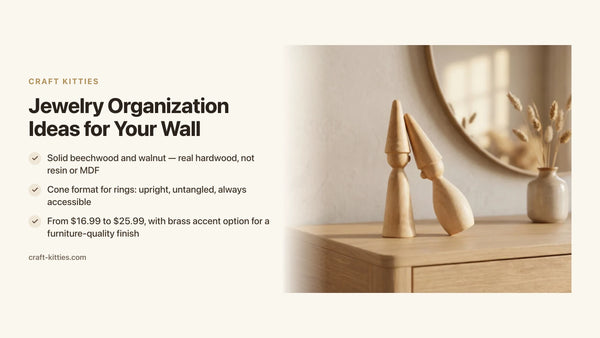
- Solid beechwood, walnut and red oak — real hardwood grain that synthetic surfaces cannot replicate
- Cone form on the nightstand: one natural object that anchors the whole surface
- From $16.99 for the beechwood cone set; walnut with brass base from $25.99
Biophilic design has become the shorthand for a genuine frustration: rooms that are finished but feel wrong. Every surface is clean, the furniture is the right size, the palette makes sense in theory — and yet the room does not feel like somewhere you want to stay. The diagnosis, when people get around to naming it, is almost always the same. There is no material in the room that is what it appears to be. The floor is vinyl that looks like wood. The countertop is laminate that looks like stone. The decorative objects are resin that looks like ceramic. Everything is accurate and nothing is real, and after a while the room registers that way.
Biophilic design is the correction. It does not mean filling a room with plants, though plants help. It means reintroducing materials that have grain, variation, and texture that came from something that grew — and placing them where hands and eyes encounter them most. Wood is the most practical vehicle for this because it is durable, finishable, and available in forms that serve a function, so the object stays out permanently rather than being repositioned every time the surface gets cleared.
This guide works through biophilic design room by room, with a specific focus on solid wood — beechwood, walnut, and red oak — and on the ring holder cone as the anchor piece. Not because jewelry display is the point, but because a solid wood cone on a nightstand is the most direct case of functional biophilic design at intimate scale: one useful object, one natural material, visible every single day.
What biophilic design actually means — and what it does not require

The technical definition is long. The practical one is shorter: biophilic design means reducing the cognitive cost of living in a room by reintroducing the sensory cues humans recognize from natural environments — variable texture, material depth, organic form, and living elements. Research on the effect has moved from psychology journals into architecture standards, but the design outcome can be stated simply: rooms with natural materials feel less exhausting to occupy.
What biophilic design does not mean is scale. It does not require a full wood-panel wall, a ceiling of exposed beams, or a living plant on every surface. A single solid wood object placed where your eyes rest most — the nightstand, the entryway shelf, the bathroom counter — contributes to the effect because it introduces something the rest of the room almost always lacks: grain. Grain is depth. It is what the eye registers as warmth rather than as decoration, and it cannot be printed convincingly onto a flat surface. The test is immediate: run your thumb across a real walnut ring holder and across a resin cone with a wood-look finish. The weight, the temperature, and the grain that continues through the cross-section are things one object has and the other does not.
Solid wood vs resin vs veneer: the material question that decides everything
The market for wood-look home accessories covers a wide range of materials that behave very differently over time, while often looking identical in a product photograph. Understanding the three main options is the first decision in building a biophilic room — before species, before form, before palette.
Solid wood is cut from a single timber. The grain runs through the piece; the cross-section looks like the face. It dents rather than chips at corners, develops a patina rather than losing a printed layer, and ages with individual character because no two pieces from the same species are identical. Solid beechwood is a pale, fine-grained hardwood with a Scandinavian character — dimensionally stable, smooth to the touch, suited to pale palettes. Solid walnut is deep brown, tight-grained, furniture-quality — it reads in a room the way a well-chosen piece of furniture reads, with presence.
Veneer is a thin layer of real wood bonded over a composite core. The face is genuine wood; everything underneath is not. The seam at corners and edges reveals the construction within a few years of regular handling. For objects that sit in one position and are rarely moved, veneer is more acceptable — but it will not age the way solid wood does. The veneer layer lifts or chips before the core degrades, which registers as the object wearing out rather than maturing.
Resin with a wood-look finish has the grain printed on the surface. It does not continue through the material; the weight is lighter; the thermal feel is plastic rather than wood. A large portion of the ring holder market is manufactured this way, and the visual difference in a photograph is negligible. On a nightstand at arm's length, in natural light, the difference is not negligible. A resin cone reads as imitation — which is precisely what biophilic design is trying to correct.
For a biophilic room, only solid wood holds the full benefit. The functional and aesthetic arguments converge: honest material ages better, which means it stays on the surface longer, which means it contributes to the room more consistently. Solid beechwood ring holders begin at $16.99. Resin alternatives are typically $8 to $14. The price gap is smaller than buyers assume; the material difference is larger than photographs convey.
Beechwood, walnut or red oak: choosing the species for your palette
The three species in our ring holder lineup differ first to the eye, and each has a clear pairing logic with the most common room palettes.
Beechwood is pale — a light honey that reads nearly white in strong natural light. The grain is fine and consistent; the texture is smooth. It has a Scandinavian character that suits rooms built on white, linen, soft grey and warm neutrals. Against a dark wall or a dark-wood bed frame, beech creates a deliberate brightness; against a pale wall, it reads as part of the neutral scheme without competing. It is the most versatile species in the lineup because the pale grain disappears least easily across room types.
Walnut is the statement species. Deep chocolate brown, fine tight grain, cool undertones that sit naturally next to brass and aged metal. Walnut on a light nightstand reads like a piece of furniture placed with intention. It suits rooms with warmth already present in the palette — terracotta, dusty rose, ochre, sage — or rooms anchored by other dark-wood furniture where one more dark element creates continuity rather than contrast. Walnut is the choice when the design direction is already made and you are adding the piece that confirms it.
Red oak is the grain species. Honey-amber, with a bold, visible grain that reads across the room at distance rather than disappearing when you step back. It suits transitional rooms — not fully Scandinavian, not fully warm-toned — where the grain character is the decorative move and the color is secondary. Red oak is less precious than walnut, which means it pairs naturally with mixed-material rooms where warmth comes from accumulated texture rather than from a single strong tonal choice.
The reliable rule is contrast: pale wall or pale room, choose a dark species. Dark or warm-toned room, choose pale wood. When the palette is uncertain or the room will be redecorated, beechwood is the safe default — its light, fine grain suits almost any setting without competition.
The ring holder as biophilic anchor piece
A ring holder appears, on the surface, to be a jewelry organization tool. Its biophilic function is deeper and more consistent than that suggests. A solid wood cone placed on a nightstand does three things at once: it introduces a natural material into a surface otherwise entirely occupied by synthetic objects; it introduces an organic form — the taper of a cone, the weight of a base — that the eye reads as intentional; and it keeps rings in view, which resolves the quiet, persistent anxiety of not knowing where they are.
That last point matters more than it initially sounds. The anxiety of lost rings is low-grade and continuous — it does not spike; it drains. A cone that is always in the same place, always in view, removes that drain entirely. The biophilic benefit and the organizational benefit compound each other: the object stays out permanently because it is both beautiful and useful, which means the natural material is present in the room every day rather than being put away when the surface gets cleared.
This is the distinction between decorative biophilic design and functional biophilic design. A plant on a shelf is decorative — it adds nature but serves no other practical function, so it can be moved or replaced without changing how the room operates. A solid wood ring holder is functional — it replaces a habit (rings on the bathroom sink, on the kitchen counter, in a pocket) with a fixed location, so removing it costs something. Objects that are beautiful and useful stay out. Objects that are only beautiful get repositioned.
The cone vs the flat tray: choosing the right form

The two primary forms for a wood ring holder are the cone and the flat tray. The decision is practical before it is aesthetic, though both have aesthetics worth naming clearly.
A cone is vertical. It occupies a small footprint — the base diameter is typically between 1.5 and 3 inches — which makes it the right choice for a nightstand with limited surface area. Rings slide onto the taper and rest at different levels, which prevents them from touching each other and from scratching stones and metals. At a glance from the bed, you can confirm the rings are there without moving. The cone is also an organic form with an immediate logic: the taper means each ring finds its own position without needing to be arranged. A pair of cones — one per partner — is the default configuration for a shared nightstand.
A flat tray is horizontal. It occupies more surface and holds more categories: rings alongside earrings, bracelets, a watch. It is the right choice when the nightstand or dresser serves the full morning and evening jewelry routine rather than rings alone. For ring-only display, the cone is more precise in how it keeps pieces separated and visible. For mixed display, the tray is more practical.
The two forms are not mutually exclusive and often coexist in a well-organized bedroom: a cone on the nightstand for rings, a tray on the dresser for the rest. Our studio pieces are designed to enable that configuration, with consistent species and finish across forms so the two objects read as part of the same room rather than as separate acquisitions.
The five pieces from our studio
Five solid wood ring holders selected to cover the main profiles: the couple sharing a nightstand, the design-conscious buyer who wants one precise brass accent, the buyer building a walnut-only warm room, and the buyer whose gift needs to work for a room they have never seen.

Description
The beechwood cone set is the piece we point to when the question is which ring holder will work regardless of the room. Two solid beechwood cones — pale, fine-grained, Scandinavian in character — on a shared natural wood base that keeps both cones stable and visually unified. The tapered form means rings find their own level without arrangement. At $16.99 for the set, it is the entry point to solid wood ring display, and the set-of-two format makes it the strongest nightstand pairing in the lineup. The pale beech grain suits white, linen, soft grey and warm white rooms without competing with the palette — which is exactly the function a biophilic anchor piece is meant to serve.

Description
The walnut cone with solid brass base is the choice when one object is meant to carry all the intention. Solid walnut — deep chocolate brown, fine tight grain — set into a base of genuinely solid brass rather than plated metal. The combination of warm wood and warm metal is the most deliberate palette move in the studio lineup. This is not a piece that blends in; it is a piece that is noticed. At $25.99, it suits rooms where the design decision is already made and this is the accent that confirms it: a warm-toned bedroom, a nightstand with aged brass hardware, a room where walnut furniture already provides the frame.

Description
The walnut set of two is the paired version of the statement piece: two solid walnut cones matched in species and finish, designed to sit side by side on a shared nightstand or across a dresser surface. Where the beechwood set is the safe default, the walnut set is the committed warm-room choice — it assumes the room already has warmth and adds one more deliberate layer of it. At $18.99 for the set, it is the right pick when the design direction is settled and both cones should confirm that direction rather than introduce contrast.
Description
Read as a gift, the beechwood set changes emphasis. Two cones signal that the giver thought about both partners — the primary social logic of a wedding or housewarming gift for a couple. The pale beech is the right default when the recipient's décor is unknown: it suits a room you have not seen and a palette you cannot predict. The solid wood construction means it will remain on the nightstand rather than being put away after the first week, which is what every gift needs to do — remain visible. At $16.99, it sits at a price point where it can pair with another piece from the same collection without changing the gift's register.
Description
When the recipient's room is known and the design direction is warm — walnut furniture, brass hardware, terracotta or ochre on the walls — the walnut-and-brass cone is the gift that lands precisely rather than safely. At $25.99, the solid brass base distinguishes it from every plated alternative, and solid walnut carries the grain depth to justify that distinction visually. This is the gift for a couple whose bedroom is already considered, and for whom the right piece is specific rather than neutral.
Comparison table
| Model | Price | Wood | Hardware | Best for |
|---|---|---|---|---|
| Beechwood Cone Set | $16.99 | Solid beechwood | Natural wood base | Any palette, couples nightstand |
| Walnut + Solid Brass Base | $25.99 | Solid walnut | Solid brass | Statement piece, warm-toned room |
| Walnut Cone Set of 2 | $18.99 | Solid walnut | Natural wood | Committed warm palette, couple sharing a nightstand |
Decision matrix — which piece for which room and buyer
| Your situation | The right pick |
|---|---|
| Light or neutral palette — white, linen, soft grey | Beechwood Cone Set |
| Warm room — terracotta, ochre, aged brass already present | Walnut + Brass Base |
| Committed walnut room, couple sharing a nightstand | Walnut Cone Set of 2 |
| Gift for a couple — recipient's décor unknown | Beechwood Cone Set (safe default, any palette) |
| Premium gift for a known warm-toned room | Walnut + Brass Base |
| One finishing accent in a near-complete room | Walnut + Brass Base — specific enough to read as intentional |
Applying biophilic design room by room
The bedroom nightstand
The nightstand is the first surface. It is the last thing encountered before sleep and the first after waking, which means it accumulates the most contact and contributes the most to the room's felt character. Most nightstands in practice are an unsorted accumulation: phone, charger cable, glass of water, book, lamp — all synthetic, none placed with intention. A solid wood ring holder introduces one natural material into that accumulation. It is not a wholesale redesign; it is a material correction in the most-used position.
The rule for the bedroom is repetition within one material family: whatever species you choose for the ring holder, look for it in one other object on the same surface — a small tray, a lamp base, a box for ear plugs or a retainer. Two or three objects in the same solid wood on a nightstand read as a composed surface rather than as a collection of things. The ring holder is typically the first piece; the others follow from it.
The dresser and dressing area
The dresser is where the morning jewelry routine happens — which means it is where the flat tray earns its place. A solid walnut tray holding earrings and bracelets alongside a walnut cone set for rings is the most common configuration for a dressing area that uses both forms. The material thread is the same species and the same finish; the form changes to serve the function.
The dressing area is also where the hardware rule becomes most visible. If the nightstand cone has a brass base, the dresser tray should have brass hardware — a ring dish, a tray with a brass lip, a jewelry box with brass fittings. The metal thread ties pieces that are in different places into a room that reads as considered. Breaking the hardware thread — brass cone, matte black tray — is the most common way for a biophilic bedroom to look assembled rather than designed.
The living room
In the living room, biophilic design operates at a different scale. Objects are larger, the viewing distance is greater, and the visual competition is higher. A small cone holder is not the primary form here; a wood bowl, a raw-edge tray, a set of solid walnut bookends, or a wood-and-linen object plays the same anchor role at the right size. The principle transfers: one natural material, in the most-used visual position, in a form that serves a function rather than being purely decorative.
What carries from the bedroom into the living room is the hardware logic. If the bedroom chose brass — the walnut cone with the solid brass base — the living room continues that language: aged brass candleholders, a brass-edged tray, a lamp with a brass arm. The metal stays consistent; the wood can vary in species because the brass provides the thread that makes the room cohere.
The entryway
The entryway is the smallest room and often the most neglected biophilically. It is where the transition from outside to inside happens, and a natural material at that threshold has an outsized effect on the room it introduces. A wood hook rack, a wood key tray, or a small wood bowl for keys and change — any of these positioned at the entry point makes arrival different. The choice of material here propagates: once the entryway has real wood, the threshold for wood elsewhere in the home lowers, because the eye has learned to trust what a natural material looks like at close range.
Ring holders belong on nightstands and dressers rather than in entryways. But the species logic transfers directly: beechwood for a light, Scandinavian-influenced entry; walnut for an entry with dark floors or warm brick; red oak where the grain character is the statement rather than the color.
Mistakes that cost a room its character
Choosing the species from the product photograph rather than from the wall. A walnut cone glows against a white studio backdrop. On a dark-wood nightstand, it can disappear. Before ordering, look at the actual surface the piece will sit on and apply the contrast rule: pale surface or wall, choose dark wood; dark surface or wall, choose pale wood.
Mixing natural materials without a hardware thread. Beechwood next to walnut next to raw stone reads as collected rather than composed unless one element ties all of them together. That element is almost always a metal finish: one hardware family — brass, matte black, natural steel — running across every piece in the room converts a collection into a room. The hardware does not have to be large or obvious; a small brass base on a walnut cone is enough to anchor the thread.
Treating biophilic design as a single large intervention. A full wood-panel wall is a commitment. A solid wood ring holder on a nightstand is not. Starting small and one surface at a time allows for observation of what actually shifts the room's character before anything is irreversible. Most rooms find their turning point at two or three well-placed natural elements — earlier than most people expect.
Choosing imitation at near-price-parity. Solid beechwood ring holders start at $16.99. Resin alternatives with a printed grain are typically $8 to $14. The price gap is smaller than buyers assume, and the material difference is larger than photographs convey. At the price points involved, solid wood is not a premium decision — it is the correct one.
FAQ — biophilic design with wood
1 — What is biophilic design, in plain terms? Biophilic design is the practice of bringing natural materials, light, and organic forms into built interiors to reduce the fatigue that comes from living entirely surrounded by synthetic surfaces. It does not require live plants or skylights — a solid wood object on a nightstand, an unfinished stone tray, or a linen curtain all contribute measurably. The underlying principle is material honesty: things that are what they appear to be.
2 — Does solid wood actually make a visible difference in a room? Yes, in a specific way. Solid wood introduces grain variation — depth that the eye reads as warmth — which cannot be replicated by a printed veneer or a resin shell with a wood-look finish. Two pieces of solid beech from the same tree will have slightly different grain patterns; that individuality is what registers in a room as warmth rather than as decoration.
3 — Beechwood or walnut for a biophilic bedroom? Beechwood is pale, fine-grained and Scandinavian in character — it suits rooms built around white, linen and light grey. Walnut is deep brown with a tighter, furniture-quality grain — it suits rooms with warmth already in the palette. Both are solid hardwoods that age with character rather than wear out. When the palette is unknown, beechwood is the safer default.
4 — Is a ring holder cone a biophilic object or just a jewelry organizer? Both, and the distinction matters. A solid wood cone on a nightstand introduces a natural material and an organic form into a surface that is otherwise entirely synthetic. It keeps rings safely placed and in view, which removes the low-grade anxiety of not knowing where they are. That combination of natural material, organic form and useful function is precisely what biophilic design targets.
5 — Can I mix beechwood and walnut in the same room? Yes — contrast between a pale wood and a dark one reads as intentional provided the hardware finishes stay consistent. A beechwood cone set next to a walnut tray, both with brass hardware, is a studied choice. The same two woods with mismatched hardware reads as accident rather than intention.
6 — How many natural elements are enough for one room? Three is a workable threshold: one for horizontal surfaces (a wood cone or tray), one for vertical presence (a plant or textured wall art), and one structural textile (linen or wool). Adding more returns diminish quickly — the goal is removing the sense of total synthetic saturation, not building a forest. Most rooms find their inflection point at two or three pieces in the right positions.
7 — Does solid wood require special care on a nightstand? No. A finished solid wood object on a nightstand is no more demanding than any other small accessory. An occasional dry-cloth wipe is the full maintenance requirement. The wood does not need oiling or conditioning when it carries a proper applied finish — the finish does the protective work.
8 — What makes a solid wood ring holder a good gift? It solves a real, recurring problem — where do rings go at night, and will they be there in the morning. It stays out permanently because it is both useful and attractive. The set-of-two format signals that the giver thought about both partners. Over 243 customers have reviewed our ring holders on Etsy, and the gift-for-couples pattern is one of the most consistent observations in that feedback — the piece gets used daily and stays visible on the nightstand.
Where to go next
The ring holder is typically the first solid wood piece in a biophilic bedroom — rarely the last. The same logic that makes a cone right for a nightstand extends to every other surface: what material is it actually made of, and does it serve a function that keeps it visible. Our ring holder collection is organized around that principle — solid beechwood cones, walnut with a solid brass base, and matched walnut sets, all cut and finished in our studio.
Conclusion — one material, one surface, a room that feels different
If this guide leaves you with one method: start with the nightstand, choose the species by contrast with the wall, and let that first solid wood piece make the case for the rest. The beechwood cone set is the answer for most rooms — pale, fine grain that works against any palette, and the set-of-two format is right for a shared surface. The walnut with brass is the answer when the room is warm-toned and one precise accent is what it needs. The walnut set of two is the answer when the design direction is committed and both cones should confirm it. Three paths, one result: a surface with one real thing on it, and a room that registers differently for it.