At a glance
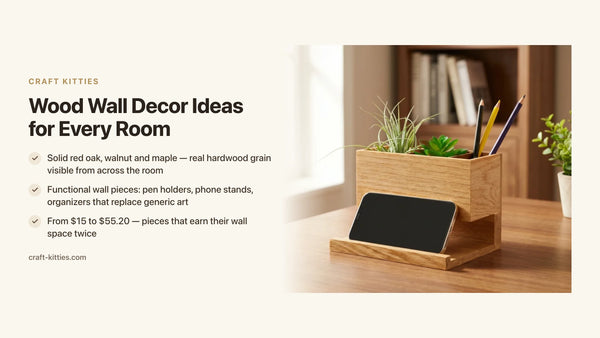
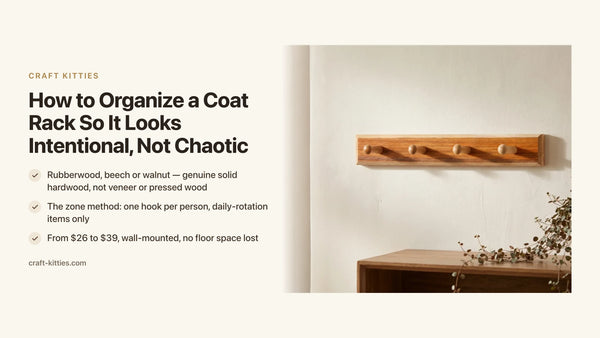
- Solid maple, beech or walnut — real hardwood that ages with the home
- Valet tray + key rack: the one object that sets the daily landing habit from day one
- From $29.99 to $55.20, three species, three styles
The first Christmas in a new home is its own occasion — something between a holiday and a milestone. The couple or person who just moved in is still figuring out where everything goes, what routines to build, and which objects are going to earn a permanent spot in the space. A gift that answers one of those questions is a gift that gets remembered.
Most Christmas gifts for new homeowners miss this. Candles burn out. Throw pillows compete with the ones they already ordered. Kitchen gadgets end up in a drawer. What tends to stay — and to be used every single day — is a piece that solves a specific, recurring problem: where do the keys go? Where does the wallet land at the end of the day? Where do the glasses, the watch, the phone rest overnight?
A solid hardwood valet tray answers all of those questions at once, and it does it in a form that improves the look of wherever it sits. This guide covers why that matters, which species to choose for different rooms and tastes, the models in our valet tray collection with their current prices, a comparison table, a decision matrix, and answers to the questions we hear most often about gifting this category.
Why the first home is the right moment for a valet tray

In an established home, the landing routine already exists — even if it is a pile on the kitchen counter, it is a pile with a history. In a first home, that pattern has not formed yet. The weeks after moving in are when habits get built, and those early habits tend to stick. A valet tray introduced in those first weeks does not just hold keys; it defines where keys go, and that definition shapes the room.
This is what makes the category different from most homeware gifts. You are not decorating a shelf or filling a gap in a collection. You are giving the recipient something that will structure their mornings and evenings — the moment they walk in, and the moment they set down what they are carrying before bed. Done well, that routine runs invisibly, which is exactly how the best domestic design works.
The other dimension worth naming: a valet tray in solid hardwood improves the visual register of the surface it sits on. A dresser with a walnut tray reads differently than a dresser with a pile of loose objects. A console table with a maple tray and a key rack reads as designed, not assembled. For new homeowners who are actively trying to make their space feel intentional, this is the kind of object that does quiet, consistent work.
Solid hardwood vs. the alternatives: what actually lasts
Before the species comparison, the material question is worth addressing directly — because the market for valet trays spans a wide range, from solid hardwood at one end to lacquered MDF, bamboo composite, and pressed-wood-veneer at the other. They can look similar in photographs. They do not behave similarly over time.
MDF and laminate are the most common materials at the low end of the market. They are smooth, predictable and inexpensive to manufacture. They also show wear at edges and corners quickly — within a year or two of daily use, the coating chips and the substrate absorbs moisture from objects placed in the tray. They photograph well at launch and degrade steadily in daily use.
Bamboo deserves a specific note because it photographs like wood and is often marketed alongside solid wood alternatives. Bamboo is a composite grass material, constructed from narrow strips bonded under heat and adhesive. The adhesives used are typically formaldehyde-based resins; the material is dimensionally less stable than solid hardwood across humidity changes; and the "grain" visible on the surface is the adhesive bond between strips, not a natural wood grain. It is a serviceable material for some applications. For a tray that takes daily contact and will sit on a surface for years, it is not the same thing as solid hardwood.
Solid maple, beech or walnut — the three species in our lineup — are milled from whole lumber. There is no adhesive bond between material layers, no veneer over a substrate, no particleboard core. The grain is natural and continuous. Over years of daily use, these trays develop a patina rather than degrading. They are the version of this gift that the recipient will still have in ten years, which is the version worth giving.
Red oak, walnut, maple or beech: choosing the species

The three species in our lineup read differently on a surface, and the choice should be made by contrast with the recipient's room rather than by personal preference alone.
Maple is the palest of the three — a creamy white-to-blond tone with a fine, tight grain. It disappears against white or cream walls in the best possible way: it becomes part of the room rather than competing with it. For homes that lean Scandinavian, minimalist or light-industrial, maple is the natural fit. It is also the most forgiving species for gift-giving when you know the recipient has a light palette but are not sure about the details.
Beech sits slightly warmer — a pale honey tone with a regular, fine grain and subtle ray flecks. It is not as dramatically neutral as maple or as statement-making as walnut; it belongs to the middle ground that works well in most palettes. Beech is the default recommendation when you are genuinely uncertain about the recipient's décor: it is neither too dark nor too light, and it cooperates with both warm and cool rooms.
Walnut is the most distinctive choice. American black walnut carries a deep chocolate brown color with a fine, straight grain that reads as furniture quality. Against a light wall it stands out clearly; in a room that already has warmth and natural material, it anchors the surface. Walnut is the right pick when you know the recipient has design preferences and appreciates a considered object. It is not a safe default — but it is the most visually memorable gift.
A useful rule of thumb for any of these species: choose by contrast. Dark room, lighter wood. Light room, darker wood. The tray should read against the surface it sits on, not blend into it.
The models from our studio, in detail
Five entries across three product handles, covering the main configurations: the combined entryway model with a key rack, the mid-range desk organizer in three species, and the premium solid wood tray at the top of the lineup.

Description
This is the model for new homeowners who have not yet solved the entry question: where do the keys go, the mail, the phone, the things that pile up at the door. The integrated key rack keeps the tray and the keys co-located — same reach, same surface, same habit. The solid hardwood body gives the combination enough visual weight to anchor an entryway console or sideboard without demanding attention. At $29.99, it is the most accessible entry in the lineup and the most practical gift for someone in the early weeks of a first home.
Description
The same piece reads differently on a nightstand than on an entryway console. There, the key rack doubles as a phone resting spot or a narrow ledge for a watch strap. The solid hardwood surface is the right size for the objects that accumulate bedside — glasses, earphones, a ring — without the tray becoming a catch-all that grows unchecked. For new homeowners setting up a bedroom from scratch, this kind of doubled purpose in a single object is worth naming when you give it.

Description
At $47.20, this model addresses a different surface: the home office desk. For new homeowners who work from home — increasingly the default — the desk is not incidental; it is one of the most-used surfaces in the house and one of the most visible. A solid hardwood desk organizer in maple, beech or walnut moves the desk out of the "laptop-on-an-unfinished-surface" category into something that reads as set up. The three species options mean the gift can be chosen specifically for the recipient's aesthetic rather than defaulting to a single option.
Description
The maple version of this tray works particularly well in home offices that favor a light, pared-back aesthetic. The pale, tight grain of maple does not demand attention; it holds objects and adds material warmth without pulling focus from the work surface. For recipients who are deliberate about their workspace — who care about the keyboard, the monitor stand, the cable management — a maple tray in this price range signals that you understand what they are building.

Description
At $55.20, the premium desk organizer tray is the version for the recipient who will hold it, notice the weight of real solid wood, and register that the grain runs continuously through the piece. The price difference over the mid-range model reflects material and construction — heavier stock, greater dimensional depth, the kind of presence that a surface benefits from having. In walnut, this piece sits at the intersection of functional object and considered décor. It is the right choice when you want the gift to be unambiguous about its category.
Comparison table
| Model | Price | Species | Primary use | Best for |
|---|---|---|---|---|
| Valet tray + key rack | $29.99 | Solid hardwood | Entryway / bedside | Practical first gift, entry daily-carry habit |
| Hardwood desk organizer tray | $47.20 | Maple, beech or walnut | Home office desk | WFH recipients, desk-first setup |
| Solid wood desk organizer tray | $55.20 | Maple, beech or walnut | Desk / dresser statement piece | Design-conscious recipient, premium gift |
Decision matrix — which model for which recipient
| Your situation | The right pick |
|---|---|
| Practical gift, clear budget under $35 | Valet tray + key rack — $29.99 |
| Recipient works from home, desk setup matters to them | Hardwood desk organizer — $47.20 |
| Recipient has design preferences, you want the gift to show that | Solid wood desk organizer — $55.20, walnut |
| Unknown décor — safe choice that works in any palette | Hardwood desk organizer in beech — $47.20 |
| Light, Scandi or minimalist home | Solid wood tray in maple — $55.20 |
| Gift for a couple settling into their first home together | Valet tray + key rack — $29.99 (one for each, or a shared entryway piece) |
Why most Christmas gifts for new homeowners don't last
This is worth addressing honestly, because the gift-giving instinct for new homeowners is often misdirected — not from a lack of care, but from a misread of the moment.
New homeowners do not need more things. They are surrounded by boxes, decisions and a house full of objects that have not yet found their places. What they need is objects that solve problems — and specifically, objects that solve the problems that new homes reliably create.
The candle problem. Candles are given in enormous quantities as new-home gifts. They are pleasant, consumable, and by definition temporary. They do not stay.
The kitchen gadget problem. Unless you know for certain that the recipient cooks and specifically lacks a particular item, kitchen gifts enter a competitive space. Most first homes are already equipped with the basics, and specialized gadgets go into the drawer of good intentions.
The décor problem. Art, cushions, decorative objects — all of these require alignment with a taste that you may not know precisely enough. The wrong pillow is not wrong in a way that is easy to explain, and it gets quietly returned or relocated.
A hardwood valet tray sidesteps all of these problems. It is not décor in the sense of adding a visual element to an existing scheme; it is organization that happens to look like a considered design object. Its function is universal — everyone has keys, a phone, a wallet, something that lands at a surface — and its form works across a wide range of aesthetics. It is the opposite of a consumable. And it is specific enough that it does not compete with objects they already have.
Where to place the tray: entryway, dresser or desk
The valet tray question that people underestimate is placement. All three surfaces are valid; the right one depends on the problem the recipient is most likely to face in their first home.
Entryway — the highest-leverage placement. The entry is where the day begins and ends. Keys get lost because there is no consistent landing spot near the door; phones run out of battery because there is nowhere obvious to plug in; wallets get set on the counter and migrated to pockets and back to different counters. A tray at the entry fixes all of this, and in a first home where the habit has not yet formed, a tray placed there immediately becomes the default landing spot. The key-rack model is purpose-built for this placement: keys on the rack, phone in the tray, ready.
Dresser top — the bedroom placement, which works especially well for the objects that leave pockets at the end of the day: watch, rings, earphones, glasses. The dresser version of this habit is the mirror of the entry version — instead of the morning readiness routine, it is the evening wind-down routine. Both are worth building. For couples, a tray on each side of the dresser is the more considered gift when budget allows.
Desk — the home-office placement, which matters more now than it ever has. In a first home with a dedicated workspace, the desk surface is a daily environment that shapes how work feels. A solid hardwood tray at the desk is not primarily about organization; it is about establishing that this surface is taken seriously, that it has been set up rather than assembled.
Mistakes to avoid when choosing a wood gift for new homeowners
Choosing the wood from the product photo without thinking about the wall. A walnut piece photographed against a neutral studio background can look lighter or darker than it will against the recipient's specific wall color. If you know their room, use the contrast rule: dark wall, lighter wood; light wall, darker wood.
Underestimating the key-rack model because of its price. The $29.99 entry-level tray with key rack is not the "budget compromise" version of this gift — it is the most functional piece in the lineup for a new homeowner who is still building their entry routine. Price is not a proxy for appropriateness here.
Buying something consumable when something durable is the right call. For a first home Christmas, the instinct toward consumables (food, candles, toiletries) reflects a fear of imposing a permanent object on someone else's space. But a solid hardwood valet tray is neutral enough in form that it adapts rather than imposing. The durability is the point, not a liability.
Pairing it with too many other objects. A valet tray as the primary gift works. A valet tray as one of six gift-wrapped items in a basket loses its signal. Let it be the thing.
What to write on the card
A gift that earns a permanent spot in the home deserves a card that names what it does — not just the occasion it marks.
Avoid the obvious: "Congratulations on your new home," "Wishing you happiness in your new space." These are true and forgettable.
Consider something closer to the object itself: "For the spot where your day starts — and where it ends." Or simply: "For the keys, the watch, the glasses, and the good habit of knowing where everything is." A card that names the ritual the tray creates gives the recipient a story to tell when someone notices the piece and asks about it. That story is part of the gift.
FAQ — Christmas gifts for new homeowners: wood valet trays
1 — What makes a valet tray a good Christmas gift for new homeowners? A valet tray answers a real daily problem — where do keys, wallet, phone and glasses land when you walk in the door? In a first home, that routine has not been established yet, and a well-placed tray sets it for good. Unlike decorative gifts that rotate out, a tray used every morning stays out permanently, which means the giver's gift is seen every single day.
2 — Which wood is best for a valet tray gift — maple, beech or walnut? Maple is pale and tight-grained, a natural fit for light, Scandi-inflected rooms. Beech sits slightly warmer with a fine, regular grain that pairs well with neutral palettes. Walnut is the deepest option — rich brown, fine grain, the tone that reads as furniture rather than accessory. When you do not know the recipient's décor, beech is the safe default; when their home leans warm and they appreciate design, walnut is the stronger choice.
3 — Is a valet tray appropriate as both a Christmas and housewarming gift? Yes, and the overlap is intentional. Many new homeowners move in during autumn and experience their first Christmas in the new place within weeks. A valet tray works in both contexts because it solves the organizational vacuum that comes with settling into any new space — the absence of habits and the absence of the right objects. Give it at Christmas and it will feel like both a holiday gift and a housewarming gift in one.
4 — What price range should I expect for a quality hardwood valet tray? In our lineup, solid hardwood valet trays start at $29.99 for the entryway model with a key rack, and go up to $55.20 for the premium desk organizer version. The difference is primarily size, compartment count and wood weight. For a Christmas gift, the $47.20 range is the most common choice — substantial enough to feel considered, without veering into a price range that creates awkwardness.
5 — Can a valet tray work in both an entryway and a bedroom? Both rooms work well, and some people use two — one at the door for keys and everyday carry, one on the dresser for jewelry, glasses and a watch. For new homeowners deciding where to place a single tray, the entryway is usually the priority: it sets the landing habit the moment you come home, which has downstream effects on how organized the rest of the home stays.
6 — How do I care for a solid hardwood valet tray? Solid hardwood trays are low-maintenance by design. Wipe with a dry or barely damp cloth. Avoid soaking or leaving wet objects directly on the surface for extended periods. Once or twice a year, a light coat of natural oil keeps the grain from drying out. There is no sanding, no special product, no ritual — just an occasional wipe and an annual re-oil if you want.
7 — Is solid hardwood better than bamboo or MDF for a valet tray? For a piece that sits on a dresser or entryway console and takes daily contact, solid hardwood is meaningfully better than both alternatives. MDF and laminate show wear at edges and corners within a year or two. Bamboo is a composite grass material, adhesive-bonded, and while it photographs like wood, it behaves differently under repeated contact. Solid maple, beech or walnut deepens in character over years — it does not degrade.
8 — What should I write on the card when gifting a valet tray to new homeowners? Something that connects the object to the moment, not just the occasion. For example: "For all the small things that make a first place feel like home" or "For the spot where your day starts and ends." Avoid generic phrases like "Congratulations on your new home" — they are true but forgettable. A card that names what the tray actually does gives the gift a story the recipient will repeat when guests ask about it.
Where to go next
The valet tray is often the first considered object in a new home — rarely the last. Our valet tray collection brings together the pieces that work alongside it: the hardwood valet tray and key rack for the entry, and the hardwood valet tray desk organizer for the workspace. All in the same solid hardwood species — maple, beech or walnut — so the pieces speak to each other across rooms.
For other new-homeowner Christmas gifts in the same material family, the same principles apply: choose for permanence over novelty, for daily use over display, and for something that earns its spot in the first week and keeps it for years. Our studio's pieces on Etsy have collected over 243 reviews from buyers who made exactly that call.
The short version
If this guide leaves you with one method: decide on the room first (entry or desk), choose the species by contrast with the recipient's wall (beech as the default when in doubt), and let the piece stand on its own. The $29.99 valet tray with key rack solves the entry problem completely at a price that is easy to give. The $47.20 hardwood desk organizer is the right call for any recipient who works from home and cares about their workspace. And the $55.20 solid wood tray is the version for the recipient who will hold it and immediately understand what it is. Three options, one material, one result: an object that is still sitting in exactly the same spot next Christmas.