At a glance
- Warmth comes from texture and material, not volume
- Solid wood, warm light and a curated surface beat a full shelf
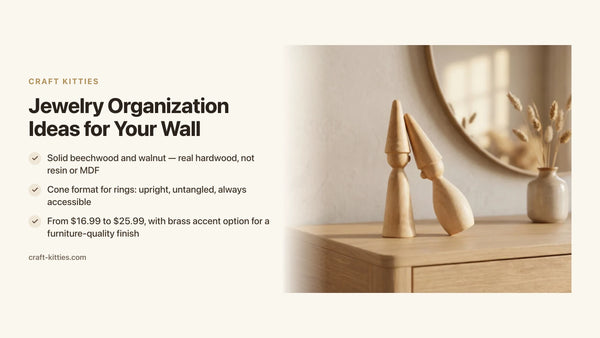
- Beech and walnut ring holders from $16.99 — functional and beautiful at eye level
The problem with minimalism is that a lot of it looks cold. White walls, empty shelves, surfaces clear to the point of clinical — the rooms that show up under "minimalist home decor" on Pinterest are often impressive and thoroughly unlivable. You would not want to spend a Sunday afternoon in them.
Cozy minimalism is the corrective. Not more stuff. Better stuff — chosen for material, not number. The distinction matters: a room with seven generic objects feels more cluttered than a room with two solid wood pieces, a linen throw and a single plant. The eye reads texture and intention, not headcount. This guide is about how that works in practice: which principles govern it, which materials carry it, which surfaces to focus on, and which objects earn their place by being used every day and beautiful to look at.
The ring holder is a useful case study, and not just because our studio makes them. A ring cone that lives on your nightstand is touched every morning and every night. If it is a cheap resin mold, it feels cheap every time. If it is solid beech or walnut with real grain and weight, it is thirty seconds of tactile pleasure twice a day, indefinitely. That is what cozy minimalism actually asks of objects.
At a glance
- Warmth comes from texture and material, not volume
- Solid wood, warm light and a curated surface beat a full shelf
- Beech and walnut ring holders from $16.99 — functional and beautiful at eye level
What cozy minimalism actually means — and what it does not
Minimalism, classically defined, is about reduction: removing until nothing unnecessary remains. The aesthetic descended from Bauhaus functionalism and Japanese wabi-sabi, arrived in Western interiors in the 2010s through a specific Instagram palette (white, grey, chrome, succulents), and got a lot of people to throw out their curtains and wonder why they felt cold.
Cozy minimalism is a practical amendment to that framework. The word "cozy" is doing real work here: it names warmth, comfort, the sense that a room is inhabited rather than staged. The resolution is material. A room can be visually quiet — few objects, abundant negative space, a restrained palette — and still feel warm if the materials carry tactile heat. Solid wood. Natural linen. Matte ceramic. Stone. These surfaces hold warmth in a way that chrome, plastic and glass do not, regardless of how sparsely you deploy them.
The misunderstanding to avoid is treating cozy minimalism as an aesthetic mood board rather than a decision-making system. It is not about buying items labeled "cozy" or "hygge" at Target. It is about a discipline of selection: keep what is used, choose it in materials that age, and leave deliberate space around it. The space is not emptiness. It is breathing room — what makes the objects you kept legible.
The three materials that carry warmth without clutter
You can reduce cozy minimalism to a material logic: some surfaces read warm and some read cold, and a room's atmosphere is largely a function of which materials dominate. The cold ones (polished chrome, glass, plastic, synthetic lacquer) are not wrong, but they need warm counterweights. The warm ones can carry significant visual weight alone.
Solid wood is the primary lever. It reads warm across species — from pale beech to mid-tone red oak to deep walnut — and it reads natural in a way that engineered wood and printed-wood-effect surfaces do not. The difference between a solid beech ring holder and a plastic-core resin one is not subtle under decent lighting: grain catches light, flat print does not. Solid wood also ages in the right direction. A scratch on beech develops into patina; a chip on printed MDF reveals white substrate. The material communicates its own quality at a glance, which is exactly what a minimalist surface needs from the few objects on it.
Linen and natural textiles are the soft complement. A linen throw on a chair, undyed or in warm oatmeal, is doing for softness what a walnut tray does for the hard surfaces. It introduces texture at a different scale and does not require a shelf of decorative pillows to make its point. One good textile placed deliberately does more than six fast-fashion equivalents.
Warm-spectrum lighting is the third material in this scheme. Not an object exactly, but a surface condition that everything else depends on. Bulbs below 3000K (2700K is the standard recommendation for residential warmth) make every material look better. The same solid walnut cone under a cold white LED looks grey; under 2700K warm white it glows amber. Light is the cheapest intervention in cozy minimalist decor and the most systematically ignored.

The surface-by-surface approach
Abstract principles about texture and restraint are easy to agree with and hard to translate into a specific room. The surface-by-surface approach is more useful: go room by room, surface by surface, and ask two questions. What is this surface's function? What is the minimum number of objects that serves that function while adding something beautiful?
The nightstand is the most high-leverage surface in a bedroom. It is what you see first when you wake up and last when you fall asleep. The cozy minimalist nightstand holds: a lamp (the warmth multiplier), something for your rings and phone (a wooden cone or small tray), a book or glass of water, and — optionally — one small plant or candle. Four objects, maximum. The test is whether each one does something: rests your phone, marks your page, holds your rings, lights the room. The fifth object that "just looks nice" is the beginning of a collection.
The dresser top operates on the same logic. A tray defines its own zone and contains objects that would otherwise scatter: rings, a watch, earrings, a lip balm. One tray. What goes inside the tray is intentional; what lives outside it is the clutter. The tray is the minimalism tool, not an additional decorative piece.
Living room shelves are where cozy minimalism gets tested hardest, because the instinct is to fill them. The rule that works: leave at least a third of each shelf empty, and treat negative space as a material decision, not a failure to buy more things. Two books, a ceramic bowl and a small plant on a shelf of four feet of shelving looks curated. The same shelf full looks like a bookstore.
The kitchen counter often gets skipped in décor discussions, but it is a high-traffic surface that rewards the same curation. A wooden cutting board that lives on the counter is functional and beautiful; a collection of novelty kitchen tools is neither.
Choosing wood species for a cozy minimalist interior
Wood is the primary material in a cozy minimalist scheme, and the species matters more than most buyers expect before they own pieces in different woods side by side.
Beech is the most versatile entry point. Its grain is fine and regular, its color a pale honey that reads cream in some lights and gold in others. It sits comfortably in Scandinavian-influenced rooms, in minimalist bedrooms with white or linen walls, and in Japanese-inspired interiors where restraint is the dominant mode. Beech is also the most democratic wood in this category: a beech ring cone at $16.99 has the presence of a piece that costs much more. It does not perform wealth; it performs care.
Walnut is richer and quieter at the same time. The dark brown with its fine, tight grain is what people mean when they say "warm" about a piece of furniture — it absorbs the room and gives back depth. Against a light wall, a walnut object stands out as a deliberate choice. Against a dark wall, it integrates and deepens. Walnut is the classic choice for nightstand objects and dresser accessories because it reads as considered rather than casual.
Red oak has a bolder, more visible grain and a warmer, honey-to-amber tone. It suits rooms where natural character is explicitly part of the aesthetic — where you want the material to be visible rather than recessive. A red oak piece in a clean room makes a quiet statement about the value of natural materials without introducing any visual complexity beyond the grain itself.

Ring holders as a case study in functional beauty
The ring holder category is worth examining in some detail because it illustrates the cozy minimalist principle at small scale. A ring cone is a tiny object. It holds two to four rings. It sits on a nightstand or a bathroom counter or the corner of a dresser. In a maximalist room it disappears. In a minimalist room it is among the most prominent objects on the surface.
That prominence creates a design problem and an opportunity simultaneously. The problem: a cheap ring holder in a spare room reads immediately as cheap, because there is nothing around it to distract from it. The opportunity: a beautiful ring holder in a spare room reads as a deliberate choice, because it is. A solid beech cone with even grain and smooth finish signals that the person who placed it there made a considered decision rather than grabbing the first thing from an Amazon results page.
The functional case is equally straightforward. Rings left on a counter scatter, disappear into drains, get knocked onto floors. A cone consolidates them in one spot and puts them at eye level. The nightly ritual of placing your ring on the cone and the morning ritual of taking it off is ten seconds of texture and weight that a plastic bowl or a generic dish does not provide. Solid wood does.
The couple's set case is its own category. Two cones on a shared nightstand, in matching or complementary wood — a beech pair, or one beech and one walnut for differentiation — function as a shared object and a small shared ritual. It is not sentimental kitsch; it is a practical object that acknowledges two people use the same surface.

Description
A pair of beech cones in this size does not occupy the nightstand; it defines it. The wood is solid beechwood — real hardwood, not veneered or printed — with grain visible enough to be felt at a glance and light enough to suit almost any wall color. At $16.99 for the set, the entry price for solid hardwood on your nightstand is lower than most people expect.

Description
The walnut and brass combination is a studied material pairing: the deep brown of solid walnut and the warm gold of solid brass occupy adjacent positions in a warm-neutral palette. Neither competes with the other. Together they read as intentional in a way that a single-material object does not always achieve. The brass base also adds enough weight to keep the cone from shifting — a functional detail that matters in daily use.

Description
The walnut set is the version for rooms that already have walnut in them — a walnut tray, a walnut-framed mirror, a dark wood bed frame. Matching the cone species to the existing wood means the nightstand reads as a coherent scheme rather than a collection of individual decisions.
The "one beautiful object" rule for curated surfaces
A heuristic that works in practice: allow one object per surface zone that has no functional purpose and exists purely because it is beautiful. A smooth river stone. A ceramic pinch pot. A single dried branch in a bud vase. One per zone.
The rule prevents two failure modes. The first is the sterile surface — clear of everything, including beauty, which ends up feeling like an Airbnb that has been professionally staged and professionally emptied of personality. The second is the accumulated surface — where "one beautiful thing" becomes five, then ten, until the minimalism is only a memory.
One non-functional beautiful object per zone is the equilibrium. It signals that a human being arranged this room and has aesthetic preferences, without signaling that they cannot stop adding things.
The same logic applies to the functional objects: when something must be there — a lamp, a ring holder, a tray for keys — it should be chosen to be the beautiful version of itself. Not ornate. Not expensive for the sake of expense. But chosen with the same care you would give an object that had no purpose except to be looked at.
What cozy minimalism is not
A few clarifications save a lot of wrong turns.
It is not Scandinavian by default. The hygge aesthetic shares some DNA, but cozy minimalism is not constrained to a Scandinavian palette. Japandi rooms, wabi-sabi-influenced spaces, warm desert interiors with adobe tones and clay objects — all of these can be cozy minimalist. The material logic (natural, tactile, warm) is portable across many visual cultures.
It is not cheap minimalism. The discipline of keeping fewer objects implies that the objects you keep should be worth keeping. A room with three well-made solid wood pieces and two good linens has more coherence and warmth than a room with twenty items from the same fast-home retailer. The budget does not have to be high, but the selection standard needs to be. $16.99 for a solid beech ring holder is not a high price; reaching for the $4.99 resin version defeats the purpose.
It is not static. Cozy minimalist rooms evolve. Plants grow. Candles burn down. A piece of wood develops patina. A book moves from nightstand to shelf. The equilibrium is maintained by removing before adding, not by freezing the room in a state photographed for an audience.
It is not a substitute for real comfort. A room can be visually cozy and physically cold. Good material choices cannot replace actual temperature, a mattress that supports you, or a chair you can sit in for more than twenty minutes. The aesthetic serves the living; the living is the point.
A room-by-room starting point
Rather than a comprehensive renovation plan, think of cozy minimalism as a one-surface-at-a-time project. Start with the surface you see most.
If that is the nightstand: remove everything except the lamp. Put back your phone charger (ideally a wooden one that doubles as a stand). Add a ring holder cone. Add one book. Consider a small plant. Stop.
If that is the dresser top: get one tray. Put all the loose objects inside it — rings, coins, earrings, sunglasses. Remove the objects that are not in the tray and do not earn their place outside it.
If that is the living room shelf: clear everything. Put back half of it, chosen for material quality or genuine meaning. Leave the other half empty.
If that is the kitchen counter: identify the two or three tools that are used every day. Put everything else in a drawer. The cutting board stays; the rarely-used appliances go.
Each step takes less than an hour. The cumulative effect across a home takes a few weeks of iteration. The maintenance is continuous but light: the discipline is removing one thing when one thing is added, which most cozy minimalist practitioners find easier to sustain than any rule-based "declutter in a weekend" system.
How to shop with a cozy minimalist lens
The shopping question for cozy minimalism is not "do I like this?" — the answer to that is always yes, which is how accumulation starts. The question is "does this replace something, or does this add to the count?"
If a new ring holder replaces a scattered arrangement of rings on a dresser, it is a net reduction in visual clutter. If a new decorative bowl joins three existing bowls, it is addition, regardless of how beautiful it is.
Practical rules that help:
Prefer solid over synthetic. Solid wood, real ceramic, genuine linen — these communicate material quality at a glance and age correctly. Printed wood-effect, synthetic linen lookalikes and veneered MDF do not.
Buy the functional version of the beautiful thing, not the beautiful version of the useless thing. A beautiful wooden ring holder that holds your rings beats a beautiful decorative object that holds nothing. Every object you add should do something.
Match the existing palette tightly. In a cozy minimalist room, a new object that does not fit the existing wood tone or textile color reads as an intruder. Bring the existing wood tone in mind before buying. Walnut with walnut; beech with beech or with light-toned ceramics.
Buy once. The economics of cozy minimalism favor higher initial investment in fewer pieces that last. A $25.99 solid walnut ring holder with brass base will outlive three $8 plastic dish alternatives with decades to spare.
Description
The beech cone set is the version you buy when the dresser or nightstand is starting from zero and the goal is to establish a material baseline before adding anything else. Pale enough to work with almost every palette; solid enough to last; a simple enough form that it does not compete with whatever comes next.
Comparison table — ring holders in our studio
| Model | Price | Wood | Format | Best for |
|---|---|---|---|---|
| Beechwood Cone Set | $16.99 | Solid beech | Set of 2 cones | Shared nightstand, couples, entry price |
| Walnut Cone Set | $18.99 | Solid walnut | Set of 2 cones | Rooms with existing walnut, richer tone |
| Walnut + Brass Base | $25.99 | Solid walnut + solid brass | Single statement piece | Dresser, solo nightstand, gift |
Decision matrix — which holder for which room
| Your situation | The right pick |
|---|---|
| Shared nightstand, want matching cones | Beechwood Cone Set — pale, versatile, entry price |
| Existing walnut furniture in the room | Walnut Cone Set — matches existing wood tone |
| Solo dresser statement, or giving as a gift | Walnut + Brass Base — two materials, one considered object |
| Light, neutral bedroom palette (white/linen) | Beechwood — pale enough to integrate without disappearing |
| Darker bedroom, moody palette | Walnut + Brass — deep wood + warm metal reads intentional against dark walls |
Common mistakes that undermine cozy minimalism
Buying "minimalist" products that are just white. A white plastic ring dish is minimalist in color and nothing else. The material is cold, the form is generic, and it will yellow within a year under bathroom lighting. White is a color, not a material quality. The warmth in cozy minimalism comes from natural materials, not from pale color palettes.
Leaving objects "for now" on surfaces. The single most corrosive habit in a cozy minimalist home is the object that is left "temporarily" on a surface and stays for months. A charger cord, a lip balm, a receipt. Once the precedent is set, the surface accumulates. The fix is one habit: before going to bed, any object that does not belong on a surface goes back where it belongs.
Matching wood tones too loosely. "It's close enough" wood tone mixing — a red-oak tray next to a walnut cone next to a pine shelf — reads as incoherence rather than warmth. Close-but-different tones look like mistakes; deliberately contrasting tones (very dark walnut with very pale beech) look like a choice. Stay tight on matching or go bold on contrast; avoid the in-between.
Under-lighting the room. Warm materials under cold or dim light read cold. A solid walnut cone under a fluorescent kitchen light loses most of what makes it a warm material. Swap one bulb to 2700K before buying more objects.
Treating minimalism as a permanent state rather than an ongoing practice. The most common disappointment with cozy minimalism is buying into it as an aesthetic event — "I decluttered, now I'm minimalist" — and finding it reverts within months. It is a maintenance practice: bring one thing in, remove one thing. That is the whole discipline.
Description
Where to explore next
Our ring holder collection gathers the full lineup in both solid beech and solid walnut, with options for singles, couples and dresser display. The beechwood ring holder cone set is the starting point for most shared nightstands; the walnut wood ring holder with brass base is the version that works as a solo statement piece or a considered gift.
If the nightstand is settled and you are working on the dresser, our ring trays and catch-all trays follow the same material logic — solid hardwood, real grain, forms that earn their place on the surface.
Craft Kitties has 243 verified reviews on Etsy, where shoppers consistently note the material quality and the way the pieces photograph and live in real rooms.
FAQ — cozy minimalist home decor
1 — What is cozy minimalist home decor? Cozy minimalist decor keeps only what is visually intentional, and chooses materials — solid wood, linen, stone, clay — that add warmth through texture rather than volume. The goal is a room that feels calm and livable at the same time, not cold and sterile.
2 — How do I make a minimalist room feel cozy without adding clutter? Layer texture instead of objects: a linen throw, a wood surface, a ceramic bowl. One solid wood piece on a nightstand or dresser does more for warmth than a shelf of decorative items. Soft, warm-toned lighting below 3000K adds perceived coziness without any physical object.
3 — What wood species work best in cozy minimalist decor? Beech is the most versatile — pale, fine-grained, it reads both Scandinavian and warm without dominating. Walnut brings deeper warmth and a quiet richness. Red oak, with its visible grain, suits rooms that want a bolder natural presence. All three are solid hardwoods that develop character over time rather than deteriorating.
4 — What is the difference between hygge, japandi and cozy minimalism? Hygge (Danish) is about social warmth and sensory comfort — candles, blankets, togetherness. Japandi is a design hybrid (Japanese wabi-sabi and Scandinavian functionalism) that stays cooler and more austere. Cozy minimalism borrows hygge's material warmth and japandi's restraint in volume: deliberately spare, never cold.
5 — How many objects should a cozy minimalist nightstand have? Three to four at most. A lamp, something that holds your rings or phone, a book or glass of water, and optionally one small plant or candle. Every object has a reason to be there — not just proximity to a shopping cart.
6 — Is solid wood worth it for small decorative objects? Yes, particularly for objects that live at eye level or in your hands daily. A solid beech or walnut ring cone, a wooden tray, a wood-based charger — these age like furniture. Veneer and MDF alternatives show their seams within a year. The price difference on a small accent piece is rarely more than $10-15 and the lifespan difference is measured in decades.
7 — What colors work with cozy minimalist decor? Warm neutrals: linen white, warm ivory, soft terracotta, dusty sage, greige. The palette stays within two to three tones per room. Wood is its own color layer that should contrast rather than blend — walnut against a light wall reads rich; beech on a greige wall reads soft and integrated.
8 — Can cozy minimalism work in a small apartment? It works better in small spaces than maximalist approaches precisely because it curates rather than accumulates. The discipline of keeping only intentional objects shrinks perceived clutter and makes a small room feel calm. The key is vertical negative space — leave some wall and surface area deliberately empty.
9 — What is the "one beautiful object" rule? A useful heuristic: allow one object per surface zone that has no functional purpose and exists purely because you find it beautiful — a small wooden cone, a smooth river stone, a ceramic sprig holder. One per zone prevents accumulation while preserving the sense that the room was arranged by someone with taste.
10 — How do wooden ring holders fit into a cozy minimalist bedroom? A wooden ring cone earns its place on the nightstand or dresser because it is functional — your rings live there every night — and quiet in form. Solid beech or walnut, simple cone geometry, no ornamentation that shouts. It fulfills the cozy minimalist requirement: an object that justifies its presence through daily use and brings warmth through material rather than decoration.