At a glance
- Solid red oak, walnut and beech — real hardwood, not wood-effect
- Warmth that reads all year, not just through December
- From $15 to $55.20, for the desk that finally looks grounded
Winter changes how a room feels before it changes how it looks. The light goes amber earlier. The air inside becomes the main weather. Suddenly, the plastic pen cup on the desk, the metal tray by the door, the powder-coated storage rack on the shelf — every synthetic surface reads cold in a way it simply did not in August.
The standard advice is to buy seasonal decor: string lights, a wreath, a throw in tartan. That works for a few weeks and then it has to go somewhere. The longer play is different — it is about replacing the objects you already have with materials that carry warmth intrinsically, not ones that symbolize a holiday. Real solid wood is the most direct answer: red oak, walnut, beech. The grain catches amber light. The surface is warm to the touch. And none of it has an expiration date.
This guide is about how to make any room — and especially any workspace — feel grounded through winter using the logic of material over motif. It covers the desk first, because that is where most people spend most of their indoor hours in winter, then moves outward.
Why material warmth outlasts seasonal decoration

There is a useful distinction between warmth that comes from a material and warmth that comes from a symbol. A walnut pen holder is warm in December, in March and in August — the deep brown grain, the weight, the waxed surface are properties of the wood, not of the month. A red-and-green candle holder is warm specifically in December because its color scheme carries that association. When January comes, it looks out of place. The wood piece does not.
This is the logic behind choosing solid hardwood objects — particularly on the desk and in the everyday line of sight — for winter decorating. You are not adding a seasonal layer on top of a room. You are changing the room's baseline: what it looks like and feels like at a material level, continuously. That shift costs the same as a seasonal wreath set but pays off across every week of every month.
The other argument for real wood is sensory. A solid red oak pen holder has a weight, a surface temperature and a tactile grain that a wood-effect plastic or printed MDF piece cannot reproduce. In winter especially, when people spend more time indoors and interact more closely with their objects, that gap is felt even by people who cannot articulate it. It is the reason certain spaces feel considered and certain ones do not.
The desk: where winter decor logic matters most
For most people working from home, the desk surface is the environment they stare at for six to eight hours a day in winter. It is also the surface that most consistently receives zero decorative attention — function gets the budget, appearance does not. The result is a workspace that feels cold not because it lacks heating but because every object on it is made of plastic or powder-coated metal.
The intervention is minimal. One or two solid wood objects change the register of a desk completely — not by adding softness or decoration in the way a plant or a candle does, but by introducing material density. A geometric walnut pencil cup, a spliced wood organizer, a red oak plant pod: these are functional objects that happen to be beautiful, which is the only kind of winter decor that does not feel like effort.
The mistake is overloading the desk surface in the name of coziness. Empty space is part of the composition. The goal is one or two high-quality wood pieces that earn their place, not a collection of small objects that collectively create visual noise.
Choosing the right wood: red oak, walnut or beech
The species determines the character, and the character should match the room's existing light and palette.
Red oak is the most visually active: light honey tone, bold open grain you can read across the room. It brightens a darker workspace and pairs naturally with warm-white walls and warm lighting. The grain catches oblique winter light — the kind that comes through a south-facing window at a low angle — better than almost any other hardwood.
Walnut is the quieter option with the stronger presence. Its deep brown, fine-grained surface is what people mean when they say something looks "expensive" without looking ornate. Against a white desk or a light wall, a walnut piece reads like a period at the end of a sentence — definitive. It is the dominant species in our pen holder lineup for that reason.
Beech sits between the two: creamy, even-grained, naturally warm without the drama of red oak or the depth of walnut. It is the underrated choice for Scandinavian-influenced spaces where the goal is warmth without contrast, a room that feels considered without drawing attention to any single object.
All three species in our studio are solid hardwood — red oak, walnut, beech cut through — never veneer over particleboard. The grain is not printed; it is the material itself. That distinction matters because winter humidity and the temperature swings of a heated indoor space are exactly the conditions that reveal the difference between solid wood and composite.
Cozy desk decor: the pen holder as a design anchor
A pen holder is the desk object with the highest daily contact rate — you reach for it multiple times an hour. It is also, for that reason, the single object most worth upgrading in a winter desk refresh: no other object will be held, placed and noticed as often.
The version made from solid red oak or walnut does something a plastic or metal holder does not: it makes the retrieval of a pen feel unhurried. That is not a small thing in winter, when the goal is a workspace that does not generate ambient stress. The material communicates intention — this desk was arranged on purpose — and that signal affects how you feel while working at it.
The range of choices goes from a $15 geometric pencil cup to a $55.20 plant-pod organizer that integrates a small planter. The logic for each is slightly different, which is why the comparison table and the individual model notes below matter more than a general recommendation.

Description
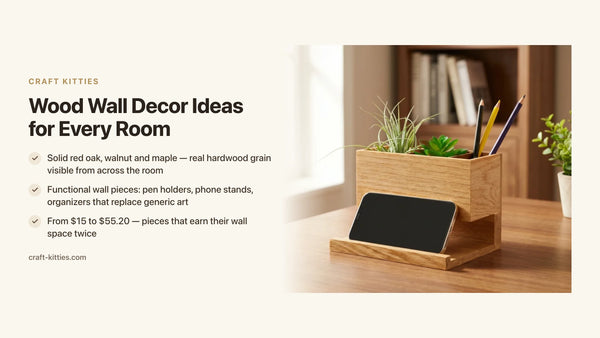
The Red Oak Plant Pod Pen Holder is the most complete winter desk upgrade in the lineup. Solid red oak — the full piece, not a veneer — with an integrated planter that lets you bring one small succulent or air plant directly into the desk surface. The plant pod adds the organic note that makes a winter desk feel alive rather than just organized. At $55.20 it is the anchor piece: you build the rest of the desk around it and stop there.

Description
The Walnut & Maple Spliced Wood Pen Holder pairs two solid hardwoods — walnut and maple — in a design where the joint between the two species is visible and intentional. That splice line is the design. On a winter desk it reads as material craft: the kind of object that prompts a question from anyone who sits across from you. At $36.00 it is the mid-tier pick for the person who wants something clearly considered without the full plant-pod commitment.

Description
The Walnut & Red Oak Pen Holder does the same material pairing at a smaller scale and a lower price point ($15.99). Solid walnut and solid red oak, handmade, with the contrast between the two tones doing the visual work. It is the entry point into the two-tone range — compact, functional, immediately warm on a desk that currently holds only plastic.

Description
The Wooden Pen Holder & Phone Stand solves a specific winter desk problem: the phone that migrates across the surface looking for a resting place. This organizer gives it one — a fixed slot that keeps the screen facing you without taking up additional footprint. At $35.00 it is the functional-plus-beautiful middle ground, useful for anyone who takes video calls from their desk and wants the phone visible without it lying flat.

Description
The Wooden Pen Holder for Desk is the geometric, minimal pick: a clean pencil cup in solid wood at $15.00. No secondary function, no additional slot, no planter — just the right form in the right material. It is the answer for the person who wants to warm up the desk without changing how it is organized, and for whom $15 is the right threshold for the experiment.
Comparison table: five solid wood pen holders for a cozy winter desk
| Model | Price | Wood | Extra function | Best for |
|---|---|---|---|---|
| Red Oak Plant Pod | $55.20 | Solid red oak | Integrated planter | Winter anchor piece — desk + plant in one |
| Walnut & Maple Spliced | $36.00 | Solid walnut + maple | — | Visible craftsmanship, two-tone statement |
| Wood Pen Holder + Phone Stand | $35.00 | Solid wood | Integrated phone stand | Video calls, dual-function desk |
| Walnut & Red Oak Pen Holder | $15.99 | Solid walnut + red oak | — | Entry two-tone, compact upgrade |
| Geometric Pencil Cup | $15.00 | Solid wood | — | Minimal entry, pure form |
The decision matrix: which pen holder for which winter workspace
| Your situation | The right pick |
|---|---|
| You want one piece that anchors the whole desk and includes green | Red Oak Plant Pod |
| You want visible material craft, something people ask about | Walnut & Maple Spliced |
| You take video calls and want phone + pens in one footprint | Pen Holder + Phone Stand |
| First solid wood upgrade, compact, two-tone warmth under $20 | Walnut & Red Oak Pen Holder |
| Minimal approach — one beautiful pencil cup, nothing more | Geometric Pencil Cup |
Beyond the desk: three principles for a warmer room

The desk is the easiest room to warm up because its scale is small and the objects on it are already expected to change. The living room, bedroom and kitchen follow the same logic at a different scale. These three principles apply across all of them.
Lead with tactile surfaces. Winter warmth is perceived as much through touch as through sight. A linen throw, a wooden tray, a ceramic mug — these objects are warm before you look at them, because you already know how they feel. When you are choosing what to add or swap in a winter decor refresh, prioritize objects that will be touched: the pen holder on the desk, the tray on the coffee table, the organizer on the kitchen counter.
Change the light before you change the furniture. Warm-white bulbs (2700–3000K) change a room more than almost any furniture swap, at a fraction of the cost. Winter light is blue and low; indoor light should compensate. A $12 LED swap in three lamps does more for winter coziness than a new rug. The wood grain on your new walnut pen holder will look entirely different under 2700K light than under a cool-white 5000K bulb.
Edit before you add. The impulse in winter decorating is to add: more throws, more candles, more objects on the shelf. The rooms that feel most intentionally cozy are rarely the fullest — they are the ones where every object has been chosen rather than accumulated. Before adding anything, remove something. The remaining objects read with more weight and presence when they have breathing room.
How to mix wood tones without the room looking accidental
The most common mistake in natural-material decor is combining wood tones without a logic. A walnut bookend, a light pine shelf and a beech tray on the same surface read as three separate decisions rather than one considered room.
The rule that works consistently: one dominant species, one accent. Choose the wood that you want to be the room's baseline — ideally the species of its largest piece, the dining table or the bed frame — and match at least two-thirds of your smaller wood objects to it. The remaining third can contrast intentionally: a red oak piece in a walnut room, a walnut piece in a beech room.
Hardware is the other axis. Keep it consistent across every metal finish in a room: if the desk lamp is brass and the drawer pulls are brass, the pen holder's hardware should be brass too. Black metal works the same way. Mixing hardware finishes reads as accidental in a way that mixing wood tones does not — wood variation reads as organic; metal variation reads as error.
For a winter desk in particular: choose walnut or red oak for the dominant species, use black metal hardware throughout, and let one warm lamp do the rest. Three decisions, one room that feels like it was arranged on purpose.
Winter cozy decor that is also a gift
Solid wood objects sit in an unusual gift category: they are useful enough to be functional gifts (no one resents receiving a pen holder they will immediately use) and beautiful enough to be decor gifts (the recipient keeps them long after the occasion). That combination is rare and, in winter, particularly relevant — holiday gifting tends toward objects that are immediately meaningful, and a handmade walnut organizer is both immediately useful and lastingly present.
The practical consideration for gifting wooden desk objects is personalization through species choice. Knowing whether someone's desk is light or dark — whether they have a walnut desk or a white laminate — lets you pick the contrast correctly. In the absence of that information, walnut is the safer bet: its deep tone reads well against white, light-gray and beige surfaces, which is what most home office desks are.
A complete winter desk gift set: one solid wood pen holder (species matched to desk), one small succulent for the plant pod if you choose the Red Oak Plant Pod, and a notebook. Total under $70, lasting longer than any candle set.
Mistakes that undo a cozy winter room
Overloading surfaces with seasonal objects that date. A pumpkin in October is right; in December it is wrong. Avoid any object that reads as belonging specifically to one month of winter. Wood, linen, ceramic and stone have no expiration.
Choosing the wood tone from a product photo rather than from your room. A walnut organizer photographed on a white studio surface looks darker than it will on a white desk in natural window light. Red oak photographed against a warm backdrop looks more amber than it will on a cool-white desk. Order with your room in mind, not the product image background.
Confusing clutter with warmth. A room full of small objects — coasters, decorative stones, tiny frames, candle holders — can feel suffocating rather than cozy. Warmth comes from material quality and light, not from object count. Two solid wood pieces chosen with care will warm a desk more than ten small seasonal objects placed without logic.
Ignoring the lamp. Every solid wood piece in this guide looks fundamentally different under warm-white light versus cool-white. If the room still uses cool-white or daylight bulbs, no amount of material upgrading will produce the warm, grounded feeling that is the actual goal. Swap the bulbs first.
Where to go next
The pen holder collection gathers all our solid wood desk organizers — red oak, walnut, beech, in formats from the $15 geometric cup to the $55.20 plant-pod anchor. If you are building out a full desk, start with the Red Oak Plant Pod Pen Holder as the anchor piece and work outward from its material tone. For a two-tone pairing, the Walnut & Maple Spliced Wood Pen Holder is the first complement to add.
You can also find our desk organizers on Etsy, where 243 reviews reflect how these pieces work in real home offices and living spaces day to day.
FAQ — cozy winter home decor ideas
1 — What makes a home feel cozy in winter without looking seasonal? Natural materials — particularly solid wood — create warmth that reads year-round rather than seasonal. A walnut or red oak desk organizer brings the same grounded feeling as a wreath or candle, without the expiration date. The key is texture and grain: visible wood grain catches light the way plastic or powder-coated metal cannot.
2 — Which wood species is warmest-looking for winter home decor? Walnut reads the warmest — its deep brown tone absorbs and reflects amber light beautifully. Red oak is lighter, more honey-toned, and works well in rooms that are already rich with dark textiles. Beech sits between the two: creamy, even-grained, naturally bright. All three are solid hardwood, not veneer, so the grain goes through the piece.
3 — Is real solid wood worth the price over cheaper wood-look alternatives? Yes, for two reasons. First, solid hardwood — red oak, walnut, beech — ages with character rather than chipping or warping. Second, the sensory difference is immediate: the weight, the grain pattern and the smoothness of a waxed surface are things a wood-effect print cannot replicate. For decor you look at and touch daily, the gap is more noticeable than the price.
4 — How do I mix wood tones in a room without it looking accidental? Pick one dominant species and use it for at least two-thirds of your wood pieces, then allow one contrasting tone as an accent. For example: walnut as the base (pen holder, phone stand, tray) with a single red oak piece for contrast. Hardware ties everything together — keep it consistent: black metal or brushed brass, not both.
5 — What are the easiest cozy winter home decor changes to make on a budget? Start with the surfaces you look at most — your desk, your bedside table, your kitchen counter. A solid wood pen holder or geometric pencil cup at $15 changes the character of a workspace more than a $200 rug swap. Tactile materials at eye level read faster than large-surface changes.
6 — Can a wooden desk organizer work as a cozy decor piece, not just storage? That is exactly what it is when made from solid hardwood. A geometric walnut pencil cup or a red oak plant-pod organizer functions as decor first — the grain, the weight, the waxed surface are things people comment on, not just use. Storage capacity is the secondary benefit.
7 — What winter decor ideas actually last beyond the season? Anything rooted in material quality rather than seasonal motif. Solid wood, linen, ceramic — these materials feel right in January, in March and in July. Avoid Christmas-specific colors or patterns; lean into the textures and tones that winter light flatters: deep browns, honey yellows, matte blacks.
8 — How do I decorate a home office for winter without losing focus? The goal is warmth without visual clutter. One or two solid wood objects on the desk — a pen holder, a phone stand — add material richness without demanding attention. Avoid over-decorating the desk surface; empty space is part of the composition. Pair wood with a warm lamp and one plant for the full grounded effect.
9 — What is the hygge approach to home decor? Hygge (Danish/Norwegian concept of coziness) prioritizes sensory comfort over visual impact: warm light over bright light, natural materials over synthetic, fewer objects chosen with care over many accumulated by default. A solid wood organizer on a desk, a candle in the evening, a wool throw — hygge is about the feeling a room produces, not its look in a photo.
10 — Do wooden desk organizers make good winter gifts? They are among the most universally useful gifts because everyone has a desk or a bedside table. A walnut pen holder or a spliced wood organizer is functional enough to justify immediately, beautiful enough to keep permanently. Pair with a small plant or a notebook for a complete desk gift.