At a glance
- Expire first, then duplicates, then backstock — most bathrooms drop 40–60% of products
- Clear the counter to three items max, move everything else to cabinets
- Solid hardwood on the walls (towel bar + hook) closes the loop permanently
Every bathroom reorganization starts the same way: a burst of motivation, fifteen minutes of moving things around, and a room that looks exactly the same two weeks later. The reason is almost always the same too — things were rearranged instead of removed, and the storage objects that were supposed to help were placed on the counter, adding to the mass instead of reducing it.
Decluttering bathroom products is not a sorting problem. It is a decision problem. This guide gives you the decision criteria — what to keep, what to cut, in which order — then shows how wall-mounted solid wood storage closes the loop by taking the things that stay permanently off the counter and onto the walls.
Start with expiry dates — the category that requires no judgment

Sunscreen degrades. Prescription eye drops expire. Serums oxidize. Most topicals carry a printed date or a period-after-opening symbol (the small open jar with a number) that most people ignore entirely. The expired stack is almost always the biggest single cut in a bathroom, and it requires no emotional deliberation: an expired product does not belong on the shelf.
Pull every item out. Check the date. Anything past it goes immediately — no "but I barely used it" exception, because that sentence describes why it expired in the first place. If there is no date, the rule of thumb for opened skincare is twelve months; for anything applied near the eyes or mouth, six.
This first cut alone typically removes 20 to 30 percent of what is in the bathroom. It also surfaces the second problem: duplicates.
The duplicate problem — why bathrooms accumulate redundant products
Bathrooms collect products from three sources: intentional purchase, impulse purchase, and migration. Migration is the one people underestimate — products carried from the previous bathroom, a hotel miniature kept out of vague frugality, a sample pouch that never got opened. These items occupy real space for no active benefit.
After expiry, remove duplicates. A duplicate is any product that performs a function already covered by something you actively use. Three hydrating serums, two leave-in conditioners, four bars of soap — keep the one you prefer, discard the rest. The working question is not "might I use this?" but "am I using this." The conditional tense is the trap.
Apply the thirty-day rule as a tie-breaker: if you have not reached for it in the past month, it is not part of your actual routine. It is occupying prime real estate on a shelf or counter that could hold nothing at all, which is always better than holding something unused.
What to actually keep — the four-category method
Once the expired and redundant items are gone, what remains should fit four categories: daily-use, weekly-use, occasional, and guest. The placement rules follow directly from the category.
Daily-use items — the ones you reach for in the first ninety seconds of your morning — earn the counter, or the top shelf of a mounted organizer. The rule is strict: three to five objects at most. A cleanser, a moisturizer, a deodorant. If a sixth item is trying to join that group, reconsider whether all five earned their spot.
Weekly-use items belong in a drawer or the cabinet under the sink. Accessible but not visible: a hair mask, a face scrub, a shaving kit. They are not part of the daily reset, so they should not take up daily real estate.
Occasional-use items — a self-tanner used three times a year, a prescription topical for seasonal flare-ups — live in a bin or a basket inside the cabinet. Out of sight is not out of reach; it is just not in the way.
Guest items go in a separate, clearly bounded zone: one small tray or one designated shelf, not scattered. Guests do not share your daily products; they need their own contained space so the host-side of the bathroom stays organized.
The counter rule: three items or fewer
The counter is not storage. It is a work surface, and like any work surface it functions best when it is almost empty.
Three items on the bathroom counter is a specific, achievable number, not a metaphor for tidiness. A soap dispenser, a cleanser, a moisturizer: those three cover the majority of what actually happens at a bathroom sink. Everything else — cotton rounds, Q-tips, a second cleanser "for when the skin feels different" — lives in a drawer.
The practical objection is that things left in the cabinet get forgotten and therefore unused. The answer is good drawer organization — small trays, not a pile — and the discipline of grouping items by category (skincare, hair, dental, shaving) so nothing is hidden. Visible-from-the-front is not the same as on the counter.
When the counter is clear, cleaning the bathroom takes two minutes instead of fifteen. That compound return is the real argument for the three-item rule.
Wall-mounted storage: the hardware that keeps the system honest

Decluttering is a decision event. What makes the result last is the environment — whether the space, once cleared, is physically set up to stay clear. That is where wall-mounted storage does its work.
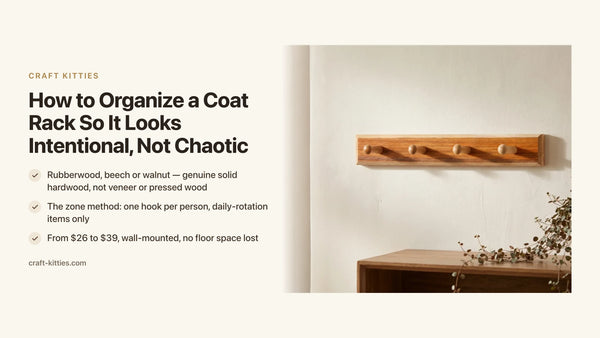
A towel left on the counter or draped over a cabinet door occupies visible space and creates visual noise regardless of how clean the rest of the room is. A towel on a wall-mounted bar has a fixed home, and putting it back requires no decision. That is the behavioral difference between storage that works and storage that eventually fails.
Our towel bars are cut from solid red oak, walnut or beech — dense hardwoods that handle bathroom humidity without swelling, warping or discoloring over years of daily use. A wax or oil-wax finish closes the grain surface and makes the bar easy to wipe clean. The difference from a chrome rail or a veneered alternative is not aesthetic alone: solid wood ages like furniture while chrome pits and veneer delaminates.

Description
The square-profile hardwood bar is the baseline: one towel, one bar, fixed once. It is the model that works in the most bathrooms because it does exactly one thing without introducing any visual complexity. The finish is wax-applied solid wood — smooth, waterproof at the surface, and warmer on the eye than any chrome alternative at this price point.

Description
The wood-and-brass set brings a second material note: solid wood bar, warm brass hardware. The combination works in transitional bathrooms where chrome feels too cold and matte black feels too deliberate. Brass ages gently alongside the wood rather than against it, and the set includes everything needed for a same-day install.

Description
The arc profile is the same solid hardwood and wax finish applied to a slightly curved bar. The curve is functional as much as aesthetic — it creates a natural cradle that keeps a folded towel in place without clips or tucks. In a bathroom where every other fixture is a straight line, the arc introduces one deliberate shape without disrupting the overall register.

Description
The double-layer bar solves a specific problem: two people sharing one bar, or a bathroom that needs both a bath towel and a hand towel in the same wall zone. Two rows of solid wood, same mounting footprint as a single bar, mounted with the same two-anchor system. It is the model that makes "towel clutter" disappear rather than just relocate.
How to choose the right bar for your bathroom
| Model | Price | Wood | Hardware | Best for |
|---|---|---|---|---|
| Square hardwood bar | $24.00 | Red oak or walnut | Matte black | Clean single-bar setup, most bathroom styles |
| Wood & brass rack set | $22.00 | Solid wood | Warm brass | Transitional bathrooms, warm metal palette |
| Arc-profile bar | $24.00 | Solid hardwood | Matte black | Minimal rooms, one deliberate shape |
| Double-layer bar | $24.00 | Solid hardwood | Matte black | Two people, bath + hand towel same wall |
| Your situation | The right pick |
|---|---|
| Solo bathroom, one towel in use at a time | Square hardwood bar |
| Warm metal hardware already in the room | Wood & brass set |
| Minimal interior, one intentional form element | Arc-profile bar |
| Shared bathroom or bath + hand towel same wall | Double-layer bar |
| Budget-first, want solid wood under $25 | Wood & brass set at $22 |
| Gift for a bathroom renovation | Arc-profile bar or square bar — timeless form |
Installing a towel bar in four steps
Wall-mounting is the one task most people delay longer than it deserves. Here is how long it actually takes.
1 — Choose the wall and the zone. The wall facing or beside the shower or tub is the natural candidate. For a primary bath towel, height of 44 to 48 inches from the floor is the standard; for a hand towel bar near the sink, 36 inches. A double-layer bar can occupy a single mounting zone at 44 inches with the lower rail at 36.
2 — Mark the anchor points. Our bars ship with a template or measurement guide. Use a level; a bar that is two degrees off horizontal is visible every single day. Mark, not assume — this step takes two minutes and prevents all the frustration.
3 — Drill and anchor. Two points, wall anchors included. If you are mounting into tile, a masonry bit and slow speed prevents cracking; into drywall, the included anchors hold the load. A bath towel weighs less than two pounds, so no structural complication is involved.
4 — Hang the towel correctly. A folded towel — halved lengthwise then halved again — hangs flat, dries faster, and looks intentional. A thrown-over towel looks disheveled regardless of how clean the room is. One fold changes the entire read of a bathroom wall.
The mistakes that bring clutter back
Decluttering the bathroom and then restoring the same surface patterns is the most common outcome. Three specific mistakes cause the relapse.
Returning products to the counter "just for now." The counter has no "just for now." Every object placed there temporarily tends to acquire a neighbor within days. The three-item rule requires that any exception be a conscious override, not a habit.
Buying storage before deciding what stays. New organizers feel like progress. A basket of items you should have discarded is still a basket of items you should have discarded, now better organized. The decision step comes first; the storage step comes after, and only to house what passed the cut.
Using the freed space as an invitation. A cleared shelf does not signal "room for more products." It signals "I have the right amount of products for this room." Backfilling a decluttered bathroom within two months — a new product here, a sample there — is the cycle that makes most bathroom reorganizations feel temporary. Buy intentionally after decluttering, not reflexively.
Why solid wood belongs in a room that is supposed to stay simple
Chrome tarnishes. Plastic organizers yellow. Printed wood-effect MDF chips at corners and swells at the bottom where condensation pools after a shower. The bathroom is a wet, humid, daily-use environment, and most of the organizers sold for it are not built for that reality.
Solid red oak, walnut and beech are different in kind, not degree. A dense hardwood finished with a protective wax coat does not absorb ambient moisture the way softwood or particleboard does — the grain is too tight, and the sealed surface does not invite water in. What ages in solid wood is surface patina, not structural integrity. A well-made oak or walnut bar looks better at year five than it did on install day.
There is also a logic to having fewer, better objects in a room you are trying to simplify. A single solid wood towel bar — well made, wall-mounted, finished properly — reads as intentional. Three wire organizers, a plastic hook strip and a chrome rail read as accumulated. The material choice and the declutter project are pointing in the same direction.
Our full wood towel bar collection is organized around this principle: one material family (solid hardwood), one finish approach (wax or oil-wax), consistent hardware options (black, brass). Pieces from the same collection answer each other on the wall without needing to match exactly.
FAQ — decluttering bathroom products
1 — How do I decide what bathroom products to keep? Apply the daily-use test: if you have not reached for an item in the past 30 days, it is a candidate for removal. Products that duplicate a function something else already covers are the first to go. Keep one per category that works, discard the rest.
2 — How many towels should I keep in the bathroom? Two bath towels and two hand towels per person is the working rule. More than that creates folding backlog, and a cluttered towel bar defeats the point of having one. A double-layer wall-mounted bar handles two sets without taking up floor space.
3 — What is the best way to organize bathroom countertop products? Clear the counter entirely first, then return only what you use every single morning. Everything else — backstock, occasional products, guest items — lives in a drawer or cabinet. A countertop with three or fewer objects is not minimalism for its own sake; it is simply a surface that is easy to clean.
4 — Is a wood towel bar durable in a humid bathroom? Yes, when the wood is solid hardwood and the finish is protective. Our bars are cut from red oak, walnut or beech — dense species that resist moisture far better than veneered particleboard or engineered wood. A wax or oil-wax coat closes the grain surface, making the bar easy to wipe clean and resistant to ambient steam.
5 — How high should a towel bar be mounted? Between 44 and 48 inches from the floor is the standard range for a primary towel bar; around 36 inches works for a hand towel. The practical check is to hang a dry towel and confirm it clears the floor with at least two inches of margin.
6 — What should I get rid of first when decluttering the bathroom? Expired products are the non-negotiable first cut — sunscreen, eye drops, prescription items and most topicals have expiry dates, and keeping them past that date is pointless. After that, remove duplicates and anything you moved from the last bathroom without re-evaluating.
7 — Should bathroom products be stored on the counter or in a cabinet? Cabinets and drawers are the default for everything not used in the first ninety seconds of your morning routine. Counter-top storage invites accumulation — every item placed there tends to attract one more. The one exception is a single tray or holder that corrals daily essentials in a defined zone.
8 — How do I keep the bathroom tidy after decluttering? Install wall-mounted storage that takes things off the counter permanently — a towel bar so folded towels have a fixed home, and a defined spot for each daily-use item. When every object has a fixed location, putting things back requires no decision, and the room resets naturally.
9 — Red oak, walnut or beech — which wood is best for a bathroom towel bar? All three perform well when properly sealed. Red oak has a pronounced grain and lighter tone; walnut is deep brown with a tighter grain for a furniture-like presence; beech is pale and fine-grained, a natural fit for minimalist interiors. Choose by contrast with your wall color and existing hardware.
Where to go next
A decluttered bathroom and a wall-mounted solid wood bar are the same project in two steps: decide what stays, then give it a fixed home on the wall. Our wood towel bar collection covers every bathroom configuration — single bar, arc profile, double layer, wood and brass — all in solid red oak, walnut or beech, finished in our studio with the same wax-coat approach.
Customers who discovered our pieces on Etsy — where we have 243 reviews — often start with one bar and return for a second piece once they see how the material registers in the room.
Conclusion — the room that stays done
The pattern in every successful bathroom declutter is the same: expire first, eliminate duplicates, enforce the counter rule, then install fixed wall storage for what remains. The last step is the one most people skip, and it is the one that determines whether the result lasts six months or six years.
A solid red oak or walnut towel bar mounted once at the right height does more organizational work than any counter organizer, because it takes the towel question off the surface permanently. The square hardwood bar is the starting point for most bathrooms; the double-layer version resolves the two-person or bath-plus-hand-towel problem in one wall zone; the wood-and-brass set at $22 opens solid wood at the lowest entry point in the lineup. Three options, one result: a bathroom that does not need to be reorganized again.