At a glance
- Vertical wall space is your best asset in a small entryway — keep the floor clear
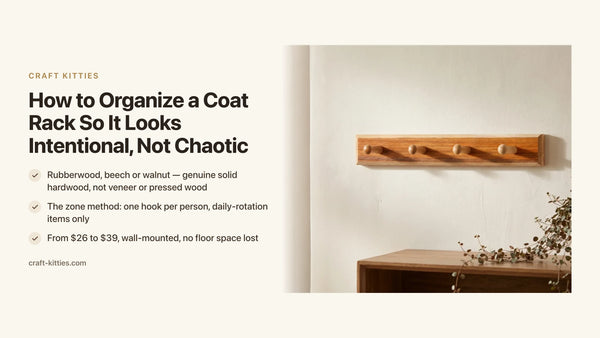
- Solid red oak, walnut or beech bars hold coats, bags and wet items without furniture
- From $22, wall-mounted, two anchors, done in under fifteen minutes
The entryway problem is a space problem. Most apartments and smaller homes give you somewhere between eighteen inches and four feet before the room opens up — not enough for a console table, definitely not enough for a bench plus a coat rack plus a shoe cabinet. So things land on the floor, and the floor stays permanently covered, and the space never quite settles into order no matter how many times you tidy it.
The solution is almost always the same once you look at it clearly: the floor is the wrong surface to organize. The wall is the asset. Every inch of vertical surface above floor height is usable storage — for coats, bags, scarves, umbrellas, dog leashes, keys — without claiming a single square foot of the space you actually walk through. This guide is about making that switch deliberately: what to mount where, which wood pieces hold up to daily use, how to avoid the common mistakes, and how to make a narrow entryway look finished rather than compromised.
One thing up front: this guide focuses on solid hardwood wall-mounted storage. Pressed-board panels and hollow-core rails look similar in product photos and cost less. They also loosen at the hardware points, bow under real bag weight, and show wear within a year. Red oak, walnut and beech cut from solid stock behave differently — they carry weight without flexing, they age well, and they look better at year three than they do on day one.
The case for wall-first entryway organization

The floor is the most expensive surface in a small entryway. Every object on it — a pair of shoes, a tote bag, an umbrella — visually shrinks the room and creates an obstacle that makes the space feel narrower and harder to navigate. Move those objects to the wall and the floor opens up, the sightline clears, and the same eight square feet immediately reads as a real room rather than a closet-width transition zone.
Wall-mounted storage also forces a useful habit: because each object has a specific, fixed address on the wall, it has to go back there. Hooks and bars are not neutral surfaces where things accumulate — they are dedicated homes. A coat hook is a coat hook, not a secondary shelf. That specificity is what makes wall-first organization hold over time when a basket on the floor never does.
The practical minimum is modest. One bar or rail at coat height — 60 to 66 inches from the floor — handles the four or five items that come off your body every time you walk in: coat, bag, scarf, umbrella. A second bar at knee height handles the overflow or the child's layer. Between those two rails, a column of eighteen to twenty-four inches of wall holds everything most households carry daily, with the floor completely clear beneath it.
What to hang where: a zone-based system
A small entryway works best when it is divided into three vertical zones, each with a dedicated function. The top zone, from roughly 55 to 72 inches, handles structured outerwear — coats, jackets, heavier bags. The middle zone, from 36 to 54 inches, handles accessories and soft items — scarves, dog leashes, reusable bags, umbrellas. The lower zone, from the floor to 35 inches, is shoe territory: a low shelf, a tray, or simply a mat that defines the boundary.
This stacking logic matters because it keeps each zone from interfering with the next. A coat on a high hook does not tangle with a scarf on a mid rail; a wet umbrella on a lower bar drips onto tile rather than onto outerwear. The zoning also means that every object in the entry has a vertical address — and when every object has an address, retrieval becomes automatic. You reach for your keys at the same height every morning without scanning the space first.
For households with children, the middle zone drops: a child's hook rail at 36 to 42 inches means kids hang and retrieve their own things without help and without contributing to floor chaos. It is one of the few organizational changes that actually modifies behavior rather than just tidying up after it.
Choosing between a bar, a double layer and a hook rail
The format question matters before the product question. Three formats do most of the work in a small entryway, and they have genuinely different use cases.
A single bar is the simplest and most versatile format. Draped items — scarves, gym bags, wet towels and umbrellas — sit over it without any fixed hanging point. It works equally well in the bathroom and the entryway, which means it pulls double duty if your layout positions them near each other. It is also the format that tolerates the most variety in what you hang on it, day to day.
A double-layer bar stacks two rails at different heights on a single wall bracket, effectively doubling the hanging capacity in the same footprint. In an entryway, the top rail handles longer items (coats, tote bags by their strap) and the bottom rail handles shorter ones (scarves, compact bags, a leash). For households with more daily gear than a single rail can absorb, the double layer is the right format without expanding the wall footprint.
A hook rail replaces the continuous bar with discrete hooks. Each hook has one job: a collar loop, a key ring, a carabiner clip. Hook rails are better for structured items that do not drape naturally. They are also better for households where everyone needs to share the rail without bunching — each person gets their own hook, and the rail reads orderly rather than crowded.
Many well-organized small entryways use two of these formats together: a bar at mid height for soft and draping items, and a hook for keys and structured bags just inside the door at eye level.
The pieces from our studio

Description
The square-profile wall-mounted bar is the piece we reach for first in a narrow entryway. Cut from solid red oak or walnut — dense, stable hardwoods with a protective wax finish — it presents a clean geometric edge that works against most wall colors and décor styles. The bracket hardware is minimal and sits flush; from a step back, you see wood, not the mount. At $24, it is a precise entry point to solid hardwood without surface-area compromise. Two anchors, a level, fifteen minutes.

Description
The wood and brass wall-mounted set pairs solid hardwood bars with brushed brass hardware — a metal that flatters both light and dark wood tones without reading as ornamental. At $22 for the set, it is the most economical path to a two-bar system: mount one at coat height, one a foot lower for accessories, and the entryway has a complete layered system in a single purchase. The brass finish holds well against daily contact and does not tarnish quickly under normal humidity conditions.

Description
The arc bar is the same solid hardwood construction and the same two-bracket mount as the square bar, with a curved underside profile that reads lighter on the wall. In a narrow entryway where a square-edged bar might feel utilitarian, the arc softens the visual without losing any functional capacity. It holds the same load, it waxes the same way, and it pairs naturally with both round-edge hardware and softer decorating styles. At $24, it is the aesthetic variant for the same function.

Description
The double-layer bar is the high-density solution for entryways that carry more daily gear than a single rail handles. Two solid wood rails on one bracket set — same footprint on the wall, twice the hanging surface. In daily use: the upper rail takes coats, the lower rail takes everything else. It is the format that makes a single 18-inch wall column absorb what most households actually bring through the door each morning. At $24, it costs the same as the single bar.
Description
Running a second bar at 36 to 40 inches — directly below the adult bar — solves the child organization problem without separate furniture. Children reach their own hooks, hang their own coats, and retrieve them without help. The pair of square bars costs $48 total, occupies one 18-inch wall column, and handles four to six daily-use items per household member. It is the most efficient use of vertical space in a narrow entryway.
Comparison of the four formats
| Model | Price | Wood | Format | Best for |
|---|---|---|---|---|
| Square hardwood bar | $24 | Solid red oak or walnut | Single rail | Versatile daily-use bar |
| Wood & brass set | $22 | Solid hardwood + brass | Two-bar set | Complete two-rail system, one purchase |
| Arc design bar | $24 | Solid hardwood | Single rail, curved profile | Softer visual in a narrow corridor |
| Double-layer bar | $24 | Solid hardwood | Two rails, one bracket | Maximum capacity, same footprint |
The decision matrix — which setup for which situation
| Your situation | The right pick |
|---|---|
| One person, minimal daily gear, you want one clean bar | Square hardwood bar — $24 |
| You want a complete two-rail system in one purchase | Wood & brass set — $22 |
| Narrow corridor, you want the bar to feel light on the wall | Arc design bar — $24 |
| Two people or heavy daily gear, same wall footprint | Double-layer bar — $24 |
| Household with children who need their own rail | Two square bars stacked — $48 total |
| Gift for a new apartment or first home | Wood & brass set — practical, elegant, immediately useful |
Why solid hardwood holds where other materials fail

The practical argument for solid hardwood in an entryway is not about aesthetics — it is about load and time. Red oak (Quercus rubra) and walnut (Juglans nigra) are both dense, closed-grain hardwoods with a Janka hardness rating that makes them resistant to denting at bracket contact points. Beech (Fagus sylvatica), which we use in several pieces, is even denser and dimensionally more stable — meaning it does not flex or bow when a loaded bag sits on it repeatedly. A coat, a laptop bag and an umbrella on the same bar, day after day for three years, is a real use case that solid hardwood handles without change.
Pressed-board and MDF alternatives fail at a specific point: the bracket fastener. The hardware pulls through the board material after repeated load cycles, particularly in entryways where bags are grabbed rather than gently lifted. Once the bracket loosens, the bar tilts, the load shifts, and the whole assembly eventually needs replacing. That does not happen with a bar cut from a two-inch red oak or walnut plank correctly anchored into the wall — the weak point migrates to the wall anchor, which is always the easier and cheaper fix.
The finish matters too. Our bars are wax-coated, which means the surface sheds moisture from wet umbrellas and damp coats without the wood absorbing it. It also means that after a year of daily contact with oily hands and bag handles, the surface wipes clean with a dry cloth. Bare wood would show those marks as permanent gray streaks within months.
Installing a wall bar in four steps
1 — Locate the wall and pick the height. For a primary coat and bag rail, mark 60 to 66 inches from the floor. Use a stud finder and mark two stud positions within the bar's span. If no stud falls in the right place, use toggle or molly bolt anchors rated for the expected load — typically 15 to 25 lbs for a full coat and bag combination.
2 — Mark and pre-drill. Hold the bracket against the wall at the correct height and mark the anchor points through the mounting holes. Pre-drill at the correct bit size for your anchor type. For stud mounting, a 3-inch wood screw into the stud center is the most secure option available without specialty hardware.
3 — Mount the brackets, then fit the bar. Attach both brackets to the wall before sliding the bar into position — trying to drive screws with the bar already in place adds unnecessary complication. Check level before tightening fully; a bar that is one degree off will be visible every day.
4 — Finish the zone. One bar solves the hanging problem. The step that makes the space look intentional is defining the floor zone below it: a small tray for shoes, a mat that marks the transition point, or a low profile shelf for two or three pairs. The wall storage reads finished when the floor treatment echoes it.
Mistakes that keep small entryways chaotic
Using furniture instead of walls. A console table in a narrow entryway gives you one surface — the top — and takes the floor space that makes the room workable. A wall bar gives you linear hanging capacity at zero floor cost. The only situation where a console wins is a hallway wide enough that floor space is not the constraint.
Mounting too low. The most common install error: the bar goes at shoulder height instead of head height because it feels more accessible. It is more accessible — but coat shoulders then drag on the wall and the bar reads like a kitchen rack, not entryway storage. Keep the primary bar at 60 inches minimum.
Mixing too many materials. A walnut bar next to a chrome hook rail and a white plastic shelf reads as accidental. Consistency in one material — all wood, or wood with a single metal accent — is what makes a small space read designed rather than assembled. Our wood towel bar collection is organized around that principle: pieces that answer each other in the same wood and hardware family.
Treating the bar as overflow storage. A coat bar with seven coats and four scarves and three bags is visually identical to the chaos it replaced. The bar only works as an organizational system if it has a fixed capacity — typically one item per person per category — and that capacity is enforced by editing rather than adding.
Ignoring the shoe zone. Shoes on the floor directly below the coat bar are the most common way a well-mounted wall system breaks down. The coats are organized; the shoes are not; the floor is still covered; the space still feels cluttered. Define the shoe zone — a tray, a small grid rack, a deliberate mat — and the whole entry reads resolved.
FAQ — entryway organization for small spaces
1 — What can I put in a small entryway with no space for furniture? Wall-mounted storage is the answer for zero-floor-space situations. A single bar with hooks handles coats and bags; a second bar at a lower height takes scarves or dog leashes. A narrow wall column of 18 to 24 inches is all you need to land three or four daily essentials without a single piece of furniture on the floor.
2 — How high should entryway hooks and bars be mounted? The standard for adults is between 60 and 66 inches from the floor — coat shoulders clear the wall, arms reach naturally when grabbing a bag. For a household with children, add a second rail at 36 to 42 inches so kids can hang and retrieve their own things independently.
3 — Can solid wood hold up in a drafty entryway? Yes. Red oak, walnut and beech are dense, dimensionally stable hardwoods that handle temperature fluctuations without warping or cracking when correctly finished. Our pieces are wax-coated at the surface, which prevents moisture from penetrating the grain during rain-wet coat contact. The main risk is prolonged standing water — which a bar used for draping rather than soaking eliminates by design.
4 — What is the difference between a towel bar and a hook rail in an entryway? A bar spans two fixed brackets and holds items draped over it — wet umbrellas, scarves, a gym bag strap. A hook rail carries discrete hooks that each grab a collar loop, a bag handle or a key ring. The bar is better for soft and flexible items; the hook rail is better for structured objects. Many entryways benefit from one of each, stacked vertically on the same wall column.
5 — How do I stop a small entryway from feeling cluttered? Assign a fixed wall address to every daily-use object and leave the floor space clear. Coats and bags go on the high bar; scarves and accessories go on the mid rail; shoes go on a defined floor tray or mat; keys go on a single hook at eye level. When every object has a wall address, the floor stays open and the space reads larger than it is.
6 — Is wall-mounted storage renter-friendly? Two anchor points per bracket are all that is required — standard drywall anchors that patch cleanly with a thumbnail of filler when you move out. Some configurations also work with heavy-duty adhesive strips on smooth walls, which leaves no holes at all. Either way, the damage footprint is smaller than most renters expect from a functional system.
7 — What wood species work best for entryway storage? Red oak is light with a bold, open grain — it brightens a narrow corridor and pairs naturally with pale or white walls. Walnut reads darker and quieter, suited to entryways that already have warmth. Beech is the densest of the three: tighter grain, slightly paler tone, excellent load-bearing capacity for heavier bags. All three are solid hardwood — not veneer, not pressed board — and all carry a wax or wax-oil coat for daily surface resilience.
8 — How much weight can a wall-mounted wood bar hold? Correctly anchored into studs or with appropriate toggle anchors, a wall-mounted solid wood bar handles several coats, bags and an umbrella without flexing. The limiting factor is always the wall anchor, not the wood bar itself. Use stud anchors wherever possible and match the anchor rating to the expected load — typically 20 to 30 lbs for a complete coat and bag combination.
9 — How do I care for a wax-finished wood bar in the entryway? A dry cloth wipe is the full maintenance routine. The wax coat handles surface moisture from wet coats and umbrella contact; it also prevents the finger oils from daily grabbing from darkening the wood permanently. No re-oiling schedule, no sanding. If a spot develops a gray cast after months of heavy use, a small amount of paste wax worked in with a cloth brings the surface back.
10 — Does a wood entryway bar make a good gift? It is one of those practical gifts that is used every single day and noticed by every person who comes through the door. For a new apartment or a first home, pair one bar with a second at a lower height — a complete two-level system for $48 that turns a blank wall into a real landing zone.
Where to go next
The bar is usually the first piece of a home that converts to solid wood — rarely the last. Once the entryway wall is organized, the same logic extends to the bathroom, the kitchen and the hallway: our wood towel bar collection gathers the pieces that work together in the same red oak, walnut and beech families, finished with the same wax care in our studio.
If you are starting from a single bar, the Wall Mounted Wood Towel Bar Holder at $24 is the right entry point — simple, solid, immediate. If you are setting up a full two-rail system in one step, the Wood & Brass Towel Rack Wall Mounted Set at $22 handles it in one order. Over 243 reviews from customers on Etsy confirm what the daily use makes clear: solid wood at the right height, correctly anchored, is the change that makes a small entryway finally work.
Conclusion — the wall is the room
The floor cannot be organized in a small entryway. There is not enough of it, and the things that land there displace the people who need to walk through. The wall can always be organized — even 18 inches of it, even in a rental, even for under $25. Mount the bar at coat height, define the floor zone below it, and the space stops being a problem and starts being a room.
The double-layer bar at $24 is the single highest-density solution for a household with more gear than a single rail handles. The arc design bar is the choice for a narrower corridor where a square profile would read heavy. And the wood and brass set at $22 is the fastest path to a complete two-level system. One wall, two anchor points per bar, and a small entryway that finally has a plan.