At a glance
- Solid red oak, walnut or beech — real hardwood that handles daily bag weight
- Wall-mounted bars free every inch of floor in a tight entryway
- Four models from $22, with brass or natural wood hardware
The entryway is the room that guests form their first impression in and that you see every single time you leave or come home. In a small space, it is also the room most likely to look like a pile. Coats end up on chair backs, bags on the floor, scarves somewhere between the two. The fix is not more space — it is vertical storage, and it needs to be on the wall before the first guests arrive for the season.
This guide covers eight practical approaches to entryway storage in small and tight spaces, then presents the wall-mounted hardwood pieces from our studio — the ones built to hold the daily pull of bags, scarves and coats without drifting, wobbling or losing their finish. The focus is on pieces that work in under thirty-six inches of wall, installed without a contractor, and that look deliberate instead of improvised.
One thing worth naming at the start: this guide is about solid hardwood, not MDF with a wood-effect film, not bamboo composites, not particleboard with veneer edges. The entryway wall takes more mechanical stress than almost any other surface in the home — things hang on it under their own weight, are grabbed and released a hundred times a week, get bumped by shoulders and bag straps. A piece made from real red oak or walnut handles that load and improves with age. A veneered alternative reveals itself within a season.
At a glance
- Solid red oak, walnut or beech — real hardwood that handles daily bag weight
- Wall-mounted bars free every inch of floor in a tight entryway
- Four models from $22, with brass or natural wood hardware
Why small entryways fail — and how the wall fixes it
The core problem in a narrow or short entryway is not a lack of storage; it is the wrong kind of storage. Freestanding coat racks, benches with cubbies, hall tables with drawers: all of them are designed for larger spaces, and all of them compound the problem in a tight one by eating into the floor area and narrowing the passage.
Wall-mounted storage does the opposite. It moves the load from the floor to the wall and puts every item at reach height — which is exactly where hands look for them. In a thirty-inch-wide entryway, a wall rail or bar takes zero floor space, keeps the sightline open at eye level, and turns the wall itself into the storage layer. The entryway does not get bigger; it gets used.
The seasonal dimension matters too. A family of three or four generates a visible coat-and-bag surge from October through January. A wall-mounted system that holds two bags on a Monday scales to four coats on a Friday when guests arrive, because the bar or rail accepts whatever hangs on it — there is no dedicated slot to fill or overflow. That flexibility is what makes it the right format for a space that needs to adapt.
At a glance
- Solid red oak, walnut or beech — real hardwood that handles daily bag weight
- Wall-mounted bars free every inch of floor in a tight entryway
- Four models from $22, with brass or natural wood hardware
The eight storage ideas that actually work in a small entryway

1. A single bar at coat height. The simplest move: one solid hardwood bar mounted between sixty and sixty-six inches from the floor, directly on the entry wall. It handles coats, bags and totes in a single horizontal line and replaces three to four hooks with a continuous surface that accepts anything with a strap or a hanger. No individual slot, no "the hook is already taken."
2. A double-layer rail for layered loads. Two bars, one above the other, mounted fourteen to eighteen inches apart. Top bar takes bags and coats, lower bar takes scarves, belts and light layers. In a home with children it is the single most practical upgrade: each bar becomes an implicit zone without any labeling.
3. An arc-design panel for organic-modern rooms. A curved wood backplate replaces the standard bracket with a sculptural piece that functions as small-scale wall art. Suits transitional, Japandi or biophilic spaces where a hard-edged rail would read as too industrial.
4. A wood and brass set for warm kitchens and entries. The entry and the kitchen share a visual axis in open-plan apartments. A brass-accented wood rail carries the warm-metal language from the kitchen into the entry so both rooms read as the same decision, not two separate compromises.
5. A ledge shelf directly above the bar. Keys, mail, sunglasses and the daily small objects that end up on the floor in a no-shelf entry. A ledge at eye height, six to eight inches deep, above the main bar creates a landing zone for everything that is not a coat.
6. A low second bar for children's coats and short items. Thirty-six to forty inches from the floor is the right height for a child to hang and retrieve their own coat. Adding a second bar at that height below the adult bar turns one wall install into a complete family system.
7. A bar on the opposite wall to create symmetry. In a corridor entry, a bar on each facing wall doubles capacity and makes the space feel designed rather than improvised. The mirror axis draws the eye down the hall and makes the corridor appear longer.
8. A dedicated bar near the threshold for wet umbrellas. A short bar or rail at sixty inches, close to the door, separates wet items from dry ones without a standing umbrella rack eating floor space at the entrance.
Choosing the wood species for your entryway light

The entryway is often the darkest room in a home — no window, borrowed light from adjacent rooms. The wood species you choose either fights that or works with it.
Red oak is the lightening choice. Its honey-toned surface with bold, legible grain reflects more light than dark woods and immediately warms a dim corridor. In a white or cream entry it reads like a natural accent; in a beige or greige room it disappears perfectly into the palette.
Walnut works the opposite logic. Its deep brown surface with tight, fine grain needs a bright or light wall to stand out. Against white paint or pale tile it becomes the room's visual anchor — the piece the eye goes to first. In a dark or busy entry it can get lost, which is not a reason to avoid it but a reason to check the wall color before ordering.
Beech is the pale, even-grained option for rooms that lean heavily neutral or natural. Its surface is almost cream-toned, with a fine texture that reads as restrained and quiet. It is the species for entries where the design language is already complete and you want the storage piece to integrate rather than stand out.
On every functional criterion — load capacity, finish durability, hardware grip, and resistance to the knocks and moisture of an entryway wall — the species perform identically. The choice is about what the wall reads, not what the bar does.
The pieces from our studio
Four wall-mounted solid hardwood pieces, each built for a different entryway profile. All are real wood — red oak, walnut or beech — finished to resist the daily contact load of an active entry.

Description
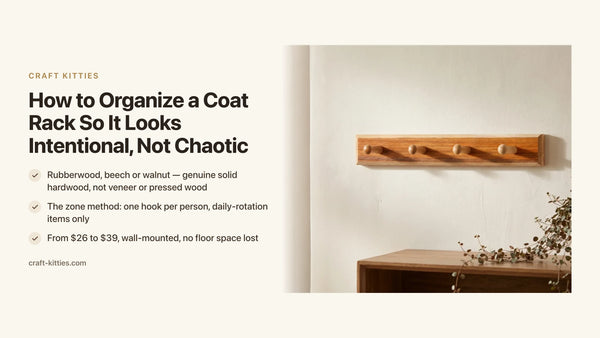
The square hardwood wall-mounted bar is the piece we recommend first. Its backplate is a clean geometric panel — not a pair of exposed brackets — which makes it read as a design decision rather than a functional afterthought. The bar itself accepts anything with a strap, hook or hanger and holds the weight of three winter coats without any flex. At $24, it is the most direct path from a bare entry wall to an organized one.

Description
The wood and brass set comes as two pieces, which is its key advantage: install both in the entry for a complete double-zone system, or split them between the entry and the kitchen to run the same warm-material language across both rooms. The brass hardware is warm-toned rather than polished, which means it pairs with aged and satin brass fixtures without reading as an exact match or an obvious mismatch. At $22, the set is the most cost-efficient way to cover an entry that needs two hanging zones.

Description
The arc-design bar replaces the standard flat bracket with a curved wood panel that has enough visual presence to stand alone on a wall. In a tight entryway with nothing else on the walls, it fills the space intentionally: the curve draws the eye, softens the corner, and the bar below it holds the practical load. For rooms where the design language is already soft and organic — rattan, linen, raw plaster — this is the piece that makes the entry match the interior rather than contradict it.

Description
The double-layer bar is the one piece that solves a family entry in a single install. Two bars at calibrated spacing — coats on top, scarves and light layers below — turn one wall into two organized zones without doubling the hardware or the decision-making. The solid hardwood construction means both bars hold load without flex even when all four slots fill simultaneously. For households of three or more, this is the piece to start with rather than work toward.
Description
The wood and brass set also makes a complete housewarming gift. The two pieces ship together, share the same wood tone and hardware finish, and require no curation from the recipient — they go up as a coordinated pair the day they arrive. For someone moving into a smaller space who has not yet worked out the entry, a matched wall-storage set removes the guesswork entirely.
Comparison table — four models for four entry profiles
| Model | Price | Wood | Hardware | Best for |
|---|---|---|---|---|
| Square hardwood bar | $24.00 | Solid hardwood | Natural wood panel | Clean, geometric entryways |
| Wood & brass set | $22.00 | Solid hardwood | Warm brass | Entry + kitchen continuity; two-zone systems |
| Arc-design bar | $24.00 | Solid hardwood | Curved wood backplate | Organic-modern, Japandi, transitional rooms |
| Double-layer bar | $24.00 | Solid hardwood | Natural wood hardware | Family entries; coats + accessories in one install |
Decision matrix — which piece for which situation
| Your situation | The right pick |
|---|---|
| One person or couple, tight entry, want one decisive piece | Square hardwood bar — $24 |
| Open-plan apartment, entry and kitchen share a wall | Wood & brass set — $22 (two pieces) |
| Room is already organic/soft — rattan, linen, raw plaster | Arc-design bar — $24 |
| Family with kids, need coats and accessories in one install | Double-layer bar — $24 |
| Housewarming gift for someone in a small apartment | Wood & brass set — $22 (complete, no curation needed) |
| Holiday-ready in one afternoon, zero design decisions | Double-layer bar — up in fifteen minutes, two zones immediate |
Installing a wall-mounted bar in a small entryway — four steps
Installing any of these pieces takes under twenty minutes and two anchor points. Here is the sequence that prevents every common mistake.
Step 1 — Choose the wall and the height. The entry wall directly opposite or perpendicular to the door is the correct wall. Avoid the wall immediately beside the door hinge — coats there will be caught by the opening door. For adult coats and bags, sixty to sixty-six inches from the floor is the target height: items clear the floor, reach is natural, nothing grazes your shoulder as you pass.
Step 2 — Mark level before drilling. Use a spirit level or a level app on your phone. Two points of the same height, connected by a pencil mark, prevent the install that looks straight from five feet and tilted from ten. This step takes ninety seconds and saves a second set of holes.
Step 3 — Anchor into studs where possible. For pieces that will hold bag and coat weight, stud mounting is more reliable than drywall anchors alone. Use a stud finder, mark the centers, and drill through the backplate directly into the stud. Where studs are not available, toggle or molly bolts rated for twice the expected load are the next best option.
Step 4 — Dress the space around the bar. The bar does the functional work; the wall around it finishes the room. A small shelf above for keys, a mirror below eye height, a narrow mat on the floor — three additions that transform a bar into an entry zone. The whole system fits in thirty-six inches of wall and zero square feet of floor.
Mistakes that make small entryways harder
Choosing a freestanding coat rack to avoid drilling. Freestanding racks claim one to two square feet of floor — exactly the floor a tight entry cannot spare. They also drift toward the door under coat weight and tip in households with children. Two small anchor holes in drywall, filled in minutes when you move, are a better trade every time.
Hanging everything on a single hook instead of a bar. A single hook fills immediately and creates a "top of the pile" problem where the last coat in covers the first coat out. A bar distributes load across its length and gives every item its own position without any designated slots to manage.
Matching the bar to the floor instead of the wall. Dark walnut against a dark hardwood floor disappears — the piece becomes invisible instead of intentional. The decision rule is contrast: dark floor, choose red oak or beech to stand out from below. Light floor, walnut or natural hardwood reads best against it.
Skipping the entry when doing a holiday refresh. The kitchen gets new runners, the living room gets a wreath, the entry gets nothing — and it is the first thing guests see and the last thing they look at when they leave. A wall-mounted bar installed two weeks before the season starts costs less than any other seasonal upgrade and is the one the entire household uses daily.
Trying to make one hook handle too many functions. A bag hook is not a coat hook is not an umbrella hook. In a small space, the bar format handles all three without any role assignment, because length distributes load and allows items of different weights and shapes to coexist without pulling each other off.
What solid hardwood changes in a high-traffic space
The entryway is the highest-contact surface in a home. Bags knock into it, coat sleeves drag across it, wet umbrellas drip near it, shoulders graze it in passing. In that context, the material choice has practical consequences that show up within a year rather than a decade.
Density matters first. Red oak and walnut are dense, closed-grain hardwoods. A bag corner that hits a walnut bar leaves a dent at most — reversible with a damp cloth and a drop of oil. The same impact on an MDF rail or bamboo composite leaves a chip, exposing the core to ambient moisture and starting a deterioration that does not stop.
Finish depth matters second. Our pieces are finished with a wax or protective oil that penetrates the wood rather than sitting on top of it as a film. A surface-coat finish — lacquer or polyurethane — looks identical in the first month and chips at contact points over time, taking the color with it. A penetrating wax finish gets burnished by use rather than damaged by it.
Weight handling matters third. A winter coat weighs between two and four pounds. Four winter coats weigh up to sixteen pounds on a single bar. Our bars are dimensioned for that load — the wood cross-section and the wall attachment points are sized for real-world use, not for the weight of a single towel. That is a specific design choice, not a byproduct of being "wood."
The result is a piece that looks better after two years of daily use than it did on the first day — the way furniture is supposed to work. Our full wooden towel bar collection is organized around that principle across every mounting format and hardware finish.
FAQ — entryway storage for small spaces
1. What is the best entryway storage for a very small space? Wall-mounted pieces are the answer for tight entryways. They reclaim the floor entirely — which is where small entryways fail — and they put storage exactly where hands reach naturally. A wall-mounted towel bar or double-layer rack handles scarves, bags and umbrellas without a single square foot of floor contact.
2. Can a towel bar work as entryway storage for bags and scarves? Yes, easily. A solid hardwood towel bar mounted at coat-hook height holds scarves, lightweight bags and belts in a single horizontal line. The bar format is more useful than individual hooks for items with handles, because the bag hangs freely without twisting and the bar accommodates different widths side by side without any designated slots.
3. How high should entryway wall hooks or bars be mounted? For coats and bags, sixty to sixty-six inches from the floor covers most adult reach without a stretch. For a second, lower bar intended for children's coats or scarves, thirty-six to forty inches works well. In a double-layer setup, the gap between bars should be at least fourteen inches so items on the top bar clear the bottom one.
4. Is solid hardwood durable enough for a high-traffic entryway? More so than any engineered alternative. Red oak and walnut are dense, impact-resistant species that get better with age. The wax or oil finish on our pieces resists knocks, scratches and the daily contact of bags and wet coats far better than lacquered MDF or bamboo composites, which chip at corners and absorb moisture at cut edges.
5. What is the difference between the arc design and the square design? Shape and visual weight. The arc design uses a curved wood panel as its backplate, which softens the wall and suits transitional or organic-modern rooms. The square hardwood design is more geometric and architectural, pairing naturally with clean-lined, Scandinavian or mid-century spaces. Functionally both hold the same load and accept the same items.
6. Can I install these without drilling? Screw mounting is recommended for bar pieces because bags and coats pull weight downward and outward simultaneously. Two anchor points and small wall anchors are enough — patch holes are minimal and the install takes under fifteen minutes. Adhesive-only mounting is not recommended for pieces that will carry bag weight daily.
7. How do solid wood entryway pieces hold up in humid climates? Solid hardwood is more stable than composite or veneered wood in varying humidity because it expands and contracts uniformly. Our pieces are finished with a protective wax or oil coat that further reduces moisture absorption. Avoid leaving wet coats draped overnight without air circulation — the wood handles it, but sustained trapped moisture is not what any wood piece is designed for.
8. Do the wood and brass pieces match other brass hardware in a space? The brass accents in our sets are warm-toned, closer to antique or satin brass than polished chrome brass. They pair naturally with aged brass cabinet hardware and warm-metal light fixtures. If your other hardware is cool-toned or very bright, the natural wood tone bridges the gap and the difference reads as intentional contrast rather than mismatch.
9. How many bars do I need for a family entryway? A single double-layer rack handles two to three people comfortably — top bar for bags and heavier coats, lower bar for scarves and light layers. For four or more people, two single bars at staggered heights cover the wall more evenly and give each person a defined zone. Two single bars from our lineup cost the same as one premium hook rail from a large home store.
10. Where can I find customer reviews of these pieces? Our full studio range is available on Etsy, where we have 243 verified customer reviews from buyers who have used these pieces in real homes. The complete collection is also at craft-kitties.com/collections/towel-bar.
Where to go next
The entry is usually the first wall in a home that gets a solid wood piece — rarely the last. Our wooden towel bar collection covers every mounting format and hardware finish: the square hardwood bar for geometric spaces, the wood and brass set for warm-metal continuity, the arc design for organic rooms, and the double-layer bar for the family entryway that needs two zones in one install.
The short version
Choose the species by contrast with your wall — red oak or beech in a dark entry, walnut against a bright one. Choose the format by load: one person or couple, a single bar; family of three or more, the double-layer. Mount at arm height, anchor into studs if they are available, and add a small ledge above the bar for keys and mail. The whole system goes up in twenty minutes and the entry holds its shape through every coat-heavy week between October and February.
The double-layer bar is the answer for most family entries. The wood and brass set covers the open-plan apartment and the housewarming gift. The square hardwood bar settles the single-bar question for under $24. Three paths, one result: an entry that looks finished before the first guest arrives.