At a glance
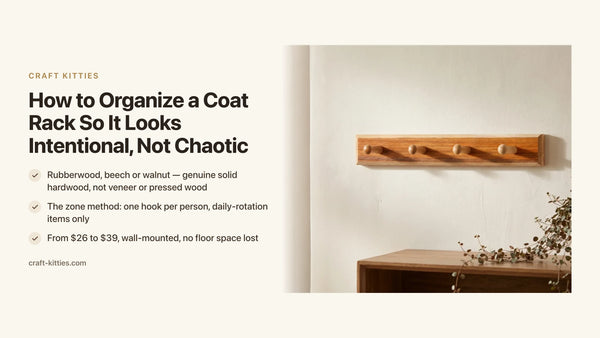
- Solid rubberwood, walnut and beech hook racks — real wood, not veneer
- 2 to 6 hooks, $26 to $39
- Zero floor space claimed, fully styled from day one
The entryway is the first room you see when you come home and the last one you look at when you leave. Most people under-invest in it. A narrow wall, a pile of coats on a chair, keys on the kitchen counter — the whole transition from outside to inside handled with whatever was closest. The consequence is small but daily: the home never quite starts well.
A modern wall hook rack changes this with a single piece. Mount it at the right height on the right wall, and every coat, bag, and set of keys has a place. The wall becomes functional and intentional at the same time. The entry reads as finished. The effect on how a home feels when you walk in is disproportionate to the object's size.
This guide covers what makes an entryway wall solution genuinely modern — not just stylistically, but in daily use — then walks through species choices, styling principles, installation logic, and the four racks from our wall hook rack collection that handle this room well.
Why the entryway wall is the highest-return surface in the house
Square foot for square foot, the entryway wall delivers more impact than any other surface in the home. It is seen twice every single day — on the way out and on the way in — by everyone who lives there and every guest who visits. A bare, cluttered, or generic wall signals something unfinished; a composed, purposeful wall signals the opposite.
The wall also carries a functional burden that no other room surface does. Coats, bags, scarves, umbrellas, leashes — everything that transitions between outside and inside needs somewhere to go in the seven seconds between stepping through the door and moving into the home. When that somewhere is a wall-mounted rack, the floor stays clear, the living room stays calm, and the search for keys at 8 a.m. disappears.
Modern design takes this seriously. The current aesthetic consensus around entryway walls — clean line, natural material, hardware that disappears — reflects the understanding that this surface needs to work as hard as it looks good. A hook rack in solid wood does both: the grain provides visual texture without pattern-mixing complexity; the hooks provide function without bulk. It is not decorating around the problem. It is solving the problem in a way that also happens to look considered.
What "modern" actually means for an entryway wall
The word modern gets applied to too many things to mean much on its own. In the context of an entryway wall, it names a specific set of choices.
Material honesty. Modern entryway design favors materials that look like what they are. Solid rubberwood, walnut, and beech read as wood because they are. A veneer over MDF reads the same way in a photo; in a room, over time, the edges tell the truth. The preference for real material is not snobbery — it is a practical choice about what ages well and what does not.
Restraint in form. Modern hooks are slender, with a clean profile and minimal projection from the wall. They hold what they need to hold without becoming an object in themselves. The boot-profile curve that holds a coat strap reliably is a design problem solved; the result is quiet, not decorative.
Contrast that does not try. The most effective modern entryway walls pair a wood rack with a wall color that is one or two shades away from the wood tone — not matching, not clashing. Light walls and a walnut rack. Dark walls and a light rubberwood rack. The contrast does the visual work; the shapes stay simple.
Negative space. A modern entryway wall is not full. One hook empty, a section of wall uncovered, a gap between the rack and the nearest light switch — these open spaces are as intentional as the objects.
Wood species for entryway hook racks: rubberwood, walnut, and beech

The three species in our entryway lineup behave differently on the wall and in daily use.
Rubberwood is a dense tropical hardwood with a Janka hardness rating around 980 lbf — harder than pine, comparable to walnut. Its natural tone is a pale honey-blond, and its tight, even grain takes veneers exceptionally cleanly. The Rubberwood Wall Hook Rack with Brazilian Veneer and its Cherry Veneer sibling leverage this: the rubberwood core provides the structural rigidity, the veneer face provides the visual warmth of a premium hardwood without the weight or cost. Against a white or pale grey wall, both racks read as rich, intentional pieces.
Walnut is the species that modern interior design gravitates toward for statement pieces. Deep brown, fine and tight grain, a weight and presence that reads as furniture rather than hardware. The Walnut Boot Profile Wall Coat Rack is cut from solid walnut — the color is real, not applied. In a light-toned entryway it creates exactly the contrast that makes a wall feel composed.
Beech and walnut in combination solve a different problem. If the furniture in the adjacent rooms mixes light and dark wood tones — which most homes do — a rack in a single species can look stranded. The Two-Tone Beech & Walnut Wall Hook Rack uses a light beech body with walnut accents so it bridges rather than competes. It is the bridge piece that a mixed-wood interior needs and rarely finds.
In terms of durability, all three are appropriate for a high-traffic entryway. None of them is a soft wood that will show hook marks or dent under the weight of a winter coat. The choice is visual: what the wall needs, not what the material can handle.
How many hooks, and where to put them

Hook count is a practical question with a practical answer. Under-hook and the rack collapses into a pile. Over-hook and you hang things that should be put away properly, which recreates the clutter problem on a different surface.
For one to two people, four hooks is the working minimum: one per person for everyday outerwear, one for a bag, one buffer. When all four are genuinely needed daily, that fourth hook prevents the pile-on that means the rack has stopped working.
For families of three to four, six hooks is the right number. Children's coats are smaller but they accumulate — a jacket, a rain layer, a hoodie — and adults still need their two dedicated hooks. The Two-Tone Beech & Walnut Wall Hook Rack scales from 2 to 6 hooks so the configuration matches the household rather than the other way around.
Placement height follows ergonomic logic rather than convention. The standard 66 to 72 inches from the floor puts the hooks at roughly eye level to crown height, where a coat slides on and off without any adjustment. If children use the rack, a second set of hooks at 40 to 48 inches avoids the reach that ends with coats on the floor. For bag-only sections, 54 to 60 inches is the most comfortable hanging range.
Wall position matters more than most guides acknowledge. The instinct is to center the rack on the wall. The more functional choice is to mount it on the side toward the dominant hand — typically the right — so that coming through the door, the arm naturally swings toward the hook without the body turning. The extra half-second this saves is negligible alone; multiplied by twice a day every day, the small friction either gets solved or it gets tolerated indefinitely.
The four racks: in detail
The four pieces in our entryway lineup cover the main design profiles — warm Brazilian veneer, classic cherry tone, two-tone bridge, and solid walnut statement — with hook counts and prices that match the range of actual households.

Description
The Brazilian Veneer rack is the right answer when the entryway wall needs warmth rather than drama. The rubberwood core is solid hardwood — dense, rigid, stable across seasons — and the Brazilian veneer face gives it a golden-amber tone that pairs naturally with white, greige, or sage walls. At $39, it is the premium piece in the lineup, and the veneer-meets-solid-core construction is the reason: it looks like a high-end furniture-grade board because the wood it is faced with is exactly that.

Description
The Cherry Veneer version of the same rack takes the tone one register warmer and slightly deeper. Cherry is the species that reads as both modern and traditionally warm — it suits the entryway of a home with mid-century furniture, with darker floors, or with a wall color that already leans terracotta or warm white. At $37, it is the same construction, different statement.

Description
The Two-Tone Beech & Walnut rack is the most versatile piece in the lineup, and the most underrated. Light beech body, walnut accent detail — the two tones echo whichever wood family the existing furniture belongs to, so it neither fights the room nor disappears into it. Configurable from 2 to 6 hooks, and starting at $26 for the 2-hook version, it is also the entry point for solid-wood entryway decor without compromise.

Description
The Walnut Boot Profile rack is the decision for entryways where the wall is the statement. Solid walnut throughout — not veneered — with a boot-curve hook profile that holds a heavy winter coat as cleanly as it holds a linen blazer. At $28.80 for four hooks, it is also the most direct specialementsion of what a modern entryway rack should be: one species, one form, nothing extra.
Comparison: the four racks side by side
| Rack | Price | Wood | Hooks | Best for |
|---|---|---|---|---|
| Rubberwood, Brazilian Veneer | $39.00 | Solid rubberwood + Brazilian veneer | 4 to 6 | Warm, premium look on light walls |
| Rubberwood, Cherry Veneer | $37.00 | Solid rubberwood + cherry veneer | 4 to 6 | Richer tone, mid-century interiors |
| Two-Tone Beech & Walnut | From $26.00 | Solid beech + walnut accents | 2 to 6 | Mixed-wood interiors, flexible count |
| Walnut, Boot Profile | $28.80 | Solid walnut | 4 | Statement piece, light-walled entryway |
Decision matrix: which rack for which entryway
| Your situation | The right pick |
|---|---|
| White or pale grey walls, 2-person household | Rubberwood, Brazilian Veneer — 4 hooks |
| Warm walls, mid-century or eclectic furniture | Rubberwood, Cherry Veneer — 4 to 6 hooks |
| Mixed-wood home, not sure which species to commit to | Two-Tone Beech & Walnut |
| Light-walled entryway, want one piece that stands out | Walnut Boot Profile |
| Family with children, need 5 to 6 hooks | Two-Tone Beech & Walnut — 6 hooks or Brazilian Veneer — 6 hooks |
Installing a wood wall hook rack: the four-step method
Installing a wall hook rack takes less time than most people expect. The friction is usually not the installation itself but the two decisions that precede it: exactly where on the wall, and at what height. Getting those right the first time means not filling unnecessary holes.
1 — Identify the wall. The first choice is which wall. In most entryways, the wall immediately to the right or left of the door is the right answer: it catches the natural arm swing as you enter and does not require turning. The wall directly opposite the door is the second choice — it gives the rack maximum visual presence but can feel confrontational in a narrow space. Avoid the wall immediately behind the door; anything hung there is blocked when the door opens.
2 — Fix the height. For a primary adult rack, mark 68 to 70 inches from the floor as the center line of the hooks. This is shoulder-to-crown height for most adults — the coat goes on without a stoop or a reach. Mark the position with painter's tape before drilling anything. Stand back and look.
3 — Find the mounting points. For a four-hook rack, two mounting screws at the outer points of the backboard are sufficient. Use a stud finder. If the screws cannot land on studs, use hollow-wall toggle anchors rated for at least twice the expected load. The rack itself is light; the coats and bags are what the anchor needs to handle.
4 — Level, fix, and dress. A small bubble level takes ten seconds and prevents the rack from looking crooked six months later. Drive the screws, hang the rack, then add the detail that most people skip: a small tray or shelf below for keys, a single piece of wall art at eye level nearby, and one hook left empty. The composition changes the rack from storage to decor.
Styling an entryway wall beyond the rack
The hook rack is the anchor; the wall needs two or three more decisions to read as intentional rather than accidental.
The shelf below. A small floating shelf or a wall-mounted tray at 30 to 36 inches — below the coats, at counter height — gives keys, sunglasses, and mail a designated landing spot. This is the move that actually solves the scattered-items problem. The rack handles what hangs; the shelf handles what pockets.
The vertical rhythm. A hook rack runs horizontal. A framed piece or a small mirror mounted at eye level to the side — not above — gives the wall vertical interest without stacking everything into a single column. The spacing between the two objects should be at least 8 inches; less than that and the arrangement reads cramped.
The floor anchor. A narrow wooden bench or a single statement shoe tray below the rack completes the zone. It signals that this is a thought-out space, not a corridor. It also handles the practical problem that hooks solve for everything except footwear.
Light. Entryways are often the least lit rooms in a home. A small sconce to one side of the rack, or a floor lamp in the corner, changes the feel of the whole space when you walk in after dark. This is the detail that most guides leave out and that makes the biggest difference in how the home feels at 7 p.m.
Mistakes that undermine a modern entryway wall
Mounting the rack too low. The most common mistake. At 54 inches, the hooks are at bag height — everything hangs fine until a full-length coat arrives and drags on the floor. The 66-to-72-inch range exists for a reason.
Using too many hooks for the wall's length. A 40-inch backboard with six hooks creates visual density that reads as cluttered even when half the hooks are empty. Match the hook count to the wall width: roughly 6 inches of board per hook is the comfortable minimum for a modern, airy result.
Mixing three or more wood species in a small space. One rack in walnut, a console table in oak, a shoe bench in pine, and a picture frame in bamboo — the entryway reads as a store display, not a home. Pick one warm species as the dominant note and allow one accent variation. The two-tone beech-and-walnut rack is designed to be that anchor in a mixed-wood room.
Overcrowding the hooks. A hook rack looks best at 60 to 80 percent capacity. When every hook holds something, the wall looks overwhelmed. The solution is not more hooks — it is a seasonal edit. Winter coats in October, summer layers in March. The off-season items move to the closet; the rack breathes.
Choosing the rack from the product photo instead of from the wall. A Brazilian veneer that glows on a white studio background can compete awkwardly with a terracotta-painted wall. Before ordering, paint a 12-inch swatch of the intended color on the wall and look at it in morning and evening light. The rack serves the wall; the wall comes first.
FAQ — modern entryway wall decor
1 — What makes an entryway feel modern without feeling cold? The combination that consistently works is clean geometry with natural material. A solid-wood hook rack with a simple profile gives the entryway warmth without pattern complexity. The grain does the visual work; the hooks handle the function. Cold modern — all metal, no texture — is a different register entirely.
2 — How many hooks do I actually need? Four for a one-to-two person household: two for outerwear, one for bags, one buffer. Six for families of three or four. Fewer than four and the rack stops working the first time a guest coat appears; more than six on a small wall and it looks busy even when half-empty.
3 — Can a wall rack replace a console table in a tight entryway? Usually yes. A console table claims 12 to 18 inches of floor depth — a significant cost in an entryway under 5 feet wide. A wall rack takes zero floor space and handles outerwear at the right height. The only thing a console table does that a rack cannot is provide a horizontal surface for keys; a small shelf below the rack solves that without the floor footprint.
4 — What finish holds up best in a working entryway? Natural oil or wax finishes outperform lacquer in high-contact zones. They absorb minor scuffs without showing them, and a spot application of the same oil refreshes any wear without refinishing the whole piece. Our rubberwood and walnut racks are finished this way — they are designed for daily use, not for display.
5 — How do I style the rack so it looks like decor and not just storage? Three moves: leave one hook empty; add a small catchall below for keys; hang a single piece of art at eye level to the side, not above. The rack becomes part of a composed wall rather than a standalone utility object.
6 — Is rubberwood a real hardwood? Yes. Rubberwood (Hevea brasiliensis) is a tropical hardwood with a Janka hardness of around 980 lbf — harder than pine, close to walnut. It is sustainably harvested from retired rubber trees, dense and stable, and takes veneers and finishes cleanly. It is not a soft secondary material; it is a genuine hardwood with a long history in quality furniture.
7 — How high should I mount the rack? 66 to 72 inches from the floor for a primary adult coat rack. That puts the hooks between shoulder and crown height so coats go on and off without adjusting posture. For a children's secondary rack, 40 to 48 inches. For a bag-only rack, 54 to 60 inches is the most comfortable range.
8 — What is the difference between the Brazilian veneer and the cherry veneer rubberwood racks? The construction is identical: solid rubberwood core, same hook profile, same mounting system. The difference is the veneer face — Brazilian veneer gives a warm golden-amber tone; cherry veneer gives a richer, slightly redder-brown. Brazilian veneer reads lighter and more neutral; cherry reads warmer and more traditional. The wall color and existing furniture tone are what tips the decision.
9 — Can I install this on drywall without hitting a stud? Yes, with appropriate hollow-wall toggle anchors. Two toggle anchors rated for 50+ lbs each are sufficient for the rack at typical loads. For added confidence — especially with a six-hook rack fully loaded in winter — hitting at least one stud with one screw and using a toggle for the second mount point is the more secure option.
10 — How does the two-tone beech-and-walnut rack work in a mixed-wood interior? It acts as a bridge piece. The beech body echoes any light-toned wood (oak, ash, pine); the walnut accent ties to any darker piece. Rather than committing to one species that might compete with existing furniture, the two-tone design quietly connects the room. It is the safest choice when the home already has two or more wood tones in play.
Where to go next
A wall hook rack is usually the first intentional choice in an entryway — and often the piece that makes the room finally feel worth finishing. Our full wall hook rack collection runs from two to six hooks across the species and finishes covered here. If you already know which tone you want, the Rubberwood Wall Hook Rack with Brazilian Veneer and the Two-Tone Beech & Walnut Wall Hook Rack are the two pieces that suit the widest range of entryways. If you want the statement, the Walnut Boot Profile is the direct answer.
For customers who found us through Etsy — where we have over 243 reviews from homeowners across the US — the same racks and the same studio quality are available here with direct shipping.