At a glance
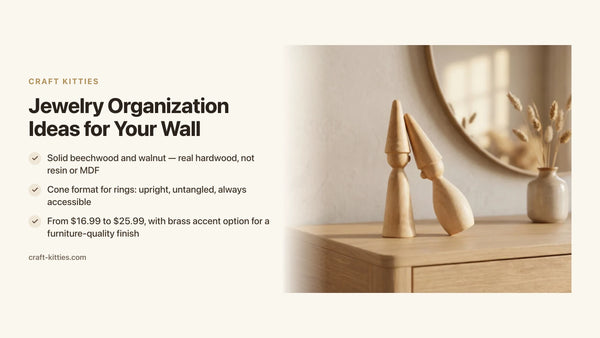
- Real solid beechwood and walnut — not veneer, not resin
- Farmhouse warmth built into the material itself, not just the color palette
- From $16.99, with brass accent options that age alongside the wood
Farmhouse style has been declared dead and revived roughly a dozen times since the first shiplap boards appeared in a lifestyle magazine spread. It persists anyway — which suggests it is not a trend at all but a preference for something more durable: rooms that look as if they were assembled over time, from real materials, by people who intended to live in them for years.
Wood is the material that carries that logic most convincingly. Not printed wood-effect panels, not bamboo composite, not resin turned to a honey-brown tone — but solid wood cut from a real tree, finished to show its grain, and left to age in place. A beechwood ring holder on a nightstand, a walnut cone on a dresser with a brass base: these are small objects, but they read the same way a well-chosen farmhouse kitchen does. They belong to a place rather than decorating it.
This guide is for the version of farmhouse style that holds up over time: the one built from real materials in pieces that have an actual job to do. It covers how to think about wood species for this aesthetic, why the cone-versus-tray decision matters more than the choice of species for ring holders, how solid wood differs from what most of the market sells, and how to layer pieces without the surface looking styled.
What farmhouse style actually asks of its materials
The phrase "farmhouse style" has been stretched to cover everything from barn doors in new construction to printed cotton cushions in chain stores. But the original logic was precise: an aesthetic that grew from function, from furniture made of whatever hardwood was local and plentiful, from metal hardware chosen for durability not shine, from surfaces that were meant to be used and showed it.
The reason it survives as an aspiration is that real farmhouse objects do not look worse as they age — they look better. A solid walnut surface develops patina under daily handling. Brass hardware acquires depth as it oxidizes. The same quality that made these materials practical in a working farmhouse makes them right for rooms designed to be lived in rather than photographed once.
The implication for buying decisions is this: farmhouse style does not live in the color palette or the mason-jar accessories. It lives in whether the material is real. A beechwood cone ring holder bought for a nightstand will look more at home there in five years than on the day it arrived — that is the material doing its job. A resin cone painted to look like wood will look less at home. Farmhouse style, understood correctly, is an argument for buying things made of real materials.
Solid wood versus resin versus veneer: why the difference becomes visible

Ring holder cones are the clearest example of material difference in the home decor market — because they are handled daily, in the same way, by the same person, for years. The differences that look minor in a product photo become obvious in regular use.
Solid beechwood and walnut are cut from the same material through and through. Their grain runs the full depth of the piece. Scratches — the inevitable result of sliding rings on and off daily — reveal more wood of the same color rather than a different substrate beneath. Over years of handling, the surface becomes smoother rather than degraded: the kind of aging that interior designers call patina and the rest of us recognize as a piece that looks better than it did when it arrived.
Veneer is a thin layer of real wood applied over an MDF or particleboard core. The surface photographs well and initially feels similar to solid wood. The difference appears at the edges — which are not surfaced in veneer — and when water or oil seeps past the surface. Bathroom and nightstand settings, where hand cream is nearby and humidity fluctuates, accelerate this failure mode.
Resin cones dominate the low end of the ring-holder market because they are inexpensive to cast in quantity and take any finish or color. They look convincing on arrival. The problem is that resin does not develop patina — it accumulates micro-scratches from the same daily ring motion that polishes solid wood, and those scratches catch light rather than absorb it. Within 18 months of daily use, most resin cones look visibly worn rather than deliberately aged. Solid wood cones used the same way look more finished.
For farmhouse interiors in particular — where the point is authentic aging — solid wood is not a premium upgrade. It is the only version of the idea that works as described.
Beechwood versus walnut: which species for which room
Wood species in the ring-holder category come down to two practical choices — solid beechwood and solid walnut — and the decision maps almost entirely to the palette of the room they will live in.
Beechwood is pale and close-grained, with a smooth, almost Scandinavian surface quality. Its natural color sits in the range of light honey to cream, with a subtle figure that reads as texture rather than bold pattern. In farmhouse rooms built on white paint, linen, aged limestone, or light pine furniture, beechwood does not compete — it belongs. The Beechwood Ring Holder Cone Set is the right choice for rooms where the wood should feel woven in rather than placed.
Walnut is the opposite: deep brown, fine grain, a presence that draws the eye. Against a light wall it reads like a small piece of furniture. In rooms that already have warmth — terracotta tile, warm-white paint, amber-toned leather, aged brass fixtures — walnut deepens the composition rather than sitting on top of it. The Walnut Wood Ring Holder with Solid Brass Base and the Wooden Ring Holder Set of 2 in walnut are the right pieces when the goal is a surface that looks curated rather than assembled.
The reliable heuristic: if the room is light and airy, reach for beechwood. If the room has warmth and depth already, walnut amplifies it correctly. Mixing both species on one surface is manageable if the accent metal stays consistent — brass with beechwood or walnut reads as intentional; brass on one piece and chrome on the next makes the surface look assembled from separate shopping sessions.
Cone versus flat tray: the decision that matters more than species

The cone-versus-tray decision is the one most buyers resolve by default rather than by deliberate choice — and default usually means whichever they see first. It is worth being intentional, because the two formats answer genuinely different behaviors.
A cone holds rings by receiving them on a tapering wooden shaft. The format keeps rings vertical and separated: stacking rings stay distinguishable at a glance rather than nested together in a pile. The cone is the right format when you have a few pieces that matter — an engagement ring, a wedding band, a ring worn every day — and want each one visible and retrievable without searching. It also reads as the more decorative of the two formats: a polished beechwood or walnut cone on a nightstand is furniture-adjacent, something a guest's eye would land on and read as intentional.
A flat tray receives jewelry horizontally. It accumulates — you set things down and pick them up without thinking about placement. The right format for everyday jewelry, mixed pieces, smaller items that would slide off a cone. Less decorative and more functional.
The most practical setup for a dresser or nightstand is one of each: a cone for the pieces that are always there, a tray for everything that changes. The Wooden Ring Holder Set of 2 in walnut offers two cones at different heights, which creates a visual composition on the surface while doubling the ring capacity — a natural choice for couples or for anyone who keeps more than two rings in daily rotation.
The pieces from our studio
Three ring holder pieces designed for rooms that take materials seriously — solid beechwood and walnut, with brass hardware where it appears.

Description
The Beechwood Ring Holder Cone Set is the entry point for farmhouse ring display done in real material. Two solid beechwood cones, each cut from the same close-grained pale hardwood and finished to show the natural figure of the wood. The two-height composition works on a nightstand without any styling effort — the varying heights break the visual line in a way that a matching pair does not.
At $16.99, this is the piece for buyers who want the right material at the most accessible price. Beechwood reads well against white, cream, linen, and aged-stone palettes — the light end of farmhouse. It does not compete with other surfaces; it joins them. A piece that will look better in five years than it does today.

Description
The Walnut Wood Ring Holder with Solid Brass Base is for the buyer who wants one piece to anchor the surface. Solid walnut — not veneer, not walnut-stained composite — on a base turned from solid brass rather than plated. Both materials share the same aging behavior: they deepen and develop character with daily contact rather than scratching toward a bare substrate beneath.
At $25.99, this is the piece that reads as furniture-quality on a dresser. The brass base will develop a subtle oxidation over time that makes it look more intentional, not less — that is how unlacquered brass behaves, and it is one of the reasons it belongs in farmhouse settings rather than chrome or matte black. The walnut shaft holds a single ring prominently or stacks several in a way that keeps each piece visible.

Description
The Wooden Ring Holder Set of 2 in walnut is the couples' piece and the practical answer for a nightstand used by two people. Two solid walnut cones at $18.99 for the set — each cut from the same deep-grained hardwood, each finished to the same surface quality. They read as a matched set rather than two separate purchases because the material is consistent: same grain family, same finish, same depth of color.
The set covers the most common nightstand configuration (one ring holder per side) without requiring a decision about which piece goes where. Both cones will develop patina at the same rate from the same daily handling — the kind of coherence that is easy to achieve with real wood from the same species and harder to replicate when pieces come from different sources.
Comparison table
| Piece | Price | Wood | Accent | Best for |
|---|---|---|---|---|
| Beechwood Cone Set | $16.99 | Solid beechwood | — | Light, airy farmhouse palettes |
| Walnut with Brass Base | $25.99 | Solid walnut | Solid brass | Statement anchor, warm rooms |
| Walnut Set of 2 | $18.99 | Solid walnut | — | Couples, both sides of nightstand |
Decision matrix — which piece for which situation
| Your situation | The right pick |
|---|---|
| White, linen or light-stone farmhouse palette | Beechwood Cone Set |
| Warm room with amber tones or existing brass hardware | Walnut with Brass Base |
| Nightstand used by two people, one cone per side | Walnut Set of 2 |
| Entry point to solid wood, most accessible price | Beechwood Cone Set at $16.99 |
| One piece to anchor the whole dresser surface | Walnut with Brass Base |
| Gift for a couple with unknown décor | Walnut Set of 2 — covers both sides, reads as considered |
How to layer wood decor pieces without the surface looking overdone
The most common failure mode in farmhouse decor is not too much wood — it is too many competing accents. A surface that mixes three metals and two different finish families reads as accidental even if each individual piece is well chosen.
The rule that keeps surfaces legible is simple: one metal family, one or two wood tones, no more than three objects per surface. In practice: if you have a walnut ring holder with a brass base, the other pieces on the dresser should share either the walnut species, the brass metal, or both. A beechwood tray with a matte black base next to the walnut-brass cone introduces two competing accent threads — the eye cannot settle on a reading.
Vertical relief matters. A flat surface covered in pieces of similar height reads as storage, not display. The Beechwood Cone Set solves this natively by pairing two heights in one purchase: one tall, one short, a natural vertical rhythm without additional objects. If you are building around it — a small ceramic vessel, a linen tray — vary the heights deliberately rather than letting them find their own level.
Negative space is part of the composition. Farmhouse style at its best shows the surface it sits on as much as the objects above it. A dresser with three well-chosen pieces and visible wood or stone beneath them reads more finished than the same dresser covered edge to edge. Leave room for the surface to breathe.
Anchor first, then add. Choose one piece as the visual anchor — typically the tallest or most deliberate — and build from there. The Walnut with Brass Base is designed to be an anchor. Once it is in place, additional pieces should read as supporting rather than competing.
Why brass belongs in farmhouse rooms
Brass has had a complicated recent history in home decor — it went from dated to ubiquitous so quickly that many buyers are uncertain whether it has already peaked again. In farmhouse settings specifically, the question does not apply in the same way.
Unlacquered and brushed brass are among the most historically grounded metals in residential interiors. Before chrome became the default hardware finish in the mid-20th century, brass was the practical choice for anything from cabinet pulls to faucets — not because it looked fashionable, but because it was durable, workable, and widely available. Farmhouse interiors that predate the chrome era used brass as a matter of course.
What this means for a solid walnut ring holder with a brass base is that the combination is not a trend choice — it is a historically coherent one. Both materials age in the same direction: they develop depth and character rather than scratching toward a flat surface beneath. Walnut deepens slightly over time. Brass oxidizes toward a warm, complex tone that makes new brass look thin by comparison. Placed next to each other, they reinforce rather than compete.
Polished chrome and nickel are the accent metals that belong least naturally in farmhouse rooms — their cool, high-contrast finish reads as contemporary-industrial. Matte black works in modern-farmhouse contexts where the palette includes cooler grays and whites. For a room that leans toward the warmer, more traditional end of the farmhouse spectrum, brass is the durable answer.
Mistakes that flatten a farmhouse room
Buying farmhouse aesthetic instead of farmhouse materials. A printed cotton cushion with a grain pattern, a resin cone with a honey stain, a bamboo tray with a "natural" label — none of these read as farmhouse on a ten-year timeline. Real farmhouse rooms look better with time because their materials develop; rooms assembled from material-adjacent objects look dated within a few years because the trend that defined them has moved on.
Overcrowding surfaces with small objects. The instinct in farmhouse decoration is to keep adding — a bundle of dried lavender here, a small ceramic pitcher there, three different holders for the same dresser. The effect is often the opposite of the intended warmth: it reads as a display assembled for a photograph. Edit to three objects per surface and notice which ones genuinely belong.
Mixing metals without a thread. Brass base on one piece, chrome on the tray, matte black on the lamp. Each choice may have been deliberate individually, but together they produce a surface that reads as assembled rather than curated. Choose one dominant metal and let the others recede or disappear entirely.
Choosing species by photo rather than by room. Beechwood photographed against a white studio background looks very pale — almost austere. In a room with warm paint and amber floors it reads completely differently in person. Before ordering, hold the species decision up against the actual wall and light conditions of the room it will live in, not the product photograph.
FAQ — farmhouse wood decor ideas
1 — What wood species work best for farmhouse decor? Beechwood and walnut are the two most versatile choices. Beechwood is pale and close-grained — it suits white-painted, linen, and light-stone farmhouse palettes without overpowering them. Walnut is deep brown with a fine, tight grain that reads as furniture-quality against both light and warm backgrounds. Both are solid hardwoods: they age rather than degrade, which is exactly the behavior farmhouse decor is built around.
2 — Is solid wood worth more than MDF or resin in a decorative piece? For pieces handled daily — like a ring holder — yes, and for a practical reason. MDF and resin cones develop micro-scratches and lose their finish within a year or two. Solid beechwood and walnut develop patina instead: the more you handle them, the smoother and warmer they look. The difference shows over time, not in the first week.
3 — Does brass work with farmhouse style? Unlacquered or brushed brass is one of the most historically authentic metals for farmhouse interiors — it was a practical material before chrome existed, and its warm undertone reads as genuinely aged rather than trendy. Polished chrome and matte black are more contemporary; they work in industrial-farmhouse settings but feel less rooted than brass against natural wood.
4 — How many ring holder cones do I actually need? Two is the practical minimum for a nightstand used by a couple: one per person, placed on each side. For a dresser used by one person, two cones of different heights create a visual composition that a single cone does not. The Wooden Ring Holder Set of 2 in walnut answers both use cases at once.
5 — Can I mix beechwood and walnut pieces in the same room? Yes — provided you keep the accent metal consistent. A beechwood cone and a walnut piece side by side read as intentional if both share a brass accent or neither has metal. What makes a surface look accidental is not the wood contrast, it is competing metals: brass next to chrome next to matte black.
6 — How do I care for a solid wood ring holder? A dry cloth wipe and the occasional application of food-grade mineral oil or beeswax are enough. Avoid soaking in water or leaving hand cream pooled at the base. The wood will naturally absorb oils from your hands over years of daily contact — that is normal and desirable, not damage.
7 — Are wood ring holders a good gift for couples? They are one of the most consistently well-received practical gifts: used every night and every morning, visible to both partners, and decorative enough to survive a decade of bedroom redecorations. The Beechwood Cone Set at $16.99 covers most budgets; the Walnut with Brass Base at $25.99 reads as a more deliberate, considered choice.
8 — What is the difference between a cone and a flat tray for ring storage? A cone holds rings vertically on a tapering shaft — it keeps stacking rings separated and visible from across the room, the right format for a few important pieces. A flat tray lies horizontal and accumulates: the right format for everyday jewelry you want to grab quickly without searching. Many people keep one of each: the cone for the ring that matters most, the tray for everything else.
Where to go next
The ring holder is often the first solid wood piece on a nightstand — rarely the last. Our ring holder collection brings together pieces that answer each other: beechwood and walnut cones, brass-accented bases, and companion trays in the same hardwood families. If you want to start with the single most versatile piece, the Beechwood Ring Holder Cone Set covers the widest range of farmhouse palettes at the most accessible price. For a room that already has warmth and depth, the Walnut Wood Ring Holder with Solid Brass Base is the piece to build from.
Customers who found us through our Etsy shop — where we have over 243 reviews — often tell us the piece they bought for one surface became the reason they reconsidered the whole room. That is usually how it works with real materials.
Conclusion — the room that looks finished
Farmhouse style, done honestly, is not a shopping category. It is a commitment to buying fewer things made of real materials rather than many things made to look like real materials. Solid beechwood and walnut ring holders are a reasonable place to start that commitment: objects small enough that they do not require a major decision, specific enough that they immediately change what a surface communicates.
If the room is light, the Beechwood Cone Set at $16.99 is the right piece. If the room has warmth already and needs an anchor, the Walnut with Brass Base at $25.99 is the more deliberate choice. And if the surface needs to cover both sides of a nightstand used by two people, the Walnut Set of 2 at $18.99 does that without requiring two separate decisions.
The common thread is solid hardwood that ages in the right direction. That is all farmhouse decor has ever asked of its materials.