At a glance
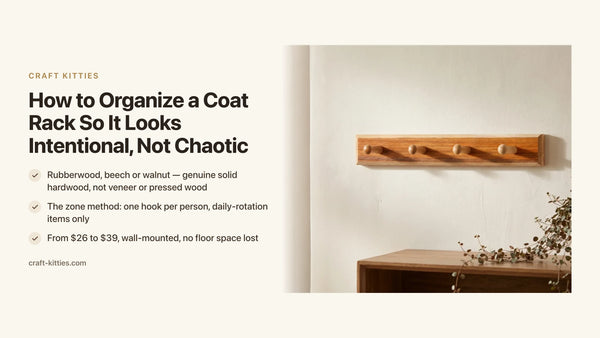
- Solid hardwood racks from $26 — walnut, beech, rubberwood with veneer
- 4 to 6 hooks, boot-profile or flat, shelf or shelf-free
- The first wall you fix is the last corner you fight every morning
The hallway is the room that does not get decorated — it gets used. Bags land on the floor, keys disappear into coat pockets, umbrellas migrate to doorknobs, and by the second winter the entry looks like a yard sale. Most people tolerate this because they assume an entryway cannot look good and function well at the same time. That assumption is wrong, and the fix is simpler than a renovation: it is a single wall, a few hooks, and the right height.
This guide covers how to think about hallway wall storage, which dimensions and zones actually matter, how to choose between hook styles and wood species, and which pieces from our studio address each profile — from the minimal two-hook rack to the heavy-duty six-hook system that handles a family of four without a second thought. The comparison table, a zoning diagram, and a wall-planning method are all here. So are the answers to the questions that end most entryway projects prematurely.
One principle runs through everything: wall storage only works if it is specific. A single hook in the right place beats twelve hooks in the wrong one.
Why the hallway always loses to the floor
The hallway floor absorbs everything because the wall is empty. There is nowhere to put a coat except on a chair, nowhere for a bag except on the floor, nowhere for a key except in the pocket where it will be lost tomorrow. The drop zone at your door is not a character flaw — it is an infrastructure gap.
Wall hooks eliminate the gap by giving each object a dedicated address: coat on hook two, bag on hook four, keys on the shelf lip. When every item has a place, the floor stays clear by default rather than by discipline. That is the core logic behind every hallway wall storage system worth building.
The secondary effect is a visual one. A clean wall with a well-designed rack reads as intentional. The same objects — coat, bag, scarf — look organized when they hang at eye level on a solid wood rack and chaotic when they pile on a chair. Same items, different support structure, completely different result.
The hallway zone map: what goes where

A hallway wall works best when it is divided into three vertical zones, each serving a different type of object.
Zone A — Hook zone (60–66 inches from the floor): This is where coat hooks belong, measured to the tip of the hook. At that height, a full-length coat hangs without touching the floor or bunching at the bottom. Bags and backpacks hang here too. If children share the hallway, a second lower row at 42–48 inches runs independently below without lowering the main adult hooks.
Zone B — Shelf zone (66–72 inches): The narrow ledge directly above the hooks, or a floating shelf mounted at roughly eye level. This is where keys live, where mail lands, where sunglasses rest. Objects here need to be retrieved quickly and without bending — eye level is the only height that makes this effortless. A rack with an integrated top shelf handles both zones A and B in a single wall fixing.
Zone C — Floor zone: Below the hooks and outside the wall system. Bench seating, a boot tray, or a low basket work here. Wall hooks are the wrong tool for floor-level storage: hooks at shin height are a tripping hazard and a missed opportunity on a surface that only vertical objects use well.
Planning the hallway before buying anything is the fastest way to avoid the most common mistake: buying a rack that covers two of the three zones but misses the one that was causing all the trouble.
How to choose the right hook rack: five criteria
A hook rack is not complicated, but five variables determine whether it solves the problem or adds to it.
1 — Hook count. Count the occupants, multiply by two, add two for guests. A family of three lands at eight; a couple lands at six; a single-person apartment is fine with four. Buying one fewer hook than you need means every extra item ends up on the floor — which is exactly where it was before.
2 — Hook style. Flat single-arm hooks suit light items: bags, scarves, leashes. Boot-profile hooks (the curved, double-arm design) suit bulkier items: heavy coats, winter jackets, structured bags. A rack with a mix of both styles handles a household's full range. Our walnut boot-profile rack is built specifically for the heavier-use scenario.
3 — Backboard width and projection. The backboard determines how much wall the rack occupies; the hook projection determines how far coats extend into the hallway. In a narrow hallway (under 40 inches), choose a rack with a shallow projection. In a wide entryway, a deeper hook profile accommodates bulkier winter coats without crowding.
4 — Wood species. Hardwood outperforms softwood under daily stress. Every hook in a hallway bears repeated sideways force — the tug of a pulled coat, the weight of a heavy bag that shifts. Walnut, beech, and rubberwood with hardwood veneer (Brazilian or cherry) all hold up to this without loosening or splintering. Particleboard and MDF fail at the screw points within the first winter of heavy use.
5 — Integrated shelf or not. A shelf above the hooks converts a single wall fixture into a complete entry station. If you have nowhere for keys and mail, a shelf is the difference between a rack that works and a rack that only half-works. If the hallway already has a console table or credenza below, a shelf-free rack keeps the wall clean and avoids visual redundancy.
The solid wood difference: species by species

Wood species in entryway storage is not just an aesthetic choice — it is a structural one. Hook racks are among the most mechanically stressed wood objects in a home: the combination of weight, lateral pull, and daily repetition punishes any material that lacks real hardness.
Walnut is the densest option in our lineup. Its grain is tight and fine, its color a deep warm brown that reads well against almost any wall tone — white, greige, sage, charcoal. In a hallway, walnut holds up without visible wear for years, and the surface develops a quiet patina rather than looking scuffed. It is the species we use in our boot-profile rack and the one that pairs naturally with brushed brass or matte black hardware.
Beech runs lighter in color — a pale honey with a more uniform, consistent grain. The Two-Tone Beech and Walnut rack layers both species in the same piece: the beech backboard and the walnut rail or accent read as a composition rather than a contrast. In Scandinavian and mid-century interiors, beech is the instinctive choice; it brightens a dark hallway without fighting the space.
Rubberwood with premium veneer is the sustainable-hardwood option. Rubberwood is a genuine hardwood (Janka rating comparable to red oak) that becomes available at end-of-life from rubber plantations — a more environmentally considered source than virgin hardwood. The veneer — Brazilian or cherry — gives the surface its finished color and grain character while the rubberwood core provides the structural rigidity. This is the construction behind our Brazilian veneer rack and cherry veneer rack, both of which offer the look of a premium wood at an accessible price.
The shared rule across all three: avoid anything described as "wood composite", "engineered wood panel", or "MDF core" for a hook rack. Those materials shear at the screw points under repeated load. Solid hardwood or a hardwood core with real veneer are the only constructions worth mounting.
The pieces from our studio
Four racks, four profiles. All in real hardwood. Mounted on the wall, not leaning against it.

Description
The Brazilian veneer rack is what we point to when the brief is "clean, warm, and hardworking." The rubberwood core is as rigid as red oak; the Brazilian veneer surface has a rich, medium-brown grain that reads like premium wood without the premium wood price. Available in 4- or 6-hook configuration, it mounts on any wall and scales to any household size. At $39, it is the most feature-complete rack in the lineup.

Description
The cherry veneer variant uses the same construction as the Brazilian model — same rubberwood core, same hook hardware, same mounting system — with a surface veneer that reads lighter and warmer. Cherry grain has a gentle shimmer in raking light that walnut and Brazilian wood do not, which makes it the right choice for white or very light interiors where a dark rack would feel heavy. At $37, it comes in under the Brazilian model by two dollars.

Description
The Two-Tone rack is the entry point for solid wood hallway storage, starting at $26 in its 2-hook format. The backboard is beech — pale, consistent, Scandinavian in tone — with a walnut accent that anchors the piece visually without overpowering it. The 2-to-6-hook range makes this the most scalable option in the lineup: a couple can start at 4 hooks and a growing household can spec 6. The design reads well against both white and dark walls.

Description
The boot-profile rack is the answer to the question "will it hold a Canada Goose?" It will. Solid walnut cut into a 4-hook row with double-arm boot-profile hooks — the deeper, curved shape that keeps heavy coats, parkas, and structured bags seated firmly rather than sliding off. At $28.80, it is the most purpose-built piece for a hallway that sees real winter use, and the walnut grain gives it a quality that overdelivers for the price.
Comparison table
| Model | Price | Wood | Hooks | Best for |
|---|---|---|---|---|
| Brazilian Veneer Rack | $39.00 | Rubberwood + Brazilian veneer | 4 or 6 | Full-household flagship, warm grain |
| Cherry Veneer Rack | $37.00 | Rubberwood + cherry veneer | 4 or 6 | Light walls, Scandinavian or mid-century rooms |
| Two-Tone Beech & Walnut | $26.00 | Solid beech + walnut | 2 to 6 | Entry price, most scalable configuration |
| Walnut Boot-Profile Rack | $28.80 | Solid walnut | 4 | Heavy coats, families, deep-projection hooks |
Decision matrix — which rack for which hallway
| Your situation | The right pick |
|---|---|
| Dark or greige walls, want the rack to stand out | Brazilian veneer, 6 hooks |
| White walls, light interior, Scandinavian style | Cherry veneer rack |
| Budget-first, want real hardwood at entry price | Two-Tone Beech & Walnut, 4 hooks |
| Family with heavy winter coats, bags, backpacks | Walnut boot-profile rack |
| Growing household, need flexibility on hook count | Two-Tone Beech & Walnut, 2–6 hooks |
Mounting a hallway rack correctly: four steps
1 — Locate the studs. A stud finder or the knock-test tells you where the studs are. Two screws into studs support the full weight of coats, bags, and the rack itself without any risk of pull-out. If studs do not land where the rack needs to be, toggle bolts rated for 50+ lb per anchor are the reliable alternative on drywall.
2 — Set the height. Mark 60–66 inches from the floor for the hook tips, not for the top of the backboard. The backboard goes above that mark; the hooks hang below it. If the hallway is also used by children, mark a second pair of holes at 42–48 inches for a second lower strip.
3 — Level before drilling. A two-foot level held against the backboard in its intended position takes thirty seconds and prevents a rack that looks correct until compared to the door frame. Two mounting holes means two drill points: level between them, not just at one end.
4 — Dress it immediately. A rack with nothing on it looks like a rack. A rack with a coat on each hook and keys on the shelf reads as infrastructure. Hang the coats, put the keys where they live, and the entry is done. There is no step five.
Five hallway mistakes worth avoiding
Buying a single coat hook instead of a rack. A single hook holds one item. A rack holds the whole household. The difference in installation effort between one hook and a six-hook rack is roughly five minutes. The difference in daily function is enormous.
Mounting at the old fixture's height without testing it. The previous occupant had different proportions and possibly different priorities. Do the seated coat-grab test: stand as though you are about to put a coat on, and reach naturally toward the wall. Mark where your hand is. That is the right hook height — not the previous bracket's ghost holes.
Overloading the same hook with multiple items. A hook overloaded with two coats, a bag, and a scarf looks like a corner with hooks. Giving each item its own dedicated hook is the entire discipline of an organized hallway. More hooks at lower cost is always better than fewer hooks at higher cost.
Mixing the rack material with the hallway's other wood furniture. A cherry veneer rack next to a walnut console table does not read as intentional. Choose one wood family and keep the visible pieces consistent. The rack, the console if any, and the floor molding read as a room when they share a common grain direction and tone.
Ignoring the wall above the rack. A bare wall above the hook rack is wasted prime real estate. A floating shelf at 66–72 inches, or a rack with an integrated top ledge, completes the entry station. Keys, mail, sunglasses, dog leash loop — all of it belongs at eye level, not on a side table three rooms away.
How many hooks is enough: a quick sizing guide
The arithmetic is simple but almost everyone misses it. Start with the number of people who live in the home — call it N. Each person needs two hooks during a typical week: one for a coat or jacket, one for a bag or backpack. That gives you the daily baseline: 2N hooks.
Add two more for guests. A couple has dinner friends who need somewhere to put their coats; a family receives school friends who arrive with bags. Two buffer hooks handle this without overflow. Final formula: 2N + 2.
A single person: 4 hooks. A couple: 6 hooks. A family of three: 8 hooks — which means a 6-hook rack with a single additional hook elsewhere, or two 4-hook racks if the hallway width allows it. A family of four: 10 hooks minimum, which a pair of 6-hook racks serves well if mounted side by side with a few inches of breathing room between them.
The instinct to buy fewer hooks than needed is always regretted. The instinct to buy one more than needed is never noticed.
Layering wall storage: when one rack is not enough
A single rack solves the coat problem. A layered wall system solves the hallway problem. The difference becomes clear in the second winter: the coats are organized, but the hats, gloves, umbrellas, and dog leashes have no address.
Three layers answer three categories of objects.
Layer 1 — The primary hook rack. Coats, jackets, bags. Mounted at 60–66 inches. This is the piece this guide has been about.
Layer 2 — Small-item hooks or a shelf. Keys, small bags, leashes, caps. A narrow shelf at eye level (66–72 inches) or a row of small single hooks just below the shelf lip. The shelf catches anything flat; the hooks catch anything with a loop or strap.
Layer 3 — A low peg rail or bench hook. Children's items, an umbrella, a reusable shopping bag. Mounted at 42–48 inches on a second rail, or integrated into a bench-and-hook unit on the floor. This layer keeps children's items accessible without pulling the main rack height down for adults.
Three layers, one wall, complete entry storage. Each layer can be added independently as the household's needs change — which means starting with the primary rack today and adding layers as needed is the most practical path.
FAQ — hallway wall storage
1 — How high should I mount a wall hook rack in a hallway? For adults, position the hook tips at 60 to 66 inches from the floor. Full-length coats hang freely, bags and backpacks sit at natural reach, and the rack reads at eye level rather than above or below it. For mixed-height households with children, add a second row at 42 to 48 inches rather than lowering the main row.
2 — How many hooks do I actually need? 2N + 2, where N is the number of people in the household. Two hooks per person for daily use plus two buffer hooks for guests. Under-buying is the only error that cannot be corrected without a second installation.
3 — What is the best wood for a hallway hook rack? A hardwood or a rubberwood core with real veneer. Walnut, beech, and rubberwood are all appropriate choices — they hold screws under repeated load without shearing. MDF and particleboard are not appropriate choices for a loaded hook rack.
4 — Can I mount a rack on drywall without hitting a stud? Yes, with toggle bolts or hollow-wall anchors rated at 50+ lb per fixing. For maximum confidence with a full load of winter coats, hit at least one stud. The combination of one stud fixing and one toggle bolt is the reliable middle ground in most hallways.
5 — What is the difference between flat hooks and boot-profile hooks? Flat single-arm hooks are best for light items: bags, scarves, leashes. Boot-profile double-arm hooks are designed for heavy coats and structured bags — the curved double arm keeps the item seated rather than sliding forward. For a family that wears real coats in winter, boot-profile hooks are the right architecture.
6 — Is it better to have a shelf above or below the hooks? Above the hooks. Keys and small items at 66 to 72 inches are at natural reach; below the hooks, small objects disappear under hanging coats. A shelf integrated into the rack handles both zones in one mounting session.
7 — Can a hook rack work in a narrow hallway? Yes. Most wall-mounted racks project 4 to 6 inches from the wall when unloaded. Coats add another 2 to 4 inches of projection. In a 36-inch hallway, that is completely workable. Choose a model without a deep protruding lower shelf and the clearance remains comfortable.
8 — What if I have a rental and cannot drill? Command strips rated for the rack's weight work in many cases for lighter racks. For heavier multi-hook systems, the most reliable renter solution is to negotiate a single stud-mount at move-in — the holes fill in five minutes with spackling paste and are invisible with fresh paint. A modest entryway system is almost always worth that conversation with a landlord.
Where to go next
The hook rack is usually the first piece of wall storage that goes up in a hallway — and the one that opens the door to the rest. Our wall hook rack collection covers the range from the minimal Two-Tone rack to the six-hook flagship, all in real hardwood and all sized for a hallway that needs to work from the first nail.
If the hallway problem is more visual than practical, the related guides on modern wood wall hooks and the solid wood wall-mounted coat rack cover the styling and design side in more depth.
For anyone discovering our studio for the first time: we have 243 reviews on Etsy from customers who replaced plastic and wire solutions with real wood — the feedback is consistently that the difference is more visible than expected.
One wall, one morning, a different house
The hallway will not fix itself. It fixes at the moment the first hook lands on the wall, and within a week the floor-dropping habit is gone — not by discipline, but because the hooks are faster. The method is straightforward: map the three zones, count the hooks you need, choose a hardwood that contrasts with your wall, and mount it at the height your arm actually reaches.
The Brazilian veneer rack in 6 hooks is the answer for most households. The Two-Tone Beech and Walnut is the entry point if budget is the first filter. The boot-profile walnut rack is the answer when the coats are real and heavy. Three paths, one destination: a hallway that looks like a decision rather than an accident.