At a glance
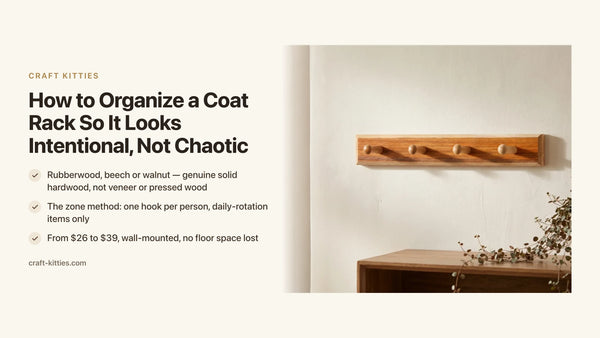
- Solid rubberwood, beech, walnut — real hardwood, not pressed board
- Wall hook rack from $26, 2 to 6 hooks, installs in under 20 minutes
- Seasonal layers on top of a permanent anchor: the method that survives December intact
The entryway is the first room guests see and the room your family passes through a dozen times a day. During the holidays, it has to absorb more than usual: extra coats, scarves, bags of gifts, packages left by the door, wet boots tracked in from the first cold snap. Most entryways fail not because they are too small, but because their storage was built for a normal Tuesday, not for December.
The decorating ideas that hold up over an entire holiday season share one property: they start with function and layer seasonal warmth on top. The approach that fails is the reverse — leading with decoration and hoping organization follows. A garland looks beautiful for three days, then it becomes the backdrop to a pile of coats thrown over a chair because there was nowhere to hang them.
This guide walks through the principles and the products that make a holiday entryway work from the first week of November through the last week of January — not just for the one evening you had guests over.
Why the holiday entryway fails (and the fix)

There are two distinct ways an entryway falls apart in December. The first is decorating without any organizational infrastructure — adding a wreath, a garland, some lanterns, and a seasonal mat, then discovering on the first busy weekend that coats are piled on the stair railing because there is no rack, or the hooks that exist are already full. The decoration becomes invisible behind the chaos.
The second failure mode is more subtle: the infrastructure exists — a hook rack, a bench, a small table — but it was never designed for holiday load. A four-hook rack that works for two adults falls apart when a guest coat and four scarves arrive. The holiday season concentrates use precisely when the system has the least slack.
The fix is the same in both cases: before anything seasonal goes on the wall, audit the entryway's load-bearing capacity. Count the hooks, add one for every guest coat you expect to receive on a busy evening, and make sure the rack itself is mounted in solid wood studs rather than drywall alone. Then — and only then — the garland looks intentional rather than optimistic.
Choosing the right wood hook rack as the permanent anchor
The hook rack is the load-bearing spine of any well-organized entryway. Everything else — the decorative tray, the seasonal greenery, the boot rack below — orbits around it. Choosing well means choosing once: a solid hardwood rack mounted correctly will outlast dozens of holiday seasons without loosening, bowing, or requiring any maintenance beyond an occasional wipe.
Three properties separate a rack that holds up from one that does not. First, the species: solid rubberwood, red oak, beech, and walnut all hold mounting screws reliably under the stress of winter coats. Pressed board and MDF are adequate for decorative shelves; they are not adequate for hooks that support five or six coats plus bags. Second, the backboard thickness: anything under three-quarters of an inch will flex visibly once loaded. Third, hook spacing: hooks set less than five inches apart end up with coats overlapping, which defeats the organization benefit. Every rack from our studio is built on these three criteria — real hardwood, proper board thickness, and generous hook pitch.
The racks from our studio: four species, four characters

Rubberwood is a dense, fine-grained tropical hardwood — harder than pine, close in density to red oak — and it takes veneer facing exceptionally well because its own grain is tight and neutral.

Description
The Brazilian veneer facing is the lighter of the two rubberwood options — a cream-warm tone that reads almost Scandinavian in bright light. It reflects rather than absorbs light, which makes it the right pick for narrow entryways where dark finishes can shrink the visual space. On a white or beige wall, the rack is visible and intentional without competing with seasonal decoration. During the holidays, a eucalyptus or pine garland draped above it adds depth without the rack itself getting lost.

Description
The cherry veneer facing shifts the tone toward amber-warm — closer to honey oak in photographs, though the grain pattern is tighter and more refined. For entryways that already have warm tones in the flooring or adjacent furniture, the cherry veneer creates a natural thread rather than a contrast. Seasonally, it pairs well with burgundy textiles, deep green, and natural linen — the palette that tends to dominate holiday interiors from November through January.
Wood tone contrast is one of the design principles that makes a space feel curated rather than assembled. When a single piece delivers its own internal contrast — blond body, darker accent — it does some of the styling work before anything seasonal is added.

Description
The beech and walnut two-tone rack pairs a blond solid beech backboard with solid walnut hooks — the contrast between the two species is structural, not painted or applied. Beech is a hard, tight-grained wood with a pale creamy color; walnut is darker, with the brown tones that have dominated home décor for the past several years. The combination reads warmer than all-beech and lighter than all-walnut, giving it unusual versatility across neutral, Japandi, Scandinavian, and warm-minimalist interiors. At $26 for the two-hook version, it is also the most accessible entry point to real hardwood in the lineup. During the holidays, the built-in two-tone means seasonal decoration can be minimal: a sprig of eucalyptus above the rack is enough to signal the season.
Not every entryway hook rack needs to be quiet. In a larger entry hall, or as the only decorative element on a long blank wall, a rack with architectural presence does more than hold coats — it defines the space.

Description
The walnut boot-profile rack is solid walnut — not walnut-stained, not walnut-look — with hooks shaped in a widened, curved boot profile that prevents bags and coat straps from sliding off. At four hooks on a single row, it is clean and linear; the dark brown walnut grain does the decorating. This is the rack that looks intentional on a white wall without a single additional piece of styling. During the holidays, it works as a frame: a wreath above it, a small bench below, and nothing else needed. The material earns its own attention.
How to layer holiday decoration without losing function
A functional entryway and a decorated one are not opposites — they require sequencing, not a tradeoff. The method that works across any entryway size:
Step 1 — Fix the permanent anchor first. The hook rack goes up, into studs, at the right height, before any seasonal item is added. Mark the studs, use the correct hardware, and load-test the mounted rack before the season begins. If it is going to fail, it will fail on the first heavy coat.
Step 2 — Assign every hook a category. One hook per household member, one for guest coats, one for bags and totes. The category assignment stops the seasonal creep where a single hook becomes a pile. During December, the "guest" hook goes unused most days — that empty hook is not wasted space, it is the cushion that keeps the system functional when guests arrive.
Step 3 — Add one seasonal layer at a time. Start with something above the rack: a wreath, a garland, a branch of dried eucalyptus or magnolia leaves. These are the most visually effective holiday additions because they use vertical wall space that the rack does not occupy. The rack stays clear, the decoration is above eye level when you walk in, and the combination reads curated.
Step 4 — Put functional items at floor level, decorative items at eye level. A boot tray or a narrow console below the rack handles wet boots, keys, and incoming mail. A small candle or lantern on the console is the only floor-level decorative element that survives a busy December — anything more elaborate will be knocked, moved, or covered within a week.
Step 5 — Edit in January. The seasonal items come down. The rack stays. The entryway returns to its default state without any rearrangement because the infrastructure was never moved in the first place.
Comparison table — wall hook racks for the holiday entryway
| Model | Price | Wood | Hooks | Best for |
|---|---|---|---|---|
| Rubberwood — Brazilian veneer | $39.00 | Solid rubberwood + Brazilian veneer face | 4 to 6 | Light walls, Scandinavian and neutral interiors |
| Rubberwood — Cherry veneer | $37.00 | Solid rubberwood + Cherry veneer face | 4 to 6 | Warm-toned walls, amber and earthy palettes |
| Beech & Walnut two-tone | $26.00 | Solid beech body + solid walnut hooks | 2 to 6 | Built-in contrast, mixed-wood interiors, entry price |
| Walnut boot profile | $28.80 | Solid walnut | 4 | Statement piece, modern and industrial entryways |
Decision matrix — which rack for your entryway
| Your situation | The right pick |
|---|---|
| White or beige walls, you want the rack to read light and clean | Rubberwood — Brazilian veneer ($39) |
| Warm-toned walls, wood floors, amber or earthy palette | Rubberwood — Cherry veneer ($37) |
| You want contrast built into the piece itself, starting at $26 | Beech & Walnut two-tone ($26) |
| Larger entryway, you want one strong focal piece | Walnut boot profile ($28.80) |
| Small household (1–2 people), minimal footprint | Beech & Walnut two-tone — 2-hook version ($26) |
| Holiday gift for a new homeowner or couple | Rubberwood — Brazilian veneer ($39) — universally suited, ships ready to install |
Seasonal styling ideas that work with wood hook racks
Wood and natural holiday materials are in the same family — which is why greenery, dried botanicals, and woven textiles work so consistently with solid wood furniture. The following ideas are organized from least to most involved; all of them are reversible without touching the rack itself.
The single wreath. A wreath hung directly above the rack — centered, with a ribbon or a simple nail — is the most effective single element for a holiday entryway. It uses vertical space above the rack's hooks, keeps the hooks completely clear, and reads distinctly seasonal without any additional layering. For a light-toned rack like the Brazilian veneer, a dark-green eucalyptus wreath with a cream or linen ribbon creates the most contrast. For the walnut boot-profile rack, a dried neutral wreath in wheat or preserved leaves complements rather than competes with the dark wood.
The garland above the rack. A short garland — two to three feet — draped along the top edge of a long hook rack fills the horizontal space that a single wreath does not. It works especially well with the six-hook versions of the rubberwood racks, where the wider backboard creates a natural ledge line. Keep the garland lightweight: fresh eucalyptus or pine is fine for the first two weeks; dried alternatives last the season without dropping needles.
The textured hook. One or two linen or wool holiday stockings hung from a dedicated hook — not shared with coats — add texture and seasonal color without any wall installation. This is the most minimal intervention and also one of the most effective: the material of a good stocking against solid walnut or beech reads intentionally styled.
The entry tray below. A small wooden tray on a narrow console or a wall-mounted shelf below the rack corrals the seasonal overflow: incoming cards, a few wrapped candies, a candle. It defines a surface where things can land intentionally rather than accumulating on the floor. Keep the tray edited — three items maximum — and the entryway stays tidy even under holiday load.
Mistakes that undermine a holiday entryway
Choosing decoration before solving storage. A garland above a hook-less wall looks beautiful and creates exactly zero additional function. The sequence matters: fix the hook count first, then decorate around it.
Hanging the rack too high. The instinct to mount high — to keep things out of the way — produces hooks that require effort to reach, which means people stop using them. The top hooks should be reachable by all adult household members without stretching. At 64 to 68 inches, the rack is visually present and practically accessible.
Underestimating holiday coat volume. A rack sized for a household of three works for most of the year and fails on Christmas Eve. If you regularly host gatherings of six or more, a six-hook rack — or two four-hook racks on the same wall — gives you the actual storage you need in December without improvised solutions.
Mixing seasonal and everyday items on the same hook. When the hook that normally holds your work bag also holds a holiday wreath-in-progress and a guest scarf, nothing comes off cleanly. Assign holiday storage to specific hooks for the season; everyday items stay on dedicated hooks that do not change.
Leaving seasonal items up past February. A holiday entryway that is never edited becomes a background — invisible, slightly tired, and harder to update for the next season. Take the greenery down in January, reset the rack to its default, and the same decorating sequence will feel fresh again eleven months later.
Installing a wall hook rack in the holiday entryway
1 — Locate the studs. In any entryway with a load-bearing rack, at least one anchor point should go into a stud. A stud finder takes two minutes; using toggle bolts in drywall alone takes five years before a heavily-loaded rack loosens. Find the studs first.
2 — Mark the height. The center of the top hook row should sit between 64 and 72 inches from the floor for a standard household. If the household includes young children, mark a second height for a lower row at 40 to 48 inches — accessible for their coats and bags without requiring your help.
3 — Use the drilling template. Our racks ship with a paper drilling template that positions all mounting holes in one pass. Tape it to the wall at the marked height, level it, and drill through the template — no measuring tape errors, no misaligned holes.
4 — Mount and load-test before the season. After installation, load the rack with five or six winter coats and leave it for a day. If the anchors are holding, the backboard is solid, and nothing is pulling away from the wall, the rack is ready for the season. Better to discover a loose anchor on a Wednesday than on Christmas morning.
5 — Style the wall above. With the rack secure, the wall above it is ready for seasonal decoration. The wreath or garland goes up last — not as an afterthought, but as the intentional finishing layer on top of functional infrastructure.
Where to go next
If you are building out the full entryway — not just the hook rack — our wall hook rack collection gathers the complete lineup: from the two-hook beech-and-walnut starter to the six-hook rubberwood configurations. The Rubberwood Wall Hook Rack with Brazilian Veneer and the Two-Tone Beech and Walnut Wall Hook Rack are the two most versatile starting points across interior styles. Both are also straightforward holiday gifts: solid, practical, shipped ready to install.
If you found us through Etsy — where we have 243 reviews — the same racks are available through our studio directly.
The short version
The holiday entryway that works all season is built in the same order every time: permanent storage first, seasonal decoration second, edit in January. A solid hardwood hook rack — rubberwood, beech, walnut — mounted correctly into the wall is the anchor everything else attaches to. The wreath above it, the garland along its edge, the stocking on a dedicated hook: all of these work because the rack gives them a frame. Without the frame, the decoration is just noise. With it, the entryway is finished — for the holidays and for the rest of the year.