At a glance
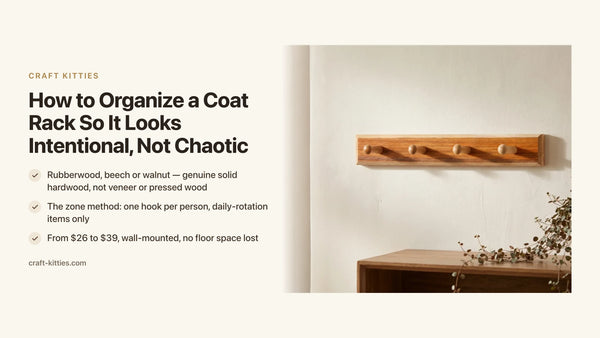
- Solid rubberwood, beech and walnut — real hardwood, not printed veneer
- A wall hook rack anchors the hallway visually and functionally: every coat off the floor, guests greeted by finished wood
- From $26.00 to $39.00, 2 to 6 hooks, mounts in under 15 minutes
Guests form their impression of your home in the four seconds between ringing the bell and stepping through the door. That first look lands in the hallway — and yet the hallway is the room most people furnish last, if at all. For the holidays, when foot traffic doubles and coats pile up on any available surface, an unfinished entry works against you before anyone reaches the living room.
The good news is that the hallway is also the easiest room to transform. It is small, it has one primary function — move people in, store what they carried — and it needs only three things done right: a surface for hanging, a warm light source, and one material that ties the space together. This guide focuses on the first of those three: the wall hook rack, the piece that does more functional and visual work per square inch than almost anything else in a home. Everything else in the holiday entry — the greenery, the candle, the runner — arranges itself naturally once that anchor is in place.
At a glance
- Solid rubberwood, beech and walnut — real hardwood, not printed veneer
- A wall hook rack anchors the hallway visually and functionally: every coat off the floor, guests greeted by finished wood
- From $26.00 to $39.00, 2 to 6 hooks, mounts in under 15 minutes
Why the hallway deserves your attention before the holidays
The living room is where you will spend the most time. The hallway is where every guest spends the most charged moments — arrival and departure, first and last impression. During the holidays those impressions carry extra weight: people are more attuned to the warmth of a home, and a well-dressed entry signals care in a way that a perfectly styled living room cannot fully compensate for if the entry felt cold.
There is also a practical dimension that becomes urgent in winter. A hallway with no real coat storage collapses the moment three families arrive at once. Coats end up piled on a banister, thrown on a chair, stacked in a bedroom — which means that at some point, a guest cannot find their coat without a small excavation. A wall hook rack solves that problem permanently and in the same gesture becomes part of the decor.
The argument for attending to the hallway is simple: the effort required is disproportionately small relative to the impact. Two hours on a Saturday — a rack mounted, a candle placed, a wreath hung — and every guest who comes through the door for the next two months encounters a finished room.
The visual logic of a holiday entry

Holiday decorating fails in the hallway for one consistent reason: too many competing pieces, none of which are functional. A ceramic figure on the console, a string of lights around the mirror, a wreath on the door, a garland on the banister, and an arrangement of pinecones on the floor — each item made sense individually, and together they read as chaos.
The three-element rule cuts through this. In a hallway:
One anchor piece at the wall. This is the load-bearing element — visually and literally. A solid wood wall hook rack in walnut, beech, or rubberwood does double duty: it holds the coats that would otherwise pile up, and it introduces a material that gives the space warmth without requiring styling. Wood reads as intentional from across a small room. Mount it at adult coat-reach height (60 to 66 inches to the top hook) and center it on the most visible wall from the front door.
One warm light source. A single pillar candle on a console, a small lantern on the floor, or a lamp with an Edison bulb. The hallway almost never has direct natural light in winter evenings — the one moment when guests arrive — so this element does more work than its size suggests. It turns a functional corridor into a room.
One textile or greenery accent. A runner underfoot, a eucalyptus wreath on the inner face of the front door, or a single sprig tucked above the hook rack rail. One piece, kept in the same tonal family as the wood, is enough. A beige runner under a light rubberwood rack reads as a cohesive palette. A navy runner under a dark walnut rack creates contrast that feels deliberate. The moment you add a fourth independent element, you cross from decorated into cluttered.
Choosing the right wood tone for your holiday palette

The wood tone on your hook rack determines which holiday palette reads as coherent in the hallway, because wood is the one material that cannot be swapped seasonally. It is the permanent undertone everything else reacts to.
Walnut (deep brown, fine tight grain) is the most natural partner for the traditional holiday palette: deep red, hunter green, brushed gold. The warmth of walnut makes those tones feel richer rather than louder. A walnut rack with a wreath of eucalyptus and dried red berries, a candle in amber glass — this is the combination that makes guests stop and look.
Cherry veneer on rubberwood (warm amber with a subtle reddish cast) sits in the middle ground. It partners easily with spice palettes — cinnamon, burnt orange, muted copper — and holds its own against cream and ivory textiles. If your holiday decor tends toward the warm but you prefer something quieter than deep green and red, cherry-veneered rubberwood is the tonal anchor that makes that work.
Beech and light rubberwood (pale honey, visible grain, calm surface) open the door to a Scandinavian-influenced holiday approach: sage green, ivory, dusty gold, and natural linen. This palette reads as quieter and more contemporary than the traditional red-and-green scheme, and it photographs exceptionally well for anyone who uses the hallway as a backdrop. Paired with a single strand of warm-white lights framing the door, beech holds the winter aesthetic without relying on seasonal color at all.
The rule of thumb: if your walls are warm (cream, taupe, terracotta), pick a wood tone with contrast — walnut or cherry. If your walls are cool (white, pale gray, greige), a lighter wood in beech or rubberwood reads as more harmonious. And if you are undecided, the Two-Tone Beech and Walnut rack bridges both tones on a single piece.
The hook racks from our studio, in detail
Four racks in solid rubberwood, beech, and walnut, chosen to cover the main profiles we meet in holiday decorating: the host who wants maximum impact in a traditional hallway, the one working with limited wall space, the one with a family of four, and the one who wants a rack that works as a design object in its own right.

Description
The Brazilian veneer on solid rubberwood is the most versatile finish in the lineup. The grain is calm, the tone is a warm natural blonde that pairs with nearly every holiday color approach — from deep hunter green to sage and ivory. At 4 to 6 hooks, it handles a family of four in full winter kit: coat, scarf, bag, each on its own hook. The rack mounts flat against the wall with no visible hardware brackets, which gives it a furniture-quality profile rather than a utilitarian one.

Description
If your holiday palette trends toward warm spice tones — cinnamon, copper, amber candles, linen textiles — the cherry veneer version of the rubberwood rack is the natural match. The reddish cast in the grain amplifies warm light sources in a way that walnut (cooler, darker) does not. Same structural core, same 4 to 6 hook count, different tonal register. At $37.00, it is the entry to a rack that reads as genuinely furnished rather than functional.

Description
The two-tone rack is the most design-forward option in the lineup. Pale beech and dark walnut in the same piece create a contrast that reads as intentional from across a hallway — the kind of piece that guests notice and ask about. It starts at 2 hooks for a narrow entry and scales to 6 for full family use, which makes it the most adaptable option when wall space is genuinely limited. At $26.00 with a 2-hook configuration, it is also the lowest entry point in solid wood in the lineup.

Description
Solid walnut with a distinctive boot-profile design: the hooks are shaped for heavier coats and maintain their grip under winter load. The 4-hook row is a single uninterrupted rail that reads as an intentional furniture piece rather than a storage solution. At $28.80, the solid walnut construction at this price point is the detail worth noting — most racks in this range use engineered wood cores that compress at the hook screws over time. This one does not.
Description
For households that host regular gatherings through December — the kind where four people arrive, then six, then someone brings an extra coat — the 6-hook configuration of the Brazilian veneer rack is the only setup that keeps the entry functional under real load. Twelve items without stacking means every guest finds their coat where they left it, which is a small but meaningful thing when the evening ends.
Comparison table
| Model | Price | Wood | Hooks | Best holiday palette |
|---|---|---|---|---|
| Brazilian veneer rubberwood | $39.00 | Solid rubberwood + Brazilian veneer | 4 to 6 | All palettes — neutral anchor |
| Cherry veneer rubberwood | $37.00 | Solid rubberwood + cherry veneer | 4 to 6 | Spice, copper, amber |
| Two-tone beech & walnut | $26.00 | Solid beech + walnut accents | 2 to 6 | Sage, ivory, dusty gold |
| Walnut boot profile | $28.80 | Solid walnut | 4 | Traditional red, green, gold |
Decision matrix — which rack for which hallway
| Your situation | The right pick |
|---|---|
| Traditional holiday palette, maximum impact | Walnut boot profile — $28.80 |
| Neutral entry, want to work with any seasonal accent | Brazilian veneer rubberwood — $39.00 |
| Warm spice and copper holiday tones | Cherry veneer rubberwood — $37.00 |
| Narrow hallway, minimal wall space | Two-tone beech & walnut, 2-hook — $26.00 |
| Hosting gatherings, need 6+ hooks | Brazilian veneer rubberwood, 6-hook — $39.00 |
| Gift for a new homeowner or couple | Two-tone beech & walnut — $26.00 |
Mounting a wall hook rack in four steps
1 — Choose the wall and the position. The wall facing the front door is the highest-impact location — the rack is the first thing guests see on entry. If that wall is too narrow, the wall perpendicular to the door works well too, especially in a galley-style hallway. Avoid mounting behind the door swing: hooks become inaccessible and pose a head-height hazard.
2 — Mark the height. 60 to 66 inches from the floor puts the top hooks at adult coat-reach. Mark the position with painter's tape before committing — live with the tape on the wall for a day if you want to be certain. In a household with children, plan a second smaller rack at 36 to 42 inches simultaneously; two separate visits to the wall costs twice the patching on move-out.
3 — Locate studs or use anchors. Most hallway walls are drywall over studs at 16-inch centers. For a 4-hook rack holding winter coats, hitting one stud and using two rated drywall anchors for the remaining points is sufficient. For a 6-hook rack at full load, aim for two stud points. A basic stud finder, available at any hardware store for under $20, eliminates all guesswork here.
4 — Mount level and add the seasonal layer. Use a spirit level for a final check before tightening — a visibly tilted rack is the one installation detail that reads as unfinished rather than rustic. Once the rack is mounted and the first coats are hung, the seasonal layer is minimal: eucalyptus above the rail, a linen ribbon looped once around a hook, or nothing at all. Solid wood needs no decoration to feel right in a holiday hallway; it provides its own warmth.
Mistakes that undermine a holiday entry
Decorating the hallway in isolation from the rest of the home. A bright red garland in the entry that connects to nothing in the living room reads as a different decorator's work. The seasonal accents in your hallway should share at least one element — a textile color, a candle scent, a wood tone — with the rest of the home.
Using too many materials at once. Metal hooks on a wood rack, a wicker basket on the floor, a fabric wreath, a ceramic figure on the console: five materials, no hierarchy. Pick two materials and commit — wood and linen, or wood and brushed metal — then repeat that combination in every seasonal accent.
Mounting the rack too high. The instinct is to go high to clear head height. The result is hooks that require a stretch every time, and hanging items that swing at face level for shorter guests. Sixty to sixty-six inches to the top hook is the ergonomic standard; higher is not better.
Leaving the floor bare. A runner in the hallway does several things simultaneously: it defines the space as a room rather than a corridor, it protects the floor from wet boots, and it adds the textile layer that gives wood warmth without cluttering the wall. It is the easiest and most underused element in a holiday entry.
Choosing a rack that looks good empty and fails in use. A rack selected from a product photo in a staged studio setting — one coat, artfully placed — may not handle four winter coats, two scarves, and three bags simultaneously. Before purchasing, check the hook count against your household's real daily load, not the idealized version of it.
Simple seasonal styling around a wood rack
Once the rack is mounted, the styling is short work. Here is the approach that works in every hallway regardless of size:
The eucalyptus layer is the most reliable holiday accent because it is fragrant, long-lasting when dried, and scale-neutral — a single branch above the rack rail is enough. A small bundle tied with a linen ribbon behind the top rail reads as designed. No floral foam, no water, no maintenance.
The candle or lantern goes on the floor or on a console at knee height, not at eye level — at eye level it competes with the rack; below it, it grounds the space without competing. A pillar candle in a simple glass holder or a small lantern in brushed black metal pairs with any of the wood tones in our lineup.
The runner finishes the floor. Choose a flat-weave or low-pile textile that handles foot traffic and vacuums clean — wool or cotton, in a neutral that pulls from the wood tone. Under a walnut rack, a rust or deep sage runner. Under a beech rack, a natural linen or ivory. Under cherry veneer, a spice-toned kilim or a simple cream stripe.
Those three elements — wood rack at the wall, candle at knee height, runner underfoot — complete the holiday entry without requiring anything else. The space is ready before the first guest arrives.
Where to go next
The hallway rack establishes the material language of your home's entry. Once it is in place, the same wood family carries naturally into adjacent spaces: a walnut shelf in the living room, beech kitchen accessories, rubberwood in the bathroom. Our wall hook rack collection brings together the full lineup — 2 to 6 hooks, four wood tones, all in solid wood or solid rubberwood with real veneer. If you found us through Etsy, where 243 customers have already left their reviews, the full range and current pricing live on the Craft Kitties store.
The short version
A holiday entry needs three things: a solid wood rack at the wall to handle every coat that comes through the door, a warm light source at knee height, and one textile that ties the floor to the space. Everything else is optional. The Rubberwood Wall Hook Rack with Brazilian Veneer works with any seasonal palette and handles any guest count from 4 to 6 hooks; the Two-Tone Beech and Walnut rack starts at $26.00 and is the right pick for a narrow hallway or a first-home gift; and the solid walnut boot profile rack at $28.80 is the one for a traditional holiday look that reads as furniture rather than hardware. Any one of the three, mounted and dressed in an afternoon, gives guests a first impression worth having.