At a glance
- Start with the bedroom dresser — it sets the tone for the whole reset
- The reset method: empty, sort, donate, re-home, assign — in that order, for every surface
- Solid wood ring holders anchor the dresser long after the reset is done
The week between the holidays and mid-January is the only moment in the year when most people feel a genuine urge to reorganize. That urge is real, and it is worth taking seriously — but it has a short window. What follows is a room-by-room method for making the most of it: not just tidying, but resetting surfaces to a default that is easier to maintain than the one you started the season with.
The reset is not the same as a clean. A clean restores surfaces to what they looked like before. A reset changes the baseline: it re-examines what lives where and why, removes what does not belong, and assigns permanent spots to the things that do. Done properly, it makes the next twelve months lighter.
This guide works through the four areas where holiday chaos concentrates most — bedroom, dresser, entryway, bathroom — with a practical sequence for each and the pieces that hold the new order once the adrenaline of the reset fades.
Why the post-holiday moment is different
There is a reason organization motivation spikes in January. The holidays bring a specific kind of clutter — gifts arriving all at once, seasonal decor claiming surfaces, daily rhythms disrupted — and once they end, the contrast is stark. A room that felt manageable in November can feel impossible in late December.
That contrast is useful. It creates enough friction to motivate action that would not otherwise happen. But the window closes quickly: by the third week of January, most people have accommodated the new normal and the urge to reset fades. The method below is designed to move fast enough to catch that window, and deliberately enough to leave a result that does not collapse within a month.
The second reason the post-holiday moment matters is that you have new things. Gifts that arrived need homes. Seasonal decor needs to be stored rather than abandoned on a shelf until March. Old items, displaced by the new ones, either need to be reassigned or let go. The volume justifies a real pass, not just a tidy.
The five-step sequence that actually works

Every surface in every room responds to the same five steps. Running them in order is what separates a reset from a tidy.
1 — Empty completely. Pull everything off the surface, out of the drawer, out of the basket. No exceptions, no "I'll leave that one where it is." This is the step most people skip, and skipping it is why resets fail — you end up reorganizing the same items in a slightly different arrangement rather than questioning whether they belong there at all.
2 — Sort into three categories: keep, donate, discard. Not four categories. The moment you add "maybe" or "store for later," things stop moving. Anything you have not used in the past twelve months and cannot name a future occasion for belongs in donate or discard. This applies to gifts with good intentions behind them: keeping something out of obligation assigns it a surface for the next decade.
3 — Re-home before you put anything back. "Keep" items only go back to the surface they came from if that is genuinely their best location. A phone charger that was on the dresser might belong at the desk. A book that accumulated on the bathroom counter belongs on the nightstand. The re-home step is where you assign spots, not just return things to where they were by default.
4 — Assign an anchor piece to each surface. An anchor piece is the object that gives each surface its identity and sets a visual limit. A ring holder on the dresser says: this is where jewelry lives, and it holds enough for one person's daily rotation. When it is full, you put things away rather than setting them down. A small tray at the entryway says: keys, wallet, here. Nothing else. Anchor pieces are what keep resets from becoming temporary.
5 — Test for one week, then adjust once. Give the new arrangement seven days before changing anything. The instinct to keep adjusting is what turns a reset into an ongoing project. After one week you will know which spots are working and which are genuinely wrong — adjust those specifically, leave the rest.
The bedroom dresser: where to start
The dresser is the right place to begin a post-holiday reset for a simple reason: it is the most-used surface in the bedroom and the one that most directly sets the tone for how the room feels. A clear dresser reads as a calm room even when the closet behind it is imperfect. A cluttered one makes the whole room feel unsettled regardless of what else is organized.
The dresser also concentrates the most common categories of holiday clutter: new jewelry received as gifts, small items displaced by seasonal decor, and the accumulated small decisions that did not get made during a busy December — a pair of earrings set down next to the holder rather than on it, a receipt, a hair tie, a lip balm that belongs in the bathroom.
Run the five steps in full on the dresser before moving to anything else. Empty the surface completely. Sort everything. Re-home items that belong elsewhere. Then return only what genuinely belongs on a dresser — which, for most people, is jewelry in active rotation and a single anchor piece to hold it.
Solid wood versus resin: the ring holder question
The single most useful anchor piece for a dresser reset is a ring holder. It takes up almost no space, solves the main source of surface clutter — rings and small jewelry set down rather than put away — and stays visible enough to be used without thinking. But the material matters more than most buyers realize.
The majority of ring holder cones on the market are cast resin with a painted finish. They are light, often decorated, and available at low prices. They are also the kind of object that looks fine in a photograph and accumulates small chips, fading and wobbling within a year or two of daily contact. A ring slid on and off every morning is not a gentle interaction.
Solid wood behaves differently. Beechwood (Fagus sylvatica) and solid walnut (Juglans nigra) are dense, stable hardwoods that do not chip at the rim where the ring meets the cone. The finish wears in rather than off — the surfaces develop a patina from use. A solid wood ring holder placed on a dresser after a January reset is the kind of object that is still there, unchanged in function, five years later. That is the relevant comparison when you are anchoring a reset: not which holder looks nice in January, but which one is still working in December.
The models from our studio
Three holders, chosen to cover the three buyer contexts that come up most often in a post-holiday reset: the person resetting a shared dresser and needing two cones for two people, the person who wants one high-quality piece for a dresser that already has warmth, and the person resetting a minimalist bedroom who wants matching walnut at a practical entry price.

Description
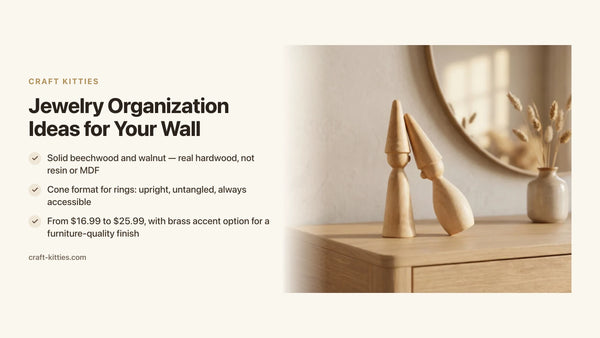
The Beechwood Ring Holder Cone Set is the reset anchor for shared dressers. Two cones cut from solid beech (Fagus sylvatica) — pale, tight-grained, dimensionally stable — sit on a shared base that keeps both pieces together without taking up separate surface area. Each cone holds a ring at the right height to be visible and accessible, which is the point: when the cone is visible, you use it rather than setting the ring down beside it. At $16.99 for both pieces, it is the entry to solid wood in this category and the most practical choice for anyone resetting a bedroom shared by two.

Description
The Walnut Ring Holder with Solid Brass Base is the statement piece: a single cone precision-turned from solid American walnut (Juglans nigra), deep brown with the fine, consistent grain the species is known for in furniture. The base is solid polished brass — not plated, not lacquered to a chrome approximation. The two materials together have a weight and permanence that the dresser surface carries differently from lighter pieces. At $25.99, it is the right choice for a bedroom that has already been through several rounds of curation and needs one last anchor that does not look like an afterthought.

Description
The Wooden Ring Holder Set of 2 in Walnut delivers the same solid walnut material — Juglans nigra, real hardwood — in a two-cone format at $18.99. It is the right pick when the bedroom already has warmth (wood furniture, warm lighting, earth-tone walls) and the priority is matching tone rather than introducing a second material like brass. Both cones share the same walnut character; placed side by side on the dresser they read as a coordinated pair rather than two separate objects.
Description
In a white or light-toned minimalist bedroom, the beechwood cone set works as a deliberate Scandinavian accent — the pale, fine-grained wood barely contrasts against white furniture, which is exactly the point. The pieces are present enough to be found and used, quiet enough to disappear visually when the ring is on your finger. Two cones, one surface, no visual noise.
Description
As a housewarming or occasion gift paired with a post-holiday move or reset, the walnut and brass holder communicates care without requiring explanation. It sits on the dresser as an object with clear function and clear quality — the recipient does not need to wonder where to put it or whether they will still want it in two years. For gift contexts, the solid brass base adds enough visual weight to read as a considered piece rather than a token.
Comparison table
| Model | Price | Wood | Format | Best for |
|---|---|---|---|---|
| Beechwood Cone Set | $16.99 | Solid beechwood (Fagus sylvatica) | 2 cones, shared base | Shared dresser, light or neutral bedroom |
| Walnut & Brass | $25.99 | Solid walnut (Juglans nigra) | 1 cone, solid brass base | Curated bedroom, statement anchor, gifting |
| Walnut Set of 2 | $18.99 | Solid walnut (Juglans nigra) | 2 cones | Warm or dark bedroom, matching pair |
Decision matrix — which holder for which reset context
| Your situation | The right pick |
|---|---|
| Resetting a dresser shared with a partner | Beechwood Cone Set — two cones, one base, entry price |
| Bedroom is light-toned, white or Scandi | Beechwood Cone Set — pale wood disappears into the palette |
| Bedroom has warmth, dark wood or earth tones | Walnut Set of 2 — matching tone, consistent pair |
| One carefully curated dresser, buying for myself | Walnut & Brass — the piece the dresser was waiting for |
| Giving as a post-holiday housewarming gift | Walnut & Brass — presents well, universally legible |
| Unknown bedroom palette, safe default gift | Beechwood Cone Set — pale wood works across any palette |
Resetting the entryway
The entryway is the second area to tackle because it controls what enters the rest of the home. A disorganized entryway is not just an aesthetic problem — it is a routing problem. Items that should land at the door (keys, bags, mail, scarves) instead travel into the house and end up on kitchen counters, bedroom chairs or living-room tables. Organizing the entry tightens the whole home.
After the holidays, the entryway typically accumulates packaging material that was never fully cleared, seasonal bags, outdoor items that came inside during cold-weather gatherings and never went back, and gift-related cardboard waiting to be recycled. Clear all of that first. Then apply the five-step sequence to whatever remains: hooks, a tray or bowl for keys, a shelf for bags that are in regular rotation.
The organizing principle for an entryway is the same as for a dresser: one anchor piece per function. A tray or dish at the door holds keys and small items. A hook rack holds the two or three coats and bags that are used most often. Anything beyond those two anchor functions is overflow that belongs somewhere else in the house.

Resetting the bathroom counter
The bathroom counter is the surface most likely to accumulate objects that arrived as gifts — new skincare products, candles, a diffuser, seasonal items — alongside the existing occupants that were already there. By January, most bathroom counters have doubled their surface population.
The reset principle here is strict: the counter holds only consumables in active daily use. A serum you reach for every morning belongs on the counter. A serum you received as a gift and plan to try later belongs in a cabinet until you are ready. A candle you light sometimes belongs in a different room where you actually light candles.
The specific challenge with bathroom counters is that the items on them tend to feel semi-medical — like keeping them visible means you will use them. In practice, the opposite is true: the more objects on the counter, the less attention each one gets. A clear counter with three things on it produces a more consistent routine than a crowded one with fifteen.
Mistakes that derail a post-holiday reset
Buying organizers before completing the sort. The most common reset error. You see a basket or set of bins and decide it will solve the clutter — then fill it with items you would have discarded if you had sorted first. Buy nothing until the sort and re-home steps are complete. At that point you will know exactly what size container you need and whether you need one at all.
Treating the reset as a one-afternoon project. A genuine reset of bedroom, entryway and bathroom takes a full weekend — one longer session per room. Trying to compress it into a few hours produces the tidy-not-reset result: surfaces look clear for a few days and then return to their previous state because the re-home and assign steps were skipped.
Keeping things out of guilt. Holiday gifts have real sentiment behind them, and that sentiment can assign objects surfaces they do not deserve. The reset is the right moment to make those decisions, because the holiday is recent enough to remember the warmth but distant enough for objectivity. An object that does not have a genuine home will create clutter no matter how well-meaning its origin.
Resetting without anchoring. A surface that is cleared but not anchored — no designated object that defines what belongs there — reverts to its previous state within weeks. The anchor piece does not need to be elaborate: a ring holder on the dresser, a tray at the entryway, a single candle that marks the bathroom counter as a minimal surface. The anchor defines the surface's identity, which is what makes the reset last.
What makes a reset last beyond February
Most post-holiday resets dissolve by mid-February. The reasons are consistent: the sort was incomplete (some items went back by default), the re-home step was skipped (items landed back where they came from rather than where they belong), and the anchor pieces were either missing or not functional enough to be used consistently.
The anchor piece question is worth examining carefully because it is the step that most directly determines whether a reset survives. An anchor piece needs to meet three criteria: it needs to be visible (not hidden in a drawer), it needs to hold specifically the things that land on the surface by default, and it needs to be pleasant enough to use that using it is easier than not.
A solid wood ring holder meets all three for a dresser. It is visible by design — the cone format works because the ring is on display, not stored. It holds the exact items that land on a dresser by default — rings removed at night, earrings at the end of the day. And it is pleasant to use: the weight and texture of solid beechwood or solid walnut in the hand every morning and evening is a different experience from a plastic dish. Small differences in daily texture accumulate into habits, and habits are what resets become.
FAQ — home organization reset after the holidays
1 — What is a post-holiday home reset? A post-holiday home reset is a structured process of decluttering, reassigning surfaces, and returning each room to a baseline that is easier to maintain than what you started the holiday season with. Unlike a seasonal clean, a reset changes the default state of each surface — so that keeping order requires less effort than it did before.
2 — Where should I start? Start with the bedroom dresser. It is the most-used surface in most homes and the one that sets the tone for how the rest of the room feels. Once the dresser is clear and organized, the momentum carries naturally to the entryway, bathroom, and living areas.
3 — How long does a full home reset take? A focused reset covering bedroom, entryway and bathroom typically takes a weekend — one afternoon per room. The key is running the full five-step sequence (empty, sort, donate/discard, re-home, assign) for each surface before moving to the next room. Skipping the re-home step is what turns a clean into a temporary tidy.
4 — What should I do with holiday gifts I do not need? Decide within the first week, before items develop the feeling of permanence. The options are: integrate (find a designated spot), regift immediately, return if possible, or donate. Anything without a clear designated home will end up on a surface and stay there.
5 — How do I stop the dresser from becoming cluttered again? Assign a specific object to hold the items that land on the dresser by default — rings, earrings, a watch. A solid wood ring holder cone is the most effective anchor: it gives rings a permanent, visible spot, which removes the main source of surface clutter. When the cone is occupied, you put things away rather than setting them down.
6 — Cone or flat dish — which is better for a dresser reset? Cone holders are more practical for rings worn daily. You remove the ring at night, slide it onto the cone, and it is exactly where you reach for it in the morning. Flat dishes work for a collection display but require searching. For a functional reset, the cone format is the more useful default.
7 — What wood is best for dresser organization pieces? Beechwood (Fagus sylvatica) is pale, tight-grained and Scandinavian in character — it suits light bedrooms and white furniture. Walnut (Juglans nigra) is deep brown with fine grain, furniture-forward and warm — it pairs with darker or warmer rooms. Both are solid hardwoods, not resin or veneer. Choose by contrast with the surface they sit on.
8 — Can I do a reset without buying anything? Yes. The reset method requires no purchases — it is a process of emptying surfaces, sorting, donating, and assigning designated spots. Buying organizers before completing that sequence is one of the most common reset mistakes. Do the process first, then identify the one or two surfaces that genuinely benefit from an anchor piece.
Where to go next
The ring holder is often the first solid wood piece on a dresser — and the one that makes the most difference to daily routine. Our ring holder collection covers the full range: from the Beechwood Cone Set at $16.99 for shared dressers to the Walnut and Brass for curated, single-surface anchoring. Each is real hardwood, each designed to stay on the dresser rather than in a drawer.
If you are resetting other surfaces as part of the same January pass, our studio offers anchor pieces in the same solid wood families — coordinated in grain and tone so the bedroom reads as intentional rather than assembled. You may already know our work through Etsy, where 243 reviews reflect years of daily use across ring holders, organizers and dresser accessories.
Conclusion — reset the surface, change the habit
The post-holiday window is short and specific. Use it to change the defaults rather than restore the previous state: sort thoroughly, re-home deliberately, and place an anchor piece on every surface that has a recurring clutter problem. The dresser gets a ring holder. The entryway gets a tray and a hook. The bathroom counter gets cleared to consumables only.
The Beechwood Ring Holder Cone Set is the right starting point for most resets — two cones, one surface, $16.99, and the kind of object that is still on the dresser next January. If the bedroom already leans warm and dark, the Walnut Set of 2 at $18.99 matches the tone. And for a dresser that deserves one considered anchor piece, the Walnut and Brass at $25.99 is the one the room was waiting for.