At a glance
- Turn any wall near your front door into a working entryway — no foyer required
- Layer: hooks at shoulder height, bar or shelf below, mat on the floor
- Solid hardwood (red oak, walnut, beech) holds daily load and adds warmth to a corridor
Most apartments do not have a foyer. What they have is a front door that opens directly into a living room, or a corridor narrow enough that two people cannot pass each other comfortably. That gap between what the floor plan offers and what daily life requires — a place to land when you walk in, a place to prepare before you walk out — is where most small spaces fail.
The failure is not about square footage. It is about intention. An entryway is not a room; it is a behavior zone. Any wall near the front door, even twelve inches of it, can become functional and considered if you treat it with the same deliberateness you bring to a kitchen setup or a home office corner. This guide shows you exactly how to do that — the logic behind the decisions, the specific pieces that make it work, and the order in which to put them in place.
Why most small-space entryways feel chaotic
The common version looks like this: one hook screwed into the wall at an arbitrary height holding three coats and four bags, a pair of shoes by the door that never quite finds its home, keys dropped wherever — counter, pocket, floor. The entrance tells everyone who walks in that the apartment is managed reactively, not by design.
The reason is not laziness. It is that the entryway does not get a design decision. People apply thought to the kitchen, the living room, the bathroom — the zones that feel like "rooms". The entryway, which is technically a transition, gets the leftover hook and the inherited door mat.
The correction is also not a major project. The corridor or wall strip near your front door already exists. The question is just what goes on it, in what order, and at what height.
The three-layer principle: hooks, bar, mat

Every functional small-space entryway is built on three layers, each with a specific job.
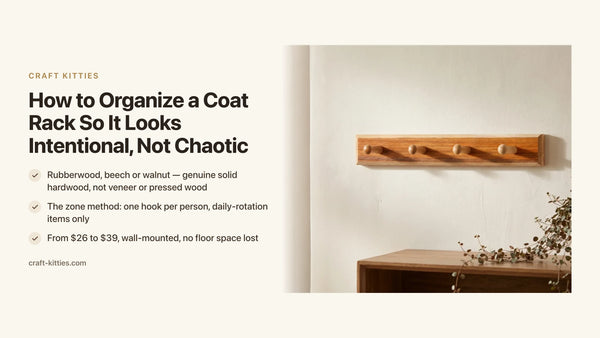
Layer 1: hooks at shoulder height. This is where outerwear lives — coats, jackets, the bag you bring every day. The height matters: too high and the coats drag on the bar below; too low and longer items touch the floor. The reliable method is to stand in position and reach your arm horizontally — that mark, roughly 60 to 66 inches from the floor, is where the top of your hook row belongs. A wall hook rail with four to six hooks handles a couple's daily rotation without crowding; fewer hooks means fewer decisions about what actually hangs there (a discipline that keeps the zone from reverting to chaos).
Layer 2: a bar or narrow shelf at hip to mid-torso height. This layer is the least intuitive and the most useful. It holds the items that are not quite coat-rack territory: the tote bag that stays home three days a week, the scarf that comes off at the door, the reusable shopping bags. A wall-mounted wood towel bar works better here than most people expect — it spans the full width of the section, lets items drape rather than compete for a fixed hook point, and in solid red oak or walnut reads as an intentional design element rather than utility hardware. Below or adjacent, a small key tray or a wall-mounted shelf completes the layer: one place for keys, one place for mail, nothing left to chance.
Layer 3: a mat that defines the boundary. The floor mat is the frame of the entryway. Where the mat ends, the entryway ends. This boundary is more important than it sounds: it is what prevents the "zone" from blurring into the living room. A mat 24 to 36 inches deep in front of the door is enough to establish the transition without blocking the passageway. It is also the single item that signals to guests — and to your own brain — that this is a distinct zone, not just a wall with some stuff on it.
These three layers work in a corridor, in an apartment where the front door opens directly to the living room, in a studio, even in a shared house where the only personal territory near the door is a 16-inch strip of wall. The principle scales to the space available.
Choosing your wall section — and how much you actually need
The first decision is not about furniture or hooks. It is about identifying which strip of wall becomes the entryway. In a dedicated corridor, this is obvious: the two or three feet of wall on the dominant-hand side of the door. In a living room that starts at the front door, the choice requires more intention — typically a 24 to 36-inch section directly adjacent to the door frame, separated visually from the rest of the room by a change in wall treatment (a panel, a different paint color, or simply the consistent group of objects mounted there).
What you do not need: depth. A wall-mounted entryway setup projects eight to twelve inches maximum from the surface — less than a piece of furniture, less than an open door. A 24-inch-wide strip of wall with three well-chosen pieces mounted vertically serves a couple reliably. The minimum viable version fits in 16 inches of width and three pieces: a hook, a bar, and a mat.
What you do need: a commitment not to migrate. The entryway only works if it is the place where things get deposited — every time, not most of the time. The design decision is what makes that automatic: if the hook is at the right height, the coat goes there without a second thought.
Solid wood in an entryway: why material matters here

The entryway is the single highest-traffic zone in an apartment. Everything passes through it, twice a day, carrying weight. A coat hook that bends under a heavy parka, a bar that flexes when a bag swings against it — those are functional failures, not aesthetic ones, and they compound daily.
Solid hardwood — red oak, walnut, beech — is the right material class for this reason. Red oak has a Janka hardness of around 1,290 lbf; walnut sits at 1,010; beech at 1,300. All three are denser than any MDF-backed or veneered option and will hold daily-use load without deformation. In practice, a wall-mounted towel bar in solid red oak or walnut will take the weight of a winter coat and a bag simultaneously, mounted on two anchor points, without any perceivable flex.
The second reason is warmth in a zone that tends toward austerity. Corridors and entryways suffer from the same design neglect: white walls, a bare floor, nothing that makes the space feel considered. A piece in waxed red oak or walnut introduces grain, color and tactile richness with very little visual noise — it is the opposite of decorating, it is editing. One or two solid wood pieces in a narrow entryway do more for the apartment's first impression than any number of prints or accent items.
Moisture resistance matters too, specifically at the entry: damp umbrellas, wet coat sleeves, the mist that comes in on a rainy day. A waxed hardwood surface handles ambient moisture without swelling or degrading. The finish that matters here is a penetrating wax or oil-wax blend, not a surface lacquer that chips — our pieces use exactly that, so the wood can be wiped down without any product, just a cloth.
The four pieces from our studio, in detail
The selection below covers the range of entry-zone uses: a classic bar for the hip-height layer, a wood-and-brass version that adds warmth to the metal accent, an arc-form bar that doubles as a design statement, and a double-layer bar for maximum load without expanding the footprint.

Description
The Wall Mounted Wood Towel Bar in square hardwood is the entry-zone workhorse: a full-width bar in waxed solid wood with squared-off hardware that pairs equally well with modern, minimal or warm-rustic interiors. At $24, it is the starting point for the hip-height layer — coats and bags drape over it cleanly, and the squared section gives it more visual weight than a round dowel, which reads as deliberate design rather than afterthought.

Description
The Wood & Brass Towel Rack Holder brings warm metal into the bracket — an aged brass finish against the waxed wood grain, for $22. In a corridor with white or light-sage walls, the brass bracket catches light the way jewelry does: quietly and without demanding attention. This is the piece for entryways that are trying to achieve warmth rather than contrast, or for rooms where the rest of the hardware (light fixtures, cabinet pulls) already leans gold or brass.

Description
The Arc Design bar at $24 solves a practical problem with a design gesture: the bracket sweeps outward from the wall before meeting the bar, which creates clearance between the wall surface and the hanging items. Thick winter coats, bag straps, rolled scarves — they hang freely without pressing against the wall and leaving marks. The arc form also makes the piece visually distinct: it reads as a deliberate design choice, not standard hardware.

Description
The Double Layer bar is the one to choose when one bar is not enough but a third wall anchor is too many. Two bars in the same solid wood finish, same wall footprint, same $24 — the upper bar takes coats and jackets, the lower takes bags, scarves, and the items that come off second at the door. For a couple sharing one entryway strip, this doubles capacity without doubling the wall real estate. It is also the solution when the entryway zone is truly narrow and expanding horizontally is not an option.
Comparison table
| Piece | Price | Wood | Hardware | Best use in entryway |
|---|---|---|---|---|
| Wall Mounted Wood Towel Bar | $24 | Solid hardwood | Matte bracket | Hip-height layer, bags and accessories |
| Wood & Brass Towel Rack | $22 | Solid wood | Aged brass | Warm or Japandi interiors, statement layer |
| Arc Design Towel Bar | $24 | Solid wood | Arc bracket | Clearance for bulky items, design-forward look |
| Double Layer Towel Bar | $24 | Solid wood | Dual bracket | Couples, two item types, narrow wall strip |
Decision matrix — which piece for which situation
| Your situation | The right pick |
|---|---|
| One person, one coat, one bag — minimal setup | Wall Mounted Wood Towel Bar |
| Warm-toned walls, brass or gold hardware elsewhere | Wood & Brass Towel Rack |
| Heavy winter coats, thick bag straps, need clearance | Arc Design Towel Bar |
| Two people sharing one entryway zone | Double Layer Towel Bar |
| Renting — walls must stay hole-free | Arc or Standard bar with adhesive anchors (included) |
Installing your wall pieces in five steps
1 — Map the zone, not just the piece. Before drilling, stand at the door and trace the full entryway sequence: where your hand lands with a coat, where you naturally look for keys, where you step to put on shoes. Mark those points on the wall rather than deciding from a blueprint. The piece goes to the behavior, not the other way around.
2 — Set heights before touching the drill. The bar belongs at a height where bags and scarves drape naturally — typically between 44 and 54 inches from the floor for most adults. Hooks for coats go 6 to 8 inches higher. Mark both reference points with painter's tape and step back before committing. Two minutes of visual check here prevent years of slightly wrong-height irritation.
3 — Locate the studs or use appropriate anchors. A wall-mounted bar with a bag on it generates lateral load, not just vertical. If you are hitting a stud, two screws per bracket hold indefinitely. If you are going into drywall, toggle bolts or expansion anchors rated for at least 30 lbs per point are the minimum — the adhesive strips marketed for small frames are not sufficient for a bar under daily load.
4 — Mount level, then sight-check from the door. A bar that is half a degree off reads visibly wrong from the angle of entry — this is the one zone where you always look at pieces from a moving, approaching viewpoint. Mount with a level, then step to the door and verify from approach distance before fully tightening.
5 — Activate all three layers before calling it done. The zone only works as a system: the bar is not functional without the hooks above and the mat below. Put the mat down, hang a test coat, set a key tray in place — see the complete stack before deciding anything needs adjusting. Tweaking one layer in isolation gives you an incomplete picture.
Mistakes that undo a good entryway setup
Buying freestanding furniture for a zone that has no floor space. A freestanding coat rack, a console table, a small bench without storage — these all claim floor real estate that a narrow entryway cannot absorb. The door cannot open fully, the passageway narrows, and within weeks the furniture becomes an obstacle rather than a feature. Wall-mounted is the non-negotiable format for small-space entry zones.
Giving every item its own hook. The entryway accumulates. Six hooks fill up; then items pile on top of items; then the whole system collapses. Capacity discipline matters more than total hook count: two to three hooks per person, and a clear rule that seasonal items (the winter parka in July, the umbrella in a drought) go into storage, not on the wall. The bar layer helps here — it absorbs items that do not fit a hook cleanly.
Leaving the floor undefined. Without a mat, the entryway zone has no boundary. Shoes migrate. Bags end up in the living room. The transition from outside to inside becomes gradual and formless. A mat is the cheapest single item in the whole setup and arguably the most load-bearing for the system's psychology.
Mixing three wood tones and two metal finishes. Entryways are small; visual noise is disproportionately damaging in a tight space. One wood tone (your choice of red oak, walnut or beech) and one metal finish (brass or matte black) is the rule. Our wood towel bar collection is built around consistent material families — choosing within that range handles the pairing decision automatically.
Ignoring the wall above the hook line. The twelve inches above the top hooks are usable for a narrow floating shelf that holds items that do not move daily: a basket for gloves in winter, a box for transit cards, a single piece of decor that establishes the mood of the zone. That shelf is what separates an entryway that merely functions from one that feels designed.
Adapting the system to specific situations
Studio apartment with no corridor at all. The entryway lives on the wall immediately to the right or left of the front door, marked by a mat and a defined group of objects. A rug or paint accent on the wall helps distinguish it visually from the living room behind it. In a studio, this is the most important zone to design first — it sets the tone for the entire apartment each time you walk in.
Shared housing with limited wall access. If only one wall segment is available for personal use, the double-layer bar is the most efficient use of a single anchor zone: two functions, one footprint. Add a key hook on the bracket itself (some models accept a small clip) and a small tray on a floating shelf, and the entire entryway system runs within a 24-inch-wide, 30-inch-tall wall section.
Rental restrictions. The concern is always holes. Command strips are insufficient for a loaded bar; what works is adhesive anchors rated for 40+ lbs per point (available at most hardware stores), used on a cleaned, primed wall surface. The holding strength is real for wall-mounted bars without dynamic lateral load — which a hanging towel bar, as opposed to a pull-up bar, is. When in doubt, use two adhesive anchor points and test with a load before hanging daily-use items.
Entry into a living room (no hallway at all). The zone needs a stronger visual boundary than elsewhere: a pendant light above the mat, a different floor material where possible, or a thin console shelf at the wall that acts as a visual room divider. The objects do the same job — hooks, bar, mat, tray — but they need to read as a contained zone against the backdrop of a furnished room, so grouping them tightly and consistently matters more than in a proper corridor.
What to do next
The entryway is usually the last room people deliberately design and one of the first things guests notice. Getting the three-layer system in place — hooks, bar, mat — is an afternoon of work with a drill and two wall pieces. The Wall Mounted Wood Towel Bar is the right starting point for the hip-height layer in most setups; the Wood & Brass Towel Rack if the room leans warm; the Double Layer if you are sharing the zone with a second person.
Browse the full wood towel bar collection to see the complete range of bracket styles and finishes — all in waxed solid hardwood, all sized for entryway and utility wall use. If you have already found us on Etsy (243 reviews and counting), the same pieces ship from the same studio with the same care.
Conclusion
Creating an entryway without a foyer is a systems question dressed up as a design question. The answer is not a new room; it is a 24-inch strip of wall treated with intention: hooks at the right height, a solid wood bar below, a mat on the floor. Get those three elements in place, in solid hardwood that will hold daily load without degrading, and the entryway is done — not as a room you walk through but as a zone that prepares you to leave and welcomes you back every time you return.