At a glance
- Japandi = Japanese wabi-sabi + Scandinavian hygge — calm, imperfect, wood-forward
- Core palette: stone, sage, charcoal, warm off-white — no saturated colors
- Solid red oak, walnut or beech at every scale — honest grain over veneer
- Scent is a design layer: a wood essential oil diffuser completes every Japandi room
Japandi arrived quietly in interiors about a decade ago, the way most durable aesthetics do: not as a trend announced from above, but as the convergence of two already-mature sensibilities. Japanese wabi-sabi — the acceptance of imperfection, asymmetry, the beauty of natural materials in their honest state — met Scandinavian hygge — warmth, softness, the celebration of the domestic — and the result was a style that sits somewhere neither tradition fully occupies alone: calm without being cold, spare without being bare.
It is also one of the more misunderstood styles in online interior design content. Japandi is not simply "a beige room with some wood". It has a logic: in the materials it insists on (solid wood, natural fiber, stone, ceramic), in the palette it rules out (anything saturated, anything synthetic-looking), in the spatial discipline it requires (nothing on a surface without a reason). This guide makes that logic explicit, room by room, so you can apply it without second-guessing every decision.
The article works through the principles first, then the palette, then the materials question in depth — because the choice between real wood and wood-look laminate is where most Japandi rooms either hold or fall apart — then room by room from living room through bedroom through home office, finishing with the diffusers from our essential oil diffuser collection that anchor the sensory layer of the style.
What Japandi actually means — the two roots

Wabi-sabi is a Japanese aesthetic concept that finds beauty in what is incomplete, impermanent and imperfect. A ceramic bowl with an uneven rim is more interesting than a factory-perfect one. A piece of red oak with visible grain tells a story; a laminated board with a printed wood pattern tells nothing. In practice, wabi-sabi in a room means embracing natural materials with their real texture, leaving space genuinely empty rather than filling it with decorative objects, and choosing asymmetry over symmetry in arrangements.
Hygge (roughly pronounced "hoo-guh") is a Danish and Norwegian concept that does not translate precisely but comes closest to "coziness as a practice" — the deliberate creation of warmth, comfort and a sense of being sheltered. Candlelight, soft wool, warm lighting, the smell of something good: hygge is sensory and human where wabi-sabi is philosophical and spatial.
Japandi sits at the intersection. It keeps the negative space from wabi-sabi — surfaces are not cluttered — but lets hygge soften the result so a room reads as warm rather than austere. It keeps the natural materials from both traditions — solid wood, linen, wool, stone, ceramic — and it layers in scent as a deliberate element in the way both cultures do, through incense in the Japanese tradition and through candlelight and warm aromatics in the Nordic one.
The working definition: Japandi is a calm, imperfect, wood-forward interior where nothing on a surface is accidental.
The Japandi color palette — what to use, what to rule out
The palette is probably the easiest part of Japandi to learn because it operates by subtraction. You remove saturated colors. You remove stark, cool white. You remove anything that reads as artificial — chrome, glossy plastic, bright primary accents. What remains is the Japandi palette.
The core is warm neutrals: stone beige, warm off-white (think raw linen, not hospital white), oatmeal and sand. These become the large-surface colors — walls, large textiles, upholstery. Against them you layer muted earth tones and naturals: sage green, muted terracotta, warm taupe, mushroom gray, and the natural color of wood itself — which in red oak reads as honey-amber, in walnut as deep warm brown, in beech as pale gold.
The accent colors, when they exist at all, should be desaturated versions of their hue: dusty blue rather than cobalt, olive rather than forest green, rust rather than orange. One or two accent tones in the room, not five. They arrive through textiles — a throw, a pillow, a rug — not through paint or large furniture.
Two things are explicitly out: cold gray (it pulls Japandi toward a clinical Scandinavian-modern that loses the warmth) and bright white walls (they flatten the natural texture of wood and linen and remove the depth the style depends on). A warm off-white or a light stone beige covers this ground better.
Materials — why solid wood is non-negotiable

Every authentic Japandi interior shares one trait: the materials on display are what they appear to be. This is not a stylistic preference — it is the direct application of wabi-sabi. A material that imitates another material (printed wood-look laminate, faux marble vinyl, bamboo-look MDF) is categorically not wabi-sabi. The honest state of a material — its grain, its small imperfections, the way it ages — is where the beauty lives.
For wood specifically, this means solid hardwood. In Japandi rooms, the species to reach for are red oak, walnut and beech, each with a distinct visual character:
Red oak is warm and amber-toned with a bold, visible grain. It adds hygge warmth naturally and suits a Japandi interior that leans toward the Scandinavian side — open, light-filled, soft. The grain is pronounced enough to read as texture rather than surface decoration, which is exactly what wabi-sabi asks of a material.
Walnut is the deeper option: dark brown, fine-grained, with a quiet authority that reads closer to the Japanese end of the Japandi spectrum. In a room with warm off-white walls, solid walnut becomes the visual anchor. It pairs well with muted terracotta and sage.
Beech is the lightest of the three — pale gold-blonde, fine and even-grained. It is common in Scandinavian furniture for this reason: it brightens a room without adding visual noise. In a Japandi context, beech works best where you want the wood to recede slightly and let the form of an object speak rather than the color of the grain.
The other Japandi-appropriate materials complete the picture: natural ceramic (not glazed porcelain, but stoneware with visible texture), linen and wool for textiles, stone for kitchen and bathroom surfaces, rattan and bamboo for small baskets and trays. Each material in the room should be able to answer the question: what is this made of? If the honest answer is "a printed surface over composite board", it is not Japandi.
The living room — negative space as a design decision
The living room is where most Japandi beginners struggle, because the instinct when decorating a living room is to fill it — gallery wall, throw pillows in five colors, a shelf where every inch is occupied. Japandi asks for the opposite impulse: decide what belongs, then leave the rest empty.
Start with the sofa. In Japandi, the sofa is low-profile — a platform silhouette or a sofa with short, solid wooden legs. Upholstery is linen or bouclé in a neutral tone: oatmeal, warm gray, stone. No tufting, no pattern on the main upholstery.
The coffee table is the first real-wood object in the room. Choose solid wood over a glass-top table: the grain of red oak or walnut becomes a visual element at the center of the room. If a tray sits on the coffee table, it holds one or two deliberate objects — a small ceramic, a wood diffuser, nothing else.
On shelves and side tables, apply what designers in the Japanese tradition call ma (間): conscious emptiness. An object has more presence when it is the only thing on a surface than when it competes with four others. A Wood Essential Oil Diffuser — Tree of Life Pattern on an empty floating shelf is a Japandi arrangement. The same diffuser surrounded by ten other objects is noise.
Lighting should be warm (2700–3000K), layered (floor lamp + table lamp + candle rather than a central overhead light alone), and ideally include a pendant or wall sconce in a natural material — rattan, wood, ceramic — rather than a metal or glass fixture.
The bedroom — the fewest objects, the most intentional
The Japandi bedroom has one governing principle: the bed is the room. Everything else is subordinate to the bed and to sleep. This sounds simple; it requires real discipline.
The bed frame is low to the ground — platform or tatami-style — in natural wood. Bedding is linen or cotton sateen in warm white or oatmeal, with one or two solid-color linen pillows in a muted accent tone. No printed duvet covers, no pattern mixing.
The nightstand is the Japandi bedroom's tell. In a conventional bedroom, the nightstand holds a lamp, a book, a water glass, charger cables, a notebook and whatever arrived from the pockets that day. In a Japandi bedroom, the nightstand holds the lamp and one other object. The rest is put away. That one other object is where a wood essential oil diffuser earns its place: it adds scent as a sensory layer, it brings a natural material to the surface closest to where you sleep, and its form — especially a diffuser with a quietly detailed pattern like the Heart Field or Virgo — reads as intentional rather than functional.
Closet doors, when possible, should be closed. Exposed clothing is visual noise in a Japandi space. If the closet is open-concept, an undyed linen curtain on a tension rod resolves it.

Description
The bathroom — natural materials where humidity usually rules out wood
Bathrooms are the room where people most often break the Japandi material commitment, because the conventional wisdom is that wood does not belong in a humid environment. This is partly true for untreated or veneered wood; it is not true for properly finished solid hardwood.
In a Japandi bathroom, the goal is to remove plastic and chrome from every surface they do not absolutely need to occupy. Replace a plastic soap dispenser with a ceramic one. Replace a chrome towel bar with a wooden one in red oak or walnut. Add a teak or beech bath mat rather than a synthetic rubber one. Let the wall tile itself be the neutral — white subway tile or large-format stone-look porcelain — and bring the warmth through the wood accessories and natural fiber towels.
A small wood diffuser on the bathroom shelf adds scent to a space where it reads as intentional rather than as air freshener. Choose an oil suited to the setting: eucalyptus and cedarwood are particularly resonant in a bathroom context.
The palette in the Japandi bathroom skews cooler than in the living room or bedroom — more stone, more soft gray, a little more of the Japanese side of the equation. But every surface that can be natural material should be.
The home office — function with no clutter
The Japandi home office is the discipline test. Home offices accumulate clutter by nature — cables, papers, pens, devices — and every item that accumulates without being addressed breaks the aesthetic. The solution is not to ban function; it is to create deliberate places for every functional object and then use them.
The desk is the center. In Japandi, the desk surface holds only what is being used right now. Everything else goes into a drawer, onto a shelf, or into a closed box. A desk lamp in a natural material, a keyboard and a single solid-wood object — a tray, a pen holder, or a small diffuser — is the complete Japandi desk surface.
Cable management is non-optional. In a Japandi room, a cable hanging over a desk edge breaks the visual line as effectively as a pile of papers. A cable box or a clean channel behind the desk resolves it.
Shelving in the home office follows the same ma principle as in the living room: less on the shelf reads as more. Books spine-in (a Japanese shelving style that makes the spines invisible) or books arranged by color in a neutral range both work. One plant in a plain ceramic pot, one wood object, two to three books visible — that is a Japandi shelf.

Description
The entryway — the first and last impression
The entryway in Japandi is the transition space: between outside and inside, between the world's noise and the home's calm. It sets the tone for every room that follows.
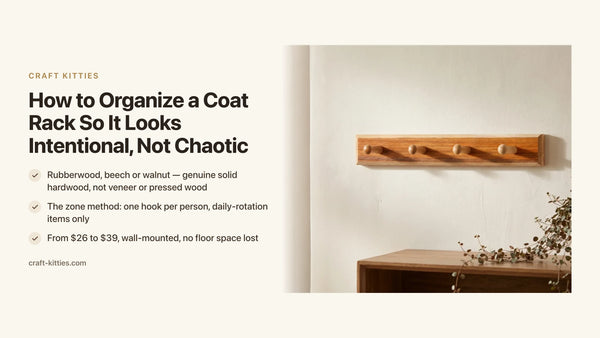
The Japandi entryway needs three things: a place for shoes (a low bench with hidden storage, or a simple shoe cabinet flush to the wall), a place for outerwear (solid-wood wall hooks rather than a bulky coat rack), and one sensory signal that the home is calm. That last point is where a diffuser positioned at nose height — on a small wall shelf, on the entry table — does its most precise work. Walking into a home that smells of sandalwood or hinoki cedar is a different experience than walking into a home that smells of nothing, and the Japandi entryway is designed to notice that difference.
Keep the floor clear. In both Japanese and Nordic traditions, the entry floor is treated as a decompression zone: nothing accumulates on it. One doormat in natural fiber (jute or coir), nothing else at floor level.

Description
Choosing and placing a wood essential oil diffuser in a Japandi home
An essential oil diffuser is one of the few objects that operates simultaneously in three registers: visual (the form and material of the object), tactile (the grain of the wood when you pick it up to refill it) and olfactory (the scent in the room). For this reason it is one of the most Japandi-consistent objects in a home — it earns its place on a surface rather than simply occupying it.
The wood diffusers from our essential oil diffuser collection are made from real solid wood — red oak, walnut or beech — with patterns laser-cut rather than printed or painted on. The distinction matters for Japandi: a printed pattern is decoration applied to a surface; a laser-cut pattern is the material itself revealing a form. The grain of the wood reads through the openings, changing the way the pattern looks as the light changes across the day.
For placement: in the living room, a coffee table or floating shelf at eye level when seated. In the bedroom, the nightstand. In the bathroom, a shelf at nose height. In the home office, one corner of the desk surface. In the entryway, a small wall shelf. One diffuser per room is enough; more than one is too much in a Japandi context.
For oil selection: the oils most resonant with Japandi aesthetics tend toward the wood and earth register — hinoki (Japanese cypress), cedarwood, sandalwood, vetiver, white tea. Lighter options: yuzu, bergamot, green tea. Floral notes work only when restrained; heavy floral is not Japandi.
Comparison — the five diffuser patterns and which room they suit best
| Pattern | Price | Visual character | Best room | Mood |
|---|---|---|---|---|
| Heart Field | $17.00 | Fine repeating hearts — intimate, soft detail | Bedroom, nightstand | Warm, personal, quietly romantic |
| Leo | $17.00 | Celestial lion motif — bold but refined | Home office, desk | Purposeful, grounded, focused |
| Time Vortex | $17.00 | Geometric spiral — precise, meditative | Living room shelf | Calm, structured, contemplative |
| Tree of Life | $17.00 | Branching organic form — nature-forward | Entryway, living room | Rooted, natural, welcoming |
| Virgo | $17.00 | Constellation detail — fine, minimal, precise | Bedroom, bathroom | Refined, quiet, intentional |
Decision matrix — which diffuser for which starting point
| Your Japandi starting point | The right diffuser |
|---|---|
| First Japandi object — bedroom, nightstand | Heart Field — $17 |
| Home office, want a single natural object on the desk | Leo — $17 |
| Living room shelf, geometric and contemplative feel | Time Vortex — $17 |
| Entryway, want an organic nature motif that welcomes | Tree of Life — $17 |
| Bathroom or bedroom — refined and minimal | Virgo — $17 |
| Gift for someone building a Japandi home | Any pattern — the solid-wood material and neutral price point make any of the five a safe, considered gift |

Description
Four mistakes that break a Japandi room
Mixing too many materials at once. Japandi rooms read clearly because they use few materials. When a single room has rattan, bamboo, pine, oak, chrome, stone, ceramic and jute all at once, the eye has no rest. Pick two or three materials and let them recur.
Choosing wood-look laminate instead of real wood. This is the most common compromise, and the one that costs the most aesthetically. Laminate is smooth where real wood is tactile, uniform where real grain is varied. In a style built on the honest quality of natural material, the substitution is immediately legible.
Empty shelves that read as forgot, not as intentional. There is a difference between ma (the Japanese concept of purposeful emptiness) and a shelf that is empty because nothing has been hung on it yet. Purposeful emptiness has one object at one end, a deliberate asymmetry, some quality of arrangement. A shelf that is bare top-to-bottom reads differently.
Scent as afterthought. Japandi is a sensory aesthetic, not a visual-only one. Rooms that look Japandi but smell of nothing — or worse, of artificial air freshener — miss a fundamental layer. The olfactory element does not need to be complex: one diffuser per room, one or two oils that belong to the wood and earth register, and the room is complete in a way it cannot be otherwise.

Description
FAQ — how to decorate Japandi style
1 — What is the difference between Japandi and Scandinavian design? Scandinavian design emphasizes function, light interiors and cozy hygge warmth. Japandi adds the Japanese layer: wabi-sabi acceptance of imperfection, deeper contrast, asymmetry and the discipline of negative space. The result is quieter than Scandi alone and warmer than strict Japanese minimalism.
2 — What colors work in a Japandi palette? Warm off-whites, stone beige, sage green, muted terracotta and charcoal are the core palette. The rule is desaturation: no bright primary colors. Warm neutrals on large surfaces, one or two muted accent tones for textiles and objects.
3 — What wood species suit Japandi interiors best? Red oak reads warm and slightly rustic — it works in Japandi living rooms and bedrooms where hygge warmth dominates. Walnut reads cooler and more refined, closer to the Japanese aesthetic. Beech is the lightest option, well suited to a Scandinavian-leaning Japandi palette. The key is solid wood, not veneer — the honest texture of real grain is central to both traditions.
4 — Can I use patterns in Japandi decor? Yes, but they should be quiet and geometric or drawn from nature. The Heart Field, Tree of Life or Virgo patterns on our wood diffusers are good examples: fine laser-cut motifs that add visual detail at small scale without competing with the calm of a neutral room.
5 — How do I make a Japandi living room feel complete without spending a lot? Start with the surfaces: a neutral wall and one real-wood object on every horizontal plane (coffee table, shelf, side table). Add a single textile in a muted tone. Then place one aromatic element — a wood diffuser is ideal — to engage scent as a layer of calm. The room reads intentional with fewer than five deliberate choices.
6 — Is Japandi the same as wabi-sabi? No. Wabi-sabi is one influence that feeds into Japandi from the Japanese side — the acceptance of imperfection, asymmetry and the beauty of natural wear. Japandi pairs it with Scandinavian hygge (warmth, softness, human comfort), making the result more livable than strict wabi-sabi, which can read as austere.
7 — Do essential oil diffusers fit in a Japandi room? Yes — and they fit particularly well in Japandi because scent is treated as a design element in both Japanese and Nordic traditions. A wood-bodied diffuser with a carved or laser-cut pattern adds a tactile, natural object that earns its place on a shelf rather than breaking the visual calm. Choose a diffuser in solid red oak, walnut or beech to stay within the Japandi material palette.
8 — How do I apply Japandi style to a bedroom on a budget? Clear the nightstand to one object. Replace a plastic or ceramic piece with a solid-wood item — a diffuser, a tray, a small bowl. Add one muted linen pillow. Remove overhead lighting and use a warm low lamp. Four moves, no renovation.
9 — Should furniture legs be visible in a Japandi room? Low-to-the-ground furniture is more Japandi (closer to the Japanese tatami tradition), but furniture with slender solid-wood legs that reveal the floor reads correctly as well. The key is that the leg, if visible, is solid wood — not chrome or plastic.
10 — How many plants belong in a Japandi room? One to two per room, and they should be architectural rather than bushy — a single-stem monstera, a snake plant, a small bonsai rather than a dense collection of varied pots. One well-placed plant is Japandi; a shelf of twelve plants is something else.
Where to go next
The essential oil diffuser collection gathers all five patterns in solid natural wood. If you are building a Japandi room piece by piece, a diffuser is often the right first purchase: at $17 it is a low-commitment way to place a real-wood natural-material object in a room and see how the aesthetic reads before investing in furniture.
The two diffusers that work most broadly as starting points are the Heart Field (warmer, softer, suits bedrooms and intimate spaces) and the Tree of Life (organic and nature-forward, suits entryways and living rooms). Both are solid wood, laser-cut pattern, $17.
We have over 243 reviews on Etsy from customers who have placed our diffusers in exactly these kinds of rooms — the feedback consistently notes how much the solid-wood material reads differently from resin alternatives in person.
The short version
If this guide leaves you with one method: decide on your palette first (stone beige, warm off-white, one muted accent), then choose your wood (red oak for warmth, walnut for depth, beech for lightness), and then apply the ma principle — every surface holds one deliberate object, not a collection. The scent layer completes it: one wood essential oil diffuser per room, one or two oils in the wood-and-earth register, and the room is doing everything Japandi asks it to do.