At a glance
- Warm materials — solid walnut, red oak, hardwood — do more work than any single décor item
- Cable management and desk organization come before aesthetics: you cannot style clutter
- Lighting is the highest-leverage change: one warm desk lamp outperforms a full accessory refresh
Most home offices look like they were set up in an afternoon and never revisited. A monitor, a laptop, a power strip on the floor, a mug that may or may not contain today's coffee. The desk functions, more or less. It does not feel like a place anyone would choose to spend eight hours.
Making a home office feel cozy is a problem people solve in the wrong order. They buy a plant, a nice print, a candle — and three months later the desk still feels cold because the cables are still a mess and the overhead light is still doing all the work. The objects were right. The sequence was wrong.
This guide goes in the right order: first the invisible foundations that coziness depends on, then the materials and objects that carry the warmth, then the specific pieces from our desk organizer collection that do the most work in a home office setting. The goal is a desk that feels genuinely good to sit at — not styled for a photo, but comfortable over the course of a full workday.
Why most home offices never feel right
The fundamental problem with home office aesthetics is that the things that make a workspace cold are structural, not decorative. A plant on a corner of the desk does not undo what overhead fluorescents do to a room. A nice desk mat does not compensate for the visual noise of six cords looping around a monitor arm. Decoration applied on top of a structurally cold workspace reads as decoration — it does not transform the space.
The structural factors that make a home office feel cold rather than cozy: flat overhead lighting that creates no shadow or depth, visible cable bulk that reads as infrastructure rather than workspace, surfaces covered with objects that accumulated rather than were chosen, and the absence of any warm material — real wood, linen, ceramic — in the desk's visual field.
Fix those four things, and the decorative layer starts working. Leave any one of them in place, and it limits everything else.
Lighting first — the change that costs the least and does the most

Overhead ceiling lights — recessed cans, flush mounts, the fixture that was already in the room — are designed to illuminate a room evenly. Evenness is exactly the wrong quality for a workspace meant to feel warm. Even lighting means no shadow, which means no depth, which means the room looks like a supply closet regardless of what you put on the desk.
A desk lamp with a warm-white bulb in the 2 700–3 000 K range does three things overhead lighting cannot. It directs light onto the work surface at the angle where it is useful, rather than flooding the room from above. It creates shadow and depth behind and beside it, which immediately changes the character of the space. And it moves the primary light source into your peripheral vision rather than above your head — the difference between sitting inside a warm room and being lit like a subject under examination.
The desk lamp does not need to be expensive. What matters is the color temperature (warm-white, not daylight or cool-white) and that it is the primary source during work sessions rather than a supplement to the ceiling. Turn the overhead off or dim it to the point where it fills shadows without washing out what the lamp is doing. That shift alone changes the feel of a home office more than most material changes will.
A secondary warm light source — a small table lamp on a bookshelf behind the monitor, a bias light strip behind the screen — layers the effect further. But the desk lamp comes first.
Clear the surface before you style it

Surface coziness depends on intentionality: the sense that every object on the desk is there because someone decided it should be there, not because it landed and stayed. Clutter is not just visual noise — it carries a background cognitive cost. A desk where your eye can rest on a clear surface between tasks is quieter to work at than one where every available inch is occupied.
The editing sequence that works: remove everything from the desk surface, then return objects one by one in order of daily-use frequency. What you reach for every session goes back. What you reach for occasionally goes in a drawer or on a shelf. What you have not touched in a month does not belong on the desk at all.
The second pass is the cozy pass: once the daily-use objects are back, identify which of them could be replaced by a warmer version of the same thing. A plastic pen cup becomes a walnut pen tray. A loose power strip becomes a cable organizer box with a solid wood surface. A pile of miscellaneous desk items becomes a hardwood valet tray with two tiers. The function stays identical; the material changes what the surface feels like to look at.
Five to seven objects is the working maximum for a desk that feels both organized and warm. One anchor organizer, one pen holder, one lamp, one plant, two optional objects — a small notebook, a smooth stone, a single framed photo. Beyond that, the desk starts reading as storage.
The material that carries the most warmth: solid hardwood
The single most effective material for a cozy home office is solid hardwood. Not printed wood-effect plastic, not veneer over MDF — solid wood with grain you can feel with a fingernail, weight that registers when you pick it up, and a surface that develops character rather than degrading over years of daily use.
The reason hardwood works so reliably in a home office context is contrast. Most desk setups are built around cool, smooth, reflective surfaces: a white or light-gray desk, a monitor with a plastic bezel, a laptop lid in aluminum or matte plastic. A solid walnut or red oak object on that surface reads as deliberately warm against a cool background. The grain catches light differently depending on the angle. The weight telegraphs quality without announcing it.
Three species worth knowing for this context. Walnut — deep brown, tight grain, furniture-quality presence — is the most effective for creating warmth against a white or light-gray desk. It reads like an object that has always belonged in a considered room. Red oak — honey-toned, bold and open grain — suits desks where the room already has warmth and you want contrast rather than doubling down on brown. Beech — pale with a tight, even grain — is the right choice for minimalist or Scandinavian setups where walnut would feel heavy. All three are real solid hardwood: the weight, the coolness to the touch, and the grain running continuously through the piece rather than printed on a surface.
The anchor piece: a hardwood valet tray that earns its place

Description
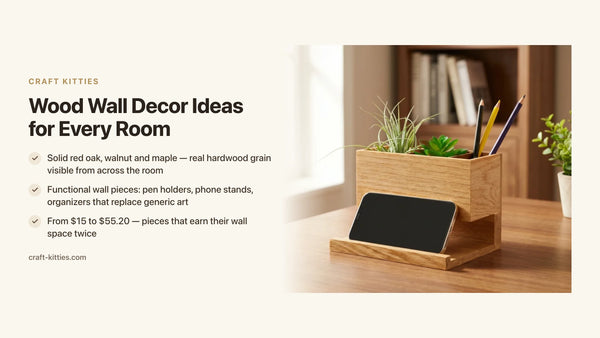
The Hardwood 2-Tier Valet Tray is the piece that earns the most space on a desk surface because it consolidates what would otherwise scatter. The upper tier holds what you reach for throughout the day — phone, earbuds, a pen — in a visible, deliberate spot. The lower layer handles stationery, cables and the objects that tend to migrate: a small charger, a USB hub, a few items that need a defined home.
At $39, it replaces the cost of several smaller organizing solutions that would each take up their own footprint and contribute their own visual noise. Solid hardwood across the full structure means the tray reads as a furniture piece on the desk surface rather than an organizing product. The two-tier format creates vertical depth on an otherwise flat surface — a small shift that changes how the desk reads in peripheral vision while you work. This is the piece to place first, closest to the dominant hand, before the rest of the desk organization resolves around it.
Hiding the cord bulk: a cable organizer that looks like furniture

Description
The Walnut Cable Organizer Box solves the single most reliably cold element in a home office: the visible power strip. Most desks have one. Some have it on the floor, which moves the problem out of immediate sight but does not address the cords running up from it. Others have it on the desk surface — a plastic brick in permanent view that no amount of styling around it can neutralize.
At $46, the cable organizer box encloses the power strip entirely in solid walnut — real wood, tight grain, the same material language as the valet tray and pen tray. The cords enter the box and exit through managed openings; what sits on the desk surface is a walnut object that reads as a considered addition to the setup rather than infrastructure. When the power strip disappears, the cord situation above the desk simplifies dramatically — only the exit cables are visible, and those can be guided along the desk edge out of the primary line of sight.
This is the change that makes the rest of the desk styling work. You can put excellent objects on a desk that has a visible power strip in the corner, and the visual weight of that power strip will compete with all of them. Remove it, and everything else on the desk gets quieter.
Keeping pens and stationery from becoming clutter

Description
The Walnut Pen Tray Desk Organizer at $39 addresses the specific problem of stationery scatter. A desk cup tends to accumulate every pen and marker in the house until it becomes a cylinder of clutter, and most of what it holds is reached for rarely. A flat tray changes the relationship to the tools — everything is visible and reachable without searching, which means you can keep the tray to the four or five items you actually use and let that act as a natural filter.
Solid walnut in a flat format sits low on the desk surface, which keeps the desk's visual plane clear rather than adding vertical bulk. It is also the piece that most immediately reads as décor rather than organizing product — the grain, the weight, the shallow profile — while remaining fully functional as the place where your pens and a spare notebook live. Pair it with the valet tray and cable box and the desk material language becomes consistent: walnut across three surfaces, each doing a different organizational job.
How wood species changes the feel of the setup
The choice between walnut, red oak and beech on a desk is primarily a contrast decision, not a quality one. All three are solid hardwood with similar durability and care requirements. What differs is how each reads against the surfaces around it.
Walnut against a white or light-gray desk is the most reliably warm combination. The deep brown pulls the neutral desk surface toward warmth without adding color, which keeps the setup looking considered rather than busy. It is the right default for most setups — if undecided, walnut is the safe starting point.
Red oak suits rooms that already have warm tones: a white oak floor, a warm paint color, warm-white lighting throughout. Its honey tone with bold grain adds character rather than just warmth — more visual presence than walnut, better suited to a desk where the wood will be the dominant aesthetic rather than a quiet anchor.
Beech — pale, even-grained — is for setups where walnut would feel heavy: a very small desk in a bright room, a strict minimalist Scandinavian arrangement, light-colored floors and walls. It is the least warm of the three species and the most neutral, which is exactly what some setups need.
The principle: choose by contrast with the desk and room, not by the species name alone. The warmest species in a room that already runs warm can read as muddy. The goal is for the wood object to stand out enough to register as a warm element against whatever surrounds it.
Comparison table — three desk organizers, three jobs
| Piece | Price | Species | Primary job | Best for |
|---|---|---|---|---|
| Hardwood 2-Tier Valet Tray | $39 | Solid hardwood | Consolidate daily carry and stationery in two tiers | The desk anchor piece — place this first |
| Walnut Cable Organizer Box | $46 | Solid walnut | Enclose power strip and cord bundle off the visual plane | Visible power strip or cord bulk on the desk surface |
| Walnut Pen Tray | $39 | Solid walnut | Hold 4–6 pens and stationery items in flat visible layout | Replacing the pen cup or clearing stationery scatter |
Decision matrix — which piece to start with
| Your situation | Start here |
|---|---|
| Desk has a visible power strip or cord tangle | Walnut Cable Organizer Box — fix the cold element first |
| Phone, keys, charger and earbuds scatter across the surface | Hardwood 2-Tier Valet Tray — one location for daily carry |
| Pens and stationery crowd the surface without a home | Walnut Pen Tray — flat, minimal, deliberate |
| Setting up a new home office from scratch | All three — consistent walnut and hardwood material language across the surface |
| Looking for a considered gift for a remote worker | Hardwood 2-Tier Valet Tray — the piece most people do not buy themselves |
Plants on the desk — what actually survives the conditions
A plant on the desk works if it can tolerate low light, irregular watering, and the ambient heat from a monitor and nearby power brick. Most desk setups cannot support the plants people actually put there: bright-light tropicals, herbs that need daily moisture, succulents that need more direct sun than any north-facing window can provide.
The two plants that are genuinely low-maintenance at desk conditions: pothos and ZZ plant. Both tolerate low to indirect light, irregular watering (every one to two weeks is fine for a ZZ plant), and do not need supplemental fertilizer to stay alive through winter. Neither requires a grow lamp. Both have enough leaf mass to register as a living element on the desk without demanding daily attention.
A small ceramic or terracotta pot keeps the plant grounded in the warm-materials vocabulary of the desk. A plastic nursery pot does not. The swap from nursery pot to ceramic costs less than a new plant and changes how the plant reads on the desk surface.
One plant is enough. Two plants start to compete with the desk objects rather than complementing them. The goal is a single living element in the desk's visual field — one point of warmth and movement.
Mistakes that undermine a cozy desk setup
Styling before organizing. A desk that has warm objects arranged on a cluttered surface reads as clutter with décor on it. The surface edit — removing everything and returning only daily-use objects — has to happen before anything else.
Buying more objects to feel less cluttered. Adding a new tray does not reduce clutter if the existing objects redistribute themselves across the new tray and the old surface. The edit comes first; the new piece fills the role that the edit revealed is needed.
Leaving the overhead light on. The desk lamp cannot do its work as a warm anchor when the ceiling light is competing above it. Dim or turn off overhead lighting during work sessions and let the desk lamp be the primary source. The room will feel smaller and warmer — which is the goal.
Mixing wood tones without a connecting thread. A dark walnut tray next to a honey-oak pen holder next to a pale beech cable box reads as accidental. Choose one species or two adjacent species (walnut and beech, or red oak and walnut) and keep the desk accessories within that range. Commit to the dominant tone and let it govern the next purchase.
Treating every desk surface as a storage opportunity. The warmth of a well-organized desk depends partly on visible negative space — some empty desk surface between objects. Filling every inch creates a market-stall feeling rather than a workspace one. Edit the objects down until the empty surface between them feels like part of the composition.
FAQ — making a home office feel cozy
1 — What makes a home office feel cozy instead of just organized? Coziness in a workspace comes from warm materials (solid wood, natural fibers), layered lighting that includes at least one non-overhead source, and removing visual noise so the surfaces you do see are intentional. Organization is the prerequisite, but warmth comes from the materials you choose to keep on the desk, not just the absence of clutter.
2 — What wood species works best for a cozy desk setup? Walnut is the most effective single species for a warm desk aesthetic: its deep brown tone with tight grain reads like fine furniture against most white or light-gray desk surfaces. Red oak is the lighter alternative with a bolder grain — better when the room already has warmth and you want contrast. Beech is the pale neutral option that suits Scandi and minimalist setups without adding color.
3 — Is a valet tray actually useful on a desk, or is it just decorative? A valet tray is functional first. It collects the objects that would otherwise scatter across the desk — phone, earbuds, keys, a pen — and keeps them in one visible spot. The decorative quality is a byproduct of the material: a solid walnut or hardwood tray on the desk surface looks intentional rather than cluttered. The two-tier version adds a second layer for stationery or cables, replacing a drawer you may not have.
4 — How do I manage cables without making my desk look cold or technical? A solid wood cable organizer box hides the power strip and cord bundle under a surface that reads as furniture, not equipment. Once the power strip disappears into the box and only the exit cables are visible, the desk surface feels clean without looking like a server room. Walnut is the most effective species for this: its weight and grain tone make the box look like a desk accessory rather than an afterthought.
5 — What is the single most impactful change for a cozy home office? Replacing overhead lighting as your primary work light. Overhead fluorescents or recessed ceiling lights flatten the room and create a clinical feel regardless of what objects you put on the desk. Adding a desk lamp with a warm-white bulb (2 700–3 000 K) changes the character of the entire space. The second most impactful change is putting a warm-material object — solid wood or linen — in the eyeline above the monitor.
6 — How many items should sit on a desk to feel cozy but not cluttered? A working rule: one functional anchor piece (organizer tray or valet tray), one writing tool holder, one lighting source and one object that has no function except to be pleasant — a small plant, a smooth stone, a single book. Five to seven items total. Beyond that, the desk starts reading as storage rather than workspace.
7 — Does a wooden desk organizer require special care? No. A dry cloth is the only regular maintenance a wax- or oil-finished solid wood desk accessory needs. Avoid leaving wet glasses or damp objects on the surface for extended periods, but brief contact is not a problem. The natural oils in walnut and red oak protect the wood from the minor abrasion of daily use; the finish deepens and develops character over time rather than degrading.
8 — Can a cozy desk setup work for serious focus, or does it become distracting? A well-executed cozy setup actively supports focus. The mechanism is reduction of low-grade irritation: when cords are hidden, surfaces are clear, lighting is warm and direct rather than flat overhead, and the objects in your field of vision are materials you chose rather than things that accumulated — the cognitive cost of the environment drops. What distracts is clutter, not warmth.
Where to go next
The desk is usually the first surface in a home that shifts toward intentional material choices — rarely the last. Our desk organizer collection gathers the pieces that answer each other in the same solid walnut, red oak and hardwood families: trays, pen holders, cable management and desk accessories that build a consistent material language rather than a miscellaneous collection. The Hardwood 2-Tier Valet Tray is the right starting point for most desks; the Walnut Pen Tray Desk Organizer completes the stationery side of the surface.
If you found us through Etsy — where over 240 customers have reviewed our solid wood desk pieces — our full range is available on craft-kitties.com, including pieces and configurations not listed in the Etsy shop.
Conclusion — the order that makes the difference
If this guide leaves you with one method: fix the lighting and the cables before styling anything else, then anchor the surface with one piece made from real solid hardwood and let the rest of the desk organize around it. The Hardwood 2-Tier Valet Tray earns its place as that anchor for most setups. The Walnut Cable Organizer Box removes the element that undercuts everything else. The Walnut Pen Tray closes the stationery question. Three pieces, one material language, a desk that finally feels like somewhere you chose to work.