At a glance
- Wall-first rule: clear the floor, claim the walls with a solid wood hook rack
- Vertical zones: hooks at coat height, floating shelf above, slim bench or shoe cabinet below
- Real wood — rubberwood, beech, walnut — holds daily use and improves with age
A narrow entryway is not a design problem. It is a sequencing problem: when items land in the wrong order — coat on the floor, shoes blocking the path, bags on the only chair — the space feels impossible. Change the sequence, and the same three feet of corridor becomes an entryway that actually works.
This guide walks through every decision from scratch: how to assess the space, which zones to claim, what furniture depth matters, how to choose a wall hook rack that holds up to real daily use, and what mistakes permanently shrink a tight foyer. The products in the lineup are solid wood — rubberwood, beech, walnut — finished to age with use rather than deteriorate from it.
The underlying principle is simple: floors are for walking, walls are for storage. In a narrow entryway, that principle is not a suggestion.
Measure the space before buying anything
The first mistake in a narrow entryway is buying furniture without understanding the lane. Before ordering anything, measure two numbers: the clear width of the corridor (wall to wall), and the depth of each wall surface available for mounting.
A lane narrower than 36 inches cannot support any floor furniture without obstructing passage. At 36 to 48 inches, you have room for a very slim bench — no wider than 10 to 12 inches deep — but nothing more on the floor. Above 48 inches, one piece of slim floor furniture becomes viable. Everything else, at every width, belongs on the wall.
The second measurement is wall length. A hook rack needs a horizontal run of 18 to 36 inches of clear wall — no light switches, no door frames, no outlets in the path. Measure from the door stop to the nearest obstruction on each wall, and that number tells you the maximum rack width. Buy to fit the wall, not the ideal.
The five functional zones of a narrow entryway

A narrow entryway functions when each object has an assigned zone. Without zones, the nearest surface collects everything and the system collapses within a week.
Zone 1 — Door zone. The immediate perimeter of the door: a small key hook or tray within arm's reach, a mail slot if the layout allows. This zone handles the items you need in the first and last two seconds of your day. Keep it minimal; every item that lands here by default instead of by design becomes clutter.
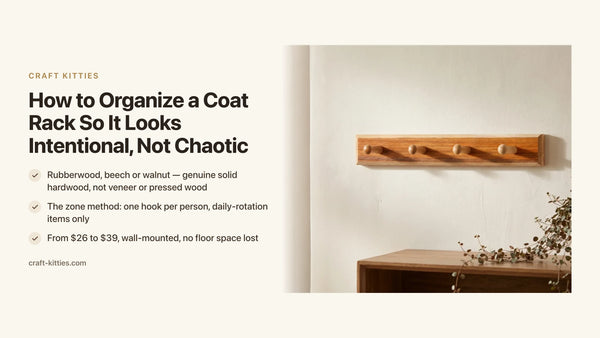
Zone 2 — Coat zone. This is the primary wall real estate: a wall-mounted hook rack at coat height, 60 to 66 inches from the floor for adults. This zone absorbs coats, bags, scarves and helmets. It is the zone where the right rack matters most, because it carries the heaviest loads and sees the most use. A solid wood rack with properly spaced hooks — 6 to 8 inches between each — keeps items accessible without tangling.
Zone 3 — Shelf zone. A floating shelf mounted 6 to 10 inches above the hook rack extends the storage column upward without consuming width. This shelf holds the items that are not daily — a candle, a seasonal hat, a basket for sunglasses. Some hook racks include a top shelf in their profile; if yours does not, a simple floating shelf in the same wood tone completes the column.
Zone 4 — Shoe zone. The floor immediately below the hooks is the logical zone for shoes — but only if shoes are contained, not scattered. A slim bench with a lower rail, a wall-mounted folding bench, or a shoe cabinet under 12 inches deep keeps two to four pairs off the floor. The rule: no shoe extends into the walking lane.
Zone 5 — Light and mirror zone. Natural light and visual depth. A mirror — ideally full-length or at least 24 by 36 inches — mounted on the facing or side wall reflects light and makes the corridor read as wider than it is. A single ceiling fixture or sconce provides enough light that the entry does not feel like a service corridor at night.
Wall hook racks: what separates a good one from a decoration

The hook rack is the anchor of the narrow entryway. It is the piece that takes the most weight — a winter coat with a scarf and a bag can reach 10 to 15 pounds on a single hook — and the most repetitions. Choosing one based on appearance alone is the reliable path to replacing it inside a year.
Material comes first. Solid rubberwood, beech or walnut are the species that hold up to daily rotation without warping, cracking or letting hooks pull away from the backing. These are true solid hardwoods — not MDF wrapped in wood-look film, not pine veneer over particleboard. The distinction matters because an entryway hook takes lateral stress every time you hang and remove a heavy bag; veneered board delaminates at the mounting points over months of that motion.
Hook spacing is the second criterion. Hooks spaced closer than 5 inches force coats to overlap, which means each retrieval disturbs three other items. Six to eight inches of spacing keeps each hook independently accessible. A 4-hook row at proper spacing requires about 24 to 30 inches of wall — confirm that run before ordering.
Profile depth is the third criterion. In a narrow corridor, a rack that projects 6 inches from the wall narrows your lane by 6 inches for its entire length. Good entryway racks project 3 to 4 inches maximum — enough to hold a coat hook at the right angle without claiming walking space.
Load rating matters, and brands rarely publish it clearly. As a baseline: a row of four solid-wood-backed hooks at standard spacing should hold 44 to 66 pounds distributed across the row. If the manufacturer does not publish a number, the absence is usually meaningful.

Description

Description
Slim furniture: the depth rule that changes everything
Furniture depth is the variable most buyers overlook and most retailers do not lead with. In a standard room, a console table at 14 inches deep is slim. In a 36-inch corridor, 14 inches is 39% of your lane — not a console table, a wall.
The depth rules for narrow entryways:
- Bench or console: 10 to 12 inches maximum. Look for "hallway bench" or "wall-mounted bench" rather than "entryway bench," which typically runs 14 to 16 inches.
- Shoe cabinet: 9 to 11 inches. The category exists specifically for this constraint; standard shoe racks at 12 to 14 inches push into the lane.
- Floating shelf: 8 to 10 inches for a display shelf, 12 inches if it needs to hold a basket. Wall-mounted, so depth does not reduce the lane — it only affects overhead reach.
- Mirror: flush or recessed frame only. Mirrors with a 2-inch deep frame project into the corridor exactly like furniture would at eye level.
The corollary of the depth rule: wall-mounted beats freestanding at every category in a narrow entryway. A wall-mounted bench that folds flat when not in use costs the corridor zero depth when not in use; a freestanding bench costs its full depth at all times, including at 7 AM when you are trying to leave.
How to install a wall hook rack: the four-step method
Installation is the step where well-chosen hardware becomes useless or becomes permanent. In drywall — which covers the majority of American walls — the sequence is straightforward, and the most common mistake is skipping the stud finder.
Step 1 — Find the studs. A stud finder takes two minutes and changes the load the rack can hold by a factor of four. Drywall anchors alone hold 30 to 50 pounds per anchor; a screw into a stud holds 80 to 100 pounds. For a coat rack that will hold three winter coats and a pair of bags on a Monday morning, the stud matters. Mark the stud centers in pencil; measure the spacing to confirm (standard 16 inches on center in American framing).
Step 2 — Mark the height. Measure 60 to 66 inches from the floor and mark the centerline of the rack. Check with a level — a rack installed 2 degrees off level will catch the eye every day for as long as it hangs there. Extend the level line across the full rack width before marking the screw holes.
Step 3 — Pre-drill and mount. Drill pilot holes slightly smaller than the screws, which prevents splitting the wood backing of the rack and gives the threads purchase rather than a path through. For racks that span a stud and an open cavity, use a stud screw on the stud side and a rated drywall anchor on the cavity side. Snug the screws; do not over-tighten into wood-backed hardware.
Step 4 — Load test before trusting it. Hang a 15-pound bag on each hook and leave it for ten minutes. Check the plate against the wall; if a gap appears at any corner, one screw has not caught. Correct it now, not after six months of daily loading.

Description
Vertical stacking: multiplying storage without widening the footprint
The narrow entryway has one abundant resource: vertical height. Most corridors run 8 to 9 feet floor to ceiling, and the zone above 72 inches is almost always empty. Vertical stacking turns that dead space into usable storage.
The column system that works in practice:
- 72 to 84 inches: floating shelf for seasonal or occasional items — a hat, an umbrella, a basket of gloves. Too high for daily reach, right for the rotation that happens once a week.
- 60 to 66 inches: the hook rack, as established. Primary daily storage.
- 48 to 58 inches: a secondary hook row for children, or a hook rated for bags rather than coats (bag hooks sit slightly lower so the bag clears the floor).
- 30 to 44 inches: the shelf or console zone, if the corridor allows a shallow surface for a key tray, a small lamp or a plant.
- 0 to 18 inches: the shoe zone. Contained, not scattered.
The vertical column does not require matching pieces from a single manufacturer — it requires consistent depth and consistent material tone. A rubberwood hook rack above a beech floating shelf above a walnut shoe cabinet works if the depth across all three pieces stays within two inches and the wood tones are adjacent on the warm-neutral spectrum.
The comparison table — four hook racks for narrow entryways
| Model | Price | Wood | Hooks | Best for |
|---|---|---|---|---|
| Rubberwood, Brazilian Veneer | $39.00 | Solid rubberwood + Brazilian veneer | 4 or 6 | Statement piece, top shelf included |
| Rubberwood, Cherry Veneer | $37.00 | Solid rubberwood + cherry veneer | 4 or 6 | Warm-toned floors and walls |
| Beech & Walnut Two-Tone | $26.00 | Solid beech + walnut accent | 2 to 6 | Mixed-tone rooms, entry price |
| Walnut, Boot Profile, 4-Hook Row | $28.80 | Solid walnut | 4 | Dark wood preference, structured profile |
Decision matrix — which rack for which entryway
| Your situation | The right pick |
|---|---|
| Light walls, want a warm finish that reads premium | Rubberwood, Brazilian Veneer — $39 |
| Warm wood floors already in the space | Rubberwood, Cherry Veneer — $37 |
| Mixed wood tones in adjacent rooms, want flexibility | Beech & Walnut Two-Tone — $26 |
| Dark furniture throughout, want the rack to match | Walnut Boot Profile — $28.80 |
| Couple or solo — minimal hook count needed | Beech & Walnut, 2-hook config — $26 |
| Family of three or four — need 6 hooks | Rubberwood Brazilian Veneer, 6-hook config — $39 |
| Looking for a housewarming gift that is daily-use | Rubberwood Cherry Veneer — $37, ships ready to gift |
Mistakes that permanently shrink a narrow entryway
Buying furniture for the catalog photo, not the corridor. A bench that looks proportionate in a styled photo with 6 feet of surrounding space looks like a barricade in a 40-inch corridor. Measure the depth, not just the length.
Treating the back of the door as dead space. The back of the door is one of the highest-leverage surfaces in the entryway: over-the-door hooks hold bags, umbrellas and lightweight coats without consuming a single inch of wall or floor. Most entryways have six square feet of usable back-of-door space that goes entirely unused.
Installing hooks at a single universal height. A household with adults and children needs two hook heights: adult coat height at 60 to 66 inches, and a child row at 42 to 48 inches. A rack with a single row at 66 inches forces children to either pile things on the floor or stretch to reach — and they will choose the floor.
Using open shoe storage in a narrow lane. An open shoe rack with four pairs of shoes protruding 12 inches into a 40-inch corridor leaves 28 inches of walking space — less than a standard door. Closed shoe storage, wall-mounted folding benches, or a slim cabinet with a door maintains the lane.
Choosing white or light wood for a high-traffic entry. A scuff on white paint or a mark on pale wood reads immediately against a light background. Dark walnut, stained rubberwood or cherry veneer hides the incidental contact that a high-traffic entry inevitably accumulates.
Letting the entry become a permanent parking zone. No organizational system survives without a rule about transit versus storage. Items in transit — a bag going to the car, a package waiting to be mailed — need a designated temporary zone, usually the bench seat. Items in storage — coats that belong here, house keys — go on the rack. Without that distinction, every surface fills.

Description
The wood species in our hook racks: what each one is
Because the choice of species affects the look of the entryway for years, a short clarification of what each rack is made from:
Rubberwood (Hevea brasiliensis) is a dense tropical hardwood harvested from rubber trees after their latex production cycle ends. It is classified as a genuine solid hardwood — not a softwood, not engineered wood, not a composite — with a Janka hardness comparable to ash. Its grain is fine and relatively neutral in tone, which makes it an excellent base for veneer finishes. The Brazilian and cherry veneer options in our lineup apply a thin layer of natural wood veneer over a solid rubberwood core, giving both the structural integrity of solid hardwood and the visual character of the veneer species.
Beech (Fagus sylvatica) is a European hardwood prized for its uniformity, tight grain and pale blonde tone. In the two-tone rack, the beech body provides a clean background that lets the walnut accents read clearly. Beech is one of the most stable hardwoods in interior conditions — it does not shift seasonally the way softer species do.
Walnut (Juglans nigra, black walnut) is the deepest and most richly grained species in the lineup. Its Janka hardness of around 1,010 lbf makes it a genuine structural wood, not a decorative one. In the boot-profile rack, the walnut is cut and finished to show the grain direction clearly — the figure varies piece to piece, which is a property of real wood, not a defect.
All four models use solid or solid-core construction. None are MDF, particleboard, or wood-look laminate.
Maintaining wood hook racks in an entryway
An entryway is a damp environment in winter — wet coats, snow-dusted bags, rain-streaked umbrellas. The maintenance protocol is minimal but not zero.
Wipe down once a week with a dry or barely damp cloth to remove the surface film that builds up near the door. No harsh cleaners, no spray polish on the wood surface.
Check the screw torque every six months. Daily load cycles work screws slightly loose over time. Snugging each screw back takes under two minutes and keeps the rack plate flush against the wall.
If the surface marks, a small amount of matching wood wax applied with a soft cloth and buffed off restores the sheen without stripping the finish. The finish on solid wood is reparable in place; the finish on veneer-over-MDF is not.
Do not let wet items sit against the wood for extended periods. A coat dripping with rain should be hung — that is what the rack is for — but a soaked umbrella resting against the rack face for hours, repeatedly, will eventually raise the grain. A hook at the lowest point of the rack for umbrellas, or a small umbrella stand on the floor below, separates the dripping problem from the wood surface.
Where to go next
The wall hook rack collection brings together every model in the lineup — from the two-hook minimal configuration to the six-hook family rack — with consistent photography so you can compare wood tones directly. For entryways that need more than hooks, the Rubberwood Wall Hook Rack with Brazilian Veneer and the Two-Tone Beech and Walnut Wall Hook Rack both ship ready to mount, with hardware included. Our studio has 243 reviews on Etsy from buyers who chose solid wood for exactly this kind of daily-use context.
Conclusion — three moves that change the entryway
If this guide resolves to three actionable moves: clear the floor completely, mount a solid wood hook rack at the right height for the people who use it, and stack a floating shelf above it to claim the vertical zone. Every other decision — bench depth, shoe strategy, mirror placement — builds from that foundation.
The Rubberwood Wall Hook Rack with Brazilian Veneer is the answer for most entryways: real hardwood, top shelf included, 4 or 6 hooks, $39. The Two-Tone Beech and Walnut rack is the entry point at $26 for smaller households or tighter walls. The Walnut Boot Profile rack is the choice when the rest of the house runs dark. Three paths, one result: an entryway that works from the first morning you use it and improves from there.