At a glance
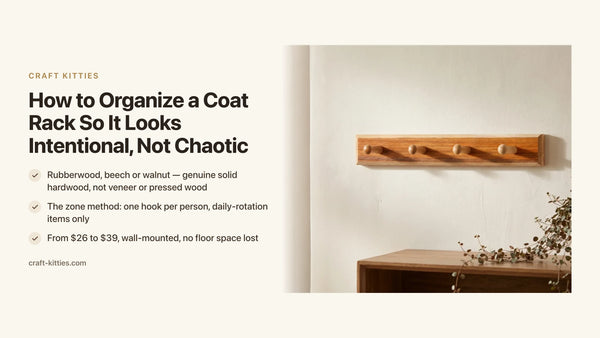
- Wall-mount beats floor storage in any entryway under 8 ft wide
- Solid rubberwood, beech or walnut: hardware that looks like decor, not furniture you apologize for
- From $26 to $39, four to six hooks, modular by design
Walk into most homes and the entryway tells the story before anyone opens their mouth: a shoe pile by the door, a few coats draped over the stair rail, a bag that has lived on the floor so long it has become part of the architecture. The space is small, high-traffic and merciless about revealing whether a household has a system — or is getting by without one.
Organizing entryway shoes is not a storage problem. It is a habit problem with a storage solution. The right fixture makes the ordered behavior effortless: a hook rail that holds shoes, bags and coats in one place means returning home and hanging up becomes the path of least resistance, not a conscious act of discipline. The wrong fixture — the one that is too narrow, too low, or too ugly to use — gets ignored within a week.
This guide covers every meaningful approach: wall-mounted hook racks, slim benches, vertical tiered shelves and hybrid systems. It identifies which format works in which entryway size, how to mount properly so the fixture holds for years rather than months, and which solid-wood pieces from our studio are worth the investment. One note upfront, because it shapes every recommendation that follows: wood matters. A rubberwood or beech rail with a walnut or cherry veneer is not the same object as a painted MDF bracket or a wire grid screwed to the wall. The grain ages, the hardware develops a quiet authority, and guests notice — not because it is showy, but because it reads like a deliberate choice.
At a glance
- Wall-mount beats floor storage in any entryway under 8 ft wide
- Solid rubberwood, beech or walnut: hardware that looks like decor, not furniture you apologize for
- From $26 to $39, four to six hooks, modular by design
Why most entryway shoe systems fail within a week
The failure mode is almost always the same: the system asks for more effort than the alternative. A tiered floor rack pushed against the wall sounds organized until the third rainy day, when two pairs of wet boots block it and nobody wants to crouch down to re-stack the dry pairs behind them. The pile reasserts itself.
What makes a system stick is a one-motion action. You open the door, you step in, you hang your shoes — one gesture, then you are done. Wall-mounted hook racks enforce this naturally: the hook is at eye level, the motion is vertical, and there is no crouching, rearranging or stacking involved. The entryway stays ordered because the easiest thing to do is the ordered thing.
The second failure is sizing. A four-hook rail for a household of four means four hooks shared across sixteen daily shoes plus coats plus bags. It runs out in the first hour of a school morning and gets abandoned by Wednesday. The math matters: budget at least two hooks per person at minimum, with one extra hook for guests and one dedicated to bags. Most entryways need six to eight hooks, not the four that look tidier in a product photo.
The third failure is height. A hook rail mounted at the wrong height — often wherever the last tenant's picture frame left marks — trains everyone in the household to ignore it. Shoes that do not hang at an easy angle get dropped on the floor instead. Mount at 60 to 66 inches for adults, 48 inches if children share the rail.
The four entryway archetypes — and which storage approach fits each

Narrow corridor, under 36 inches wide. The floor is off-limits. Any object on it — a bench, a tiered rack, a basket — either blocks the path or narrows it to the point where two people cannot pass. The only viable system is fully vertical: a wall hook rail that lifts every shoe, coat and bag off the ground. Six to eight hooks on a rail that runs the length of the usable wall is more capacity than most households realize. Nothing touches the floor.
Mid-size entryway, 36 to 48 inches wide. Enough width to allow a bench along one wall without blocking the passage. The bench serves two functions: a seat for removing shoes and a visual anchor that makes the space feel intentional rather than transitory. Pair it with a hook rail mounted directly above the bench, and the zone becomes self-contained — shoes sit on the bench during the removal ritual, then go on the hook or into a basket underneath.
Generous entryway, 48 inches or wider. Room for a bench, a rail and a side element — a floating shelf, a small console or a mirror. The risk in larger spaces is over-furnishing and ending up with the same visual clutter, just more spread out. Keep the furniture count low and let each piece do more than one job: the bench stores, the rail holds everything vertical, the shelf handles keys and mail.
Open foyer, no defined walls. In loft-style homes or open-plan apartments where the entryway is a zone rather than a corridor, define the boundary with a rug and anchor it with a freestanding rail or coat tree. The hook rail goes on the nearest structural wall or is mounted on a freestanding panel. The discipline here is zonal: everything that belongs to the entry routine lives in the zone, nothing migrates inward.
Wall-mounted hook rails: the core of any entryway system
A wall hook rail does something a floor-based system cannot: it removes footwear from the ground entirely and makes it part of the wall's visual composition. Done with solid wood and proper hardware, the rail reads like an architectural element rather than an afterthought.
The key variables are material, hook count, hook profile and mounting height. On material: rubberwood and beech are both dense, stable hardwoods that handle the humidity swings an entryway experiences every time an exterior door opens in winter or summer. A cherry veneer or walnut veneer surface over a rubberwood core gives you the warmth of fine wood grain at a practical price; solid walnut throughout is the most durable and the most satisfying to touch. Either way, the distinction from painted MDF or bamboo composite is felt as much as seen — the hooks hold firm, the rail does not flex under load, and the wood does not swell at the edges over humid seasons.
On hook profile: standard coat hooks are designed for textile — they grip a collar or a loop. The boot-profile hook has a longer, heavier arm that lets you hang a boot by its shaft or drape two pairs of shoes by their collars without them sliding off. If the household uses tall boots in winter, at least two boot-profile hooks in the rail are not optional.
On hook count: start with the number of household members times two, then add two for guests and bags. A solo apartment can work with four hooks; a family of four needs eight, minimum. Our modular rails go from two to six hooks on a single backing — long enough to anchor a wall without overwhelming it.
How to mount a wall hook rail so it holds for years
The mistake most people make is mounting into drywall alone. Drywall anchors rated for the weight shown on their packaging are rated for a static load — not the lateral force you apply each time you yank a wet boot off a hook. Two anchor points into wall studs, or toggle bolts rated for the dynamic load, are the correct baseline.
Step 1 — Find the studs. Use a stud finder and mark both stud locations with a light pencil mark. Standard stud spacing is 16 inches on center, which is wide enough to span two studs with almost any rail over 24 inches.
Step 2 — Set the height. Mark the mounting holes at the correct height for your household (60 to 66 inches for adults-only, 48 to 54 if children share). Use a level. A rail that is mounted two degrees off horizontal is off every time you look at it.
Step 3 — Pre-drill. For drywall, a 1/8-inch pilot hole prevents splitting. For tile (in mudrooms), a masonry bit and a slow drill speed prevent cracking.
Step 4 — Drive the screws into studs. Three-inch wood screws into solid studs will hold the rail and any load you put on it for decades. If you cannot hit studs at your target location, use drywall anchors rated for at least 50 lbs each and space them 12 inches apart.
Step 5 — Load test before the finish coat. Hang a full bag from each hook and pull laterally. If the rail does not move, you are done. If it flexes, add a third anchor point at the center.
For renters who cannot drill: high-strength adhesive strips rated for 10 lbs per strip work reliably for lighter loads (sneakers, tote bags, light jackets). Use at minimum four strips per rail section, degrease the wall thoroughly, and wait the full cure time before loading. Do not use adhesive for heavy winter boots or leather coats — the load profile is too dynamic.
The five models from our studio
Four hook rails, each designed for a different entryway personality — in real rubberwood, beech or walnut, with finishes that hold up to daily use.

Description
The Brazilian veneer rail is the one to choose when the entryway is visible from the living area. The rubberwood core is dense and stable, and the Brazilian veneer surface has a warm, even grain that photographs like furniture rather than hardware. Four to six hooks on a single backing; the hooks themselves are solid and flush-mounted so nothing protrudes awkwardly. At $39 it is the highest-investment piece in the lineup — and the most durable.

Description
The cherry veneer version shares the same rubberwood core and hook configuration but carries a deeper, slightly reddish-brown tone that pairs naturally with mid-century furniture, warm whites and terracotta. The cherry grain is tighter and more uniform than Brazilian veneer — a quieter presence that recedes into the wall in the best way. At $37, one step below the Brazilian and virtually identical in construction.

Description
The two-tone beech and walnut rail is the most modular option: it starts at two hooks and scales to six on the same rail, which means you buy it for a small apartment and expand it when the household grows without replacing the fixture. Beech is a true hardwood — denser than pine, more stable than bamboo — and the walnut contrast strip across the backing gives it a graphic quality that suits both Scandinavian and contemporary interiors. At $26 it is the sharpest entry into real solid wood.

Description
The walnut boot-profile rack is purpose-built for households that rotate through tall boots. Solid walnut — not a veneer, not a composite — with four hooks on heavy-profile arms long enough to hold a boot by the shaft without the toe dragging against the wall. The walnut finish is oiled and smooth; the hardware is substantial. If your entry routine involves Chelsea boots, riding boots or tall rain boots for multiple people, this is the rail that actually solves the problem at $28.80.
Comparison table and decision matrix
| Model | Price | Wood | Hook count | Best for |
|---|---|---|---|---|
| Brazilian Veneer Rail | $39.00 | Rubberwood + Brazilian veneer | 4 to 6 | The visible, statement entryway |
| Cherry Veneer Rail | $37.00 | Rubberwood + cherry veneer | 4 to 6 | Warm-toned, mid-century rooms |
| Beech & Walnut Two-Tone | $26.00 | Solid beech + walnut accent | 2 to 6 | Modular, Scandi, apartment-scale |
| Walnut Boot-Profile Rack | $28.80 | Solid walnut | 4 (boot profile) | Boot-heavy households |
| Your situation | The right pick |
|---|---|
| Light wall, entryway visible from living area, you want it to look intentional | Brazilian Veneer Rail |
| Warm tones, mid-century or Japandi aesthetic | Cherry Veneer Rail |
| Small apartment, want to start small and expand later | Beech & Walnut Two-Tone (2 to 6 hooks) |
| Household with tall boots (Chelsea, riding, rain boots) | Walnut Boot-Profile Rack |
| Maximum budget is $30, still want real hardwood | Beech & Walnut Two-Tone at $26 |
Entryway benches: when they help, when they hurt

A bench earns its floor space only when it solves a real friction point: the one-legged balancing act of removing ankle boots or lace-ups while standing. If that friction exists in your household — and it is most acute for children, elderly residents or anyone returning home with packages in hand — a bench pays back its footprint in daily comfort.
The sizing rule is strict: the bench depth must leave at least 36 inches of clear passage after it is placed. In a corridor of 40 inches, a bench deeper than 14 inches blocks passage. In a corridor of 36 inches, there is no bench depth that leaves comfortable passage — the floor stays clear and you invest in the hook rail instead.
A bench with open storage underneath — wire baskets, wicker bins or simple cubbies — multiplies its function: the surface is for sitting, the underside is for storing off-season footwear or sports equipment. A bench with a closed base looks tidier but does less work. In a family home, open under-bench storage is almost always the right call.
Minimalist tricks that work without buying anything
Before any fixture goes on the wall, the edit matters. The most effective organizing move in any entryway is reducing the number of shoes that live there. The entryway is not storage — it is the transition zone. One to two pairs per household member belong there: the shoes they wore today, and the ones they are most likely to wear tomorrow. Everything else lives in a closet.
The second trick is the one-in-one-out rule applied at the entryway: when a new pair of shoes enters the display area, an old pair returns to the closet. This rule costs nothing and prevents every system from collapsing under accumulation over time.
The third trick is vertical space stacking. If the entryway wall is tall — 9 feet or higher — mounting two rails of hooks at different heights doubles the capacity without doubling the footprint. The lower rail handles daily shoes at 48 inches (accessible to all household members including children); the upper rail at 66 inches handles bags, coats and items used less frequently.
Finally, a boot tray placed directly below the hook rail contains the mess of wet boots and muddy soles without requiring anyone to do anything: the tray is there, the boots land in it, the floor stays clean. A solid wood hook rail above a simple boot tray is the minimal system that outperforms every more elaborate arrangement in long-term consistency.
Three mistakes that undo a well-chosen rack
Mounting on drywall without studs or proper anchors. A rack that pulls free from the wall after six months is more disruptive than no rack at all — it leaves holes, it breaks the system and it creates skepticism about fixing the next one properly. Spend five minutes finding the studs; spend $4 on the right anchors. The rail will outlast the house.
Buying more hooks than the wall or habit can sustain. Eight hooks on a wall that is only four feet wide becomes a visual nightmare once all eight are loaded with shoes, coats, bags and miscellany. Match hook count to wall width and household discipline: a two-to-four hook rail used consistently beats an eight-hook rail where three hooks are perpetually empty and five are overloaded.
Ignoring finish compatibility with the rest of the room. A raw pine rail in a room that has warm walnut floors and brushed-brass fixtures creates dissonance that is felt before it is named. The entryway sets the tone for the home; the rail is the first fixed object a guest sees. The Brazilian veneer and cherry veneer rails in our wall hook rack collection are designed to read like furniture: they carry grain, warmth and finish quality that holds its own against whatever comes through the door.
Seasonal maintenance for a wood hook rail
Real wood requires almost no upkeep — but a small annual ritual keeps it at its best. Once a year, wipe the rail down with a barely damp cloth, let it dry for 30 minutes, then apply a thin coat of wood conditioner or beeswax polish with a soft cloth. This feeds the surface, deepens the grain color slightly, and prevents the rail from drying out and developing micro-cracks around the hook hardware.
The hooks themselves — if they are metal — can develop surface oxidation in a humid mudroom environment. A pass with a dry microfiber cloth and a drop of mineral oil once a year is sufficient. For rubberwood and beech surfaces that see frequent contact from wet hands or damp shoes, a light sand with 220-grit paper followed by a fresh wax coat restores the surface in 20 minutes.
FAQ — how to organize entryway shoes
1 — What is the best way to organize shoes in a small entryway? Going vertical is the single most effective move in a small entryway. A wall-mounted hook rail keeps footwear off the floor entirely, reclaiming space without narrowing the passage. Pair it with a strict limit — two pairs per household member on display, the rest stored in a closet — and even a six-foot hallway feels ordered.
2 — How many shoes can a wall-mounted rack actually hold? A standard wall-mounted hook rack designed for entryways holds four to six hooks, which translates to four to six pairs of shoes or a mix of shoes, bags and coats. Modular systems that go from two to six hooks let you start small and expand along the same wall as the household grows.
3 — Can I install a wall hook rack without drilling? Yes. High-strength adhesive strips rated for the weight of your rack plus its load work reliably on painted drywall and tile. The limitation is load: heavy winter boots push the weight limit of adhesive installation. For lighter footwear and bags, adhesive is renter-safe and fully reversible.
4 — What wood species work best for an entryway rack? Rubberwood and beech are dense, stable hardwoods that resist the humidity fluctuations an entryway sees every time the door opens. Walnut veneer or cherry veneer over a rubberwood core gives you warmth and grain at a practical price point. Solid walnut or beech throughout is the most durable long-term choice.
5 — How high should I mount a hook rack in the entryway? Between 60 and 66 inches from the floor for an adult household; 48 to 54 inches if children share the rail. The goal is a natural arm-reach angle — the hook should meet the hand without the elbow going above shoulder height.
6 — Is an entryway bench worth the floor space it takes? In an entryway wider than 36 inches, yes — a bench makes removing shoes deliberate and comfortable. In narrower passages it blocks the path; replace it with a wall hook rail and zero floor footprint.
7 — What is the boot-profile hook, and why does it matter for shoes? The boot-profile hook has a longer arm than a standard coat hook, which lets it grip the shaft of a boot or hold two pairs of shoes by the collar without them sliding. For households with tall boots, the boot-profile rack from our studio is the rail that actually holds the load correctly.
8 — How do I keep an entryway from looking cluttered even when it is organized? Containment and contrast. Containment: every object has a fixed place, no pair migrates to the floor "just for tonight." Contrast: a walnut or cherry veneer rail against a light wall reads as decor, not storage hardware. When the fixture is beautiful, the objects on it become part of the composition rather than a pile.
9 — Can a wall hook rack hold bags and coats as well as shoes? Absolutely — that multi-function capacity is the main argument for a hook rack over a dedicated shoe rack. A four-hook rail might hold one pair of sneakers per hook alongside a tote, a school bag and a light jacket. If you need pure shoe capacity, a tiered shelf system outperforms hooks; for the full entry load, the hook rack wins by consolidating everything in one fixture.
10 — How do I choose between two hooks and six hooks? Count the household members and multiply by two: one hook for daily shoes, one for a bag or coat. A two-person household can live on four hooks; a family of four needs at least six. The Two-Tone Beech & Walnut Rail goes from two to six hooks on the same backing — start where you are and expand without replacing.
Where to go next
The hook rail is the anchor of the entryway, but it rarely works alone. Our wall hook rack collection covers every configuration covered in this guide — Brazilian veneer, cherry veneer, two-tone beech and walnut, and the solid walnut boot-profile rack — all built from real hardwood and designed to age rather than degrade. If you want to see how customers have lived with these pieces, our Etsy shop has over 243 verified reviews that describe real households and real use over time.
Conclusion — one rail, a different entryway
The organizing principle is simple: vertical is better than floor-based, real wood is better than composite, and the hook count must match the household. The Brazilian Veneer Rail is the statement choice for a visible entryway; the Two-Tone Beech & Walnut is the sharpest entry into real hardwood at $26; and the Walnut Boot-Profile Rack solves the problem that a standard hook cannot. Mount it at the right height, load it consistently, and the entryway transforms from the most apologized-for space in the home to the first thing guests notice — in the right way.