At a glance
- Solid wood hook racks at two heights: adult row at 60–66", child row at 38–44"
- Assign one hook per item, not one hook per person
- Drop zone = hooks + floor bin + narrow shelf: three pieces, one system that holds
The family entryway has an unusual relationship with organization: everyone agrees it needs it, and almost no one manages to sustain it. Coats end up on the floor ten minutes after they were hung up. The backpack that had its own hook migrates to the kitchen chair by Tuesday. Shoes colonize the mat and expand outward.
Most guides treat this as a habit problem. It is not. It is a furniture problem. When the entry is set up with the right pieces at the right heights — solid wood hook racks at two levels, a clear floor zone for shoes, a narrow surface for the objects that arrive with people — the system runs on its own. Kids hang coats because the hook is where they can reach it. Backpacks stay because there is nowhere else that is as convenient. Keys stop disappearing because there is a place designed for exactly one purpose.
This guide builds that system from the wall out: how to design the hook zone, what hardware actually holds a family's daily load, which species of solid wood survives the daily collision, and the four products from our studio that cover every scenario from a two-kid household to a narrow apartment entry.
Why entryway organization with kids fails — and what fixes it
The failure mode is almost always the same. There are hooks, but they are all at adult height. There is a basket, but it is too far from the door to intercept anything. There is a surface for keys, but it is also where homework lands, and then the mail, and then the phone charger, until it is just a table that things go on.
Three principles cut through that accumulation.
First: height is everything. A hook at 64 inches is invisible to a seven-year-old. The coat ends up on the floor not because the child is ignoring the system — it is because the child physically cannot use it without effort. The fix is a second row of hooks at their shoulder height: roughly 38 to 44 inches from the floor, depending on age. When the hook is at eye level, the coat goes there by reflex.
Second: one item per hook. The "pile-on" problem — three coats stacked on one hook, the inner two invisible — comes from under-hooking. Two hooks per person is the minimum; for school-age children with a coat and a backpack, three is more realistic. Count your items before you count your hooks.
Third: the floor zone is furniture, not an afterthought. A tray or low bin near the door intercepts shoes before they scatter. It does not have to be elaborate — a low wooden tray or a simple basket works — but it has to be there, visible, and sized correctly. Without a floor zone, shoes migrate.
The three zones of a functional family entry

A well-organized family entry has three distinct zones, each handling a different category of object.
Zone 1 — the wall. This is where coats, bags, and backpacks live. A solid wood hook rack mounted at two heights handles both adults and children. The upper row at 60 to 66 inches serves adults; a lower row — either a second rack or hooks on the same board — at 38 to 44 inches gives kids their own reach zone. The crucial rule: two hooks minimum per person. One for the coat, one for the bag. Children with a backpack and a sports bag need three.
Zone 2 — the floor. Shoes need a dedicated landing zone within direct reach of the mat. A tray, a low basket, or a simple cubby bench makes the difference between shoes that stay and shoes that scatter. The container does not need to be large — it needs to exist, and it needs to be the obvious place. Anything more than two steps from the door gets ignored.
Zone 3 — the narrow shelf. Keys, school notices, sunglasses, and wallet need a flat surface within arm's reach of the hook rack. This is where a thin floating shelf or a hook rack with a built-in ledge earns its place. Without this surface, small objects land on the floor, the windowsill, or the kitchen counter — wherever happens to be closest. Give them one correct home and they go there.
Choosing the right hook rack: what actually matters
Not all hook racks work equally in a family setting. The factors that matter in a showroom — finish, color, price — matter less than the factors that show up in daily use.
Load capacity. A full winter coat plus a loaded backpack on a single hook can weigh eight to twelve pounds. Multiply by six hooks at full load and you are asking a piece of wall hardware to hold sixty to seventy pounds consistently, with the load shifting every time a child grabs and drops a bag at speed. This is why solid wood matters over MDF: the wood itself has enough density to hold screws and anchors under dynamic load without working loose over months.
Hook design. Hooks with a slight upward curve or a double-peg configuration hold better than flat horizontal hooks. A flat hook lets a bag slide off the moment the weight shifts; an upward curve or a gap between two pegs creates a retention point. In a household where things are grabbed at speed rather than carefully placed, this is the difference between a rack that works and one that frustrates.
Number of hooks and spacing. A rack with hooks too close together causes coats to overlap and tangle, which means the inner coats never get hung up because pulling them out requires removing everything else. Look for at least four to five inches between hook centers. Six hooks on a 24-inch rack can work; six hooks on an 18-inch rack is a setup for pile-on.
Mounting method. Solid screw anchors into studs or appropriate drywall anchors are the only reliable option for a family hook rack that carries real weight. Adhesive mounting strips are not rated for this load and fail without warning.
The solid wood question: rubberwood, beech, and walnut explained

The three wood species in our hook rack lineup each have distinct properties that affect how they hold up in a high-traffic entry.
Rubberwood is the workhorse. Dense, uniform in grain, and exceptionally stable under variable humidity — the kind of humidity that swings from a summer rainstorm to a dry heated interior in one afternoon. Its tight, pale grain makes it an excellent base for veneer finishes: the Brazilian veneer and cherry veneer variants in our lineup use rubberwood as their structural core precisely because it holds its shape and doesn't telegraph stress cracks through a thin surface layer. In daily family use, rubberwood shrugs off the impact it receives.
Beech is the other pale hardwood, similar in density to rubberwood but with a finer, slightly more visible grain. In the two-tone rack, it pairs with walnut to create a visual contrast that reads architectural rather than rustic — the pale beech board against walnut-toned elements gives the rack a quiet intentionality that suits modern and Japandi-style entries.
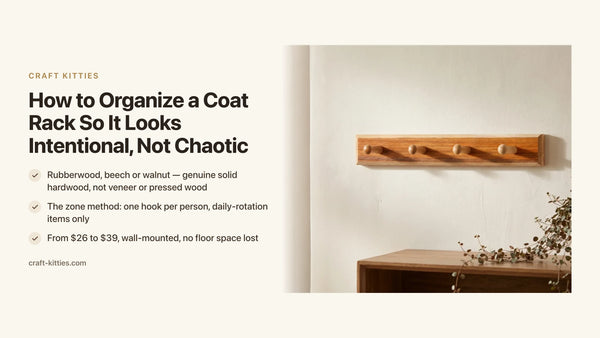
Walnut is the design choice when the entry is meant to impress. Its deep brown color and fine, consistent grain give it the furniture weight that lighter woods can't quite achieve. The walnut boot-profile rack in our lineup uses solid American black walnut for exactly this reason — it is the kind of piece that makes a narrow entry look considered rather than assembled from whatever fit.
None of these is fragile. All three are solid hardwood, not MDF cores with a printed grain film. They do not swell at the screw points, do not delaminate at the edges, and do not reveal their structure after a year of heavy use. That is the material distinction that determines whether a hook rack looks the same in three years as it did the day it went up.
The hook racks from our studio
Five products, four families of use.

Description
The Brazilian veneer rack is the one we reach for when the entry needs to hold a full household's daily load and still look deliberate. The rubberwood core handles the structural demands; the Brazilian veneer face gives it the warm, dimensional grain that reads as real furniture on the wall. Configurable from four to six hooks, with enough spread between them to accommodate winter coats alongside backpacks without pile-on. At $39 it is the most capable piece in the lineup for a family setting.

Description
The cherry veneer variant uses the same rubberwood construction with a warmer, redder face that suits cream-walled entries and lighter floors. Cherry grain has a natural luster that shifts slightly with light — it reads differently at noon than at dusk, which is what makes it a living surface rather than a painted one. Same hook count, same load capacity, different visual temperature. At $37 it is the accessible choice for a warm-palette entry.

Description
The beech and walnut two-tone rack is the entry-level piece and the most configurable. Starting at two hooks for a studio apartment or bedroom drop zone, scaling to six for a full family entry, it fits situations where both adaptability and budget matter. The pale beech and dark walnut combination works particularly well against white and light-grey walls. At $26 it is the lowest price point for a rack built from real wood.

Description
The walnut boot-profile rack takes a different approach: a compact horizontal row of four deep hooks in solid American walnut. The boot-profile design gives each hook extra depth, which matters when you are hanging a loaded bag alongside a winter coat — the extra reach keeps the bag from resting against the wall and marking it. At $28.80, this is the piece for an entry where floor space is genuinely tight and the design register matters.
Comparison table: which rack for which entry
| Model | Price | Wood | Hooks | Best for |
|---|---|---|---|---|
| Rubberwood Brazilian veneer | $39.00 | Solid rubberwood + Brazilian veneer | 4–6 | Full family entry, warm-toned walls |
| Rubberwood cherry veneer | $37.00 | Solid rubberwood + cherry veneer | 4–6 | Light walls, warm-palette entries |
| Two-tone beech & walnut | $26.00 | Solid beech + walnut | 2–6 | Budget-first, modern minimalist look |
| Walnut boot-profile 4-hook row | $28.80 | Solid walnut | 4 | Tight spaces, design-forward entries |
Decision matrix — which rack for your specific situation
| Your situation | The right pick |
|---|---|
| Family of four, heavy daily load (coats + backpacks + sports bags) | Rubberwood Brazilian veneer, 6 hooks |
| Light walls or cream-toned entry, want warmth without dark wood | Rubberwood cherry veneer |
| Two adults, small budget, white or grey walls | Two-tone beech & walnut, 4 hooks |
| Narrow entry, want a design-forward rack that reads like furniture | Walnut boot-profile row |
| Primary rack for adults + second rack for kids below it | Brazilian veneer at 64" + two-tone at 40" |
Installing a family hook rack: what the instructions don't tell you
The standard installation step — find studs, pre-drill, screw in — is straightforward. These are the four points that matter around it and that most guides skip.
Mount at two heights if you have children under ten. The adult row goes at 60 to 66 inches from the floor: reachable for an adult in a coat with hands full, high enough to keep a long coat off the floor. The child row goes at 38 to 44 inches: reachable for a five-to-eight-year-old without tipping, low enough that a kindergartener can hang a backpack without a step stool. This single adjustment eliminates most of the coat-on-floor problem.
Anchor into studs when the load is real. A hook rack carrying four heavy winter coats and backpacks in a family entry is not a lightweight decoration — it needs to be in a stud or use proper toggle anchors rated for the weight. Drywall alone, without anchors, will work loose within months under dynamic load. If you cannot find the studs, use toggle bolts rated at 50 pounds or more per anchor point.
Check level before tightening. A hook rack installed half an inch off level is visually obvious the moment something heavy hangs on it and the natural plumb line appears. Thirty seconds with a level before the final screws saves the annoyance of re-drilling.
Leave three to four inches from the top of the hook to the ceiling or shelf above. A hook too close to the overhang means coats bump and drag when you try to hang them. Measure before you commit to a mounting height if there is cabinetry or a low ceiling nearby.
The daily habits that make or break a system
The right furniture is necessary. It is not sufficient on its own with young children. These three habits, once established, are what make the system self-sustaining.
The two-minute rule at the door. Coats go on hooks before anything else happens — before shoes come off, before phones come out. It takes about eight seconds. The sequence matters: if coats come off and get draped over the nearest arm while shoes are removed, they rarely make it back to the hook. Making the hook the first act after the door closes is the only reliable protocol.
Each person has their own hook. Not just any available hook — their specific hook. Named, if necessary. This removes the negotiation about which hook is whose and eliminates the "there's no room" excuse that happens when four people share three hooks by consensus. Assign, label if needed, hold the assignment.
Weekly reset. Once a week, everything that has migrated back off the hooks goes back on. This is not a failure of the system — it is maintenance. A five-minute reset on Sunday evening means the entry starts each week in order. Without a weekly reset, drift accumulates and the system stops working within a month.
Common mistakes that waste a good system
Installing the hook rack before deciding what it will hold. The number of hooks you need is not a design choice — it is a count. List every item that needs to hang near the door (coats, bags, backpacks, helmets, leashes) and order a rack with at least that many hooks plus one spare. Installing a four-hook rack for a household with six items guarantees that two items always end up on the floor.
Putting the shoe zone too far from the door. A shoe tray three steps inside the entry is too far. Shoes come off at the door or they don't come off at all, which means they track into the house. The floor zone needs to be within one step of the mat, visible from the moment the door opens.
Ignoring the height mismatch for years. Parents often install a single row of hooks at adult height when their children are young and simply accept that the coats end up on the floor. It does not get better as children grow — it just slowly resolves at age twelve or thirteen when they can finally reach. A second row of hooks at child height is a twenty-minute fix that changes the daily dynamic of every school morning for years.
Choosing décor over function. An entry that looks perfect in a photo but has no dedicated surface for keys, no bin for shoes, and hooks spaced too close together is not an organized entry — it is a staged one. The functional test is simple: can every object that comes through the door on a Tuesday afternoon find a home in under ten seconds? If the answer is no, the setup needs another piece.
What to browse next
If this guide is pointing you toward a wall hook rack for your entry, the wall hook rack collection shows every model from our studio in one place — filtered by hook count, wood species, and format. The Rubberwood Brazilian veneer rack is the most complete option for a full family, and the Two-Tone Beech & Walnut rack is where to start if flexibility and budget are the primary criteria.
Our customers on Etsy — 243 reviews across the catalog — consistently mention that the hook spacing and the solidity of the mounting are what set these racks apart from what they'd tried before. That tracks with how they are built.
FAQ — organizing an entryway with kids
1 — How low should hooks be for children? Mount the child row at roughly shoulder height of your youngest child — typically 36 to 44 inches from the floor for five-to-eight-year-olds. The goal is that they can hang and retrieve a coat without asking for help or stretching. That independence is what builds the habit.
2 — How many hooks do I need for a family of four? At minimum, two hooks per person: one for a coat, one for a bag. For school-age children with a backpack and a sports bag, three per child is more realistic. A family of four realistically needs eight to ten hooks across one or two racks.
3 — Wall-mounted or freestanding coat rack for kids? Wall-mounted, consistently. A freestanding coat tree with four heavy coats and two backpacks on it is a tipping hazard in a room where children run. A wall-mounted rack distributes the same load against gravity and stays fixed regardless of how items are grabbed.
4 — What is the best system for school backpacks? A dedicated hook at child height — their hook, not a shared one — paired with a small bin or labeled basket below for lunchboxes and papers. The fixed personal spot is what makes the habit automatic rather than negotiated.
5 — Can I add a second rack below an existing adult rack? Yes, and it is one of the most effective upgrades for a family entry. Mount the existing adult rack at 60 to 66 inches, add a child-height rack at 38 to 44 inches below and slightly forward if space allows. The two-tone beech and walnut rack works well as the child-height addition — it starts at two hooks and scales to six.
6 — Is rubberwood or walnut better for an entryway? Both are solid hardwood and both hold up well. Rubberwood is denser and more uniform, which makes it excellent under heavy load and humidity variation — it is the material choice for longevity in a family context. Walnut is the design choice: its deep grain and rich color give it a furniture weight that rubberwood's lighter palette cannot match. Choose rubberwood for durability-first, walnut for aesthetics-first.
7 — How do I keep the entry from looking cluttered even when hooks are in use? Limit the items on hooks to what is used daily. Seasonal coats — the ski jacket in July, the rain slicker in August — should live in a closet, not occupying hook space year-round. A hook rack with six hooks actually in daily use looks intentional; a rack with fourteen hooks half-occupied by rarely-worn items looks like storage.
8 — What do I do with helmets and sports equipment? Helmets are heavy and awkward on a standard hook. A dedicated basket or low shelf at floor level handles them better than trying to hang them. The hook rack handles coats and bags; the floor zone handles hard-shell items. Mixing the categories on the same hooks leads to overcrowded hooks and scratched helmets.
9 — How do I get kids to actually use the hooks? Three conditions: the hook must be at their height, it must be their hook specifically, and hanging the coat must be the first thing that happens after the door closes — before shoes, before phone. When all three are true, the habit forms in two to three weeks. When even one is missing, it does not form.
10 — Can a hook rack work in a very narrow entry? Yes. The walnut boot-profile rack in a 4-hook row is 24 inches wide and about 5 inches deep — it fits comfortably in a hallway that is 36 inches wide or more without projecting into traffic. The key is mounting it on the wall with the most clearance, which is usually the wall opposite the door, and keeping the floor in front of it clear.