At a glance
- Straws for necklaces, a cone for rings, a roll case for the rest — the only travel jewelry system you need
- Solid beechwood and walnut ring cones hold 6-10 rings, pack in a sock, double as nightstand display
- From $16.99 — bring your rings home exactly as they left
Jewelry tangled in a suitcase is not bad luck. It is the result of a system that was never built. A knotted gold chain wastes twenty minutes at the airport hotel and sometimes bends a clasp that never quite closes the same way again. A ring that rolls to the bottom of a toiletry bag can survive or not — the odds are not interesting. And earrings separated from their pair are effectively lost, because a single earring is nothing.
None of this is inevitable. The solutions are simple, inexpensive and reusable, and most of them take about five minutes to put into practice the first time. This guide covers every jewelry category — necklaces, rings, earrings, bracelets and watches — with the method that actually works for each, a look at the travel-case formats worth buying, the DIY tricks that require nothing but items already in the house, and the wooden ring holders that solve the rings problem at home and on the road at the same time.
Why jewelry tangles in the first place — and how to stop it before you pack
Understanding the physics of tangles makes the solution obvious. A necklace tangles because it is free to move: the chain loops on itself when the bag shifts, and each shift tightens the knot. Rings scratch because hard stones meet soft metal bands when packed loose together. Earrings get separated because nothing keeps them paired after the clasp comes undone.
The fix for all three is the same principle: prevent movement at the piece level, not at the bag level. Padding the whole bag does not stop a chain from knotting inside it. What works is immobilizing each piece individually — in a tube, a pouch, a slot, or on a holder. Every system in this guide applies that principle.
One other rule worth stating upfront: keep jewelry in the carry-on bag, not the checked luggage. Checked bags get thrown, compressed and sometimes lost. A delicate chain or a ring with a stone can survive a lot — not that.
Necklaces: the straw trick and the alternatives

The straw trick is the most reliable zero-cost solution for necklaces. Thread one end of the chain through a plastic straw, pull the chain until the clasp appears at the other end, then fasten the clasp around the straw. The chain is now enclosed in a rigid tube and cannot form a loop regardless of how the bag moves. For longer necklaces, extend with a second straw pushed end-to-end. A handful of straws in the toiletry bag costs nothing and covers an entire trip's necklace collection.
The second free method is a flat zip-lock bag per necklace: lay the chain in a single line across the bag, leave the clasp hanging outside the seal, and close. The bag flattens under other items and the chain stays straight. Transparent bags have the added benefit of letting you see every piece without opening anything. The limitation is scale: ten zip-lock bags become unwieldy, which is where a roll case earns its price.
A travel jewelry roll is a soft pouch that unfolds to reveal individual pockets, hook bars and tie strings for each piece. A mid-range roll holds 8 to 12 necklaces flat, rolls to the size of a large sock, and weighs almost nothing. The hook bars are worth paying for: they keep the clasp end taut so nothing slides inside the pocket. For regular travelers, a roll is the cleanest system — one object that replaces ten individual bags.
Rings: the cone holder that works at home and on the road
Rings are the simplest jewelry category to organize for travel, and the most neglected. The typical approach — tossing a few rings into a small zipper pouch — works until it does not: bands scratch against stones, thin rings bend under pressure from the pouch's other contents, and a stack of rings in a dark pouch is difficult to navigate at 6am before a flight.
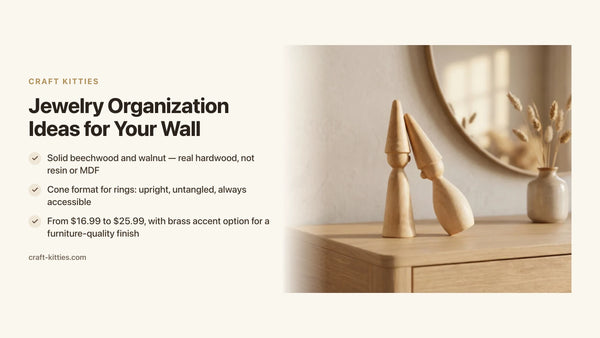
The cone ring holder solves this completely. A turned wood cone, sized to fit a finger's worth of rings, holds a stack of 6 to 10 bands upright and separated. Each ring rests against the wood rather than against another ring's edge. At the destination, the cone comes out of your bag, sits on the nightstand or vanity, and serves as a display — no secondary case, no hunting through a pouch. At departure, the rings go back on the cone and the cone goes into your bag.
Our beechwood ring holder cone set is the travel-ready version of this idea: two solid beechwood cones sized for couples or for organizing rings by type (everyday versus formal). At $16.99 for the pair, each cone fits in a sock for padding during transit. Beechwood is a closed-grain hardwood — smooth enough that it does not catch on soft fabrics, dense enough to protect the rings' finishes from contact damage.

Description
For rings with significant stones or rings you would rather display at the destination on a proper holder, the walnut ring holder with solid brass base is the upgrade. Solid walnut — genuine American black walnut, not a veneer or composite — with a weighted brass base that keeps the holder upright on any surface. The brass adds enough weight that the holder does not tip when rings are added on one side. At $25.99, it is a piece that works as well on a hotel vanity as it does at home.

Description
Earrings: keeping pairs together when they would rather not
Earring posts are the most likely items to end up at the bottom of any bag, separated from their pair. The clasp lets go, the post rolls into a corner of the toiletry bag, and a matching earring is lost to soft fabric somewhere between departure and arrival.
The simplest DIY fix is a button card: a piece of stiff cardstock with small slits cut into it. Push each earring post through a slit and fasten the back on the other side. The button card keeps pairs together, lies flat in any pouch, and costs nothing to make. A more refined version uses a small piece of foam: push the posts directly into the foam, which grips them without any fastening required.
For stud earrings, a weekly pill organizer bought at a drugstore is the most underrated travel solution in existence. Each compartment holds one pair, the organizer labels itself by the days of the week which handily indicates how many pairs are packed, and the flip-top snap keeps everything shut in a bag without ceremony. It takes up less space than a dedicated jewelry case and costs less than $5.
For drop and chandelier earrings, a soft roll case with individual zippered pockets works better than any DIY method. The pocket gives each pair room to hang without catching on a neighbor's hook. If you are using a necklace roll, check whether it has small zippered side pockets — most do, and they are sized exactly for earrings.
Bracelets and bangles: the bundle method
Bracelets and bangles are among the least problematic pieces to travel with, with one exception: metal bangles that clank and scratch each other when packed loose. The solution is bundling — stack the bangles as you would wear them, wrap the stack twice with a small hair tie or elastic band, and pack the bundle as a single object. The stack holds its shape, the bangles do not separate, and the elastic costs nothing.
For delicate chain bracelets, the same straw method used for necklaces applies: thread through a short section of straw, fasten the clasp. Chain bracelets are typically shorter than necklaces, so a straw section three to four inches long is usually sufficient.
Cuff bracelets, because they have no clasp, simply need a small soft pouch each — a cotton pouch, a cut section of clean sock, or a small fabric bag from another product. The goal is preventing metal-on-metal contact; the pouch achieves that without any special equipment.
Watches: separate from everything else
A watch deserves its own compartment every time. The crystal face scratches easily against any surface harder than felt, and a bracelet-style watch can snag and bend on rings, necklaces or even earring posts if packed together. Most travel cases designed for watches include a padded roll or a snap-close slot that holds the watch face-up and keeps the crown from catching on anything.
If you do not want to carry a dedicated watch roll, an eyeglass case is a good substitute: hard shell, right size, adequately padded. A thick sock pulled over the watch and its strap is a workable fallback for a short trip where space is the constraint.
The rule of thumb: whatever you pack the watch in, the face should be the last thing in contact with anything. Position it face-up or face-against-soft-fabric, not face-against-metal.
Travel case formats: which one is right for your trip

The roll case is the right default for most travelers. It folds to the size of a paperback book, weighs 3 to 6 ounces, and fits into a carry-on without occupying meaningful space. Inside, hook bars separate necklaces, snap-close or zippered pockets hold earrings, and a flat pocket takes bracelets and small watches. The main limitation is impact protection: a roll offers none. For everyday travel with non-heirloom pieces, that is an acceptable trade-off. For an engagement ring or a grandmother's bracelet, it is not.
The hard case is the right choice for longer trips, for pieces of significant value, or for anyone who travels frequently enough to want a system that requires no improvisation. Hard cases range from small clam-shells at $15 to full-sized organizers with pull-out trays at $80 and above. The differentiating features to look for: individual latched compartments (so one compartment opening does not cascade into the next), a ring roll or cone slot (so rings are not loose in a flat tray), and foam lining rather than fabric over plastic (fabric over foam absorbs impact; fabric over hard plastic does not). Size matters less than compartment quality — a small well-organized case handles more pieces than a large case with poor separation.
The wooden cone holder solves rings specifically and belongs in the bag alongside a case or roll, not instead of one. The reason it earns a dedicated mention is the dual-use: it is not a piece of travel equipment that spends most of its life in a drawer. It lives on the nightstand or vanity at home, and it moves with you when you travel. For travelers who prefer to pack objects that earn their space on every leg of the journey, a solid wood cone is the obvious ring solution.
Our walnut cone set of two is the version for this purpose — solid walnut, a warmer and slightly darker grain than beechwood, in a set that handles couples or the daily-wear versus special-occasion split. Both cones are the same profile but can hold different sizes, which matters if your everyday bands are thinner than your dress rings.

Description
The packing sequence that protects everything
Packing order matters as much as the containers themselves. The sequence below takes about eight minutes the first time and about three minutes once it becomes routine.
Step 1 — rings first. Stack your rings on the wooden cone in the order you plan to wear them at the destination — heaviest bands at the base, stones facing the same direction. The cone goes into a sock or a small pouch.
Step 2 — necklaces. Thread each chain through a straw, fasten the clasp, and lay each prepared necklace flat in a zip-lock bag or into the hook bar of your roll. Necklaces prepared this way can be packed at any point in the process without risk.
Step 3 — earrings. Pair each set and place in a button-card slot, a pill organizer compartment, or a roll pocket. Do this before anything else is packed so pairs are confirmed before you leave.
Step 4 — bracelets. Bundle bangles with an elastic, pouch delicate chains, and add them to the roll's flat pocket or the hard case's bracelet compartment.
Step 5 — watches. Last in, face-up. A watch should never be underneath other items.
This sequence — small, delicate, irreplaceable first; structural and impact-resistant last — mirrors the logic used for packing electronics and for the same reason: the things most likely to be damaged by compression go on top.
Comparison table
| Method / Product | Best for | Protection | Pack size | Doubles as display |
|---|---|---|---|---|
| Straw trick | Necklaces, any length | Tangle prevention only | Near zero | No |
| Jewelry roll case | Necklaces, earrings, bracelets | Soft — separation, no impact | Paperback book | No |
| Hard jewelry case | All pieces, valuable items | Impact + tangle prevention | Medium — dedicated item | No |
| Beechwood cone set | Rings (6-10 per cone) | Separation, finish protection | Fits in a sock | Yes — nightstand cone |
| Walnut cone, brass base | Rings, elevated display | Separation, finish protection | Small pouch | Yes — vanity statement piece |
Decision matrix — which system for which traveler
| Your situation | The right pick |
|---|---|
| Weekend trip, 3-5 pieces only | Straw trick + button card + ring cone in a sock |
| Week-long trip, full jewelry rotation | Roll case + beechwood cone set |
| Traveling with valuable or heirloom pieces | Hard case with impact protection |
| Couples traveling with shared rings/bracelets | Two-cone beechwood set |
| Frequent traveler who wants dual-use objects | Walnut cone with brass base + roll |
Mistakes that cost pieces or damage them
Packing jewelry last. When jewelry goes in after everything else is packed, it ends up in whatever gap is left — which is usually a loose pocket where pieces migrate freely for the duration of the flight. Pack jewelry in dedicated containers before any clothing goes into the bag.
Assuming a zip-lock bag is enough for rings. A flat zip-lock without a holder lets rings move against each other. A stone will find a band edge, and a band edge will find a stone. For rings specifically, a vertical holder keeps each ring separated and static.
Keeping jewelry in the checked bag. Checked luggage is compressed, thrown, and occasionally lost. For any piece you would be unhappy to lose, carry-on is the only acceptable option.
Using cotton balls as padding without separation. Cotton padding is comfortable but provides no separation between pieces. A diamond ring in a cotton-padded box with a chain necklace is still an invitation for scratching if they share the same pocket. Padding is not a substitute for individual compartments.
Forgetting to check clasps before packing. A clasp that is already slightly weak at home is a clasp that will fail during travel. Check every fastener before packing; a necklace that opens in the bag is a necklace that may never be found.
At the destination: where to put rings so they are never lost
The hotel nightstand problem is real: a ring placed on a nightstand surface can roll to the floor, slide behind the furniture, or be left behind at checkout. The same applies to bathroom ledges, sink edges and vanity counters. Rings placed casually on any of these surfaces have an exit route.
The cone holder removes this risk entirely. Set the cone on the nightstand, put your rings on it as you remove them each evening, and every ring is visible and accountable every morning. The beechwood cone set and the walnut cone with brass base are both designed to work as nightstand objects — not just as storage, but as pieces that belong on a surface and look like they do.
Browse the full ring holder collection for the complete range.
FAQ — how to organize jewelry for travel
1 — What is the best way to pack necklaces without tangling? Thread each necklace through a drinking straw and fasten the clasp around the straw. The chain is enclosed in a rigid tube and cannot loop on itself regardless of how the bag moves. For longer chains, push two straws end-to-end before threading. This method costs nothing, uses no space, and works for every chain length.
2 — Can I bring a wooden ring holder in carry-on luggage? Yes. A solid beechwood or walnut cone contains no liquids, no batteries and no restricted materials — it clears security without issue. Wrap it in a sock to protect its finish from metal items in the same compartment.
3 — How many rings does a cone hold? A standard cone holds 6 to 10 rings depending on band width and profile. The beechwood cones in our studio's set hold 6 to 8 stacked rings comfortably, keeping each piece's finish away from the edges of its neighbors.
4 — What is the difference between a roll and a hard case? A roll is ultralight, packs flat, and fits in a toiletry bag — right for weekend trips with non-heirloom pieces. A hard case offers impact protection and more compartment variety, and is the better choice for longer trips or for pieces with stones that need protection against pressure and vibration.
5 — How do I keep earring pairs together? Thread each pair through a button card or a small piece of foam. A pill organizer with individual flip-top compartments is the most practical solution for a large earring collection: one pair per day, each compartment labeled, nothing to open and re-sort at 5am.
6 — Is a wooden ring cone better than a plastic ring travel box? For destination use — on a hotel nightstand, a vanity, or a bathroom ledge — yes. Solid beechwood and walnut are gentler on ring finishes than rigid plastic, and the cone shape keeps rings accessible without a lid to remove. For maximum impact protection in transit, a padded hard case adds a layer wood alone does not provide; ideally, use both.
7 — What is the DIY straw trick for necklaces? Thread one end of the chain through a straw, pull until the clasp appears at the far end, then fasten the clasp around the straw. The chain cannot tangle because it is contained in a linear tube. Use a longer straw or two straws connected end-to-end for longer necklaces.
8 — Should I keep jewelry in my carry-on or checked bag? Always carry-on. Checked luggage is compressed, thrown and occasionally lost — none of which is an acceptable risk for jewelry. A carry-on under the seat in front of you is the only reliable option for pieces you want to arrive intact.
9 — Where should I put my rings at the hotel so I do not lose them? On a ring cone holder placed on the nightstand. A cone removes every casual surface (nightstand edge, bathroom ledge, sink rim) from the equation: rings go on the cone as you remove them, and they are visible and counted every morning. The beechwood or walnut cone that traveled with you from home serves exactly this purpose.
10 — Do wooden ring cones work for couple jewelry? Yes. The beechwood cone set includes two cones — designed for couples who each want their own holder, or for one person separating daily rings from occasion-wear rings. Each cone handles 6 to 8 rings and occupies the space of a small apple in a bag.
Where to go next
A cone that holds your rings while traveling holds them the same way every night at home. Our full ring holder collection includes the beechwood cone set for couples, the walnut cone with brass base for a more elevated finish, and the walnut cone set of two — all in solid hardwood, all ready to live on a surface rather than in a drawer.
Craft Kitties has over 243 reviews from customers who use these pieces daily — the ring holders are among the most returned-to items in the catalog, precisely because they solve two problems at once: keeping jewelry organized at home and making it impossible to lose a ring on the road.