At a glance
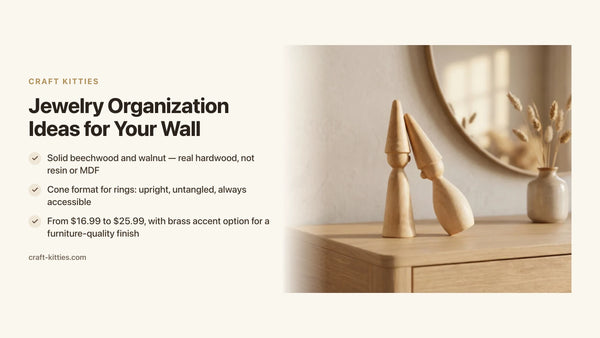
- Cone ring holders for rings, compartment trays for earrings, velvet rolls for bracelets and necklaces
- Solid beechwood or walnut — real wood, not plastic, not velvet foam that collapses
- Measure your drawer depth before buying any vertical insert
- From $16.99 for the beechwood cone set
The average jewelry collection fits comfortably into one drawer. The average jewelry drawer is a mess regardless. The gap between those two facts is almost always a method problem, not a space problem: without a system that assigns every piece a fixed address, jewelry migrates, tangles, and disappears into the corners of the drawer until someone gives up and leaves everything in a pile on the dresser.
This guide covers the full method — what to store where, which formats work for which jewelry types, how to measure your drawer before buying anything, and which materials hold up over time. It also presents the ring holders from our studio, with their prices, a comparison table, and answers to the questions that come up most when people try to solve this for the first time.
One clarification at the start, because it changes the rest of the advice: rings need a different solution than bracelets, earrings, and necklaces. The drawer organization mistake that generates the most frustration is buying a single insert type and expecting it to solve all four jewelry categories at once. It does not. Each category has its own logic, its own tangle failure mode, and its own optimal storage format. This guide treats them separately.
Step one: empty the drawer and sort by jewelry type
Before anything else: pull everything out and sort into four piles — rings, earrings, bracelets and bangles, necklaces. This step is not optional. People skip it because it feels like delay, but a drawer organized around the wrong category mix is reorganized again in three weeks.
While sorting, separate the damaged or unworn pieces into a fifth pile. A drawer that contains three broken chains and a single stud with no partner will always feel cluttered, because it is. The storage problem is partly a curation problem. What you choose not to store matters as much as how you store what remains.
Once sorted: count the rings. The number drives the rest of the decision — how many cone holders you need, whether a single tray suffices or you need two, whether one drawer can hold everything or the collection needs to split across two.
At a glance
- Rings → cone holders
- Earrings → compartment tray
- Bracelets → velvet roll
- Necklaces → channel tray or roll
Why rings are the hardest category to organize — and how cones solve it

Rings fail in drawers for a specific reason: without vertical orientation, they roll. A flat tray with no structure lets rings slide to one side, stack randomly, and hide stones against the drawer bottom. Finding a specific ring means picking up every other one. Over time, metal scratches metal.
The cone holder solves the rolling problem entirely. Each ring sits around a tapered cone — the taper grips the ring at the right diameter, holds it upright, and keeps it readable from above. You open the drawer, see every ring in the collection at a glance, and lift exactly the one you want without moving anything else.
Solid wood cones — beechwood, walnut — add a second advantage: the wood surface is gentle on metal and on stones. Plastic cones scratch. Foam cones compress and lose their shape within months. Beechwood and walnut stay dimensionally stable, and their natural texture does not mar the inside of a ring band even with daily use.
For collections where rings span several sizes and styles — stacking rings, engagement rings, cocktail rings, wide bands — multiple cones are the right format. One cone per category keeps the collection navigable without crowding.

Description
Earrings: the compartment logic
Earrings have two failure modes in a drawer: stud pairs split up (left earring in one corner, right in another), and hook earrings tangle around everything within reach. Both problems share one cause — no fixed address per pair.
The fix is a compartment tray with cells small enough to force one pair per cell. The right cell size for stud earrings is roughly 1.5 × 1.5 inches. For hook and drop earrings, cells of 2 × 2 inches give enough room without letting the earring flop sideways and hook onto its neighbor.
The storage habit that makes the tray work is pairing before storing. Every time a pair of earrings comes off, it goes into its cell as a pair — both pieces together, right then. The drawer that becomes a mess again within a week is almost always one where earrings go in one at a time, unpaired, with the intention of sorting "later."
For stud earrings specifically, a silicone-lined cell or a velvet-bottom compartment prevents the stud post from sinking through gaps and disappearing beneath the tray. Flat-bottom compartments work; mesh inserts do not.
Bracelets and bangles: the velvet roll
Bracelets and bangles are the easiest category to manage because they have no small parts to lose. They do, however, scratch each other if stored loose — metal bangles piled together develop surface marks within a few months, especially on gold-plate or polished silver.
A velvet roll — a fabric insert that folds open and wraps bracelets individually — is the right format here. Each bracelet lives in its own section of the roll, separated by velvet panels that prevent contact. The roll sits flat inside the drawer and can be lifted out as a unit when needed.
The one sizing check: measure the interior width of your drawer against the roll's unrolled length. Most velvet rolls unroll to 12–16 inches. A narrow drawer (under 12 inches wide) may require a custom insert or stacking two shorter rolls.
Necklaces: the format that prevents tangles
Necklaces are the jewelry category most frequently abandoned to a dish or hook outside the drawer, precisely because drawer storage so often fails them. The cause is always the same: necklaces laid flat with no separation tangle in minutes, and the finer the chain, the faster it happens.
Two formats work reliably. The first is a velvet roll with individual pockets: each necklace wraps or folds into a separate fabric pocket before the roll closes. Unrolling reveals each piece separated, with no contact between chains. Best for a collection of under twelve necklaces where each piece is genuinely worn.
The second is a tray with long parallel channels: each necklace lies in its own channel, separated by thin raised dividers. The clasp sits at one end of the channel, the pendant at the other. This format works better for longer chains and statement pieces that do not fold neatly into a roll.
For both formats, the rule is the same as with earrings: put each piece away in its designated spot immediately after removing it, not in a staging area with the intention of sorting later.
Measuring your drawer — the step people skip
Insert purchases that fit the drawer in theory and fail in practice almost always come down to one measurement: interior depth from base to the top of the drawer interior, not from base to the top of the drawer front.
A typical dresser drawer has 2.5 to 3.5 inches of usable vertical space. A cone ring holder with 3-inch cones needs at least 3.25 inches of clear vertical space to sit in the drawer without the drawer catching on the cones when closing. If your drawer is shallower, the cone holder sits on top rather than inside — functional, but not the flush-fitted organization most people are aiming for.
The second measurement: interior width and depth. Most tray inserts are designed for standard dresser or vanity drawer widths (12, 14, or 16 inches). A non-standard drawer may need a custom cut insert or a combination of smaller pieces placed side by side.
Measure twice. The return process for drawer inserts is tedious.

Solid wood versus foam and plastic: why the material matters long-term
The drawer insert market is dominated by plastic trays with fabric lining and foam inserts with velvet covering. Both are inexpensive. Both degrade in specific ways that matter for daily-use jewelry storage.
Plastic scratches the inside of ring bands and the prongs of stone settings on contact. The scratching is invisible at first, then cumulative. Polished gold and silver show surface drag marks after six to twelve months of contact with harder plastic edges.
Foam inserts lose their shape. A foam cone or a foam-lined compartment that holds a ring firmly when new will compress within a year of daily use and stop providing support. The ring sits in a wider, softer well and starts to tip.
Solid wood — beechwood, walnut, red oak — neither scratches metal nor compresses. The surface of a beechwood cone is smooth and slightly porous, which means it grips the ring gently without leaving marks. Walnut's finer grain and density give it a near-finished surface straight from production. Both materials look the same on day one and on year five.
The price difference between a solid wood insert and a foam insert is modest at the cone level. At $16.99 for a beechwood set and $18.99 for a walnut set of two cones, the cost per ring holder is comparable to mid-range foam inserts — with a material that outlasts them by years.

Description
The three products from our studio, in detail
Our ring holder lineup covers three configurations: a multi-cone set in beechwood for couples or collectors with rings across several categories, a single-cone walnut piece on a brass base for a more refined presentation, and a two-cone walnut set for a mid-range pairing solution.

Description
The beechwood cone set is the entry point: natural, unfinished beechwood with a surface that grips rings without marking them, in a multi-cone configuration that separates rings by type from the start. At $16.99 it is the most accessible solid wood ring holder in the lineup, and it suits the drawer format well — the cones sit side by side without taking up disproportionate space.
The walnut cone with brass base is the piece for someone who wants one object, well-made, that works on the dresser surface or inside a drawer. The walnut cone is solid — not laminated, not veneered — and the brass base is cast rather than plated, which means neither element changes appearance over time. At $25.99 it is the price point for a piece that functions as décor as much as storage.
The walnut set of two covers the in-between case: a couple sharing a drawer, or a collection where one category of ring genuinely needs its own cone. The two-cone format at $18.99 is the practical middle between the entry set and the single statement piece.
Comparison table
| Model | Price | Wood | Cones | Best for |
|---|---|---|---|---|
| Beechwood cone set | $16.99 | Solid beechwood | Multiple | Couples, collectors, mixed ring sizes |
| Walnut set of 2 | $18.99 | Solid walnut | 2 | Two categories, one drawer, one person |
| Walnut + brass base | $25.99 | Solid walnut | 1 | Statement piece, dresser top or open drawer |
Decision matrix — which setup for your situation
| Your situation | The right pick |
|---|---|
| Couple sharing one drawer, mixed collection | Beechwood cone set — multiple cones, assign one side per person |
| One person, rings span stacking, everyday and occasions | Walnut set of 2 — one cone per category, $18.99 |
| Drawer is shallow (under 3 in), want open-top display | Walnut + brass on dresser top — brass base keeps it planted |
| Gift for someone who wears rings daily | Walnut + brass base — the piece that reads as a gift, not a functional buy |
| Budget-conscious, solid wood mandatory | Beechwood set at $16.99 — real hardwood, entry price |
| Minimalist dresser, one ring worn every day | Walnut + brass — one object, one ring, clean surface |
Common mistakes that undo good drawer organization
Buying the insert before measuring. The most frequent return reason for drawer inserts is a mismatch in the one measurement people skip: interior vertical clearance. Cone holders need drawer depth; rolls need drawer width. Measure both before ordering.
Mixing all jewelry types in the same compartment format. A tray designed for earrings does not work for rings. Rings roll, fall on their sides, and pile. The categories genuinely require different formats, and the solution is not finding a universal tray — it is accepting that two or three different inserts will coexist in one drawer.
Treating the insert as the whole system. The insert creates the address for each piece. The habit of returning each piece to its address after wearing completes the system. An insert used for a week and then abandoned when the drawer "fills up again" was not abandoned because the insert failed — it was abandoned because the habit was not formed. The insert holds; the habit maintains.
Storing fine jewelry in a bathroom drawer. Humidity, temperature swings, and residual steam from the shower accelerate tarnish on silver and weaken adhesives on glued stone settings. A dresser drawer in a bedroom is the right environment. If convenience requires bathroom-adjacent storage, a closed box with anti-tarnish lining is the safest compromise.
Skipping the curation pass. A drawer with twenty rings requires different organization than a drawer with eight. Before investing in inserts, remove anything broken, unworn for over a year, or missing a pair. The reduced collection almost always fits more cleanly than expected — and the inserts needed cost less.
How to maintain jewelry drawer organization over time
The most durable drawer organization systems share one structural feature: no staging area. Staging areas — a dish on the dresser, a corner of the counter, a small pouch on the nightstand — are where organization dies. The piece placed in the staging area "just for tonight" is the piece found in three different locations over the next month.
The system that holds is one where every piece has one place, and that place is the drawer insert. Coming home, earrings off, earrings in their compartment cell. Ring off, ring on its cone. The action takes four seconds. The drawer stays organized because the alternative — the staging area — does not exist.
The second maintenance principle: monthly review. Once a month, open the drawer, look at what is there, and remove anything that does not belong. A collection grows over time; the inserts that fit in year one may need supplementing in year two. A monthly glance catches the drift before it requires a full reorganization.
Description
Where to go next
Once rings have a system, the ring holder collection covers the full range of formats — from the entry beechwood set to the walnut and brass statement piece. The walnut ring holder with brass base is the piece that transitions easily from inside a drawer to on top of a dresser; the beechwood cone set is the multi-cone solution for collections that span more categories than one cone handles.
For the other jewelry categories — earring trays, velvet rolls, necklace channels — the principles in this guide remain the same: one address per piece, measure before buying, skip the staging area. The format changes; the habit does not.
Description
Our studio's work — and over 240 verified reviews from buyers who wear jewelry daily — is visible on our Etsy shop if you want to read through how other people have built their own systems before deciding on yours.
The short version
Empty the drawer and sort by type first. Rings need cone holders — solid beechwood or walnut, not foam, not plastic. Earrings need a compartment tray with one cell per pair. Bracelets and necklaces need velvet rolls or channel trays. Measure vertical clearance before buying anything with height. Return each piece to its spot immediately after wearing — that is the only habit that keeps the system working. The rest is execution.
The beechwood ring holder set at $16.99 is where solid wood ring storage starts; the walnut set of two at $18.99 covers the two-category case; and the walnut with brass base at $25.99 is the piece that earns its place on the dresser top as much as inside the drawer.
FAQ — how to organize jewelry in a drawer
1 — What is the best way to organize rings in a drawer? A cone-style ring holder is the most reliable method for rings specifically: each ring sits on its own cone, stays upright, and can be spotted at a glance without touching anything else. Pair it with small compartment dividers for earrings and a velvet roll for bracelets, and a single drawer can hold an entire collection with no tangles and no lost pieces.
2 — How do I stop earrings from getting tangled in a drawer? Compartmentalized inserts are the direct fix. Each pair lives in its own cell — stud pairs together, hooks across one row. The critical step people miss is pairing earrings before storing them, not after. A hook earring left loose with its partner missing is the origin of every tangled drawer.
3 — Is a wooden ring holder better than velvet or plastic? For rings, solid wood cone holders are better than velvet rolls (which are designed for bracelets and necklaces) and significantly better than plastic (which scratches metal and looks cheap over time). Beechwood and walnut cones grip the ring softly, keep it upright, and display it without hiding the stone.
4 — How deep should a jewelry drawer be? A standard dresser drawer of 2.5 to 3 inches depth is workable for flat trays and ring cone sets. The real constraint is the ring cone height: most cones are 3 to 4 inches tall, so the drawer either needs to clear them or you choose a lying-flat tray format instead. Measure your drawer interior before buying any insert that has vertical elements.
5 — Can I organize fine jewelry and costume jewelry in the same drawer? You can, but separate compartments are mandatory to avoid scratching. Fine metals scratch against rhinestones or brass-plated pieces. The safest system: one tray or section per material family, with each piece in its own cell. Anti-tarnish lining on the tray slows oxidation on silver pieces stored in the same drawer.
6 — What should I do with necklaces in a drawer? Necklaces are the hardest jewelry type to drawer-organize because they tangle instantly when flat. The two methods that work: a velvet roll that wraps each necklace individually, or a tray with long shallow channels where each necklace lies in its own lane. For long pendants and statement chains, a drawer insert with a hook rail at the back edge is the cleanest solution.
7 — How many rings fit on a cone ring holder? A standard cone holds between three and six rings depending on the ring width and the cone's taper. Cocktail rings and wide bands stack fewer; thin stacking rings can pile four to five high. The beechwood cone set provides multiple cones so you can spread rings by type rather than crowding a single cone.
8 — How do I protect jewelry from tarnishing in a drawer? Four things reduce tarnish: anti-tarnish strips placed in the corner of the drawer, velvet lining on trays, keeping the drawer closed when not in use, and storing silver and copper pieces separately from gold. Never store fine jewelry in a humid bathroom drawer — a dresser in a climate-controlled room is the right environment.
9 — What is the difference between a ring tray and a ring holder? A ring tray is a flat insert with rows of thin slots — rings lie flat on their sides, sorted by row. A ring holder (or ring cone) is a vertical object each ring sits around — rings stand upright and can be read from above. Trays work better inside closed shallow drawers. Cones work better in deeper drawers where the vertical display lets you grab a specific ring without disturbing the others.