At a glance
- The clasp is the real enemy — physical separation per chain is the only fix that holds
- 7 methods ranked from no-cost hacks to solid beechwood and walnut cone holders
- Works for fine chains, layering necklaces, travel cases, and dresser displays
Tangled necklaces are not bad luck. They are a geometry problem: clasps catch on neighboring chains, and every drawer shuffle, every lid closing, every trip through a bag tightens the knot one turn further. Once you understand that the clasp is the culprit, the fix is obvious — keep each chain physically separated so that clasps never meet.
This guide covers seven methods in order of effort and permanence, from things you can do tonight with household items to the display solutions that prevent tangles by design and look deliberate on a dresser. For each method there is a clear best use case, a note on which chain types it suits, and where it falls short. By the end you will know exactly which approach fits your collection, your storage space, and how you use your jewelry day to day.
One principle runs through all seven: hanging a chain so it hangs freely is always better than laying it flat where clasps can wander. That single insight solves perhaps 90 percent of the problem.
Why necklaces really tangle — and why most storage does not help

Most jewelry boxes are the wrong shape for necklaces. They are designed for earrings and rings — flat trays with small compartments where everything sits at the same level. A necklace in a flat tray moves freely when the lid opens or closes, and its clasp hooks the nearest chain. Repeat several times a day and a loose pile becomes an unsolvable mass.
The second trap is the multi-pocket pouch. Fabric separators keep pieces visually apart but they compress under movement, pushing clasps through the weave or over the partition. A delicate chain does not need much to knot — a single centimeter of contact is enough when the clasp is spring-loaded.
Understanding this explains why the methods below all work the same way at a mechanical level: they put distance between clasps, either by threading the chain through a tube so the clasp is isolated, by hanging the chain vertically so gravity keeps it extended, or by placing each piece on its own hook or cone where no other chain can reach.
Method 1 — The drinking straw trick (the best zero-cost fix)
Thread the chain through a plastic or paper drinking straw, then fasten the clasp at the outside end of the straw. The straw holds the chain straight, prevents it from folding on itself, and — critically — keeps the clasp at one defined point where it cannot snag anything else.
This method works reliably for fine chains up to about 1.5 mm and medium chains up to 24 inches. Longer chains need two straws end to end, secured with a small piece of tape at the join. Chunky statement pieces are too thick to thread and need a different approach.
The straw trick is the best solution for three situations: storing necklaces you wear infrequently in a box or drawer, organizing chains before a more permanent display is in place, and travel. A zip-lock bag of strawed chains takes almost no space in a bag and comes out knot-free regardless of how much the bag moves.
Its weakness is inconvenience for daily-wear pieces. Unthreading and re-threading a fine chain twice a day adds friction that most people abandon after a week, which is why the display methods below are better for pieces you reach for regularly.
Method 2 — Individual hook strips
A small adhesive or screw-mounted strip with evenly spaced hooks — placed on the inside of a closet door, inside a drawer frame, or on a bathroom wall — gives each chain its own hanging point. The chain hangs extended, the clasp hangs at the bottom, and nothing touches anything else.
The key detail is hook shape. S-hooks and cup-hooks with raw metal edges scratch plated finishes over time. Smooth-tipped cup hooks, finished wood pegs, or coated hooks are gentler on chains and on ring connections. If you install a hook strip on a bathroom wall or inside a humid cabinet, choose a finish that does not corrode — bare metal hooks in a humid space will discolor both the hook and the chain it holds.
This method scales well: a strip of ten hooks along a 12-inch span can organize ten necklaces in less space than a single drawer insert. It works for all chain lengths and all chain thicknesses, making it the most versatile hanging method for a large collection.
Method 3 — A cone holder on the dresser (the display approach)

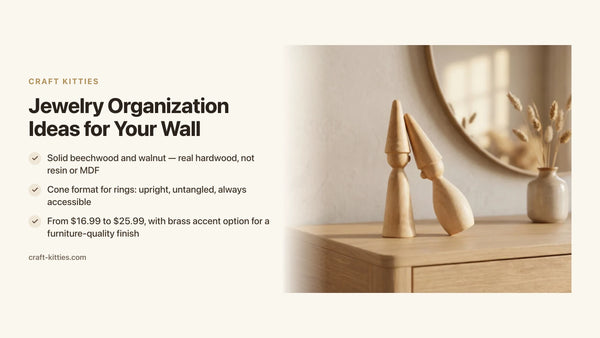
A ring holder cone was designed for rings — but the shape is equally well-suited to necklaces. You drape the chain over the cone, letting it fall around the wood surface. Gravity keeps the chain extended and the clasp at the bottom, away from any other piece. Three to five chains can share a single cone without touching each other, provided you drape them at different heights.
The material of the cone matters more for necklaces than for rings. A cone that holds rings sits still and has no friction contact with the metal. A cone that holds necklaces has chains sliding over its surface every day. Solid beechwood and solid walnut — the two species we work with at our studio — are dense, smooth-grained hardwoods that do not scratch gold-fill, vermeil, or sterling silver. Rough-sanded softwood, rough-cut MDF, or raw pine will eventually leave micro-scratches on delicate links.
For a dresser or nightstand, two cones side by side give you six to ten separated hanging positions in a footprint smaller than a coffee mug. That is enough organization for most everyday collections, and the cones read as décor rather than clutter — the wood grain on a dresser looks intentional in a way that a plastic stand does not.

Description
The Beechwood Ring Holder Cone Set is the entry point to this approach. Two solid beechwood cones on a simple shared base: smooth-grained hardwood that will not scratch delicate chains, heavy enough to stay put when you drape or retrieve a piece. At $16.99 the set, it is the most direct upgrade from a tangled jewelry box. Works as both a ring display and a necklace stand — nothing about the design is single-use.

Description
The Walnut Wood Ring Holder with Solid Brass Base is the single-cone version in solid American black walnut, finished with an oil-wax coat and set on a polished solid brass base. The brass base is not decorative only — it lowers the center of gravity so the cone does not tip when you drape a heavier chain. Walnut is one of the densest domestic hardwoods; the surface is smooth enough that even a 14-karat gold-fill chain slides without friction. At $25.99, it is the right piece when the dresser already has a considered aesthetic and plastic or MDF would look out of place.

Description
The Wooden Ring Holder Set of 2 in solid walnut gives you two cones at $18.99 — the format for a collection of six to ten pieces where one cone is not quite enough. Both cones in the same walnut oil-wax finish, same weight and stability, sized for a shared dresser or a split arrangement (one cone per side of a shared nightstand). Each chain gets its own arc of wood to drape over; the set effectively creates eight to twelve separated hanging positions in a footprint of two coffee mugs.
Method 4 — Velvet drawer inserts with loop slots
A velvet-lined drawer insert with individual necklace loop slots is the contained-storage equivalent of the hook strip. Each chain lives in its own slot, lying flat but separated by fabric dividers that keep clasps on their own side.
The quality of the velvet matters: cheap synthetic velvet pills and catches on delicate links over time. Proper velvet-lined inserts use a short-pile velvet that chains slide over without snagging. For drawer storage specifically, a slot insert is better than a cone because nothing is exposed to dust or daylight, which matters for silver pieces that oxidize in open air.
The limitation is access. Retrieving a necklace from a slot insert requires lifting it carefully to avoid dropping the chain into a neighboring slot — you lose the one-second grab that an open display cone provides. For pieces worn daily, friction matters; for pieces worn occasionally, protected slot storage is the right trade-off.
Method 5 — Individual zip-top bags (temporary fix)
A fine chain in its own small zip-top bag — sold in bulk at craft stores — is separated from every other chain and protected from air oxidation simultaneously. This is the correct solution for long-term storage of pieces you wear rarely: traveling rings, inherited jewelry, pieces waiting for a repair.
For daily-wear pieces, the zip-top bag method generates enough friction at retrieval that most people stop using it within two weeks. The better use case is keeping it as a travel solution alongside the straw method, or using it for archival storage of pieces you might wear once a year.
Method 6 — Over-door jewelry organizer
A fabric or acrylic over-door organizer with clear pockets can hold necklaces if the pockets are large enough (at least 4" × 4") and smooth enough not to snag links. The advantage is vertical scale — a door-mounted organizer with forty pockets fits a large collection in a space that was otherwise unused.
The challenge is chain length. Most pocket organizers are sized for earrings and bracelets. A 24-inch chain folded into a 4-inch pocket will still knot if the clasp can reach the other end. The workaround is to thread the clasp end through the pocket's hang loop at the top, so the chain hangs extended inside the pocket rather than pooling at the bottom. This works but requires care at both storage and retrieval.
For collections above twenty necklaces where wall or dresser space is limited, an over-door organizer adapted with this technique gives more separation per square foot than any other method.
Method 7 — Wall-mounted peg rack
A wall-mounted wooden peg rack — three to eight smooth-finished pegs on a backing board — gives each necklace a permanent designated hook and makes the collection part of the room's décor. This is the display-first approach: the necklaces are visible, accessible in one motion, and organized without any container.
The requirement is wall space: ideally a dedicated section of wall in the bedroom or dressing area where the rack is not competing with art or a mirror. A peg rack works best for daily-wear pieces and statement necklaces that benefit from display. Delicate chains with high oxidation risk — sterling silver, gold vermeil, brass-plated pieces — are better in closed storage where air contact is limited.
Comparison table — which method fits your situation
| Method | Cost | Best chain type | Daily-wear speed | Best for |
|---|---|---|---|---|
| Drinking straw | $0 | Fine to medium (<1.5 mm) | Slow (thread/unthread) | Travel, occasional-wear, drawer |
| Hook strip | $5–20 | All lengths and thicknesses | Fast (one motion) | Large collections, closet door |
| Beechwood cone set | $16.99 | Fine to medium chains, short pendants | Fast (drape and go) | Dresser display, 4–10 pieces |
| Walnut cone, brass base | $25.99 | Fine to medium, heavier pendants | Fast | Nightstand, 1–2 daily necklaces |
| Velvet drawer insert | $15–40 | All, excels for short chains | Medium (careful lift) | Hidden storage, anti-oxidation |
| Zip-top bags | $2–5 (bulk) | All | Very slow | Long-term archival, travel backup |
| Wall peg rack | $20–60 | All lengths, statement pieces | Fastest (hook and unhook) | Display collections, bedroom wall |
Decision matrix — matching method to collection
| Your situation | Best fit |
|---|---|
| Two or three necklaces worn every day, dresser space available | Walnut cone with brass base |
| Four to ten necklaces, want a display that looks intentional | Beechwood cone set or Walnut set of 2 |
| Large collection (10+), need maximum separation | Hook strip or wall peg rack + cones for daily pieces |
| Travel, need tangle-free portable solution | Straw method or zipper roll with hook loops |
| Sterling silver or brass pieces prone to tarnish | Velvet drawer insert or zip-top bags |
| Renting, no wall holes allowed | Dresser cone holders (no installation required) |
| Shared dresser, both partners need necklace storage | Beechwood cone set — one cone per person |
How to untangle a necklace that is already knotted
Even with the best storage system, a knot appears eventually — usually from a move, a travel bag, or the one time you set a chain down carelessly. The technique matters: pulling from the ends of a knot tightens it. The correct approach works from the inside out.
Lay the chain flat on a smooth, hard surface — a wood cutting board or a glass table works better than fabric, which adds friction. Apply one small drop of baby oil, mineral oil, or olive oil directly onto the knot. The oil reduces the friction between overlapping links enough that they can separate under gentle pressure. Let it sit for thirty seconds.
Use two straight pins, toothpicks, or thin needles to work into the center of the knot — not the edges. Gently push the pins apart from inside the knot, expanding it from the center rather than pulling any single strand. Work in small increments. Most knots in fine chains open completely within one to two minutes with this method. For heavier chain tangles, the same technique applies; it simply takes a few more passes.
Once the knot is open, wipe the chain with a dry cloth to remove the oil before storing it. Any oil residue on a plated chain will attract dust over time.
Storage mistakes that recreate tangles
Closing a drawer or lid before clasps are positioned. A clasp that rests against another chain when the drawer closes will hook it. One extra second to lay the clasp in a corner of the slot, or to make sure it is at the bottom of the cone, prevents the problem entirely.
Storing necklaces at different lengths together without separators. An 18-inch and a 24-inch chain in the same section of a tray will find each other because the longer chain can reach the shorter one's clasp. Either use individual slots sized for the specific chain, or hang them at different heights on a cone or hook.
Traveling with chains loose in a makeup bag. Even a ten-minute trip from home to a hotel room is enough to tangle a fine chain that shares a bag with other items. The straw method or a dedicated travel pouch with individual loops removes the variable entirely.
Mixing necklaces and rings in the same compartment. Ring settings — particularly prong settings — catch fine chains reliably. Store rings and necklaces in separate zones, even if both live in the same box.
Caring for necklaces in storage
Proper storage is also the main maintenance a necklace needs between wears. The three things that degrade jewelry in storage are air oxidation, humidity, and friction.
Oxidation affects silver and brass-plated pieces most: contact with air causes the surface to tarnish. Closed storage — velvet-lined slots, zip-top bags, or a lidded jewelry box — slows this significantly. Anti-tarnish strips placed inside closed storage containers absorb sulfur compounds from the air and extend the time between cleanings.
Humidity accelerates oxidation and can damage certain settings. A bathroom jewelry display is convenient but the humidity from daily showers shortens the finish life on plated pieces. The dresser or nightstand is a better location for anything you care about.
Friction from other pieces, from rough container surfaces, and from frequent handling gradually dulls finishes. Solid hardwood cones — beechwood or walnut — provide a surface smooth enough that daily draping and retrieval does not introduce scratches. The oil-wax finish on well-made wooden holders closes the wood grain, preventing microscopic fiber contact with the chain.
Where to go next
Necklace storage and ring storage are the same organizational problem: you want each piece physically separated, accessible in one motion, and displayed in a way that fits the room. Our ring holder collection gathers the cone holders, display sets, and wooden ring dishes that solve both at once — most of the cone models work as dual-purpose necklace and ring stands. The Beechwood Ring Holder Cone Set is the natural starting point for a dresser that needs both functions covered from a single piece of solid wood.
For those new to the studio: we have 243 reviews on Etsy from customers who have been using these holders daily — a useful reference if you want to read how the pieces hold up over time before deciding.
The short version
The problem is always the same — clasps catching neighboring chains — and the fix is always the same: physical separation. The straw method solves it tonight for free. A cone holder on the dresser solves it permanently and looks considered while doing it. And for a large collection where neither approach alone is enough, a hook strip or peg rack handles the scale.
Choose by what you actually wear daily: the fastest retrieval method wins for everyday pieces, and the most protective method wins for the ones you wear twice a year. The Walnut Wood Ring Holder with Solid Brass Base is the right single piece for most nightstands; the Wooden Ring Holder Set of 2 in walnut handles a larger collection without a wall installation. Both are solid hardwood, finished with an oil-wax coat that is smooth enough for daily chain contact and stable enough that the cone does not tip under a pendant's weight.