At a glance
- Walnut: deep brown, fine grain, premium feel — softens with age
- Red oak: honey-light, bold grain, slightly harder and more affordable
- Beech: the pale, tight-grained option between the two
- Pick by contrast with your wall, not by spec sheet
The question comes up constantly in home décor: is walnut better than oak? The short answer is no — not universally. The real answer is that walnut and red oak are different tools for different rooms, and choosing the right one has almost nothing to do with hardness charts or botany. It has everything to do with the color of your walls, the tone of your existing furniture, and the feeling you are after when you walk into a room.
This guide is written for people buying finished home goods — valet trays, desk organizers, entryway pieces — not for flooring contractors or woodworkers. It covers the properties that actually matter in that context: color, grain, aging, hardness where it counts, and price. It then applies those criteria to three species available in our solid wood valet tray collection — walnut, red oak, and beech — and helps you make the call for your space.
One ground rule before anything else: this guide is about solid hardwood. Walnut veneer, oak-effect laminate, and MDF with a wood-look finish behave like separate materials and are not relevant here. Solid wood ages differently, finishes differently, and lasts differently. The comparison only makes sense within the same category.
The one property everyone cites — and why it barely matters for home goods
Janka hardness is the number everyone quotes when comparing wood species. Red oak scores 1290; black walnut scores 1010. Red oak is harder — by about 28%. That is a real and measurable difference in material science.
For flooring or work surfaces that receive heavy, sustained impact — a restaurant counter, a workshop bench — hardness matters a great deal. For a valet tray sitting on a dresser, a desk organizer holding a stapler, or an entryway piece holding keys and a wallet, it is almost irrelevant. The contact forces involved are far below the threshold where a 28% hardness gap becomes observable. Neither species will dent from a dropped phone, a coin, or a set of keys landing in the same spot every morning for ten years.
The only scenario where walnut's slightly lower hardness might surface as a real consideration is a piece used as a cutting board or subject to dragging sharp objects — which is not what a valet tray or desk organizer is for. For any home goods category this guide addresses, both species are more than hard enough. Cross hardness off the decision list and focus on what actually changes your day-to-day: appearance.
Color and grain: the real difference between walnut and red oak

Walnut starts deep. Fresh-cut black walnut is an espresso brown, sometimes with purple undertones, with a fine and relatively straight grain that reads as quiet and refined at a distance. The texture is smooth to the touch, and light reflects off it evenly. On a light wall — white, cream, pale grey — a walnut piece jumps. It becomes an intentional object, not a passive one.
Red oak is the inverse. It starts light — a honey-amber tone — with a bold, open grain that includes the cathedral arches and ray flecks that make oak instantly recognizable. At a distance it reads warm. Up close it is textured and active. On a dark wall or alongside darker furniture, red oak lifts and brightens; against a white wall, it settles in without dominating.
Beech — a third species available in our lineup — occupies the pale end of the spectrum. Cream to light tan, very tight-grained, almost featureless at distance. It reads closest to maple: calm, modern, suitable for Japandi and Scandinavian interiors where warm grain would feel busy. Beech is the species for rooms that want wood without its drama.
The practical rule: choose by contrast. A walnut piece on a walnut-colored desk disappears. A red oak piece against a terracotta wall competes. The moment you pin each species against the dominant tones of your room, one answer usually becomes obvious.
How walnut and oak age — what to expect over five years
Wood is not static material. Both walnut and red oak change color as they age, and knowing which direction they move can be as important as their starting tone.
Walnut lightens. Black walnut, when exposed to UV light — a sunny desk, a south-facing entryway — will move from its deep espresso toward a warm honey-brown over two to three years. The transformation is gradual and uneven in areas shielded from light. Once it stabilizes, walnut settles into a tone that is still darker than red oak but closer to a medium brown than the near-black it starts at. Many people find the aged walnut more versatile — it blends more easily with mixed-wood interiors.
Red oak deepens. Starting light, red oak picks up an amber warmth over time, especially under oil or wax finishes that oxidize gently. The grain becomes more pronounced, not less, and the cathedral arches gain depth. Aged red oak in good condition is often mistaken for a more expensive species — it gets better-looking with use, not worse.
Beech is the most stable. Its tight grain and pale starting color change minimally with UV exposure. What you buy is close to what you keep for years. This makes beech reliable for pieces in rooms where color consistency matters — a matched set of desk accessories, for example.
For a piece that lives on a bright dresser or desk, walnut's drift toward lighter tones can actually be an advantage: it blends better with surrounding pieces as the room evolves. For a piece in a darker corner that ages in less light, it will hold its dark character much longer.
Grain character: the aesthetic you are committing to
Grain is the underrated dimension in wood selection. The hardness conversation obscures it, but grain determines how a piece photographs, how it reads at distance, and how it fits into a design language.
Walnut's grain is fine, mostly straight, occasionally with gentle waves or curls in figured cuts. At arm's length, a walnut piece often reads as a solid color with a hint of texture. This is why walnut became the wood of choice for mid-century modern furniture and high-end electronics — it recedes visually, letting form and proportion do the work. A walnut valet tray on a light desk looks designed, almost graphic.
Red oak's grain is course, open, and active. The medullary rays — the flecks that run perpendicular to the growth rings — catch light and create a shimmer that makes red oak recognizable at a glance. The cathedral arches that appear on flat-sawn boards give it movement. A red oak piece in the same spot as walnut reads as handmade, warm, immediate. It announces its material.
Beech's grain is tight, uniform, and quiet — almost like fine-grained hardboard in appearance. It takes a wax or oil finish beautifully and develops a subtle sheen that reads as refined without being showy. If walnut is the moody species and red oak is the specialementsive one, beech is the well-edited one.
The grain you choose is also a style commitment. Walnut suits contemporary, mid-century, Japandi and minimalist interiors. Red oak suits craftsman, farmhouse, warm-modern and eclectic spaces. Beech suits Scandinavian, modern and clean-line interiors. None is universally better — each fits a specific visual context.
Price: what you actually pay for walnut versus oak
The price gap between walnut and red oak in finished goods is real, though often overstated. Walnut grows more slowly and in smaller regional quantities than red oak, making the raw material consistently more expensive. For solid wood home goods — a valet tray, a desk organizer — that premium typically translates to $10–$20 per piece.
In our lineup, the entry-level Hardwood Valet Tray & Key Rack is available at $29.99, covering multiple wood options. The mid-tier Hardwood Valet Tray Desk Organizer runs $47.20, and the flagship Solid Wood Valet Tray Desk Organizer sits at $55.20. These differences reflect construction complexity and material grade more than species alone — a solid beech piece in the same build quality as walnut will land at a similar price.
The practical advice: if walnut appeals to you aesthetically but the price gives you pause, look at the construction first. A well-built piece in red oak will outlast a careless piece in walnut every time. Spend the money on the build, then choose the species.
Five products from our studio: solid wood in three species
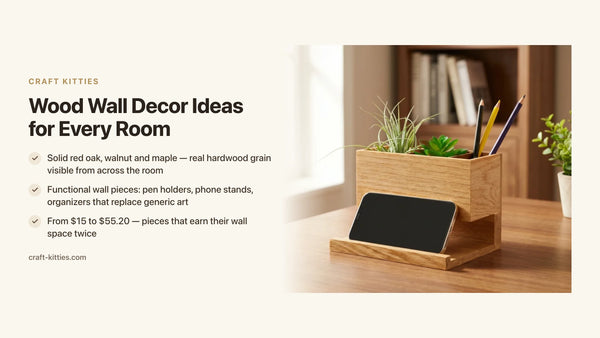
The pieces below are all cut from solid hardwood — red oak, walnut, beech or maple depending on the model — and finished with a wax or oil coat that protects the wood and develops character with age. No veneer, no laminate, no engineered panels.

Description
This is the piece for people who want real wood at an accessible price. The combined key rack and tray format solves the entryway in one object — keys on the rack, wallet and phone in the tray — and the solid hardwood build means it will still look good in ten years. At $29.99, it is the most direct answer to "I want to upgrade my entryway without overthinking it."

Description
The mid-tier organizer adds depth and compartmentalization. Available in maple, beech or walnut, it is built for the desk — slightly larger, with sections sized for a full daily carry including glasses and a pen. At $47.20 the walnut option is the one most people end up choosing: the dark tone against a light desk makes the piece the best-looking object in the workspace.

Description
The flagship tray is the most carefully constructed piece in the lineup. Same species options as the mid-tier — maple, beech, walnut — but with tighter joinery, more refined proportions and a finish that takes longer to apply. At $55.20 it is the answer for people who want one very good object on their desk rather than several acceptable ones.
Description
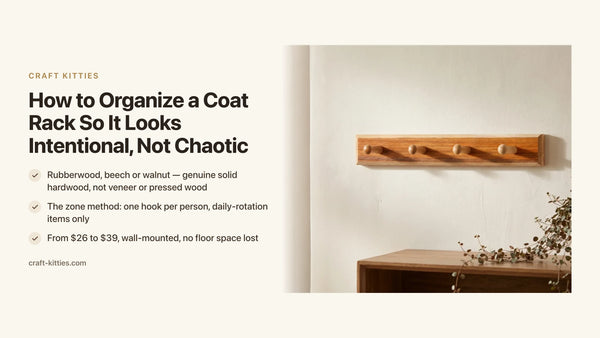
The same entry-level tray reframed as an entryway key station. Mount it near the door — it holds everything you touch first when you walk in and last when you walk out. The integrated rack handles four to six keys; the tray catches wallet, sunglasses, earbuds, whatever the pocket holds. Solid hardwood throughout at $29.99.
Description
The mid-tier organizer is also the most frequently purchased as a gift — practical enough to use every day, material enough to be appreciated by someone who cares about objects. Choosing the species for the recipient's desk takes thirty seconds of looking at a photo; the rest takes care of itself. $47.20, ships ready.
Comparison table: walnut vs red oak vs beech for home goods
| Property | Black Walnut | Red Oak | Beech |
|---|---|---|---|
| Starting color | Deep espresso brown | Honey-amber, light | Pale cream to light tan |
| Grain character | Fine, straight, quiet | Bold, cathedral arches, ray flecks | Very tight, even, minimal |
| Janka hardness | 1010 lbf | 1290 lbf | 1300 lbf |
| How it ages | Lightens over time | Deepens to amber | Very stable, minimal change |
| Relative price | Premium | Mid-range | Mid-range |
| Style fit | Contemporary, Japandi, mid-century | Craftsman, warm-modern, eclectic | Scandinavian, modern, minimal |
| Best with | Light walls, black metal | Warm walls, brass or natural metal | White or pale walls, chrome or matte black |
Decision matrix: which species for which situation

| Your situation | The right species | The right piece |
|---|---|---|
| Light-colored desk, you want one object that stands out | Walnut | Solid Wood Valet Tray — Walnut |
| Warm, eclectic room — you want grain and character | Red oak | Hardwood Valet Tray — Oak option |
| Japandi or Scandinavian interior, pale tones throughout | Beech or maple | Hardwood Valet Tray — Beech option |
| Entryway, first solid wood piece, accessible price | Any — pick by wall color | Hardwood Valet Tray & Key Rack — $29.99 |
| Gift for someone with a light-wood desk | Walnut (contrast gift) | Hardwood Desk Organizer — Walnut |
| Mixed-wood home, you want something neutral | Beech (most neutral) | Solid Wood Valet Tray — Beech |
Three common mistakes when choosing between walnut and oak
Choosing the wood from a product photo taken in studio light. Studio photography is calibrated to make products look their best — which means walnut looks richer and red oak looks warmer than they will in an overcast apartment or a north-facing room. Before deciding, hold a wood sample or look at photos taken in lighting similar to your space.
Letting the hardness number decide. Red oak beats walnut on Janka by 28%. For a valet tray or desk organizer, that difference does not translate to any observable behavior in use. Keys, coins, a phone, a wallet — these objects do not exert enough force to dent solid hardwood of either species. Optimizing for hardness in this category is solving the wrong problem.
Matching wood to wood instead of wood to wall. The most common misstep is buying a walnut tray to match an existing walnut desk lamp. The result: two dark objects that compete, and neither reads as intentional. Match to the wall and the surrounding light instead. A walnut piece on a white desk against a cream wall makes both the desk and the tray look chosen. The same walnut tray sitting next to a walnut monitor stand on the same desk produces a brown corner.
Caring for a solid wood valet tray or organizer
Solid hardwood finished in wax or oil requires almost no maintenance — far less than the internet makes it sound. A dry or slightly damp cloth handles daily cleaning. Wax-finished pieces benefit from a light coat of paste wax once or twice a year if the surface starts to look dry, but many pieces go years between re-waxing with no visible change. Oil-finished pieces can be refreshed with the same oil used originally, wiped in and buffed off.
The actual rules: no prolonged standing water (a glass ring wiped after the fact is fine; a wet cloth left overnight is not). No harsh chemical cleaners — they strip the finish. No dishwasher, obviously. Everything else is fine. Drop your keys in it every morning for five years and the tray will look better for the wear.
Where to go next
This guide focuses on the material question. For help choosing the right form — which tray format works for an entryway versus a desk, how much compartmentalization you actually need — the solid wood valet tray collection is organized by use case as well as species, which makes narrowing down faster than browsing by price alone.
If you are buying as a gift, the Hardwood Valet Tray Desk Organizer at $47.20 is the safest all-around choice: the walnut option reads as a premium object in any room, and the beech or maple options are right for anyone running a light, modern setup. Over 240 customers have reviewed our pieces on Etsy, and the recurring theme is that they look substantially better in person than in the photos — which, given how good the photos are, says something.
FAQ — walnut vs oak for home goods
1 — Is walnut harder than red oak? No. Red oak scores 1290 on the Janka scale; walnut scores 1010. Red oak is harder by about 28%. For any home goods application — valet tray, desk organizer, entryway piece — this difference does not affect daily use. Both species are more than sufficient.
2 — Which wood lasts longer, walnut or oak? Practically speaking, both last decades in normal indoor use. The finish (wax or oil) matters more than the species for longevity. A well-finished red oak piece will outlast a poorly finished walnut one. Under identical care, both species reach similar lifespans — the question of which lasts "longer" is not meaningful at the home goods scale.
3 — Does walnut get lighter over time? Yes. Black walnut lightens with UV exposure over two to three years, moving from deep brown toward a warm honey-brown. Red oak does the opposite — it starts light and deepens with age. Both stabilize once they reach their mature color.
4 — Which is better for a desk organizer? Both are excellent. Choose walnut for a dark, quiet aesthetic against a light-colored desk; choose red oak when you want warm grain and a lighter tone. The functional difference is zero — the decision is purely visual.
5 — Is walnut worth the extra price? If the deep tone and fine grain match your room better than red oak or beech, yes. If you would be equally happy with either, red oak or beech delivers the same construction quality and solid hardwood durability at a lower price point. There is no performance premium in walnut for home goods — only an aesthetic one.
6 — Can I mix walnut and oak in the same room? Yes, intentionally. The contrast between walnut's dark brown and oak's light honey creates visual depth when the pieces share a finish sheen. Choose one dominant species and use the other sparingly as an accent — two or three pieces of one, one or two of the other.
7 — What does beech look like compared to walnut and oak? Beech is pale cream to light tan, tight-grained and very even. It looks closest to maple and reads as the most modern, neutral option of the three. It suits Japandi and Scandinavian interiors where warm grain would feel busy.
8 — Which species is best for a gift? Walnut is the most universally received — its deep tone reads as premium regardless of the recipient's interior. If you know the recipient has a light-colored desk or a pale interior, walnut is even safer as a contrast piece. Red oak is the right pick if you know their space runs warm.