At a glance
- Japandi entryway = one solid-wood hook rack, fewer hooks than you think, zero floor clutter
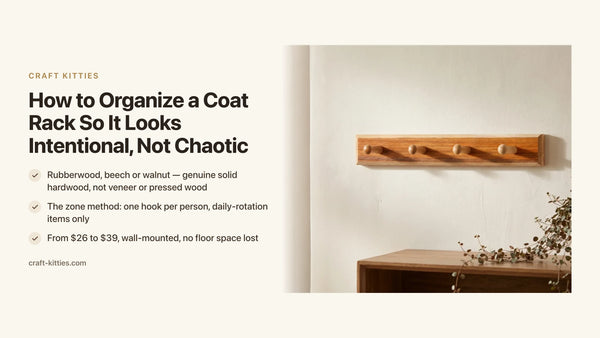
- Rubberwood, beech and walnut — real hardwood throughout, not veneer
- From $26 to $39, 2 to 6 hooks
The entryway is the one room in the house that everyone sees and no one decorates on purpose. It accumulates — shoes, bags, coats dropped because there is nowhere to put them — until the hallway reads as a holding zone rather than a threshold. Japandi design has a direct answer to that problem: one rack of solid wood hooks, mounted at the right height, and strict restraint about everything else.
This is not a style trend that demands a full renovation. It is a very precise set of decisions: which wood species, how many hooks, how high, and — most importantly — what not to add. This guide walks through each of those decisions with the specific hook racks from our studio that apply them in practice. A comparison table, a decision matrix, mounting instructions and a complete FAQ follow the product section.
What Japandi actually means in an entryway
Japandi is the collision of two design traditions that have coexisted for decades before acquiring a shared name. Japanese minimalism brings the concept of ma — the intentional gap, the empty space that is not a failure of decoration but a compositional element in its own right. Scandinavian design brings the material preference: wood over plastic, matte over glossy, crafted over manufactured. When those two sensibilities meet in a hallway, the result is a space that feels emptier than most and more composed than any.
The defining characteristics translate into concrete choices. A Japandi entryway has one dominant material — almost always solid wood — and avoids mixing finishes. It has a single point of visual focus, typically a wall-mounted rack, rather than multiple competing objects. The floor stays as clear as possible. There is no "just in case" storage: no extra bag on the floor, no pile of shoes that might be needed next month. What remains out is what is used every day. Everything else lives behind a door.
For people accustomed to American-style entryways crammed with hooks, cubbies, benches and baskets, the Japandi approach requires an act of subtraction before it requires any purchase. Remove before you buy. That is the premise the rest of this guide assumes.
The three wood species that belong in a Japandi palette

Not every wood species sits naturally in a Japandi interior. The aesthetic favors grain that is quiet rather than dramatic, tones that read as warm neutrals rather than saturated color, and finishes that are matte or very lightly oiled — never gloss. Three solid hardwoods cover the full range of what works.
Rubberwood is the Japandi chameleon. It is harvested from Hevea brasiliensis trees at the end of their latex-producing life, making it a genuinely sustainable species. Its grain is tight and consistent; its natural color sits in the pale honey range. What makes rubberwood particularly useful is that it takes veneer exceptionally well, which is how the same solid hardwood substrate can carry a Brazilian veneer finish that leans toward amber, or a cherry veneer that shifts the reading toward reddish-brown. In both cases the product is real wood throughout: a solid rubberwood board with a decorative surface veneer, not a particleboard core wrapped in paper. The distinction matters in a high-contact spot like an entryway where coats and bags graze the surface daily, and where the edges take the most wear.
Beech anchors the Scandinavian end of the Japandi spectrum. Its tone is the palest of the three — a light, almost neutral cream with a subtly interlocked grain that catches light without demanding attention. Against off-white or warm greige walls, a beech rack reads as a tonal element; against muted sage or slate, it becomes the warm counterpoint that keeps the room from reading as cold. Beech is also one of the most dimensionally stable of common hardwoods, which matters in a room that experiences temperature swings every time the front door opens in winter.
Walnut occupies the other end of the palette: deep chocolate brown, fine straight grain, the wood that the furniture world considers its most versatile dark tone. In a Japandi context walnut works best against light walls, where it functions as the single dark accent in an otherwise pale room. It is the wood that makes the entryway feel most deliberately furnished — a rack that reads as an object chosen by someone with a considered point of view.
The practical selection rule is contrast. Pale or off-white wall — go walnut or cherry veneer so the rack has presence. Warm mid-tone wall — beech or Brazilian veneer to lighten it. Dark wall — beech, without ambiguity.
How many hooks a Japandi entryway actually needs
The most consistent mistake in entryway organization is over-hooking. A rack of twelve hooks invites twelve coats, which is how twelve coats end up hanging in the hallway permanently. The Japandi principle is simple and strict: one hook per regular occupant of the home, plus one hook kept permanently empty to preserve visual breathing room. For a two-person household, that is three hooks in active use at most, four on the rack to leave the aesthetic intact.
This runs against the American mudroom logic where more capacity always seems like better planning. But the objects that accumulate on entryway hooks are almost never the ones you planned for — they are the jacket you are not sure whether to keep, the reusable bag that belongs in the kitchen, the coat from a guest who left three weeks ago. Giving those items a dedicated hook does not solve the problem; it institutionalizes the clutter at eye level.
The practical method: before buying any rack, count the coats, bags and umbrellas that actually leave with you on a regular basis. That number, plus one, is your hook count. Our racks are available in 2, 4 and 6-hook configurations. The 4-hook version handles the large majority of households cleanly. The 2-hook version suits a studio or a secondary space — a bedroom entry, a mudroom overflow spot — where only one or two items hang at a time.
The hook racks from our studio — in detail
Four solid-wood hook racks that cover the main Japandi entryway profiles: the warm-amber statement, the reddish-brown warmth, the two-tone contrast piece, and the clean walnut line. Prices and configurations are current.

Description
The Rubberwood Wall Hook Rack with Brazilian Veneer is the pick for pale walls that need a single warm note. The substrate is solid rubberwood throughout — a genuine hardwood with a Janka rating around 960 lbf, close to American black cherry. The Brazilian veneer surface adds an amber tone that shifts between honey and caramel depending on the light. Hooks are spaced at equal intervals along a clean horizontal rail with no ornament competing for attention. Available in 4 or 6-hook configurations, at $39.

Description
The Rubberwood Wall Hook Rack with Cherry Veneer uses the same solid rubberwood core as the Brazilian above, surfaced with a cherry veneer that shifts the reading toward reddish-brown. The effect is closer to walnut in feeling — deeper, slightly darker, with more red in the warmth register. It is the pick for entryways that want the visual presence of walnut without the full walnut price. At $37, in 4 or 6-hook configurations, it sits in the same Japandi palette as its Brazilian sibling while offering a different tonal note.

Description
The Two-Tone Beech & Walnut Wall Hook Rack is the most explicitly Japandi piece in the lineup. The rail is solid beech — pale, quiet, the Scandinavian anchor. The hooks are solid walnut — dark, warm, grounded. Both species are genuine hardwoods, machined into a single object rather than assembled from two separate pieces, which is what makes the contrast read as deliberate rather than accidental. Available in 2, 4 and 6-hook configurations starting at $26. The 2-hook version suits a studio or bedroom nook; the 4 and 6-hook versions handle the hallway entry proper.

Description
The Walnut Wood Wall Coat Rack — 4-Hook Row, Boot Profile is the purist's version: no veneer, no two-tone combination, solid walnut throughout. The boot-profile hook shape is a simple arc — enough geometry to hold a heavy coat without the hook reading as a decorative statement in itself. Four hooks on a clean rail, walnut grain straight and fine, hardware recessed. At $28.80 it is the most concentrated value in the lineup: the fewest visual decisions, the widest compatibility with any Japandi palette.
Comparison table
| Rack | Price | Wood | Hooks | Best for |
|---|---|---|---|---|
| Rubberwood — Brazilian veneer | $39.00 | Solid rubberwood + Brazilian veneer | 4 or 6 | Pale walls, amber warmth |
| Rubberwood — Cherry veneer | $37.00 | Solid rubberwood + cherry veneer | 4 or 6 | Reddish-brown warmth, walnut feel |
| Beech & Walnut — Two-Tone | $26.00 | Solid beech + solid walnut | 2, 4 or 6 | Contrast-focused, most explicitly Japandi |
| Walnut — Boot Profile, 4-Hook | $28.80 | Solid walnut | 4 | Purist, dark-wood, cleanest line |
Decision matrix — which rack for which entryway
| Your situation | The right pick |
|---|---|
| Off-white or pale greige walls, want a warm honey note | Brazilian veneer |
| Want walnut depth at a lower price | Cherry veneer |
| Want visible Japandi contrast in one object | Two-tone beech & walnut |
| Pure solid walnut, cleanest possible line | Walnut boot profile |
| Studio or bedroom nook, minimal footprint | Two-tone in 2-hook configuration |
| Family hallway, four to six people | Brazilian veneer in 6-hook configuration |
The three compositional layers of a Japandi entryway

A Japandi entryway is not assembled object by object — it is composed layer by layer. Understanding the three layers makes every subsequent decision faster and prevents the most common drift patterns.
Layer one is the wall. This is the primary layer and the one that carries the full weight of the aesthetic. A single horizontal rack in solid wood, mounted at shoulder height, on the wall opposite or perpendicular to the door. Nothing else on that wall. No mirror competing with the rack for visual authority, no art frame splitting the sightline. The rack is the statement; the empty wall surrounding it is part of the composition. A hallway with one deliberate piece and three feet of open wall on each side reads as considered. A hallway with four objects mounted at different heights reads as accumulated.
Layer two is the floor. In a Japandi entryway the floor should be mostly visible. A low solid-wood shoe tray or a flat bench handles footwear without visual noise. The principle: anything on the floor that is not in active use today should not be there. Shoes that belong in a closet should be in the closet. A floor that is ninety percent visible reads as calm; a floor that is fifty percent occupied reads as a corridor between two states of disorder.
Layer three is the transition surface — the small shelf, the key bowl, the single hook for the dog's leash. In a Japandi context these elements exist only if they solve a real daily friction. A key bowl for the person who locks themselves out once a year is decoration. A key bowl for the person who spends three minutes searching every morning is furniture. The filter is honest: is this here because I use it every day, or because it might be useful one day? Japandi does not accommodate the second category.
How to mount a wall hook rack in a hallway
1 — Locate the studs. A stud finder takes sixty seconds and prevents the rack from pulling away from the wall the first time someone hangs a wet winter coat on it. In plaster or drywall hallways, studs sit at 16-inch intervals. If the rack's mounting points do not align with studs, use drywall anchors rated for at least twice the expected load.
2 — Mark the height. The standard guideline puts the topmost hook at 60 to 68 inches from the floor — shoulder height for most adults. In hallways shared with children under ten, the better approach is a second lower rail at 36 to 40 inches rather than compromising the main rack's height downward. Mark a pencil line across both mounting points and check level before drilling.
3 — Drill and mount. Two screws are the minimum for a rack in this weight class; four screws add meaningful stability for a 6-hook version under heavy winter coats. Drive until the rack sits flush with the wall — not overtightened, which can compress the wood against the bracket over time.
4 — Step back before hanging anything. The rack on a clear wall with nothing hung on it is the moment to confirm the height feels right and the position reads as intended. Once coats go on, adjusting is a project. Without them, it takes two minutes and a screwdriver. Take the two minutes.
Mistakes that undermine a Japandi entryway
Over-buying on hooks. The instinct to accommodate every seasonal coat, every possible guest and every hypothetical scenario produces a rack that is always full and never looks organized. Count what leaves with you daily. That count is the right number of hooks. Anything beyond it is future clutter assigned a permanent address.
Mixing wood tones across the entry. A rubberwood rack above a pine shoe bench beside a bamboo umbrella stand reads as a miscellaneous collection, not a composed space. Japandi uses one wood species — or one tightly related family — per room. If the rack is rubberwood with Brazilian veneer, the bench should be close in tone, or absent entirely.
Adding a mirror without subtracting something else. Mirrors work well in Japandi entryways: they extend the sense of depth and provide a last look before leaving. But they carry visual weight on the wall, which means they compete with the rack. A mirror and a busy 6-hook rack loaded with coats fight for attention. A mirror and a clean 4-hook rack with two items on it coexist.
Treating the floor as overflow. The clearest signal that a Japandi entryway has drifted back toward accumulation is floor clutter: shoes against the baseboard, a bag set down temporarily two weeks ago, a rolled umbrella. The rack exists precisely so those things go somewhere vertical. If objects remain on the floor, either the rack has capacity that is not being used, or a different organizational decision needs to be made about where those objects actually live.
Choosing the wood from the product photograph rather than from the wall. Product photography is controlled: warm studio light, curated backgrounds, perfect exposure. The Brazilian veneer that glows amber in a product image may read as honey, caramel or something else entirely against your specific wall under your specific natural light. When the decision is close, lean on the contrast rule: choose the darkest option your wall can hold without losing the rack against the background.
Where to go next
The hook rack is almost always the first piece a Japandi hallway gets right — rarely the last. Our wall hook rack collection is organized by wood species and hook count, so the next configuration is easy to find. If you are building out the full space and want to compare the Rubberwood Wall Hook Rack with Brazilian Veneer alongside the Two-Tone Beech & Walnut Wall Hook Rack before committing, both pages show the current available configurations with dimensions and pricing.
For those who found us through our Etsy shop — where we have built up over 243 reviews from customers across the US — the same racks and configurations ship directly from craft-kitties.com.
Conclusion
A Japandi entryway does not require a renovation. It requires one decision made precisely: which rack, in which solid wood, at what height, with exactly the right number of hooks for the people who live there. The design does the rest — or more accurately, the deliberate restraint does. The open wall around the rack, the clear floor below it, the single object that holds everything that needs to be held: that is the complete idea. One well-chosen piece of solid wood, in the right place, is what turns a hallway from a threshold you pass through into a room that holds itself.
FAQ — Japandi entryway ideas
1 — What makes an entryway truly Japandi? A Japandi entryway combines the Japanese principle of ma — deliberate empty space — with the Scandinavian preference for warm, natural materials. In practice this means one solid-wood hook rack at the right height, a single place for shoes, and nothing on the floor that does not earn its spot. The discipline is subtractive: what you remove matters as much as what you add.
2 — What kind of wood suits a Japandi entryway? The wood species that sit best in a Japandi palette are those with quiet, fine grain: walnut for its deep brown warmth, beech for its pale neutral tone, and rubberwood for its tight grain and genuine hardness. All three are solid hardwoods — not veneer over particleboard — which matters because entryway pieces absorb daily contact from bags, hands and coats.
3 — How many hooks does a Japandi entryway actually need? Fewer than you think. The Japandi approach allocates one hook per person in the household, plus one permanently empty hook to preserve breathing room. For a two-person household, four hooks total is the practical ceiling: two in active use, two for guests or overflow.
4 — Should entryway hooks be level or staggered? For a Japandi look, a single level row reads cleaner than staggered heights. A straight rail with equidistant hooks reinforces the horizontal calm that characterizes the style. Staggered heights work better in farmhouse or rustic contexts where visual variation is part of the vocabulary.
5 — What color walls suit a Japandi entryway best? Off-white, warm greige, pale sage and muted charcoal are the four most compatible Japandi wall tones. Against all of them, a solid wood hook rack reads immediately as a deliberate object rather than a fixture. Pure white works but can read as too clinical unless the wood tones are warm enough to offset it.
6 — Can rubberwood be used in a high-traffic hallway? Yes. Despite its name, rubberwood is a genuine hardwood with a Janka hardness rating of around 960 lbf — close to American black cherry and harder than most pine species. It holds hooks, tolerates daily bag-hanging, and takes veneer exceptionally well, which is why it is a reliable substrate for Brazilian and cherry veneer finishes.
7 — How high should wall hooks be mounted in an entryway? Between 60 and 68 inches from the floor covers the range for most adults. Mount the topmost hook at shoulder height for the tallest regular user of the space. In a hallway shared with children, add a second lower rail at 36 to 40 inches rather than compromising the main rack's height.
8 — Does a two-tone beech and walnut rack look intentional or mismatched? Intentional, when the contrast is built into the product rather than assembled from two separate pieces. A single rack machined from two distinct solid wood types reads as a design choice; hanging a beech bar next to a walnut rack would look accidental. The two-tone beech and walnut rack achieves contrast within a single object — that is the Japandi-compatible version of the idea.
9 — What goes on the floor below a Japandi hook rack? As little as possible. A low solid-wood shoe bench or tray at most — something that grounds the rack without competing with it. The floor below the rack should be close to clear: that emptiness is part of the composition, not a gap waiting to be filled.
10 — Is a solid wood hook rack difficult to install? No. Our racks mount with two to four screw points and include all necessary hardware. The process takes under fifteen minutes: mark the stud positions or use drywall anchors, level the rail, drive the screws, hang the rack. The result is solid — these racks hold coats, bags and umbrellas without flexing.