The bathroom is the room that takes the longest to feel intentional. A kitchen gets the renovation, the living room gets the furniture investment, and the bathroom inherits the leftover chrome fittings from a previous decade. Japandi style has become the most useful framework for fixing that gap: it borrows Scandinavian warmth and Japanese restraint, and it applies both without requiring a demolition permit. A changed towel bar, a cleared countertop, a single piece of solid hardwood on a plain white wall — the approach works room by room, object by object.
This guide covers the principles that make japandi work specifically in the bathroom: the palette, the material hierarchy, the role of solid wood, the layering sequence, the mistakes that undermine the calm, and the towel bars and rack sets from our studio that fit the aesthetic by design. It ends with a comparison table, a decision matrix, and answers to the questions we hear most from people converting their bathroom to this direction.
At a glance
- Japandi bathroom: warm off-white palette, solid wood (red oak / walnut / beech), matte black or brushed brass hardware
- One principle above all: remove before you add
- From $22, wall-mounted solid hardwood towel bars that hold the look
What japandi actually means in a bathroom context
Japandi is not a catalog aesthetic you assemble from a mood board. It is a set of decisions: what you leave out, what material you choose when you do add something, and how each piece relates to its neighbors. In the bathroom, that translates to three commitments that govern every object in the room.
Surfaces stay clear. The countertop holds only what is used every day. Everything else goes into a drawer or disappears entirely. This is the Japanese half of japandi speaking — the wabi-sabi principle that empty space is not wasted space but active space. A soap dispenser and a single plant. A wooden tray with two items. That is the ceiling, and it is a firm one.
Materials are honest. Solid wood reads as wood. Stone or stone-look tile reads as stone. Linen reads as linen. Veneered surfaces, printed-grain panels, and plastic frosted to suggest glass all introduce a note of falseness that the eye registers eventually. In a room as small as the bathroom, that note is impossible to tune out. Solid red oak, walnut, or beech finished in wax does not pretend to be anything; its grain depth and weight declare what it is before you touch it.
Hardware stays muted. Matte black and brushed brass are the two metals that belong in a japandi bathroom. Polished chrome is too reflective, too clinical, too much in the tradition of the generic bathroom fitting that japandi is a deliberate reaction against. One finish, used consistently across every fixture in the room — towel bar, robe hook, mirror frame, faucet — is the rule that holds the palette together.
The result of these three commitments is a bathroom that feels quieter than its square footage suggests. Japandi does not add calm to a room. It removes what was preventing it from being there in the first place.
The japandi palette for bathrooms: warmer than most people expect

The palette mistake most people make with japandi is pulling it too cool — stark white walls, pale gray tile, silver fixtures. That is Scandinavian without the Japanese influence, and it reads clinical rather than serene. Japandi tilts warmer.
Walls perform best in warm off-white, parchment, stone, or a very muted sage. The Japanese tradition leans toward materials that carry a faint earthiness — sand, clay, moss — rather than pure optical white. This warmth is what makes solid wood fit the space naturally rather than standing out as an addition bolted onto a neutral backdrop.
Tiles should be matte, textured, and single-tone. Subway tiles in a cool bright white work in Scandinavian bathrooms; in japandi, they read too busy and too busy means too loud. Larger-format tiles in a concrete or stone finish keep the wall calm. If the existing tiles are fixed and beyond changing, concentrate the japandi work on the objects — towel bars, a shelf, the soap holder, the mirror frame — and the room's character shifts substantially even without touching the tile.
Wood accents introduce the warmth the palette alone cannot provide. Red oak has a honey-blond character with an open, readable grain that suits lighter walls; its texture brings natural presence without color drama. Walnut is deeper — a mid-to-dark brown with a fine, quiet grain. Against a warm white or stone-gray wall, walnut does not disappear; it anchors. Beech sits between the two: a warm blonde with a subtler grain than oak, often the most neutral of the three and the most forgiving when the wall color is still undecided. All three are solid hardwoods, not veneered panels — the grain depth, the aging behavior, and the weight differ fundamentally from printed-wood surfaces. In the japandi bathroom that difference is visible and legible every single day.
Metal is the last layer. Matte black suits lighter woods — red oak, beech — and creates clean contrast. Brushed brass adds warmth to the entire composition and flatters walnut in particular; it also bridges the two halves of japandi by evoking both Nordic craftsmanship and Japanese metalwork tradition. Choose one finish and repeat it across every fixture. Mixed metals in a japandi bathroom are always a mistake.
The role of solid hardwood in japandi bathroom design
Wood in a japandi bathroom is not decoration. It is one of two or three materials the entire composition is built around, which means species and finish both matter more than in a casual styling exercise.
Why solid hardwood specifically. Japandi draws on the Japanese concept of mono no aware — an appreciation of natural imperfection and material authenticity. Solid red oak, walnut, or beech ages visibly: grain deepens slightly over years, the finish develops a subtle patina, small marks accumulate into character rather than damage. Veneered or particleboard surfaces do not age this way — they chip at edges under repeated contact and telegraph the substrate through their surface coat. In a bathroom, where surfaces face daily handling and humidity fluctuations, that difference manifests within months.
The finish. A wax or wax-oil coating is the correct finish for solid hardwood in a bathroom. It seals the grain against ambient moisture without masking it behind a plastic-looking lacquer. The grain remains visible and tactile, the surface wipes clean. Bare, unsealed wood absorbs humidity and swells — wax-finished solid hardwood does not.
The number of pieces. Three to five solid wood pieces from the same species create coherence. More than five and the material starts to feel like a deliberate theme, which is the opposite of the effortless space japandi is aimed at.
Choosing the right solid wood towel bar for a japandi bathroom
The towel bar is usually the first wood piece in a japandi bathroom and the most consistently visible. It hangs at eye height, holds a textile that is changed and touched daily, and defines the wall it occupies. Choosing it well sets the tone for every subsequent addition.
Three decisions govern the choice.
Species. Light walls: red oak or beech, whose honey tones stand out gently. Darker or stone-toned room: walnut, which deepens the existing warmth. Avoid mixing species on the same wall.
Hardware finish. Match the existing faucets, or plan to swap those too. Matte black reads crisp and architectural. Brushed brass is more forgiving across the full palette range and ages without polishing.
Configuration. A single bar handles two or three towels. A double-layer bar doubles capacity from one wall position. An arc profile opens visual space below the bar, which reads well in narrow bathrooms where the wall needs to feel taller.
All four models below are solid hardwood, wax-finished, and wall-mounted — the only format that keeps the floor clear and places the towel precisely where a wet hand reaches without thought.

Description
Square edges, solid hardwood, a single horizontal bar. This is the model to reach for when the brief is "as little as possible, as well-made as possible." The square profile echoes the geometry japandi borrows from Japanese joinery tradition — functional precision without decorative elaboration. Wax-finished solid wood, mounting hardware included, suitable for any wall material. The piece that starts the japandi bathroom without requiring any further commitment.

Description
The wood-and-brass pairing is one of the most consistent in japandi interiors because it works across the full tonal range without needing the existing palette to cooperate. This rack set mounts cleanly to the wall; the brushed brass hardware bridges Japanese warmth and Scandinavian craft tradition with no deliberate styling effort required. It is the pick for bathrooms where the palette already includes warm metal on the faucet, the mirror frame, or a light fixture — and the piece most likely to be the right answer for a considered housewarming gift.

Description
The arc design is a quiet departure from the square-profile standard: the curve softens the geometry without breaking the minimalist rule or adding visual clutter. In a narrow bathroom, an arc on the wall creates the impression of height by drawing the eye upward along the silhouette. Solid hardwood, wax finish, matte hardware. The piece reads differently depending on the direction and temperature of the light — which is a specific strength for a style that values texture and shifting presence over static color.

Description
A double-layer configuration serves households where a single bar never quite holds everything in rotation. Two bars, one wall position, one set of anchor holes — the solution is tidier than adding a second single bar elsewhere on the wall and more considered than a multi-bar utility rack. The solid hardwood frame keeps both bars level and stable under weight; the gap between the two layers is sized to let towels air properly between uses, which matters in a bathroom that values both order and hygiene.
A japandi bathroom for two: why the double-layer bar changes the equation
Shared bathrooms are where japandi discipline gets tested most directly. Two people, two towels, twice the surface clutter to manage — and the instinct is usually to add another bar, another hook, another shelf elsewhere on the wall. The japandi answer is different: add capacity without adding visible elements.
A double-layer solid wood bar doubles the hanging capacity from a single wall position without requiring a second drill pattern or a second bracket set. The visual footprint on the wall stays identical to a single bar; the practical capacity doubles. In a shared bathroom, both people can follow the japandi rule of one object per function without a second fixture interrupting the clean wall.
Description
Two bars, one set of holes, solid hardwood frame. The gap between layers is sized to let towels air between uses. Wax-finished, matte hardware, the same build quality as every piece in the collection.
How to layer japandi elements in a bathroom
Japandi bathroom design is easier to execute in sequence than all at once. A layering order that consistently produces the right result:

Step one: clear the countertop and all surfaces. Remove everything that is not used every single day. What remains tells you what the bathroom actually needs — and how much storage or display room you are actually working with. This step costs nothing and makes every subsequent decision easier.
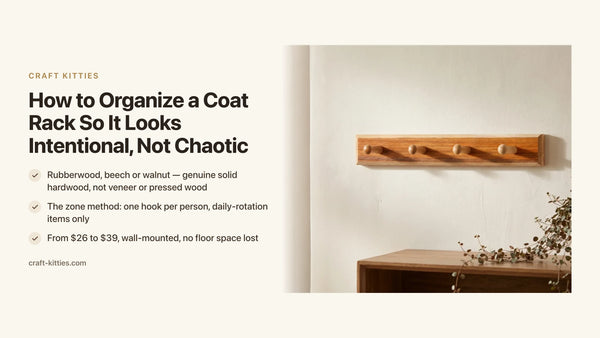
Step two: change one material. The towel bar is the highest-visibility swap because it occupies wall space at eye height and is touched by every person who enters the bathroom. Replacing a chrome bar with a solid wood one changes the character of the room without touching a single tile or fitting.
Step three: align the textiles. A linen or waffle-weave towel in a stone, sage, or off-white tone costs under $30 and reinforces the palette that the wood introduces. Pattern, bright color, and synthetic sheen all work against the aesthetic.
Step four: address the light. A small fixture on the mirror wall — matte black or brushed brass — adds the warm directional light japandi depends on. A single bulb at 2700K changes the reading of solid wood and textile alike: the grain opens, the palette warms.
Step five: add one plant. A single plant — a monstera leaf in a stone vase, a small potted sansevieria — is the organic element japandi imports from the Japanese tradition. One plant in the right corner. Two is usually one too many in a bathroom.
Comparison table — solid wood towel bars for japandi bathrooms
| Model | Price | Profile | Hardware | Best for |
|---|---|---|---|---|
| Square hardwood bar | $24.00 | Single bar, square edge | Matte black | Pure japandi minimalism, first piece |
| Wood & brass rack set | $22.00 | Rack set, horizontal | Brushed brass | Warm palette, existing brass fixtures |
| Arc design bar | $24.00 | Single bar, arc silhouette | Matte black | Narrow bathrooms, visual height |
| Double layer bar | $24.00 | Double bar, stacked | Matte black | Two-person bathrooms, shared space |
Decision matrix — which model for which japandi bathroom
| Your situation | The right pick |
|---|---|
| You want the purest japandi geometry, no detail, one object | Square hardwood bar — $24 |
| Your faucets are brass and you want the room to match | Wood & brass rack set — $22 |
| Compact or narrow bathroom where the wall needs to feel taller | Arc design bar — $24 |
| Two people sharing, one bar is never enough | Double layer bar — $24 |
| Housewarming or renovation gift that photographs well | Wood & brass rack set — the one that photographs well |
Mistakes that break the japandi bathroom
Adding before removing. The instinct when styling any room is to bring things in. Japandi works in the opposite direction: the first move is always subtraction. A bathroom that is cluttered but has a solid wood towel bar is still a cluttered bathroom. Clear the countertop before purchasing anything. That sequence is not optional.
Using two wood species in the same room. A walnut towel bar next to a red oak shelf next to a bamboo soap tray creates visual noise even when the individual tones are close to each other. Choose one species for the wood pieces in the bathroom and hold to it. Species consistency is what makes a room read as designed rather than assembled over time from unrelated impulses.
Mixing polished chrome with matte hardware. Chrome reflects the room back at you — your own reflection, the light source, the opposite wall. In a japandi bathroom, that reflection is a constant distraction. A single matte black or brushed brass fixture surrounded by polished chrome reads wrong immediately; a fully matte bathroom reads right. The swap does not require touching the plumbing — a matte towel bar and a matte robe hook are enough to shift the balance of the room perceptibly.
Choosing wood from a catalog photo without considering the actual wall. Studio photography flattens tonal relationships. A walnut towel bar that reads "medium warm brown" on a white background may read nearly black against dark-veined tile, or nearly disappear against a honey-oak vanity. Look at the actual wall under actual lighting before ordering.
Buying a wood-effect surface expecting it to hold up. Printed wood-grain panels, veneered MDF, and laminate deteriorate in a bathroom — edges swell, the printed layer chips, the substrate shows through. Solid red oak, walnut, or beech with a wax coating does not behave this way.
Installing a wall-mounted wood towel bar
Mark the position first. Standard height is 48 inches from the floor — mid-chest height, high enough that a hanging towel clears the floor. In compact bathrooms, 44 inches works. Mark both bracket positions before drilling.
Find the studs or use anchors. Drywall alone will not hold a bar under the weight of wet towels over time. Locate a stud for at least one mounting point, or use the correct drywall anchor. Mounting hardware is included with each bar.
Check level before tightening. Two degrees off reads crooked for as long as the bar is on the wall. A bubble level takes thirty seconds.
Allow the installation to settle. If adhesive is part of the mounting system, allow the full cure time — typically 24 hours — before hanging anything.
FAQ — japandi bathroom design
1 — What colors define a japandi bathroom? A japandi bathroom stays within a narrow palette: warm off-whites, stone grays, sage greens, and muted earthy tones. The governing rule is that no single surface should compete for attention. Natural wood accents — solid red oak, walnut, or beech — provide the warmth while the walls and tiles remain quiet and secondary.
2 — Does japandi use light or dark wood? Both, but deliberately. Light red oak and beech suit white or light-tile bathrooms where the wood reads warm without heaviness. Walnut works best as a single statement accent — a towel bar, a shelf — against a light or stone-tone wall. Mixing light and dark species in the same room breaks the cohesion that japandi depends on.
3 — Can a japandi bathroom be achieved without a full renovation? Yes. Replacing a chrome towel bar with a solid hardwood one, adding a pebble bath mat, and clearing the countertop costs under $50 and shifts the room's character visibly. Japandi is defined by reduction, not by new tile.
4 — What materials work best in a japandi bathroom? Solid hardwood, stone-look tile, matte ceramic, linen or waffle-weave textiles, matte black or brushed brass accents. Polished chrome, heavy pattern, plastic, and glossy surfaces all pull against the aesthetic. The fewer distinct materials, the more coherent the result.
5 — Is solid hardwood safe in a humid bathroom? Yes, when properly sealed. Solid red oak, walnut, or beech finished with a wax or wax-oil coat resists ambient humidity without swelling or degrading. The critical difference from raw or veneered wood is that sealed grain does not absorb moisture from the air. An occasional wipe with a dry cloth is the only ongoing maintenance required.
6 — How many wood accents are too many in a japandi bathroom? A useful ceiling is three to five pieces from the same species: towel bar, toilet paper holder, a small shelf, perhaps a soap tray. Beyond five, the material starts to feel like a deliberate theme rather than a natural choice. Japandi rewards restraint — one well-placed piece reads more powerfully than a dozen scattered ones.
7 — What is the difference between japandi and Scandinavian bathroom design? Scandinavian design allows more tonal contrast, warmer textiles, and occasional decorative playfulness. Japandi absorbs Japanese wabi-sabi into that Scandinavian base: emptier surfaces, lower color temperature, a preference for natural imperfection over geometric precision. In the bathroom, the difference is most visible in how little sits on the countertop and in how the wood grain is displayed — japandi favors visible, honest grain over painted or whitewashed finishes.
8 — Which towel bar hardware finish suits japandi best? Matte black and brushed brass are both appropriate for japandi. Matte black pairs with lighter woods — red oak, beech — and reads clean without the clinical quality of chrome. Brushed brass introduces warmth and flatters walnut grain without gold-toned excess. Polished chrome and nickel are the finishes to avoid: their high reflectivity conflicts with the muted, textured surfaces the aesthetic is built on.
9 — What height should a wall-mounted towel bar be installed at? The standard guideline is 48 inches from the floor — mid-chest height, high enough that a hanging towel clears the floor. In compact bathrooms where the visual space below the bar matters, 44 inches works. Mark both bracket positions before drilling and check level before tightening any screws.
10 — Is a solid wood towel bar a good housewarming gift? It is one of the most useful housewarming gifts precisely because most people outfit their bathroom in chrome by default and never revisit it. A solid wood towel bar — especially the wood-and-brass pairing — reads as an intentional choice rather than a utilitarian purchase. Pair it with a linen towel in a stone or sage tone for a set that is immediately usable and genuinely considered.
Where to go next
The towel bar is rarely the last piece that changes in a japandi bathroom. Our wood towel bar bathroom collection brings together the full range — square profiles, arc silhouettes, brass hardware sets, double-layer configurations — all in solid hardwood with consistent hardware finishes, so adding a second or third piece requires no color-matching effort. Start with the Wall Mounted Wood Towel Bar Holder if the priority is pure form, or the Wood & Brass Towel Rack Set if the existing fixtures already include warm metal. Either one anchors the style direction for everything that follows.
For customers who have discovered us through our Etsy shop — where we have built over 243 reviews — the complete towel bar lineup is available directly on this site with the same craft behind every piece.
Conclusion — one honest material, a different bathroom
The japandi bathroom is a study in what happens when you decide that less is not a compromise but a preference. A cleared surface is not an empty surface — it is a surface that finally lets the material beside it read clearly. That material, in this case, is solid red oak, walnut, or beech, wax-finished and wall-mounted at the height where a wet hand reaches without thinking.
The square hardwood bar and the arc design answer the two most common japandi briefs: pure geometry and visual lightness. The wood and brass rack closes the loop when the rest of the room already includes warm metal. The double-layer bar solves the shared bathroom without adding a second fixture to the wall. None of them asks for a renovation. Each one changes a wall permanently — and changes the room with it.