A Japandi bedroom is not a decorating style you apply from the outside. It is a philosophy about what deserves to be in a room in the first place. The word itself — a portmanteau of Japanese and Scandinavian design — names the productive tension at the heart of the aesthetic: Japanese wabi-sabi, which finds beauty in imperfection and impermanence, colliding with Scandinavian hygge, which prizes warmth, natural materials and quiet functionality. The two movements share more than they differ on: an aversion to ornament for its own sake, a preference for solid over simulated materials, and an understanding that a calm room is a room that asks little of its occupant.
This guide is about the bedroom specifically — the room where that philosophy pays its highest dividend. You spend a third of your life there. What you see when you open your eyes in the morning, and what you see when you set your rings down before sleep, shapes the quality of your rest more than most people expect. The decisions that matter are not large: it is the palette, the horizontal line of the bed, the material integrity of the objects on the nightstand. Get those right and the room takes care of itself.
At a glance
- Japandi bedroom = wabi-sabi calm × Scandi warmth, built on restraint and solid natural wood
- The nightstand is the hardest surface to edit — use height variation and limit objects to five
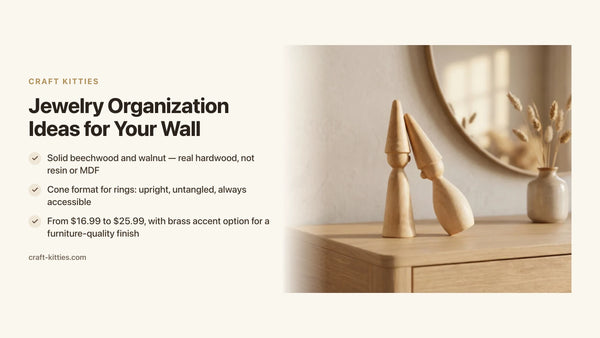
- A beechwood or walnut ring holder cone earns a place here: sculptural enough to stay visible empty
What Japandi actually means — and what it does not
Japandi is not minimalism with houseplants. It is not a white room with a single piece of furniture. It is also not the result of buying a specific product line — no aesthetic survives that kind of shortcut.
The Japanese side brings wabi-sabi: the acceptance that beauty is incomplete, transient, imperfect. A wooden surface that shows the grain. A ceramic piece that is not quite symmetrical. A nightstand where the ring cone is not perfectly centered, and no one tries to fix it. The Scandinavian side brings functional warmth: natural light, textiles that invite touch, a bias toward objects that serve a daily purpose rather than objects that perform one. The synthesis, in a bedroom, looks like this — quiet neutrals on the walls, a low platform bed, natural-fiber bedding, and a nightstand surface where every object was chosen rather than accumulated.
What Japandi is not: all-white rooms (that is Scandinavian without the warmth), bare industrial lofts (that is a different philosophy entirely), or rooms where "minimal" means empty. Japandi has warmth, texture and a handful of deliberate objects. The discipline is in stopping at a handful.
The palette: earthy neutrals, not cold contrast

The Japandi palette is built from three layers. The base layer — walls and ceiling — works best in warm off-whites, bone tones or pale stone. Not bright white, which reads cold, and not warm cream, which reads traditional. The specific paint colors that recur in well-executed Japandi bedrooms share a common character: they absorb and reflect light without bouncing it back as glare.
The mid layer comes in through textiles and large surfaces. Clay, warm sand, moss green, slate grey — these ground the room and prevent the base layer from reading as sterile. Linen bedding in natural undyed tones is the most direct path here: one duvet cover and two pillowcases in unbleached linen changes the character of a bed more than most furniture swaps. Wool or cotton throws in sage or warm grey add the second texture layer.
The accent is not a color you introduce. In Japandi, the accent is the natural tone of your wood pieces. A pale beechwood cone ring holder against bone-white walls reads as a warm note without competing for attention. A walnut piece against clay-toned walls deepens the warmth without noise. The rule that follows from this: do not introduce a separate accent color (no terracotta throw against natural wood, no dusty rose pillow against walnut). Let the material itself carry the accent.
The bed: low, horizontal, linen-dressed
The bed is the visual center of every bedroom. In Japandi rooms, it sits close to the floor — a platform bed or a low-profile frame — because height reduction is one of the primary techniques Japandi borrows from Japanese residential design. The horizontal line of a low bed anchors the room, creates the visual calm that makes the space feel restful before you lie down in it.
The frame material should be honest. Solid wood — beech, walnut, or light oak — in a simple profile with no decorative millwork. Upholstered headboards can work if the fabric is linen or a neutral boucle and the profile stays rectangular. Avoid painted MDF that mimics wood grain; the eye reads the difference at close range, and Japandi's aesthetic premise rests on material honesty.
Dress the bed in natural fibers: linen or washed cotton for the sheets, a weightier linen duvet cover, and one or two throw pillows in the same material family as the duvet. Euro shams are optional — a single large linen pillow per side is enough. The rule is texture variation within a narrow tonal range: three textures, one palette, not three palettes and one texture.
The nightstand: the hardest surface to edit
The nightstand is where Japandi discipline is tested most directly. It is a small surface, it is close to the bed, and it accumulates objects the way flat surfaces always do — a book left face-down, a charger, a glass of water, two rings, a hair tie, a receipt. By morning it is already the room's most chaotic corner.
A well-composed Japandi nightstand follows one structural rule: height variation across three levels. A lamp provides the tall anchor — its shape should be simple, its base either ceramic, stone or solid wood. A single book provides the horizontal layer. One to three purposeful objects complete the composition. The ring cone is one of those objects, and it earns its place because it serves a daily function (you put your rings there every night) while reading as a sculpture when empty. A ceramic vessel for a few sprigs of dried grass adds organic texture at mid-height. That is four objects. That is enough.
What does not belong: a phone charging cable left in a tangle, a glass with a ring mark, anything that is there because it was set down once and never moved. The discipline of the Japandi nightstand is not about buying the right objects — it is about returning everything that does not belong.
Wood species for Japandi bedrooms: beech vs walnut

Both beechwood and walnut are solid hardwoods — the starting assumption for any Japandi-compliant material selection. The difference between them is visual, not functional.
Beechwood is pale, with a fine and tight grain that reads as almost texture-free from a distance. In European furniture traditions, beech is the wood most associated with Scandinavian design: it reflects light without warmth, reads as clean and precise, and suits rooms where the dominant visual register is cool and airy. Against warm off-white walls, a beechwood cone ring holder reads as a subtle warm note. Against bone or stone, it disappears into the palette in the best way — present but not competing.
Walnut is the opposite proposition: deep brown, with a fine grain that has more visual depth than oak without the coarseness of ash. Walnut reads as quiet luxury. In Japandi bedrooms that lean toward the Japanese aesthetic — more asymmetry, deeper tones, a more deliberate relationship with shadow — walnut is the right wood. Against clay walls or aged linen bedding, a walnut ring holder is not a contrast piece; it is a continuation of the palette in a different material.
The practical rule is this: if your bedroom already leans toward light and airiness, choose beechwood for your wood pieces. If it already has warmth and depth, walnut will feel at home immediately. If you are choosing wood pieces first and building the room around them, beechwood is the safer starting point — it commits to fewer assumptions.
Cone vs flat tray: the ring holder decision axis in Japandi
The primary decision for jewelry display on a Japandi nightstand is not which wood species — it is the form: cone or flat tray.
A cone ring holder stands vertically and holds rings in a stack on a pointed cone. Its visual effect is sculptural: when empty, it reads as a small object with its own integrity. When it holds a ring, the ring is displayed, not stored. The silhouette has height, which introduces the third visual level on a nightstand that might otherwise sit too flat. In Japandi interiors — where every remaining object should justify its presence — the cone passes the test: it serves a daily function and reads as a deliberate choice even before a ring touches it.
A flat tray organizes multiple pieces horizontally. It is more practical if you remove multiple pieces of jewelry every night, but it reads as organizational tool rather than display object. For a pure Japandi nightstand, the flat tray introduces the wrong visual language — it says "organized storage" rather than "intentional object." The exception is a very minimal wooden tray in a matching wood tone used as the lowest layer of the nightstand composition, under the cone.
For Japandi bedrooms specifically, the cone holder is the right answer. It belongs on the surface. The tray, if used, goes under it.
Solid wood vs resin vs veneer — why material honesty matters here
This section exists because the ring holder market is dominated by resin and painted wood-look pieces that fail the Japandi test on first principles.
Solid wood — beech or walnut — has a visible grain that continues across the entire surface. The cut end shows the same grain as the face. When you pick it up, the weight is real. It develops a slight patina over time. It can be re-oiled if needed. A solid beechwood cone at $16.99 or a solid walnut cone at $18.99 is not an expensive object; it is a real material at an accessible price.
Resin cones dominate the low end of the market. They are lightweight, often painted in stone or marble patterns, and they degrade on close inspection — the pattern is printed, not inherent, and after months of daily handling the surface chips or dulls at contact points. In a Japandi bedroom, a resin cone fails the material-honesty test immediately. The philosophy rejects simulation.
Veneered wood sits between the two: a thin layer of real wood over a substrate. The surface grain is real, but the cut end and the weight tell a different story. Veneered pieces are appropriate in furniture at scale; as a small display object used every day, the simulation is too visible at close range.
The rule for Japandi is simple: if you cannot tell what the material is from looking at the cut edge of the piece, it is not the right material. Solid beechwood and solid walnut pass. Resin and veneer do not.
The ring holders from our studio
Three solid wood ring holders, each suited to a distinct Japandi nightstand profile.

Description
The beechwood cone set is the entry point for Japandi-inflected ring display: solid beechwood, pale fine grain, a minimal cone silhouette with no hardware or decorative detail. Set of two means both sides of a shared nightstand are covered with a matched material. At $16.99, it is also the most accessible path to a real-material ring holder — no resin, no veneer, no compromise on material honesty. Against white, bone or stone walls, the beech tone reads as a quiet warm note without competing.

Description
The walnut cone on a solid brass base is a more deliberate object: the walnut provides depth, the brass base introduces one metal accent at the narrowest possible point. In Japandi interiors, brass is one of the few metals that reads as a natural material rather than an industrial one — its warm tone rhymes with wood rather than contrasting it. The piece works best in rooms that already have at least one other brass element (a lamp base, cabinet hardware) so the metal appears intentional rather than accidental. At $25.99, it sits at the top of this lineup and justifies that position.

Description
The walnut cone set of two occupies the middle ground: solid walnut without the brass base, so the material statement is pure wood. At $18.99 for a matched pair, it is the right choice when the room already has warmth and a metal accent would compete. Two identical cones — one per side of the bed — also carry a quiet relational logic in a shared bedroom: the symmetry is intentional without being rigid.
Description
If you are choosing a ring holder as a gift — a housewarming, a wedding, a new apartment — the beechwood cone set is the answer that works regardless of the recipient's décor. Pale beechwood sits against any wall color without fighting, the pair format means both partners have a designated surface, and the price at $16.99 lands well below the point where a gift starts to feel heavy. The material is solid beechwood: real wood grain, real weight, real aging. Nothing simulated.
Description
There is a moment in designing a room when every large decision is made and one small object would close it. The walnut cone with a solid brass base is built for that moment. Deep walnut grain, a weighted brass platform that prevents it from being nudged, and a patina that develops slowly over time rather than wearing off. At $25.99 it is the top of this lineup and the object that earns its position most visibly — guests notice it before they notice the lamp.
Comparison table
| Model | Price | Wood | Base / accent | Best Japandi register |
|---|---|---|---|---|
| Beechwood cone set | $16.99 | Solid beechwood | None — pure wood | Light, airy, Scandi-leaning rooms |
| Walnut cone set of 2 | $18.99 | Solid walnut | None — pure wood | Warm, clay or linen rooms, no metal accents |
| Walnut + brass base | $25.99 | Solid walnut | Solid brass | Refined rooms with one other brass element |
Decision matrix — which holder for which room
| Your bedroom situation | The right pick |
|---|---|
| White or bone walls, light palette, Scandi-leaning | Beechwood cone set |
| Clay, linen or warm-grey palette, no brass in the room | Walnut cone set of 2 |
| Room already has brass lamp or hardware — one more accent works | Walnut + brass base |
| Shared nightstand, two people, want symmetry without a statement | Beechwood set (matched pair, both sides) |
| Gift for someone whose bedroom style you are not certain of | Beechwood cone set — safe default across any palette |
| Finishing a Japandi room that is nearly there — one final piece | Walnut + brass base |
Lighting: the quietest decision with the highest return
Lighting in a Japandi bedroom follows one rule: warm and indirect. The overhead light is not the question — it is already the least useful light in the room by evening. The question is what replaces it.
A bedside lamp with a warm-toned bulb (2700K or lower) and a shade in linen, rice paper or ceramic does three things simultaneously: it removes the overhead glare that makes a bedroom feel like a workspace at night, it introduces a pool of warm light that makes the room feel smaller in a positive sense, and it gives the nightstand a tall anchor that the rest of the composition can build beneath. The base material should be ceramic, stone or solid wood — the same material logic that applies to the ring holder applies here.
Avoid LED strip lighting as an ambient layer in Japandi bedrooms. The even, cool glow that looks dramatic in darker interiors reads as clinical against the natural materials and warm tones of a Japandi space. One lamp per side, warm bulb, material-honest shade. That is enough.
Textiles: texture variation within a single palette
The textiles in a Japandi bedroom work as a system. Every piece should come from the same material family — natural fibers: linen, washed cotton, wool — and every piece should sit within a three-tone range. Not three different colors: three adjacent tones within one palette family.
The bed is the largest textile surface in the room, so it sets the range. Unbleached linen in a natural ecru tone is the single most useful starting point. It reads as neither warm nor cool, it improves with washing, and it photographs identically in every light condition — a practical indicator of how a material behaves in a room across the day. From there, a throw in warm grey or sage adds the second tone, and two linen pillowcases in the same ecru as the duvet complete the system without requiring additional decisions.
The floor is often the most neglected textile surface. A wool or jute rug in natural undyed tones — placed so it extends at least eighteen inches beyond each side of the bed — softens the floor and prevents the room from feeling hard and echoic. In a Japandi bedroom, the floor rug is not a statement piece. It is the ground plane that makes the rest of the room feel settled.
What to remove before you add anything
The most reliable Japandi technique is subtraction. Before purchasing anything, the exercise that creates the most change in a bedroom is a surface edit: remove every object from the nightstand, the dresser top, and any visible shelf. Every object. Then return only what you can justify.
The return criteria: does the object serve a daily function? Does it have visual integrity on its own? Is it made of a real material? Is there a version of the room where it does not come back? If the answer to that last question is yes, it stays off the surface.
Most bedrooms reveal, after this exercise, that the room was not lacking objects — it was lacking space. The rings that had no home (and therefore sat wherever they landed) get a home: a beechwood cone on the nightstand. The cable tangle disappears when the charger gets a fixed route. The book stack collapses to one book. The room that results from this edit is already more Japandi than any new purchase would make it.
Mistakes that undermine a Japandi bedroom
Misreading "minimal" as "empty." A Japandi bedroom has objects — it has five or six deliberate objects per surface. Empty is cold. Japandi is warm. The discipline is choosing, not excluding.
Mixing the material vocabulary. A solid walnut nightstand next to a chrome lamp base and a fabric-covered ring dish reads as three separate intentions competing. Every visible surface should tell the same material story: wood, natural fiber, ceramic or stone, and one metal tone if any. One exception breaks the logic.
Choosing wood pieces that simulate the material. A resin cone painted to look like stone, a veneer tray with a printed grain — these fail on contact in a Japandi room. The philosophy reads material simulation as the antithesis of wabi-sabi. Real material, even at lower price points, is always the right choice.
Overcrowding the color range. Adding a mustard throw "for warmth" when the room is already warm, or a terracotta pillow "for earthiness" when the palette already has clay tones, is how a Japandi room tips into a mood board collage. The palette disciplines itself: warm off-white, one mid-tone, natural wood. That is already three colors. The wood is the accent.
FAQ — Japandi bedroom ideas
1 — What is Japandi style and how does it differ from Scandinavian or Japanese design?
Japandi is the intersection of Japanese wabi-sabi philosophy and Scandinavian hygge sensibility. Where Scandinavian design favors light woods, white walls and functional warmth, and Japanese interiors lean toward asymmetry, negative space and raw materials, Japandi synthesizes both: pale neutrals, solid natural wood, strong horizontal lines, and a deliberate reduction of objects so each one earns its place. The result is quieter than Scandinavian and warmer than traditional Japanese minimalism.
2 — What colors work in a Japandi bedroom?
The Japandi palette builds from warm off-whites and bone tones at the lightest end, through clay, warm sand and stone in the midtones, and grounds in sage, moss green, slate or charcoal for depth. Avoid cold blues or high-contrast black-and-white — Japandi warmth comes from earthy neutrals, not graphic contrast. Accent with the natural color of your wood pieces (pale beech, medium walnut) rather than introducing a separate accent hue.
3 — What is the difference between a cone ring holder and a flat tray for a Japandi nightstand?
A cone ring holder sits vertically and displays one ring at a time — the sculptural silhouette suits a Japandi nightstand because the object itself has visual integrity even when empty. A flat tray holds multiple pieces horizontally and reads more as organized storage. For Japandi bedrooms, cone holders in pale beech or walnut tend to perform better aesthetically: they add height variation to the nightstand surface and read as intentional objects rather than utility trays.
4 — What materials are most authentic for Japandi bedroom decor?
Solid hardwood is the non-negotiable core material — beechwood for light, Scandi-leaning rooms, walnut for warmer, more Japanese-inflected spaces. Beyond wood: linen and cotton for bedding, stone or ceramic for small vessels, brass for minimal hardware accents. The rule is that every material should be identifiable at a glance: no veneers that pretend to be solid, no metallic finishes on plastic. Japandi interiors favor honest materials over simulated ones.
5 — How many objects should sit on a Japandi nightstand?
Three to five objects is the practical ceiling, and they should vary in height. A lamp provides the tall anchor. A book or journal provides the horizontal layer. One to three purposeful objects — a ring holder, a small ceramic vessel, a plant — complete the composition without crowding it. If you cannot name a reason for every object on the surface, it should not be there. Negative space is structure, not absence.
6 — Can I achieve a Japandi bedroom on a limited budget?
Yes, because Japandi is fundamentally about restraint rather than premium spending. The highest-leverage changes are free: decluttering surfaces, editing the bed to natural-fiber bedding, and regrouping what remains by material family. After that, small solid-wood objects — a ring holder cone, a wooden tray, a single plant — do more for the aesthetic than a new piece of furniture. Start with what you remove, not what you add.
7 — Is beechwood or walnut better for a Japandi bedroom?
Both are solid hardwoods — the distinction is visual. Beechwood is pale with a fine, tight grain that suits cool-airy rooms with white or stone walls. Walnut is deep brown with a refined grain that suits warm rooms with clay tones and aged linen. If your bedroom leans cool and light, choose beech. If it already has warmth and depth, walnut will feel immediately at home.
8 — What ring holders work best with Japandi decor?
Solid wood cone holders with minimal, natural shapes. The beechwood cone set brings a pale sculptural presence for lighter rooms. The walnut cone set adds depth without visual noise for warmer rooms. The walnut holder with a solid brass base introduces one metal accent — which works in Japandi when the rest of the nightstand is free of competing hardware. Avoid holders with chrome, painted resin or complex decorative detail.
9 — Are brass accents compatible with Japandi style?
Yes — satin or patinated brass is one of the most Japandi-compatible metals. Its warmth complements solid wood without the coldness of chrome or the graphic weight of matte black. Crucially, brass ages: it develops a patina that reads as wabi-sabi rather than wear, growing more beautiful with time rather than degrading. A walnut ring holder with a solid brass base, placed alongside one other brass element in the room — a lamp base, cabinet hardware — reads as deliberate rather than accidental.
10 — Does wabi-sabi mean the bedroom should look unfinished?
No. Wabi-sabi means imperfection is accepted rather than corrected — not that the room should look undone. A beechwood cone that darkens slightly from handling, a linen cover that wrinkles with sleep, a brass base that develops a subtle patina: these are wabi-sabi specialementsions of materials aging well. The room should still feel complete and deliberately composed. Wabi-sabi removes the pressure to keep everything looking new. It does not remove the responsibility to make careful choices in the first place.
Where to go next
The ring holder is one object in a larger nightstand system. Our ring holder collection gathers the solid wood pieces — beechwood and walnut, cones and trays — that complete the Japandi nightstand surface without introducing competing materials. Explore the Beechwood Ring Holder Cone Set as an entry point, or go directly to the Walnut Wood Ring Holder with Solid Brass Base if the room already has its tonal direction.
Conclusion
A Japandi bedroom is a room that asks nothing from you when you walk in. It has already done its work: the surfaces are clear, the palette holds, the materials are honest, and the few objects that remain are there because they belong. Getting there is less about buying and more about choosing — choosing which objects earn a surface, which material tells the right story, which wood tone rhymes with the palette you already have.
The ring holder is a small piece of that equation. A solid beechwood or walnut cone at the edge of the nightstand, where the rings go every night — it is not decorative in the ordinary sense. It is functional in the way Japandi understands function: it serves a daily ritual, it reads as beautiful when empty, and it is made of real material that will not simulate anything. Customers across our studio's ring holder collection consistently note the same thing: the object is smaller in person than in photos, and the room is calmer for it. Across more than 243 reviews on Etsy, that observation holds across every room style and wood tone.