At a glance
- Japandi = Japanese wabi-sabi + Scandinavian simplicity — real wood, quiet palette, intentional objects
- Solid walnut, red oak or beech — the grain IS the decoration
- 15 principles from palette to materials, with 4 handcrafted wood pieces to anchor the look
Japandi is not a trend. It is the convergence of two design philosophies that arrived at the same conclusion from opposite directions: the Japanese principle of wabi-sabi — finding beauty in imperfection and transience — and the Scandinavian value of hygge — warmth, ease, and the sense of being genuinely at home. The word appeared in Western design press around 2019, but the aesthetic it names is older and more stable than any seasonal mood board.
In a living room, Japandi resolves a tension most interiors never quite settle: how to have less without feeling empty, and how to have warmth without accumulating clutter. The answer sits in the honesty of materials. A single wall bar in solid walnut carries more visual weight than a shelf crowded with objects — and does it quietly.
This guide walks through 15 specific ideas, organized around the decisions that actually change a room: palette, furniture scale, material choice, light, textiles, and the objects that bridge function and beauty. At the end, four pieces from our studio and a comparison table to narrow the choice.

Palette: three tones, no more
The most immediate marker of a Japandi room is its palette — and the first mistake most people make is adding too many colors in the name of "warmth." Japandi rooms typically use three tones: a dominant neutral, a mid-tone, and a single accent. The dominant neutral is usually a warm off-white or a pale warm gray — linen-toned, never glossy, never cool. The mid-tone grounds the room without darkening it: a warm greige, a soft stone, a muted sage. The accent reads as natural — terracotta, charcoal, dusty rose — not primary-bright.
What holds this palette together is that every color is slightly desaturated. Japandi interiors look like they have been washed in low, warm light even at noon. The discipline of staying in this desaturated register is what produces the sense of calm that photographs of Japandi rooms communicate. Introduce one high-saturation color — a cobalt cushion, a lime-green plant pot — and the calm collapses.
A practical rule: when in doubt between two shades, pick the one closer to earth. Stone over white. Warm gray over cool. Walnut over blond pine. The direction of the choice should always be toward what feels found rather than fabricated.
Furniture scale: low, wide, unhurried
Japanese domestic spaces are historically organized close to the floor — a relationship to the room that keeps ceilings visible and opens the upper half of every wall. Scandinavian furniture translated this into practical form: low sofas with visible legs, coffee tables that barely rise above the floor, sideboards on tapered legs that create the impression of floating. In a Japandi living room these two influences reinforce each other perfectly.
The rule for furniture scale is: low enough that a standing adult sees wall and ceiling above every piece, wide enough that each piece feels settled rather than tentative. A sofa at sixty-five centimeters reads Japanese; one at eighty reads formal. Empty floor space is not a budget constraint to apologize for; it is negative space, doing as much work as the furniture.
Restraint in quantity matters as much as height. One sofa. One low table. One accent chair or floor cushion. A single storage element. A Japandi living room contains fewer pieces than a conventional room of the same size — but each one is chosen with care.
Idea 1 — Anchor the room with one piece of real solid wood
The single most effective move in a Japandi living room is placing one piece of genuine solid wood — not veneer, not MDF with a wood-look film — at eye level or above. It acts as a visual anchor: everything else in the room reads in relation to it. The grain of real walnut, red oak, or beech is intrinsically varied, irregular, and alive in a way that veneer can approximate but never replicate.
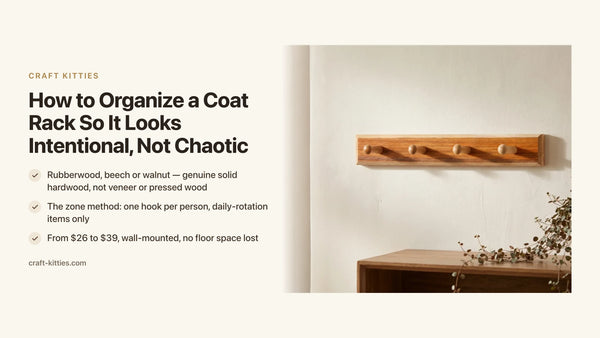
On a wall, this might be a bar, a rail, or a narrow shelf. In a living room, a wall-mounted wood towel bar or textile holder occupies a scale that feels considered: large enough to notice, small enough not to dominate. The square-edged geometry of hardwood against a flat wall — particularly in walnut, which has a depth of tone that a photographed room barely conveys — is precisely the kind of quiet statement Japandi is built on.

Description
Idea 2 — Introduce brushed brass as the only metal
Metal in a Japandi room should be singular: one species, used with restraint. Brushed brass is the material that walks the narrowest path between warmth and discipline — it reads warm without being heavy, luxurious without being shiny. The slight irregularity of a brushed surface aligns with wabi-sabi's preference for texture over gloss.
In a living room, brushed brass appears at the scale of hardware: the bracket on a wall-mounted piece, the pull on a sideboard, the stand of a floor lamp. The rule is that every metal visible in the room is the same metal. Mixing brushed brass with chrome or black iron produces the scattered-intention feeling that Japandi specifically counteracts.

Description
Idea 3 — Choose walnut over lighter wood for living rooms
Among the wood species that appear in Japandi interiors — walnut, red oak, beech, ash — walnut is the most directionally Japanese. Its deep brown tone, tight grain, and natural sheen read as refined and settled rather than bright and Scandinavian. Against an off-white wall, walnut absorbs light gently and produces the kind of quiet, furniture-like presence that makes a bare wall feel inhabited.
Red oak, with its more pronounced and open grain, leans Scandinavian — it brightens a room and works beautifully against warmer neutrals or in rooms with more natural light. Beech is the calm middle: pale, close-grained, and understated in a way that disappears into the palette rather than reading as an accent. The choice between them is a function of what the room needs — walnut for depth, red oak for brightness, beech for quietness.
All three are solid hardwood. The distinction from veneered or printed-wood alternatives is not only visual; it is tactile. Real grain has variation — the touch communicates it. In an aesthetic built on the appreciation of natural materials, that difference is not marginal.
Idea 4 — Replace pattern with texture
Japandi rooms carry almost no pattern in the conventional sense: no geometric prints, no botanical repeat, no statement wallpaper. The visual complexity comes entirely from texture — the grain of wood, the weave of linen, the pile of a jute rug, the surface of a ceramic vessel. These textures are read at close range and appreciated over time rather than registered at a glance.
This is a practical advantage in small living rooms: texture adds richness without adding visual noise. A flat-woven jute rug and linen cushions in the same muted palette as the sofa create a room that reads as layered and considered without any single object competing for attention.
The practical rule for textile selection is natural fiber only: linen, cotton, wool, and jute. Not because synthetic fibers fail aesthetically — some do not — but because the specific quality of light on natural fiber, particularly in low afternoon sun, is part of what Japandi rooms are composed of.

Idea 5 — Mount objects on the wall rather than accumulating them on surfaces
The Japandi approach to display is vertical rather than horizontal. Objects on surfaces create the visual field of clutter even when individually beautiful; objects on walls create the impression of curation. A wall-mounted bar holding a folded throw, a narrow rail with three hooks holding everyday objects, a single ceramic piece on a wall-mounted shelf — these read as decisions rather than accumulation.
The added benefit is practical: mounting objects on the wall clears horizontal surfaces, which in a Japandi room should be nearly empty. A coffee table with a single ceramic bowl and one book is a Japandi coffee table. The same table with a candle, a remote, a magazine, two coasters, and a ceramic bowl is a conventional table that happens to be low.

Description
Idea 6 — Layer light, lower the source
Lighting in a Japandi room follows a single principle: warm, low, multiple sources. The overhead fixture is rarely the primary light — it is the emergency light. Everyday living happens under floor lamps positioned at the edge of the seating area, table lamps at sofa-arm height, and candles at coffee-table level. The combined effect is a room where light pools rather than floods — corners stay in soft shadow, and the room feels enclosed and restful rather than exposed and bright.
Bulb choice matters: 2200K to 2700K, Edison-style or globe, warm rather than neutral. A Japandi room lit with 4000K LED strips looks like a dental office. The same room with 2400K bulbs and a paper shade looks like the interior of a good Tokyo restaurant.
A candle on the coffee table is the secondary light source with the most design return: real flame introduces movement that Japandi rooms otherwise contain only in the grain of wood, and it disappears when unlit, costing nothing in visual noise during the day.
Idea 7 — Edit the sofa to one
Most living rooms have too many seating options. A sofa and two armchairs and an occasional chair and a floor pouf create a room where the eye cannot rest — there is always more furniture to register. Japandi reduces seating to one decision: one sofa, plus one secondary option. That secondary option should be either a floor cushion (decidedly Japanese) or a single low armchair in the same neutral palette as the sofa.
The sofa itself should be low, firm, and plain — no tufting, no nailhead trim. Upholstery in a natural weave: boucle, linen, or close-woven cotton. If the sofa has a visible frame, make it solid wood. A sofa with tapered walnut or beech legs requires nothing else to introduce the wood tone; it becomes the wood element, and everything else builds from it.
Idea 8 — One live plant, positioned with intention
Japandi interiors include organic life — but singularly, not as a collection. One large plant, placed at one point in the room where the eye naturally rests. A single Japanese maple or fiddle-leaf fig in a matte ceramic pot does this work; a cluster of small plants on a shelf reads as hobbyist, not considered.
Position it near natural light, visible from the primary seating position, at a scale that reads from across the room. A plant only noticed on approach is in the wrong place.
Idea 9 — Build storage into one piece
Storage in a Japandi living room is closed, not open. An open shelving unit displaying an assortment of books, objects, and accessories is the opposite of the wabi-sabi principle of selective presence. A low sideboard with solid doors, a basket with a lid, a single cabinet — these contain the living of the room and present only a clean surface to the eye.
The one exception is intentional display: three objects on a wall-mounted shelf, arranged with enough space between them that each can be seen individually. Two objects exist in a relationship. Three form a composition. Four begins a collection. Five is clutter.
Idea 10 — Extend the Japandi material language into functional objects
The final idea is also the most sustainable: extend the same material logic that governs the sofa and the sideboard to the everyday functional objects of the living room. The remote goes in a small wooden tray. The extra throw is folded on a wall-mounted bar rather than draped over the arm of the sofa. The books on the coffee table have their spines facing the same direction.
These moves do not require purchasing anything new. They require applying the same principle of quiet intention that defines the room's furniture to the objects that pass through the room daily. The result is a room that looks Japandi at noon on a Tuesday, not only in a morning photoshoot.

Description
The four pieces from our studio
These are the four wall-mounted solid wood pieces in our lineup that fit a Japandi living room directly. All are solid hardwood — red oak, walnut, or beech — finished to resist contact and age well. None require drilling if you prefer adhesive mounting.
Idea 11 — Let the towel bar become the gift
The wall-mounted wood bar is one of the rare housewarming gifts that genuinely upgrades a room: it mounts in minutes, it functions every day, and it reads like a decision rather than a gesture. For someone building a Japandi home, a single solid wood bar is more useful than decorative objects that will sit on a shelf trying to find their place.
The brushed-brass-and-wood set is the version that photographs well on a doorstep and installs better: the wood body anchors the wall warmth, the brass rail brings the metal accent the room needs, and at $22 it occupies the exact price range where a gift registers as considered without reading as extravagant. The design is neutral enough to work in a bathroom, a kitchen, or a living room — which means the recipient decides where it belongs.
Description
Comparison table
| Piece | Price | Wood | Metal | Best use in living room |
|---|---|---|---|---|
| Square Hardwood Bar | $24.00 | Solid hardwood | — | Single-bar anchor, minimal wall |
| Wood & Brass Set | $22.00 | Solid wood | Brushed brass | Wood + brass accent, kitchen or living room |
| Arc Design Bar | $24.00 | Solid wood | — | Soft movement on a flat wall |
| Double Layer Bar | $24.00 | Solid wood | — | Throw + linen, two-level display |
Decision matrix — which piece for which room
| Your situation | The right pick |
|---|---|
| You want the cleanest possible wood statement — no metal visible | Square Hardwood Bar — $24 |
| You have brass hardware elsewhere and want to extend the thread | Wood & Brass Set — $22 |
| You want organic softness without pattern — a curved profile on a flat wall | Arc Design Bar — $24 |
| You fold a throw every evening and want it on the wall rather than the sofa arm | Double Layer Bar — $24 |
| You want one piece that works as a gift for someone building a calm home | Wood & Brass Set — $22, or the Arc Design Bar |
Three mistakes that undermine a Japandi living room
Mixing wood species carelessly. Walnut and red oak can coexist in a room, but they should be separated by enough space that they read as a sequence, not an accident. A walnut coffee table next to a red-oak sideboard next to a pine shelf is not Japandi — it is a forest. Pick one dominant species; let the second appear at small scale if at all.
Treating "minimal" as synonymous with "unfinished." A Japandi room is not a room where you have not yet added the decoration; it is a room where every decision has been made. Bare white walls with a sofa and a lamp in the middle read as empty, not calm. The distinction is in the quality and the completeness of what remains. Solid wood on the wall, linen on the sofa, one ceramic object on the coffee table — that is a complete room. A mattress on a floor with no other objects is just incomplete.
Using warm wood on a cold wall. The palette decisions have to hold together. Deep walnut on a cool gray wall creates tension — the wood reads warm, the wall reads cold, and they cancel each other out rather than reinforcing each other. Walnut wants off-white, warm stone, sage, or charcoal — tones that share its warmth register. If the walls are cool, work with the coolness rather than against it: red oak reads more neutral, beech reads pale and clean.
FAQ — Japandi style living room ideas
1 — What exactly is Japandi style? Japandi is a design hybrid that draws from Japanese wabi-sabi — the appreciation of imperfection and transience — and Scandinavian hygge, the pursuit of warmth and ease. The result is interiors that are pared back without feeling cold, and warm without being cluttered. Natural materials, a restrained palette, and a bias toward handmade objects over mass-produced ones are the defining traits.
2 — What colors work best in a Japandi living room? Japandi rooms typically draw from a narrow palette: off-whites, warm grays, muted sage, deep charcoal, and earth tones like terracotta or sandy beige. The key is that every color reads as grounded rather than bright. White should feel like linen, not gloss. Black reads best as matte. Accent hues — a moss green cushion, a rust-toned throw — stay desaturated.
3 — What is the difference between Japandi and Scandinavian design? Scandinavian design prioritizes function and democratic access: clean lines, light woods, mass production done well. Japandi keeps those lines but adds the Japanese layer: a preference for irregularity over perfection, darker and warmer woods like walnut, objects that have a story, and a stronger sense of stillness. A Scandi room invites activity; a Japandi room invites rest.
4 — Can Japandi work in a small living room? Japandi actually suits small spaces exceptionally well. The principle of negative space — leaving room deliberately unfilled — makes a small room feel intentional rather than cramped. Low furniture lowers the visual horizon and opens the ceiling. A palette of three neutral tones prevents the eyes from snagging on contrast. The discipline of owning less but choosing better is especially practical when square footage is limited.
5 — What wood species feel most Japandi? Walnut is the closest match: its deep brown tone and fine, tight grain convey the quiet gravitas that defines Japandi at its best. Red oak, with its bolder grain, reads more Scandinavian but works in Japandi rooms that lean lighter. Beech is a calm middle ground — pale, close-grained, understated. All three should be solid, not veneered: the texture of real wood grain is part of the aesthetic.
6 — How many pieces of furniture belong in a Japandi living room? There is no fixed number, but a useful rule is to halve what you think you need. A sofa, a low coffee table, one accent chair, and a single storage piece cover most situations. Every additional object should answer the question: does this add calm or remove it? Objects that serve both a functional and a visual purpose — a wood bar that holds linens and reads as sculpture — do the most work per square foot.
7 — How do I bring Japandi into a room without redecorating entirely? Start with the objects that get daily contact: a wood bar on the wall, a ceramic bowl on the coffee table, linen cushions on the sofa. Remove one piece of furniture that exists out of habit rather than use. Shift one light source to a warm, low position. Those three moves — add real material, subtract clutter, lower the light — shift a room's atmosphere considerably without a full redecoration.
8 — Is brass hardware compatible with Japandi? Yes, with one condition: the brass should be matte or brushed, never polished mirror-finish. Brushed brass paired with solid walnut or red oak is one of the most successful material pairings in Japandi design — it reads warm without being precious, and the slight irregularity in a brushed surface aligns with the wabi-sabi appreciation of texture over perfection.
9 — What textiles belong in a Japandi living room? Linen, cotton, wool, and jute — natural fibers with visible texture. A single chunky-knit throw in oatmeal or charcoal, linen cushion covers in muted green or dusty pink, a flat-woven jute rug. The pattern rule is close to zero: texture replaces pattern. If any print appears, it should feel organic — watercolor brushstrokes, a botanical motif — never geometric repetition.
10 — How does Japandi handle storage and clutter? Japandi treats concealed storage as architecture, not afterthought. Low sideboards with push-to-open doors, baskets made of seagrass or woven rattan, and wall-mounted rails rather than freestanding shelves are the standard toolkit. The goal is that every object in view has been chosen to be seen. Objects that are used but not displayed go behind closed doors — this discipline is what gives Japandi rooms their sense of calm.
Where to go next
The wall-mounted wood pieces in this guide belong to our wooden towel bar collection — a lineup built around the principle that a functional object should earn its place on the wall visually, not just practically. If you are starting from the bathroom and building the material language outward, the Wall Mounted Wood Towel Bar Holder and the Wood & Brass Towel Rack carry the same grain and finish logic into a different room.
Several of these pieces have been found by customers through our Etsy shop, where they carry over 243 reviews from people building the same kind of quiet, considered interiors.
The living room that earns its calm
Japandi is not a shopping list. It is a set of decisions made consistently over time: the palette held to three tones, the furniture reduced to what is used rather than what fills space, the materials kept honest — real wood, natural fiber, matte ceramic, brushed metal. A room assembled on these principles does not announce itself. It is simply the room you want to be in at the end of a long day, and it looks that way at every hour, not just in a morning photograph.
A single piece of solid walnut, red oak, or beech on a wall is the most compact version of that commitment — one object, clear material, grain you can read with your eyes and your hand. Start there.