At a glance
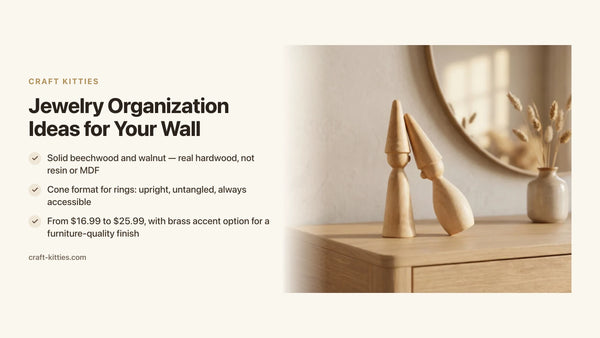
- Solid beechwood and walnut — real hardwood, not resin or veneer
- Ring cones keep bands visible and tangle-free, unlike flat trays
- From $16.99 to $25.99, with natural brass or unadorned cone options
The jewelry sitting on your dresser right now is probably piled in a dish, threaded through a tangle, or arranged in whatever position it landed in when you took it off. The problem is not that you are disorganized — it is that flat surfaces give rings, earrings and bracelets nowhere to go that makes sense. A ring slips to the edge of a ceramic dish, a necklace falls behind the earrings, and what was meant to be a display becomes a small excavation every morning.
A solid wood ring holder changes the geometry of the whole dresser top. Cones give rings a place to sit upright, visible and separated. A considered wood material gives the object a reason to be out rather than in a drawer. And a piece made from real beechwood or walnut — not a resin cone, not a piece of printed particleboard — earns its place on a dresser the way a good lamp or a quality mirror does: it belongs there, and it improves the room by being there.
This guide covers what to look for in a wood jewelry display for the dresser top, the distinction between formats that actually matters in daily use, and the five models from our studio with real prices, a comparison table, and an honest decision matrix. One clarification first, because it shapes everything that follows: all the pieces in this guide are cut from solid wood. Beechwood and walnut are dense, stable hardwoods that hold their shape and surface over years of use. That is the difference from resin "wood-look" cones, which are lighter but mark more easily, and veneered bases, which chip at the edges over time.
Why the dresser top is its own category
Not every surface in the home asks the same thing of a display piece. A jewelry armoire lives in the closet and prioritizes storage volume. A bathroom counter needs waterproof materials. The dresser top is different: it is a personal surface, usually in the bedroom, where you interact with the same few objects twice a day — when you take off your rings in the evening and when you put them back on in the morning.
The criteria that matter here are narrower and more specific than general jewelry storage. The piece needs to sit without sliding. It needs to be reachable from a standing position in the same motion as opening a drawer. It needs to look intentional in a space that is already filled with things — a mirror, a lamp, a tray of products — which means it cannot be bulky or visually noisy. And it needs to handle daily use for years without becoming something you eventually hide.
Solid wood ticks every one of these boxes. It is heavy enough to stay put without gripping the surface. Its natural grain gives it visual texture that reads well against fabric, glass and metal. And it ages — it develops a patina, a quality that resin does not and cannot.
Cone versus flat tray: the format decision that matters most

The decision between a cone and a flat tray is the single most consequential choice in this category, and it is worth making consciously rather than by default.
A ring cone holds each band upright on a tapered post. The geometry does the organizing work automatically: a ring slid down a cone cannot stack on another ring, cannot slide to the edge of the dresser, and is visible at a glance from above. For people who wear the same few rings every day, the cone is a daily ritual object — it marks where the ring is when you are not wearing it, and it makes putting it on and taking it off feel deliberate rather than incidental. The one constraint is size: very wide statement rings may not slide all the way down a standard cone, though most band widths and profiles fit without issue.
A flat tray is a horizontal surface. It works well for earrings, bracelets, a watch, and any piece that does not need to be kept upright. For rings specifically, the flat tray has a structural problem: rings roll, slide, and stack, which means the tray that looks organized when empty tends to become a pile within a few days of regular use. The tray format is better understood as a secondary surface — a place to collect whatever you take off at the end of the day, with cones handling the pieces you need to find reliably every morning.
For a dresser top where the primary interaction is daily ring removal and replacement, cones are the stronger choice. Our studio's lineup is built around this: every piece prioritizes vertical ring display, with shapes and materials chosen to suit the dresser's visual register.
Beechwood or walnut: reading the grain on your dresser

The two wood species in our jewelry display lineup differ in one way that matters on the dresser: visual weight.
Beechwood is light — a pale, warm off-white with a fine, even grain. It sits quietly on the dresser surface without demanding attention, which makes it the right choice for light-colored furniture, Scandinavian interiors, or rooms where the palette is already busy. It is also the species that reads most clearly as "natural material" in photographs and at a glance, because the grain is visible without being bold. Beechwood is a dense closed-grain hardwood, used extensively in quality furniture because it resists denting and holds a smooth finish well.
Walnut occupies the opposite register. Its deep brown color and tight, fine grain give it the visual weight of a furniture piece rather than an accessory. A walnut ring cone on a light dresser top reads as an intentional design object in the same way a good walnut desk accessory does in an office — it has presence. It suits rooms that already have warm wood tones, mid-century pieces, or dark-stained furniture. Against a white lacquered dresser, walnut creates contrast; against a dark walnut dresser, it blends in as part of the material language of the room.
On durability, hardness, and finish quality, beechwood and walnut are comparable. Both hold a smooth surface under daily ring placement. Neither warps under normal indoor humidity conditions. The choice is purely aesthetic — choose by the dresser surface it will sit on, and by whether you want the cone to stand out or to blend in.
The models from our studio
Five pieces, three products, all solid wood. Each solves a slightly different version of the dresser-top ring storage problem — from the most minimal single-cone to the couples' pairing set to the statement piece with a brass base.

Description
The Beechwood Ring Holder Cone Set is the piece we point to when the question is "where do I start." Two cones, identical in height and finish, cut from solid beechwood with its characteristic fine grain and pale tone. They sit side by side on the dresser top without visual noise, each holding a set of rings upright and visible. The pairing design makes this the natural choice for couples — one cone per person, the set giving the dresser top a composed, intentional look that a single cone or two mismatched objects cannot achieve. The light beechwood reads well against most dresser finishes, from white lacquer to natural wood to painted surfaces.

Description
The Walnut Wood Ring Holder with Solid Brass Base is the model that earns "jewelry display" rather than "ring holder." Solid walnut — deep brown, tight grain — set into a solid brass base that gives the piece visible weight and keeps it exactly where you place it. The brass base introduces a warm metallic note that pairs with gold-toned jewelry naturally. Of all the pieces in the lineup, this one transforms the dresser top most visibly: it reads as a deliberate design object rather than a storage solution. At $25.99, it is also the piece most commonly purchased as a gift, because it photographs beautifully and communicates quality immediately.

Description
The Wooden Ring Holder Set of 2 in walnut takes the matched-pair format of the beechwood set and renders it in solid walnut. Where the beechwood set reads light and Scandinavian, the walnut set reads warm and furniture-forward. It suits dressers that already have dark wood tones — oak, walnut veneer, stained pine — and rooms where the palette favors deep, warm materials. At $18.99 for the pair, it is the most practical entry point into the walnut register: the same logic as the brass-base model, without the metallic accent, for a room where the dresser does all the visual work.
Comparison table
| Model | Price | Wood | Format | Best for |
|---|---|---|---|---|
| Beechwood Cone Set | $16.99 | Solid beechwood | 2 cones, matched pair | Couples, light dressers, first purchase |
| Walnut with Brass Base | $25.99 | Solid walnut + solid brass | Single statement cone | Statement piece, gifts, gold-toned jewelry |
| Walnut Cone Set of 2 | $18.99 | Solid walnut | 2 cones, matched pair | Warm dressers, mid-century rooms, pairs |
Decision matrix — which model for which dresser
| Your situation | The right pick |
|---|---|
| Shared dresser, two people, matching set | Beechwood Cone Set — $16.99 |
| Light or white dresser, natural/Scandi palette | Beechwood Cone Set — $16.99 |
| Dark or warm-wood dresser, mid-century room | Walnut Cone Set of 2 — $18.99 |
| One statement piece, gold-toned or mixed metals | Walnut with Brass Base — $25.99 |
| Gift for a partner or for a new home | Walnut with Brass Base — $25.99 |
How to set up a dresser-top ring display that actually holds
The difference between a dresser top that stays organized and one that drifts back to chaos within a week is almost always positioning — not willpower, not more products.
1 — Anchor the cones near the corner closest to where you stand. The natural motion of taking off a ring at the end of the day is to sweep it toward the nearest surface point. If the cone is in the center of the dresser, it competes with every other object for that space. Placed in the front corner on your dominant side, it becomes the automatic landing point.
2 — Limit the surface to what you use every day. A dresser top filled with pieces you rotate seasonally becomes a searching exercise. The ring holder works best when it holds your daily-wear rings — the three or four bands and stones you put on and take off on the same schedule. Seasonal pieces can live in a drawer or a box; the cone holds what you need to access twice a day.
3 — Add a small tray only for secondary pieces. If you also take off bracelets, earrings, or a watch every evening, place a small flat tray beside the cone rather than on it. The cone handles the rings; the tray handles everything else. Keeping the functions separated keeps both surfaces usable.
4 — Check the base contact. On lacquered or high-gloss dresser tops, add a self-adhesive felt pad to the base of each cone. The solid wood base will not scratch the way ceramic or metal might, but felt eliminates even the possibility of marking the finish over repeated placement adjustments.
What to avoid on a dresser-top display
Using one cone for multiple people's rings. A single cone becomes a puzzle — whose rings are on top, and in what order — within two days of regular shared use. The matched-pair format, both the beechwood and walnut sets, exists precisely to prevent this: one cone per person, organized by position.
Treating the tray as overflow. A flat surface next to the cone that holds "everything that doesn't fit" tends to expand until it holds everything and the cone becomes decorative. Define what the tray is for before placing it — earrings and bracelets only, for example — and remove anything that isn't in scope when you notice drift.
Choosing wood by the product photo instead of the dresser. Beechwood and walnut look dramatically different in context. A walnut cone that photographs beautifully in a light studio can disappear against a dark dresser surface, or create too much contrast against a walnut-veneer top. Before ordering, look at the surface the cone will sit on: high contrast or low contrast, warm or cool.
Skipping the scale check. A single large cone on a small dresser can look heavy; two cones on a large dresser can look sparse. The matched sets are sized to leave visual breathing room on a standard dresser top — approximately 14 to 22 inches wide — without overwhelming the surface. If your dresser is narrower, a single statement cone is often cleaner than a pair.
The material difference: solid wood versus resin or veneer
The ring holder category has a spectrum of materials that is not always visible in product photos: solid hardwood at one end, resin cast in a wood-grain mold at the other, with veneer-over-MDF somewhere in between.
Resin cones are the most common type in the lower price range. They can be made in any shape, accept surface treatments that mimic wood grain convincingly in photographs, and are light enough to slide on smooth dresser tops. The practical problems are weight (they move too easily) and surface durability (they dent, scratch, and chip at the point of contact with metal bands over time). A resin cone on a lacquered ring is a recipe for visible wear within months.
Veneer — a thin layer of real wood over an MDF or particleboard core — is more expensive to produce than resin and looks closer to real wood because it is, on the surface. The problem specific to tapered cone shapes is that veneer is a thin flat sheet applied to a round form. At the tip of the cone, where the sheet has to compress to conform, the edges are vulnerable: the first drops, chips, and ring slides tend to peel the veneer from the core at exactly the point of daily contact.
Solid hardwood — beechwood or walnut cut from a single piece — has no layers to separate, no resin core to dent. The contact point between a metal ring band and the wood surface is wood against metal, and solid hardwood holds that contact without marking significantly over time. It is heavier, which means it stays where you place it. And it develops a patina rather than wearing away — the surface changes slowly in character, the way a quality leather object does, rather than degrading.
The price difference between a resin cone and a solid beechwood set is small — often five to ten dollars. The difference in the object you own five years later is not.
FAQ — jewelry tray for dresser top
1 — What is the best wood for a jewelry tray on a dresser top? Beechwood and walnut are the two strongest choices. Beechwood is light-toned with a fine, even grain — it suits Scandinavian and minimal interiors and shows off the natural material clearly. Walnut is deeper, richer, with a tight grain that reads like a premium piece of furniture. Both are solid hardwood, not veneer, which means they hold their surface and shape over years of daily use without warping, chipping, or developing soft spots.
2 — What is the difference between a ring cone and a jewelry tray? A ring cone holds rings upright on a tapered post — each band is visible, accessible, and impossible to tangle or stack accidentally. A flat tray lays everything down in one plane and works well for bracelets, earrings, and watches, but rings slide and pile on flat surfaces. For a dresser top where the primary interaction is daily ring removal and replacement, cones are more practical. A tray works better as a secondary surface for everything else.
3 — How many cones do I need? The most common setup is two cones side by side — one for each hand, or one per person on a shared dresser. Our beechwood and walnut sets are designed as matched pairs: both cones identical in height and finish, sized to sit side by side without crowding a standard dresser top. If you wear only one or two rings, a single statement cone — like the walnut with brass base — is often cleaner visually.
4 — Will a wood ring holder scratch my dresser top? Solid wood is gentler on surfaces than ceramic or metal, but for lacquered or high-gloss dresser tops, adding a small self-adhesive felt pad to the base takes five seconds and eliminates any risk. The cones' bases are flat and stable; they do not tip or slide under normal use.
5 — Can I use the ring holder set as a couple's display? Yes — the Beechwood Ring Holder Cone Set and the Walnut Cone Set of 2 are designed around exactly this use. Two matched cones, one per person, give the dresser top an intentional pairing rather than two mismatched objects placed near each other. Couples commonly use one cone per nightstand and bring both to the dresser when getting ready together.
6 — Is solid beechwood durable enough for daily ring placement? Beechwood is a dense, closed-grain hardwood used in quality furniture specifically because it resists denting and surface wear. Daily ring placement — the slight pressure of a metal band slid down the cone — will not mark the wood over time. The finish develops a gentle patina with use; it does not deteriorate.
7 — Do these make good gifts? Ring holders and small jewelry displays are among the more considered gifts in the home accessories category. They are useful every day, they sit in a personal space, and solid wood communicates quality in a way that resin or plastic never does. Our sets arrive ready to display with no assembly required.
8 — How do I clean a solid wood ring holder? A dry or lightly damp cloth is all you need. Avoid soaking or harsh cleaning products on any solid wood surface. For dust that collects around the cone base, a soft dry cloth or brush works well. There is no re-oiling routine required; the factory finish holds under normal dresser-top conditions.
Where to go next
The ring cone is usually the first piece that brings intentional organization to a dresser top — and often not the last. Our ring holder collection gathers the pieces that answer each other: individual cones, paired sets, and accent-metal options in beechwood and walnut, all cut in our studio from solid hardwood and finished to sit on surfaces that matter.
If you already know your material preference, the Beechwood Ring Holder Cone Set is the most practical starting point — two matched cones, real wood, $16.99 for the pair. For a single statement piece, the Walnut Wood Ring Holder with Solid Brass Base is what most gift buyers and design-conscious shoppers reach for.
Conclusion — a dresser top that holds its shape
If this guide leaves you with one method: choose the wood species by the dresser surface it will sit on, use cones for rings rather than a flat tray, and size for how many rings you actually wear daily rather than everything you own. The Beechwood Cone Set answers most dresser tops at $16.99; the Walnut Cone Set of 2 brings warmth for rooms with darker furniture at $18.99; and the Walnut with Brass Base is the piece that earns its place as a display object rather than just a storage tool.
The 243 reviews from customers who have found us on Etsy reflect a consistent pattern: the piece they expected to tuck away has stayed out on the dresser, because solid wood is the kind of material that earns its visibility over time.