At a glance
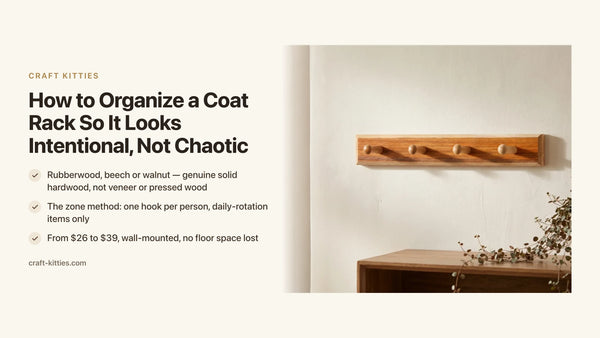
- Solid hardwood racks (rubberwood, beech, walnut) mounted at kid height — the structural fix
- Two-row setup: 36–42 in. for kids, 60–64 in. for adults
- Labels + proximity do more for the routine than any organizer
The entryway is the room that sets the tone for the whole house twice a day: once when everyone leaves, once when everyone comes back. In most homes with children, it is also the room that absorbs the most chaos for the least floor space — a thirty-second window where coats get dropped, backpacks hit the floor, and shoes land wherever gravity takes them.
The good news is that entryway chaos is almost always a systems problem, not a discipline problem. When the hooks are at the right height, the labels are clear, and the rack is solid enough to hold a loaded school bag without pulling from the wall, kids use it. This guide covers the three-part equation: the right hardware (wall hook racks in solid hardwood, mounted correctly), the right layout (hook height, cubby placement, floor zone), and the routines that make the system self-sustaining once it is in place.
Why the hook rack is the load-bearing piece

Every entryway organizer — cubby, basket, shelf, tray — works downstream of the hook rack. A coat dropped on the floor means the basket is useless; a backpack on the counter means the papers get buried. The hook solves the first and largest problem (bulk outerwear and bags) and frees every other surface to do its job.
Wall-mounted hook racks earn their place over freestanding alternatives for one simple reason: stability. A freestanding coat tree tips when a child yanks a bag off the hook at speed — and every child yanks every bag at speed. A wall rack stays fixed. It keeps the floor entirely clear below it, it positions each hook at a consistent and controllable height, and it takes up zero floor footprint in a space that never has any to spare.
The material is not decorative. MDF and veneered particleboard racks are common at the low end of the market, and they work — until a wet raincoat drips on the shelf edge, or a corner takes a knock, or the hook anchor in the board loosens after eighteen months of daily loading. Solid hardwood (rubberwood, beech, walnut, red oak) is denser, dimensionally stable through humidity changes, and the hooks are anchored in material that does not compress. It is the difference between furniture and a fixture that reads as furniture.
Hook height: the single specification that determines whether kids use the rack
Most entryway hook racks fail for children not because of the rack but because of where it was mounted — at adult height, where a six-year-old cannot reach without jumping. The result is predictable: the rack goes unused, the floor collects coats, and everyone concludes that "kids just don't hang things up."
The rule is straightforward. For children aged 4–8, the hook bar should sit between 36 and 42 inches from the floor. That puts it at or just above shoulder height for most children in that range — within natural reach, not a stretch. For older children (8–12), 42–50 inches still works without forcing the adult to crouch. The sustainable solution for a household with children across several ages is a two-row installation: a lower bar at 36–38 inches for the youngest, an upper bar at 60–64 inches for adults. Both rows on the same rack, or two separate racks mounted one above the other, are valid configurations.
Before marking any holes, have your child stand next to the wall and extend their arm naturally. Mark where their hand rests. That mark — not any chart — is where the hook bar should sit.
Choosing the right hook rack: species, hook count, and configuration

Rubberwood (Hevea brasiliensis) is the least-known name in this list and one of the strongest arguments for it. It is a plantation hardwood harvested from end-of-life rubber trees — sustainably sourced almost by definition, since the timber is a byproduct of a tree grown for latex. The wood is dense (Janka hardness ~960 lbf), dimensionally stable, and has a fine, even grain that accepts veneer beautifully. The result is a rack that looks refined and holds up to daily punishment from a household with children.
Beech (Fagus sylvatica) is harder still — Janka ~1,300 lbf — with a tight, pale grain that reads as clean and contemporary. Its hardness makes it particularly resistant to denting where a bag buckle swings against the wood repeatedly. Beech is a common choice for high-traffic furniture for exactly this reason.
Walnut brings the richest color of the three: deep chocolate-brown, tight grain, a look that belongs more to a living room than a mudroom. In an open-plan home where the entryway is visible from the main space, walnut reads as intentional design rather than utility.
Hook count follows a simple formula: one per child, plus one or two spares for guests, overflow bags, or the inevitably forgotten swim bag that shows up at the end of the week. A four-hook rack handles one or two children; a six-hook rack covers three. For larger families, two four-hook racks side by side on the same wall is often cleaner than a single long bar.
Configuration — whether the rack runs as a single row or stacks two rows — should match the age spread of the children in the house. A single adjustable-height rack works when kids are close in age; a two-row setup handles a five-year gap between siblings cleanly.
The five products in our lineup, in detail

Description
The Brazilian-veneer rubberwood rack is the model we reach for first in a kids-specific installation. Rubberwood's density absorbs the daily impact of bags swinging onto hooks without loosening the anchors; the Brazilian veneer adds a warm, richly grained surface that holds up to proximity with wet outerwear better than most finishes. Available in 4 or 6 hooks depending on family size, and priced at $39 — the solid-hardwood entry point for a rack that will genuinely last.

Description
The cherry-veneer variant runs on the same rubberwood core as the flagship. The difference is entirely tonal: where the Brazilian veneer reads as warm blond, the cherry veneer brings a deeper reddish-brown that pairs naturally with terracotta tile or earth-tone walls. At $37 it is the most accessible solid-hardwood rack in the lineup, without any structural compromise.

Description
The two-tone beech-and-walnut rack solves a common household problem almost accidentally: when each side of the rack is visually distinct, assigning "the light side" to one child and "the dark side" to another becomes a natural label system that younger children read before they can read text. Beech is the hardest wood in our entire lineup (Janka ~1,300 lbf); walnut adds the depth of color. Starting at $26 for a 2-hook version, it scales up to 6 hooks for larger families.

Description
The walnut boot-profile rack is built around a specific problem: standard hooks are too shallow to reliably hold a school backpack at a steep angle, so the bag slides off when the rack is loaded. The boot-profile hook has a deeper, more pronounced curve that seats the bag's strap securely even when the rack is fully loaded. Solid black walnut (Juglans nigra), four hooks at $28.80 — the cleanest single-row option for a tight entryway wall.
Comparison table
| Model | Price | Wood | Hooks | Best for |
|---|---|---|---|---|
| Rubberwood — Brazilian veneer | $39 | Solid rubberwood | 4 or 6 | Main kids row, daily-use flagship |
| Rubberwood — Cherry veneer | $37 | Solid rubberwood | 4 or 6 | Warm-toned entryways, earth tones |
| Two-tone Beech & Walnut | From $26 | Solid beech + walnut | 2 to 6 | Sibling assignment, visual label |
| Walnut — boot-profile hooks | $28.80 | Solid walnut | 4 | Heavy backpacks, won't slip off |
Decision matrix — which rack for which household
| Your situation | The right pick |
|---|---|
| 1–2 kids, want the hardest-wearing daily rack | Rubberwood — Brazilian veneer ($39) |
| Warm-toned walls or terracotta tile | Rubberwood — Cherry veneer ($37) |
| Two siblings who need their own territory | Two-tone Beech & Walnut (from $26) |
| Heavy school backpacks that slide off standard hooks | Walnut boot-profile ($28.80) |
| Small budget, entry-level solid wood | Two-tone 2-hook Beech & Walnut ($26) |
| Gift for a growing family or new home | Rubberwood 6-hook — the rack that scales |
How to install a kids hook rack in four steps
Installing the rack correctly matters more than any other step. A hook rack that pulls from the wall after three weeks of use teaches children that the system is unreliable — and they stop using it.
1 — Find the studs. A stud finder is a five-dollar tool that removes all guesswork. Mark stud locations clearly with tape before touching the drill. For racks that must mount between studs, drywall anchors rated for at least 50 lbs per hook are the minimum — not standard plastic expansion anchors.
2 — Mark the height. Have your child stand against the wall, arm extended naturally. Mark that height for the lower row. Add a second mark 24–28 inches above it if you are running an adult row on the same wall. Check level before any drilling.
3 — Pre-drill and mount. Use a drill bit slightly smaller than the screw diameter to pre-drill — this prevents the wood from splitting at the bracket holes. Tighten until snug, then give each hook a firm downward tug before loading it.
4 — Label each hook. A name tag, a painted initial, or a simple icon sticker (especially for pre-readers) makes the assignment visible without instructions. This is the step that turns the rack from furniture into a system.
Layout: what goes around the rack
A hook rack solves the coats-and-bags problem. The rest of the entryway — shoes, papers, water bottles, sports gear — needs its own designated zone, and those zones need to be in the right relationship to each other.
Shoes belong directly below the rack. The most natural motion after hanging a coat is stepping out of shoes. A low cubby, a tray, or a simple bin at floor level directly under the hook row captures shoes in the moment they come off, not two minutes later after the child has walked through the house. A bench with cubbies beneath it combines both steps into one piece of furniture.
Papers and communication go at adult eye level. Permission slips, school newsletters, and weekly folders get lost when they share space with hooks and bags. A small shelf or wall pocket mounted at adult height — above the kids' hook row, below the adult row — creates a dedicated inbox that adults can scan without bending.
A floor zone for sports gear. For households that run soccer bags, swim gear, and sports equipment in and out of the entryway daily, a single large basket or a low tray on the floor beside the rack designates overflow without turning the entryway into a storage room. One designated container is the difference between visible clutter and intentional collection.
The organizing principle across all three zones is proximity: each item goes in the spot closest to where it naturally lands when the door opens. The entryway system fails when items must travel more than two or three steps to their home.
Routines that make the system self-sustaining
The physical setup is the easy part. The harder part is building the habit — which is really two habits: in the door, and out the door.
The "door-to-hook in five seconds" rule. The entryway only works when the hook is the first stop, not a stop the child gets to eventually. For younger children, standing at the door and waiting until the coat is on the hook before any other transition (snack, screen, play) anchors the behavior before it becomes negotiable. The routine breaks down when adults skip it on hard days — consistency in the first two weeks matters more than anything said about the system.
The "ready stack" for tomorrow morning. Ten minutes before bed, or right after dinner, is the window when bags get checked and repacked, permission slips get signed, and the coat goes back on the hook for the next morning. A visual cue helps: some families use a small tray on the shelf as the "tomorrow box" — anything that needs to leave the house tomorrow goes in the tray the night before. The morning becomes a sweep of the tray rather than a search of the house.
One-per-one replacement. As children accumulate gear — new sports season, new school year — the hook system can drift toward overload if nothing is removed when something is added. A simple rule (one item in, one item goes to the closet or the donate bin) keeps the rack from becoming a pile.
Mistakes that undermine a well-designed entryway
Mounting at adult height. The single most common reason a kids' hook rack goes unused. A rack at 64 inches serves adults; a rack at 38 inches serves the people whose gear you are trying to organize. When in doubt, mount lower — adults can always reach down, children cannot always reach up.
Too many categories in one zone. An entryway that tries to hold coats, shoes, school papers, sports equipment, dog leashes, keys, and reusable bags in one compact space will always look chaotic and will always be abandoned. Pick two or three primary categories; everything else goes somewhere else in the house.
Hooks with no labels. Without a clear assignment, every hook is contested territory. Children share space badly when the boundary is ambiguous. Labels — names, colors, or icons — convert contested hooks into owned hooks, and the result is visible within days.
Installing without testing the load. A rack mounted into drywall without anchors, or with the wrong anchor for the wall type, will not survive three months of a loaded school bag. Test the install before walking away: hang a bag, give it a firm downward pull. If the wall flexes, redo the anchor.
FAQ — kids entryway organization
1 — How low should kids entryway hooks be mounted? For children aged 4–8, mount the hook bar between 36 and 42 inches from the floor — at shoulder height or just above for the average child in that range. Run a second adult row at 60–64 inches on the same wall for a two-generation setup. Always test by having the child extend their arm naturally before marking the wall.
2 — What is the best wood for a kids entryway rack? Solid hardwoods — rubberwood (Hevea brasiliensis), beech, and walnut — are the strongest choices. Rubberwood is an especially practical option: dense, stable, sustainably sourced, and underpriced relative to its performance. Avoid MDF and veneered particleboard, which swell at edges when exposed to wet gear and eventually loosen the hook anchors.
3 — How many hooks does a kids entryway need? One per child, plus one or two spares. A 4-hook rack handles one or two children comfortably; a 6-hook rack covers three. For four or more, two racks side by side are cleaner than a single very long bar.
4 — Can a wall hook rack hold a heavy backpack? Yes, when mounted into studs or with the correct drywall anchors. The rack and hooks are solid wood and metal rated for the weight — the limiting factor is the mount, not the rack. For a fully loaded school backpack, stud-mounted installation is the safest approach.
5 — What else can go on a kids entryway hook? Beyond coats and backpacks: sports bags, swim gear in a mesh bag, reusable lunch totes, scarves, umbrella loops, and seasonal items (hats, mittens). The boot-profile hooks in our walnut rack are designed for exactly this range — deep enough to hold a heavy bag, shallow enough not to snag a thin scarf.
6 — How do I get kids to actually use the hooks? Two things move the needle more than any furniture: labels and proximity. Label each hook (name, color, or icon for pre-readers), and place the rack within two steps of the door. The routine also needs consistency in the first two weeks — standing at the door until the coat is on the hook before any other transition anchors the behavior before it becomes negotiable.
7 — Should I use a freestanding coat rack or a wall-mounted rack? Wall-mounted, almost always. Freestanding racks tip when a child yanks a bag off the hook at speed — which every child does, always. A wall rack stays fixed, keeps the floor clear, and maintains a consistent hook height. The exception is a rental where drilling is restricted; even then, some adhesive wall-mount systems handle low-to-moderate loads safely.
8 — Is rubberwood a real hardwood? Yes. Rubberwood (Hevea brasiliensis) has a Janka hardness of approximately 960 lbf — harder than pine, comparable to black cherry. The tree is grown for latex; the timber is harvested at end-of-life (25–30 years), making rubberwood one of the most sustainably sourced hardwoods commercially available. The name causes confusion but the wood contains no significant rubber compounds and behaves as a standard dense hardwood in all furniture applications.
9 — At what age can kids hang things up independently? Most children can hang a bag on a correctly positioned hook independently by age 3–4, when the hook sits at or just above their shoulder height. The critical variable is the hook height, not the hook design. Lower the bar for toddlers; add an adult row above it so the setup grows with the family without a reinstall.
10 — What goes below the hook rack? Shoes, directly below the rack. The most natural post-door motion is coat off, shoes off — so the shoe storage should be within one step of the hooks. A low cubby, a shoe tray, or a bench with cubbies beneath captures shoes in the moment they come off, before the child has crossed the threshold into the rest of the house.
Where to go next
A solid entryway hook rack is rarely the end of the project. Once the coat-and-bag problem is solved, the next layer — shoe storage, bench seating, a shelf for papers — tends to follow. Our wall hook rack collection gathers the full range: 2 to 6 hooks, rubberwood to walnut, single-tone to two-tone. The Rubberwood Wall Hook Rack with Brazilian Veneer is where most families start; the Two-Tone Beech & Walnut rack is where families with multiple children often end up.
If you are building the entryway as part of a broader room organization project, you will find the rest of our solid wood pieces in the same section — pieces designed to answer each other in material and tone, so the room reads as a system rather than a collection of separate purchases.
We have helped over 243 customers on Etsy find the right hook configuration for their home — feel free to reach out with your wall dimensions and we can suggest the setup that fits.
Conclusion — the entryway as a system, not a collection of objects
The distinction between an entryway that works and one that does not is almost never about having enough storage. It is about having the right storage in the right place at the right height, connected by a routine that is simple enough to survive a hard Monday morning.
Start with a solid hardwood hook rack at kid height. Add labels. Place shoe storage directly below it. Keep a "tomorrow tray" on the shelf. Run the in-door and out-door routine for two weeks until it holds on its own. The Rubberwood Brazilian-veneer rack handles the structural problem at $39; the walnut boot-profile rack handles the heavy-bag problem at $28.80; and the two-tone beech and walnut rack handles the sibling-assignment problem from $26. Pick the one that fits your wall, mount it at your child's shoulder height, and the rest of the system has a foundation to build on.