At a glance
- Red oak and maple are the warmest species against white walls
- Texture and grain do the warmth work — not paint color
- Real solid wood desk accessories anchor the palette without overwhelming it
- From $15 to $55.20
There is a specific feeling that certain rooms produce: open without being bare, calm without being cold, tidy without looking like a showroom. Most of them share the same underlying palette — light wood grain alongside white or off-white walls. It is not a trend so much as a formula that keeps being rediscovered because it genuinely works. The trouble is that executing it well and executing it blandly look almost identical in a mood board. The difference lives in the materials.
This guide is about the practical side of light wood and white decor: which wood species create the warmth you are after, how texture does the heavy lifting that paint cannot, which mistakes flatten the palette into something sterile, and how the desk — the surface that arguably carries the look's most visible everyday test — can be anchored with solid wood pieces that hold the room together rather than disappearing into it. Products from our studio are included with their real prices; there is a comparison table at the midpoint and a decision guide at the end.
One premise to establish before anything else: this palette depends on real wood grain. Wood-effect laminates, printed PVC panels and melamine surfaces with a grain photograph printed on them produce a surface that the eye immediately reads as hollow — the grain has no depth, no variation, no character. Solid wood in red oak, maple or walnut has all three, and that is the difference between a room that feels warm and one that merely looks like it should.
Why light wood and white work the way they do
The combination is not a coincidence of aesthetics. It is a perceptual mechanism. White walls maximize available light by reflecting it — a white room at noon holds twice the brightness of the same room painted in a saturated color. Light wood grain, placed against that bright surface, reads as warm because of the contrast in texture and undertone: the honey amber of red oak against a cool white creates an optical warmth that neither material would generate alone.
The second reason is cognitive. Grain is a texture that the brain associates with organic material — forests, growth, time. Smooth white surfaces are processed as architectural, neutral, clean. The combination produces an environment that reads as simultaneously ordered and natural, which is why it has been the default palette of everything from Nordic residential design to Apple's retail stores. Order and nature in one room, no contradiction.
What undermines the formula, predictably, is substituting one of its two elements. Replace the white with a warm cream and the room gains color but loses openness. Replace solid wood with laminate and the room keeps the pale tone but loses the texture depth that does the warmth work. Both tradeoffs are common, and both result in a room that looks almost right.
Red oak, maple or walnut: choosing the right species for a white room

Red oak is the most versatile species for a white-dominant room. Its color sits between amber and honey — warm but not orange — and its grain is open and bold enough to read clearly across a desk or shelf without requiring close inspection. Against white walls, red oak produces the type of contrast that feels alive: you notice the wood without being distracted by it. It is the species we return to most in our pen holder and desk organizer line for exactly this reason.
Maple runs lighter, sometimes nearly blonde. The grain is tighter and more subtle, giving the piece a quieter presence. In a room with strong natural light, maple and white walls can blur together — the result is serene but can veer toward flat. Maple is better suited to rooms that already have texture from other sources: a linen curtain, a textured rug, a ceramic vase with surface interest. On a stark white desk with no other material contrast, maple alone may not be enough.
Walnut is the deliberate outlier. Deep brown with fine, tight grain, it creates real contrast against a white background rather than tonal harmony. In a room designed to read as uniformly light, walnut reads as an accent — one dark anchor that keeps the palette from floating away. One walnut pen holder on a pale maple desk in a white room follows exactly the same logic as a black picture frame on a white wall: it stops the eye and creates dimension.
The practical rule: if the goal is warmth throughout, use red oak or maple. If the goal is warmth with structure and visual anchor, introduce walnut as one deliberate piece.
The role of texture in preventing a cold, flat room
This is the principle that most light-wood-and-white rooms miss, and it is the one that matters most. A white room with smooth surfaces — polished plaster walls, lacquered furniture, glossy floors, LED panel lighting — is cold regardless of the pale wood scattered across it. The wood's tone is present, but its texture is neutralized by everything competing to look frictionless around it.
Texture is what the eye reads as warmth. Not color, not lighting, not the wood's actual grain temperature — texture. A piece of red oak with hand-finished wax that catches light differently across the face of the board is warm. The same color produced by a printed panel with no surface variation is not. The distinction is subtle in a photo and obvious in a room.
For a desk setup, the texture prescription is specific. Solid wood grain is the primary source; it should not be surrounded exclusively by other smooth, manufactured surfaces. A linen mouse pad or desk mat introduces a second texture register. A ceramic mug or planter — matte, not glossy — adds a third. These materials are not chosen for color; they are chosen because their surfaces catch and scatter light in ways that produce visual depth. The desk then reads as a composed still life rather than a collection of office supplies.
The counter-intuitive extension of this rule: a few visible imperfections help. A solid wood pen holder with a knot in the grain, a small natural color variation between two boards in a spliced piece — these are not flaws. They are the signals that confirm real material. They are what keep the room from reading as a styled photo shoot rather than a lived-in space.
How to build a light wood desk setup that holds the look

A desk is the hardest surface in the light-wood-and-white room to execute well, because it accumulates objects by nature. Books, cables, chargers, notepads and office supplies all land there, and they each carry their own material and color. The desk setup that reads as intentional is the one where the wood pieces provide a consistent frame that absorbs everything else.
Start with one species. Decide on red oak or maple as the primary material for your desk accessories and apply it consistently: pen holder, tray, monitor stand, phone stand. The visual family that results makes even heterogeneous objects — a notebook, a pair of headphones, a ceramic coffee cup — look like they belong there because the surrounding material is coherent.
Add one darker accent. A single walnut piece in an otherwise light-oak desk setup creates the focal point the eye needs. Without it, a uniform-light surface can feel unanchored. The accent can be small — a pen holder, a corner tray — as long as it is deliberate. Place it where the eye naturally lands: center desk or left front corner.
Introduce exactly one non-wood texture. The desk should not be all wood. A matte linen or leather desk mat under the keyboard adds a surface that complements the grain without competing with it. A ceramic plant pot or coffee mug brings a third material that confirms the palette is intentional rather than monotonous.
Keep the count low. Four solid wood pieces is a curated desk. Seven wood pieces in different sizes and species is a chaos that cancels out each individual piece. Edit down. The pen holder that does three jobs — holds pens, organizes small tools, supports a plant — is more valuable than three separate pieces that each do one job.
The five pen holders and desk organizers from our studio
These are real solid wood pieces — red oak, walnut, maple — finished in our studio with hardwax oil or beeswax. Each one is an object that will read clearly on a light-toned desk against white walls. Prices are as listed.

Description
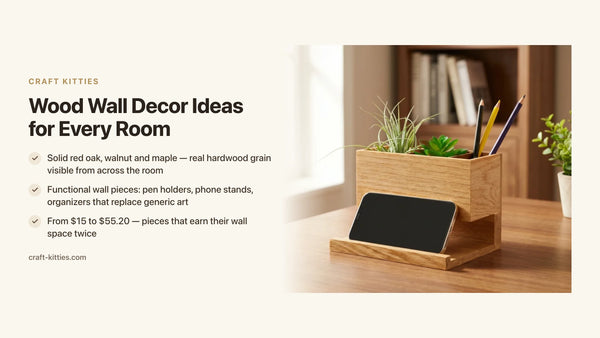
The Red Oak Plant Pod Pen Holder ($55.20) is what a desk organizer looks like when it takes the light-wood palette seriously. Solid red oak, wax-finished, with a hollowed pocket sized for a small succulent or air plant built directly into the body. The result on a white desk is exactly the composition the palette calls for: warm honey grain, a note of deep green from the plant, pens and pencils organized in a natural material container rather than a plastic cup. It is one piece doing the work of three: organizer, plant holder, desk anchor.

Description
The Walnut & Maple Spliced Wood Pen Holder ($36.00) solves the species-mixing question in a single object. Walnut and maple are jointed side by side, so the contrast between deep brown and near-blonde plays out in one piece rather than requiring two separate items. On a desk that is otherwise light — white surface, pale walls, natural light — this is the piece that provides structure: the dark walnut edge is the anchor the eye needs. Handmade, finished in our studio.

Description
The Walnut & Red Oak Pen Holder ($15.99) is the entry to the two-species approach: smaller footprint, lower price, same solid wood construction. Walnut and red oak side by side in a compact form that works as a standalone pencil cup or as a companion piece alongside a larger organizer. Under $16, it is also the least-commitment way to test the species pairing on a specific desk before committing to a larger piece.

Description
The Wooden Pen Holder & Phone Stand ($35.00) addresses a specific desk problem: the phone stand is always plastic, always out of place on an otherwise natural-material surface. This piece integrates the stand slot into a solid wood pen holder — the phone sits upright in the same material family as everything else on the desk. Practical for calls, charging, or video; invisible aesthetically because it disappears into the material palette rather than interrupting it.

Description
The Wooden Pen Holder for Desk ($15.00) is the most reduced piece in the lineup: a solid wood pencil cup in a clean geometric form. No second function, no splicing, no integrated plant pocket — just real wood in a shape that belongs on a desk. At $15, it is the first solid wood object on a desk that has none, or the quietest addition to one that already has several. It works because good material in a simple form is rarely wrong.
Comparison table — five pen holders for a light wood and white desk
| Model | Price | Wood | Extra function | Best for |
|---|---|---|---|---|
| Red Oak Plant Pod | $55.20 | Solid red oak | Plant pocket + cord management | All-in-one desk anchor |
| Walnut & Maple Spliced | $36.00 | Walnut + maple | Two-tone contrast in one piece | Built-in light/dark accent |
| Walnut & Red Oak | $15.99 | Walnut + red oak | Compact two-species form | Entry-level two-tone pairing |
| Pen Holder + Phone Stand | $35.00 | Solid wood | Integrated phone stand slot | Replace plastic phone stand |
| Geometric Pencil Cup | $15.00 | Solid wood | Clean geometric form only | First solid wood object, or quietest addition |
Decision guide — which piece for which desk
| Your situation | The right pick |
|---|---|
| Light wood palette, want one piece that does everything | Red Oak Plant Pod ($55.20) |
| Want light-and-dark contrast without buying two pieces | Walnut & Maple Spliced ($36.00) |
| First solid wood piece, limited budget | Geometric Pencil Cup ($15.00) |
| Phone stand is the one plastic object left on the desk | Pen Holder + Phone Stand ($35.00) |
| Two-species pairing, compact footprint, under $16 | Walnut & Red Oak ($15.99) |
Lighting: the step that changes everything and costs almost nothing
Light wood and white decor has a known vulnerability: cool lighting. A room with pale oak furniture, white walls and 5000 K daylight-temperature LED bulbs will feel clinical — the pale materials absorb the cool light and return it with no warmth added. The fix is simple and often underestimated.
Warm bulbs — 2700 K to 3000 K — shift every warm-toned surface in the room toward amber. On red oak, the honey notes deepen. On white walls, the light picks up just enough warmth that the room reads as neutral rather than cold. The wood grain becomes richer in artificial light at 2700 K than it does in direct midday sun; this is not intuitive, but it is consistent.
For a desk, the second consideration is directionality. An overhead ceiling fixture at low intensity supplemented by a warm desk lamp aimed at the working surface produces better results than a single bright overhead source. The desk lamp creates a pool of warm light that makes the wood grain visible and textured; a single overhead source flattens everything. The lamp itself, if it is on a solid wood base, doubles as another material anchor. A brass or matte black metal lamp paired with a wood-based pen holder completes the triangle of materials that the desk needs.
The one thing to avoid: mixing color temperatures. A 5000 K ceiling fixture and a 2700 K desk lamp in the same room will make the warm light look orange rather than warm. Pick one temperature and apply it everywhere. For a light-wood-and-white room, 2700 K is the answer every time.
What kills the palette: five mistakes worth naming
Painting the room in a warm cream instead of white. Cream is not the safe version of white in a wood-heavy room — it competes with the amber tones in red oak and maple instead of providing a neutral backdrop. The result is a room where both the walls and the wood are warm, and neither reads clearly. A cooler white — Farrow & Ball's All White, Benjamin Moore's White Dove — does what cream cannot: it provides contrast without adding a color that the wood has to fight.
Using wood-effect laminate surfaces. It bears repeating because it is the most common error: printed grain has no visual depth. Placed next to real solid wood — a pen holder, a tray, a lamp base — the difference is immediate and unflattering to both. Light wood decor requires at least one real-wood surface in each space; the rest can be laminate only if real wood exists to anchor the room.
Neglecting the floor. White walls and a pale oak desk sit on whatever the floor is. Light wood tones on a dark gray carpet create a disconnected room; light wood on a pale wood floor or a natural-fiber rug (jute, sisal, light wool) creates a room where the palette reads top to bottom. The floor is the largest surface in the room; if it conflicts with the ceiling palette, no amount of styling will fix the disconnect.
Over-accessorizing. The more objects on a surface, the lower the signal-to-noise ratio of each individual piece. Four well-chosen solid wood accessories on a desk are visible as objects; eight accessories of mixed materials on the same desk are clutter. The light-wood palette requires restraint — each piece needs enough negative space around it that its material and form register as a choice rather than an accident.
Choosing white that is too stark. Pure bright white — the kind used on exterior walls and rental apartments — is aggressive in an interior. Against solid wood grain, it reads as harsh rather than clean. The better choice is a slightly warm white with a small amount of yellow or pink undertone: it recedes as a wall color while making the wood in front of it glow rather than flatten.
Caring for solid wood pieces in a natural-light room
One practical note on longevity: solid wood pieces in rooms with strong direct sunlight will patina. Red oak lightens slightly over years of UV exposure; walnut can lighten significantly, the deep chocolate tones fading toward amber. This is not damage — it is the material behaving as it does in nature — but it is worth knowing before placing a walnut piece in full south-facing window light.
For desk accessories specifically, the care requirement is minimal. A wax-finished piece needs a dry cloth for daily wiping and a fresh application of hardwax oil or beeswax once every six to twelve months, depending on how heavily the piece is handled. There is no stripping, no sanding routine, no special product. The wax does the protective work; the maintenance is re-applying it when the surface starts to feel dry rather than smooth. Most people do this twice a year and never think about it otherwise.
The one thing solid wood does not tolerate is sustained moisture — not ambient humidity, which is fine, but direct water left standing on the surface. A wet coffee cup ring left overnight on an unprotected wood surface will raise the grain. The fix is straightforward: coasters, consistent waxing, and the knowledge that even if a ring does form, a light sand followed by rewaxing restores the surface completely.
Bringing the palette into the rest of the home
The desk setup is usually where the light-wood-and-white palette begins for most people, because the desk is the surface that accumulates objects fastest and therefore benefits most from a material discipline. But the palette extends naturally into every other room in the home.
In the living room, the same principle applies: one or two solid wood pieces — a side table, a floating shelf, a wooden tray on the coffee table — in red oak or maple against white or off-white walls. The rest of the surfaces can be neutral: a white linen sofa, a natural jute rug, ceramic accessories. The wood anchors; the other materials recede.
In the kitchen, light wood cutting boards and wooden utensil holders against white tile backsplash complete the same logic. The grain texture breaks the monotony of the tile; the white provides the backdrop that makes the grain visible.
The throughline in every room is the same: white provides the reflective, neutral field; real wood grain provides the texture and warmth that read as organic; and both materials together produce the specific quality that a single material cannot — a room that feels simultaneously clean and alive.
Our pen holder collection covers the desk end of this palette; the Red Oak Plant Pod Pen Holder and the Walnut & Maple Spliced Wood Pen Holder are the two pieces we come back to most often when the brief is a light-wood-and-white desk.
FAQ — light wood and white decor
1 — What wood species work best with white walls? Red oak and maple are the strongest pairings for white walls. Both are light-toned with visible, character-rich grain that reads clearly against a white background without competing with it. Walnut works too, but it creates more contrast — ideal when you want one dark anchor in an otherwise pale room rather than an all-over light palette.
2 — Is light wood and white decor hard to keep clean? No more than any other palette, and in some ways easier. White surfaces show dust quickly, which is actually an advantage — it makes the cleaning trigger visible rather than letting grime accumulate. Solid wood pieces finished with oil or wax wipe clean with a barely damp cloth. The palette's reputation for being high-maintenance usually comes from low-quality laminates that stain at the edges, not from real wood and genuine matte paint.
3 — How do I stop a light wood and white room from looking cold? Warmth comes from material texture, not color temperature. A white room with smooth laminate, polished concrete and cool-LED lighting will feel cold regardless of the pale wood scattered across it. The same white walls with solid wood grain, a linen cushion, a matte ceramic mug and warm 2700 K bulbs feel genuinely inviting. The wood is doing most of the work: its grain reads as organic, and organic reads as warm.
4 — Can I mix red oak and walnut in the same room? Yes, deliberately. The rule is to make the mix intentional rather than accidental. One reliable approach: use red oak for larger flat surfaces and walnut as a smaller accent. The contrast between honey-warm and deep brown reads as considered when the pieces share the same finish family — both oiled, both waxed, or both raw.
5 — What finishes are safe to use on solid wood desk accessories? Hardwax oil and food-safe beeswax are both excellent on solid wood desk pieces. They soak into the grain rather than sitting on top, which means they do not crack or peel — they simply need re-application once or twice a year. Avoid polyurethane on pieces that see daily handling: the plastic-like surface scratches and discolors in ways that are difficult to repair at home.
6 — Do solid wood pen holders scratch the desk surface? Not if they are finished with felt pads on the base, which is standard on our pieces. Solid wood is less abrasive than the injection-molded plastic alternatives that often have sharp mold seams on their undersides. The one risk is dragging a heavy piece instead of lifting it — that one habit is worth forming.
7 — How many wood pieces on a desk is too many? The threshold is visual noise rather than a specific count. Three to four solid wood pieces in the same species family read as a curated collection; six pieces in three different woods and finishes read as a craft store. A reliable test: photograph the desk from your seated position. If individual pieces blur together rather than reading as distinct objects, you have crossed the line.
8 — What plants work on a light wood and white desk? Deep-green trailing plants — pothos, heartleaf philodendron — are the strongest contrast against a pale wood-and-white palette, and they thrive in indirect light, which is what most desk setups provide. Cacti and succulents work for a more minimal, architectural look. Avoid variegated plants with white or cream leaves: they wash out against white walls and dilute the very contrast the palette depends on.
9 — Is light wood decor still on trend? Light wood had its peak in Scandinavian interior trends around 2016–2020, but it has since shifted from trend to default — the palette is now considered a neutral rather than a stylistic statement, which is more durable. Trends come and go; neutrals compound. A room built around light wood and white is unlikely to feel dated in five years.
10 — Where can I find handmade solid wood pen holders and desk organizers? Our pen holder collection covers the range from $15 to $55.20 — all solid red oak, walnut or maple, finished in our studio. The pieces are also available through our Etsy shop, where 243 reviews give a detailed picture of how each one behaves on a real desk in a real home.