At a glance
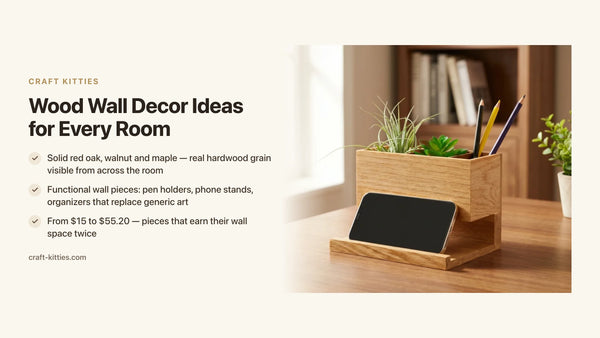
- Solid red oak, walnut or beech — not veneer, not wood-effect
- Three pieces maximum: one upright, one flat tray, one wall-mounted rail
- Waxed hardwood that improves with age, not a fixture that degrades
The desk is the most used surface in the house, and usually the worst organized one. A filing system exists for paper; a cabinet for supplies; a drawer for everything that does not have a category. But the desk itself — the surface where work actually happens — collects things by gravity rather than by design. A pen left from yesterday, a charger that lives beside the keyboard, three sticky notes for tasks that are no longer current. The surface disappears under its own residue.
A minimalist wood desk organizer does not solve this by adding storage. It solves it by giving each recurring object a fixed, visible address so the desk can return to clear between sessions. The distinction matters: the goal is not to own fewer things, it is to ensure that what stays on the desk belongs there and knows exactly where it lives.
This guide covers the criteria that produce a desk worth sitting at — wood species, the right number of pieces, arrangement logic, care and common mistakes — then presents the pieces from our studio alongside a comparison table and the questions we hear most.
One thing to establish first, because it changes everything downstream: this guide is about solid hardwood. Red oak, walnut, beech — real wood cut from the material, not particleboard wrapped in a printed wood-effect film. The difference is not just aesthetic. A veneer piece chips at the corners within a year of daily contact. A solid piece develops a patina. The desk is a daily environment; the objects on it should age like furniture, not like packaging.
Why solid wood belongs on a minimalist desk

A minimalist desk operates on a simple visual logic: every object on the surface is intentional, chosen for how it looks as much as how it functions. That logic collapses the moment a veneer piece starts to show its particleboard core at a corner — an edge that chips does not read as intentional. It reads as something that belongs in a drawer.
Solid wood behaves differently under daily use. The grain runs through the full depth of the piece, so a knock or a scratch into the surface reveals more wood rather than a contrasting substrate. A wax-oil finish applied to solid hardwood penetrates the material rather than sitting on top of it; it reinforces the fibers from inside and can be refreshed with a single coat when the piece starts to look dry. After a year of daily contact, a solid red oak organizer has a warmer, subtler appearance than the day it arrived. A veneer piece has chipped corners.
The argument for solid wood on a desk is not that it looks better in a photograph. It is that it holds up to the environment a desk represents — daily handling, occasional spills, a pen dragged across the surface — and remains the same object it was when you bought it. The wax finish is not cosmetic; it is the barrier between the wood fibers and ambient humidity, and it can be renewed indefinitely. That is the material promise solid hardwood makes, and keeps.
Red oak, walnut or beech: choosing the species

The three species our studio works with differ primarily in how they read against a desk surface. Red oak is warm and assertive — a honey-amber tone with a clearly visible open grain that adds presence to the desktop without requiring any other decoration. It contrasts well against dark desk surfaces (espresso, slate grey, matte black) and suits rooms with natural light. Walnut is the refined choice: deep brown, fine-grained and quiet. Against a pale or white desk it reads like a piece of studio furniture; paired with a walnut desktop it creates a monolithic, intentional look that needs nothing else to feel complete. Beech sits between the two — pale, consistent grain, close to the Scandinavian palette. It disappears gently into the desk rather than asserting itself, which suits setups where the tools and the screen are meant to be the focus.
On every functional criterion — density, resistance to daily wear, wax-finish compatibility — the three species are comparable. Each is a dense hardwood that resists the dents and corner chips that mark out cheaper materials. Each takes a wax or wax-oil finish that seals the surface without masking the grain. The choice is purely about what the desk should look like from across the room: the species sets the tone, the arrangement and the hardware do the rest.
The reliable rule is contrast. Light desk and pale walls — pick walnut so the organizer reads as a deliberate presence. Dark desk or warm-toned room — pick red oak or beech to prevent the piece from disappearing into the surface. When two people share a setup and cannot agree on a species, walnut and red oak coexist without conflict as long as the hardware finish is consistent across both pieces.
How many pieces a minimalist desk actually needs
The most common desk organization mistake is buying too much. A tray, a cup holder, a cable box, a monitor riser with a built-in drawer, a small shelf for the corner — each piece is reasonable in isolation. Together they reconstruct the clutter they were meant to eliminate, in a more expensive material.
Three pieces is the practical ceiling for a minimalist setup. The logic is spatial and cognitive: three objects on a surface are easy to scan; more than three requires active searching, which is the beginning of clutter. The three categories that cover the real needs of a working desk are: one upright container for pens, scissors and other vertical tools; one flat tray or closed drawer for the small objects that otherwise disappear (cards, clips, earphones, charger); and one wall-mounted rail or riser if the setup includes a laptop or second screen that needs lifting to eye level, or cables that need routing off the surface.
Everything else — the things that come to the desk occasionally, the supplies that live behind the keyboard, the reference books that stay open for a week — belongs in a drawer, a shelf above the desk or a cabinet nearby. The surface is for the objects used every working day. The rest is storage, and storage belongs behind a door.
The wall-mounted option: when it earns its place
For most desks, freestanding organizers are the natural choice: they sit where you place them, require no installation and can be moved when the setup evolves. But when desk space is genuinely limited — a narrow work surface against a wall, a standing desk with no back edge to spare — a wall-mounted bar or shelf behind the desk recovers every inch of the surface area that a freestanding piece would have occupied.
The wood towel bar bathroom wall mounted is the piece that crosses contexts most naturally: its square hardwood profile reads as a desk accessory as readily as a bathroom fixture. Mounted at the back edge of a permanently positioned desk, it becomes a cable management bar, a headphone hook or a small rail for memo cards. The wooden towel bar holder wall mount arc takes the same logic further with a curved silhouette that adds a small amount of visual lift to the back of the setup — a shape that works equally well for a dedicated headphone stand and for routing two or three cables in a way that reads as deliberate rather than accidental.
The rule for deciding between wall-mounted and freestanding is simple: if the desk will stay in the same position indefinitely and the surface is genuinely crowded, a wall mount earns the drilling. If the setup might change in the next twelve months, freestanding pieces preserve that flexibility at no cost.
The pieces from our studio
Four pieces in solid hardwood, chosen for a desk or workspace context. Each is cut from real wood — red oak, walnut or beech — and finished with a wax or wax-oil coat that seals the grain and resists daily contact. No printed veneer, no laminate core.

Description
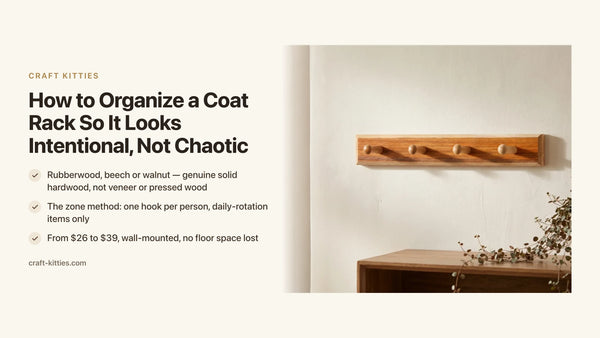
The square hardwood bar is the foundational piece for a wall-anchored desk setup. Its geometry is strictly orthogonal — no curves, no decorative elements — which is precisely why it disappears into a minimal setup without competing with the tools on the desk. Solid hardwood, sealed with a wax finish that resists the ambient humidity and repeated contact of a daily workspace. Mount it at back-desk height to keep cables and headphones off the surface, or position it slightly above to create a second visual level behind the screen.

Description
When the desk setup already includes warm metal — a brass lamp base, a brushed-gold monitor arm, copper-finish cable clips — this two-bar set brings the same material language to the wall behind it. Solid wood, brass-finish hardware, two coordinated bars that handle two categories of objects without making two separate visual decisions. The set format removes the guesswork from pairing; everything arrives speaking the same hardware dialect.

Description
The arc design is the one departure from strict orthogonality in our desk-adjacent lineup. The curve is minimal — a gentle radius rather than a bold sweep — but it is enough to make the piece read as a considered object rather than a utility rail. In practice it becomes a headphone rest, a cord organizer or a hook for a canvas bag beside the desk. Solid hardwood, waxed finish, single mounting bracket. It looks better after two years of daily contact than it does on day one, which is the measure that matters for an object in that position.

Description
When a single bar is not enough — the desk holds both a full cable setup and a headphone collection that needs its own dedicated position — the double-layer mount solves the problem without doubling the wall hardware. Two parallel bars in solid hardwood, mounted on a single bracket set at separate heights so the two tiers operate without interfering with each other. From a distance the silhouette reads as a single piece, not as two organizers stacked. The same wax finish, the same hardwood construction as the rest of the lineup.
Description
This second reading of the square bar works when the desk is permanently positioned against a wall with mounting access. At back-desk height, it becomes a cable channel that stops cords from migrating forward across the surface — the single most common reason a minimal desk stops looking minimal within a week. The square profile keeps the geometry honest at every viewing angle: no visual mass added, one problem eliminated.
Comparison table
| Piece | Price | Profile | Hardware | Best desk use |
|---|---|---|---|---|
| Square hardwood bar | $24 | Orthogonal, single bar | Brushed metal | Cable rail, memo bar, cable guide |
| Wood & brass set | $22 | Two coordinated bars | Brass finish | Warm-metal setups, two-tier rail |
| Arc bar | $24 | Curved single bar | Brushed metal | Headphone rest, mug hook, bag rail |
| Double layer bar | $24 | Two tiers, single mount | Brushed metal | Full cable and headphone setup, dual-zone |
Decision matrix — which piece for which desk
| Your situation | The right pick |
|---|---|
| Fixed desk against a wall, cables migrating onto the surface | Square hardwood bar — $24 — clean rail, orthogonal geometry |
| Desk already has warm metal (brass lamp, brushed-gold arm) | Wood & brass set — $22 — matches the existing hardware language |
| One dedicated headphone hook is all you need | Arc bar — $24 — curve designed for hanging, gentle visual accent |
| Full setup: cables and headphones in one wall section | Double layer bar — $24 — two zones, single compact footprint |
| Gift for someone building a first proper home office | Square hardwood bar — $24 — the most versatile starting point |
Arrangement logic: where each piece belongs on the desk
A minimalist desk reads well when the objects on it follow a simple spatial logic rather than an aesthetic decision made from above. The screen or laptop is the center of gravity; everything else radiates from it based on how often it is reached and with which hand.
The back edge is the correct home for wall-mounted bars and for anything with height: the monitor riser, the lamp base. Height at the back creates depth on the surface without blocking the sightline from the chair. The dominant-hand side holds the upright organizer: pens, scissors and tools all go here because the hand reaches for them without thought — no searching, no leaning. The non-dominant side holds the flat tray or the cable organizer: items that are reached less frequently but still need a fixed address. The center of the desk, in front of the keyboard, stays clear. Always. The moment a second object colonizes the center — a notebook, a coffee cup, a phone resting face-up — the desk stops reading as a workspace and starts reading as a table.
The discipline is not about aesthetics, though the aesthetics follow naturally. A desk arranged by reach frequency rather than by what looked good in a photograph is a desk where nothing needs searching. That is the practical promise of a minimalist setup: not fewer things, but every thing in the right place.
The material mix: what belongs beside a solid wood organizer
Solid wood on a desk creates a reference material: everything else on the surface will be read against it. The combinations that hold up over time follow a logic of contrast and restraint rather than matching.
Wood and matte black metal is the most reliable pairing for a modern or industrial setup. The grain of the wood provides the warmth; the black hardware reads as clean and precise. A black monitor arm, black cable clips and a wood organizer in red oak or walnut produce a surface that registers as intentional in every material, from every angle.
Wood and brushed brass is the warmer alternative. The brass catches light in the same amber register as a waxed wood surface, and the two materials reinforce each other without competing. The wood and brass set applies this logic directly — the hardware is already matched to the material, so there is no pairing decision to make at checkout.
Wood and concrete or ceramic works when the desk includes a plant or a mug that carries visual weight. A concrete planter and a walnut organizer on a pale desk create the material balance that defines most well-regarded minimal setups: one rough texture, one smooth finish, one warm organic tone.
What does not hold: mixing species without intention. A beech organizer beside a walnut riser beside a pine tray reads as three separate purchase decisions rather than one considered desk. Pick a species and hold it across every wood piece on the surface. When the desk includes a wooden lamp base or a wood monitor stand, the organizer should share its species — the desk reads as one composed object, not an accumulation.
Four mistakes that undermine a minimalist desk
Buying storage instead of practicing curation. The instinct when a desk is cluttered is to add more containers. But a desk with six organizers of different sizes is still a cluttered desk — the clutter has been sorted, not reduced. The correct question is not "where does this go?" but "does this belong on the surface at all?" A cable that is used once a week does not earn a spot on the desktop.
Choosing the organizer before deciding its purpose. A wood cup holder is not a desk organizer — it is a container. Before buying, work out specifically which objects will live in it, at what position relative to the keyboard, reached with which hand. Working out those answers before ordering eliminates the impulse pick that ends up storing three highlighters and a spare battery.
Mixing hardware finishes. A matte-black lamp, a brushed-silver monitor arm and a brass-finish organizer bracket on the same desk announce themselves as unrelated objects. Hardware finish is the easiest element to align: one metal tone across lamp, arm, bracket and cable clips resolves the visual noise at no additional cost. The wood and brass set is designed around this logic: two bars, one consistent hardware tone, zero pairing work.
Letting the desk evolve without an edit pass. A minimalist desk requires a periodic reset, not a permanent state of maintenance. Every month or so, remove everything from the surface, put back only what earned its place in the last thirty days, and let the rest migrate to a drawer. The desk that is curated once and never revisited reverts to accumulated objects within six weeks. The reset is not failure — it is the practice.
Caring for solid waxed hardwood
Waxed solid wood is the lowest-maintenance surface finish available for desk accessories. The routine is shorter than most people expect, and more forgiving than the material's quality suggests it should be.
For daily cleaning, a dry cloth is the correct tool. For a surface that has caught a coffee splash or a pen mark, a barely damp cloth followed by immediate drying is sufficient. No abrasive pads, no spray cleaners applied directly to the wood. The wax coat forms a barrier that prevents most stains from penetrating the grain; that barrier is dissolved by prolonged contact with alcohol-based products, so keep those away from the surface.
Once or twice a year — or whenever the wood starts to look matte and dry rather than subtly satin — apply a thin coat of furniture wax or wax-oil with a soft cloth, leave it to penetrate for a few minutes, and buff with a clean cloth. This one step restores the depth of the grain and reinforces the moisture resistance. After two or three applications the piece looks more itself than it did new: the wax builds a history in the grain that registers immediately in person and cannot be replicated in a product photograph.
Solid hardwood does not need sanding, stripping or re-staining under normal desk conditions. The assumption that wood demands constant maintenance is a veneer habit transplanted onto the wrong material: veneer degrades and requires replacement; sealed solid hardwood matures and requires feeding. The difference in long-term effort is significant.
Where to go next
A well-organized desk rarely stops at the desk. The same material logic — solid hardwood, consistent hardware, one species held across pieces — extends naturally to the wooden bathroom accessories collection, where the same bars and rails appear in a room that benefits from identical discipline: clear surfaces, fixed addresses for everyday objects, hardware that does not fight the material. The wood towel bar bathroom wall mounted and the wooden towel bar holder wall mount arc read in both contexts without changing their visual character. One purchase decision that serves two rooms is the most efficient version of a considered home.
The short version
Choose the species by contrast with the desk surface. Hold it across every wood piece in the setup. Pick three pieces maximum — one upright, one flat or drawer, one wall-mounted bar — and resist the fourth. Arrange from back to dominant-hand side, and keep the center of the desk permanently clear. Give the pieces a wax coat once or twice a year and an edit pass once a month. The desk that follows this logic is the desk that stays organized without effort, because every object has a fixed address and knows it.
If you have come across our pieces through Etsy — where 243 customers have shared their experience — or through search, the logic is the same: solid hardwood, considered geometry, a material that improves with daily use rather than degrading under it.
FAQ — minimalist wood desk organizer
1 — What is the best wood for a minimalist desk organizer? Red oak, walnut and beech are the three reliable choices in solid hardwood. Red oak has a bold open grain and a warm honey tone; walnut is deep brown and fine-grained, refined on pale surfaces; beech is pale and consistent, the quietest of the three. All are dense, wax-compatible and built for daily contact. Avoid anything described as "wood-effect" or "engineered wood" — that means veneer over particleboard, and the edges chip within a year.
2 — How many pieces does a minimalist desk actually need? Three is the practical ceiling. One upright container for pens and tools; one flat tray or drawer for small objects that scatter otherwise; one wall-mounted rail or riser for cables and headphones. Beyond three pieces the surface starts to feel organized rather than clear — and organized is not the same as calm.
3 — Can I use a wood organizer in a humid workspace? Yes, with a wax or wax-oil finish. Our pieces resist ambient humidity, occasional splashes and water rings. Wipe spills quickly and use a dry cloth for regular cleaning; apply a coat of furniture wax once or twice a year. What you want to avoid is unfinished bare wood in a consistently wet environment. Sealed solid hardwood is not that.
4 — Wall-mounted or freestanding for a desk? Freestanding by default — it moves, requires no drilling and adapts as the setup changes. Wall-mounted earns its place when the desk is permanently fixed and the surface is genuinely crowded. The best combination: one freestanding tray for daily items and one wall-mounted bar for cables and headphones.
5 — Does solid wood match a Scandinavian or modern desk setup? It is the natural fit. Scandinavian design builds on three materials — wood, linen and metal. A solid wood organizer belongs to that language without effort. The key is restraint: one or two pieces in the same species as the desk, hardware in brushed brass or matte black, nothing synthetic visible on the surface.
6 — How do I keep a minimalist desk from looking empty? The difference between empty and calm is intentional placement. A calm desk has every visible object earning its position — a plant in one corner, a single organizer with visible pen tips, a lamp at the correct angle. Three non-tool objects in the same palette (wood, ceramic, a book) anchor the space without filling it. Everything else belongs in a drawer.
7 — Red oak or walnut against a dark desk? Red oak against a dark desk creates the strongest contrast — the warm honey grain reads as deliberate. Walnut on a dark walnut desk is the monolithic choice: one continuous material story. Beech provides a softer contrast if neither extreme feels right. The principle: contrast is what makes an organizer read as intentional rather than incidental.
8 — Are your pieces truly solid wood, not veneer? Yes. Every piece is solid hardwood — red oak, walnut or beech cut from the real material. Not a particleboard core with a printed wood-effect surface. Solid wood tolerates repeated contact at edges and corners, takes a wax finish that penetrates the grain, and develops a patina over years. Veneer-on-particleboard looks similar in product photographs and shows its limits in the first twelve months.
9 — What order should I use to arrange pieces on a minimal desk? Back to front, from the screen outward. The monitor riser or wall bar goes at the back-center. The upright organizer goes on the dominant-hand side. The flat tray or cable organizer goes on the opposite side or left of the keyboard. The center stays permanently clear. That arrangement means every reach is natural and the surface reads as a single composed object from a standing distance.
10 — How do I care for a waxed solid wood organizer? A dry cloth for daily cleaning; a barely damp cloth for spills, dried immediately. Once or twice a year: a thin coat of furniture wax applied with a soft cloth and buffed out. No abrasive products, no alcohol spray directly on the wood. Waxed solid hardwood rewards minimum care with years of stable, good-looking use — the surface deepens rather than degrades.