At a glance
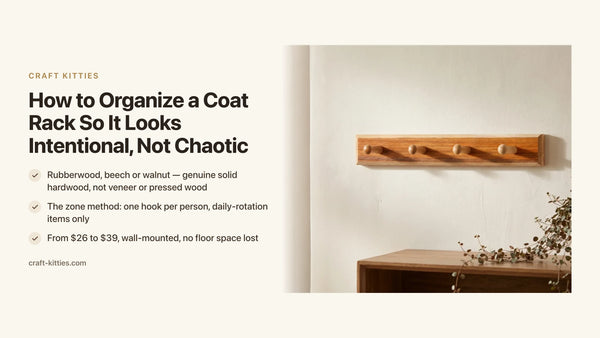
- Solid beech, walnut and hardwood — real wood, not veneer or MDF
- From $5 single hook to $26 two-hook row
- Boot-profile, swivel, magnetic and two-tone options for every entryway style
The entryway is the one space in the house that takes the most daily contact and gets the least design attention. Coats pile on chairs, bags end up on the floor, keys disappear into a bowl on the counter — not because storage is missing, but because the storage that exists is either wrong for the wall or too utilitarian to use consistently. A hook you actually want to hang things on is the solution, and modern wood wall hooks are where function and appearance stop being a trade-off.
This guide covers everything that matters before mounting: the species that work, the profiles that suit different loads, the configurations that make sense for an entryway versus a bathroom or bedroom, and the mistakes that make even a beautiful hook underperform. At the end, a comparison table and a decision matrix cut the choice to a single model.
One premise runs through all of it: the hooks in this guide are solid hardwood — beech, walnut, or equivalent hardwood throughout their entire cross-section, not veneered MDF with a wood-look surface. That distinction dictates how a hook ages, holds screws, tolerates humidity and survives the thousand daily impacts that hooks absorb. Everything else follows from it.
Why wood, and why now

Metal hooks — the chrome, brushed nickel or matte black varieties that dominate hardware store aisles — are not poorly made. The problem is that the finish is doing all the aesthetic work, and finishes degrade. Powder-coated metal chips at the points where bags and coat hardware make daily contact. Chrome plating develops micro-scratches that accumulate into a dullness that cannot be reversed. After two or three years, the hook that looked sharp in the showroom looks like something that belongs in a rental.
Solid hardwood does not have this problem, because there is no finish layer to fail. The wood itself is the material, and hardwood with a wax or oil coat develops a patina rather than deteriorating. The small marks and dents from daily use read as character rather than damage. A solid beech hook that has been hanging coats for five years looks lived-in; a chrome hook that has been doing the same looks worn out.
There is also a tactile argument. A wooden hook is silent — no metallic clank when a bag shifts, no cold contact in a winter entryway. In a narrow hallway or beside a bedroom door, that difference is noticed every single day, even if it never rises to conscious thought.
The practical case is equally simple: solid hardwood holds screws more tenaciously than MDF, tolerates the humidity swings of a mudroom without swelling, and costs less over time because it does not need replacement every few years.
Beech, walnut or mixed hardwood: the species question
Beech and walnut are the two species you encounter most in modern wood wall hooks, and the choice between them comes down to the look you want on your specific wall, not to any meaningful difference in strength or durability.
Beech is pale — a warm cream to light tan with a very fine, tight grain that borders on invisible from across the room. Against white, grey and sage walls it reads clean and Scandinavian; it is the species that tends to disappear into the room rather than announce itself. That restraint is precisely what makes it the right choice for contemporary interiors where the architecture is doing the talking and the hooks are supporting cast. Beech is also the more affordable species per piece at equivalent quality.
Walnut sits at the opposite end of the palette. It is a deep warm brown — richer than the word "brown" suggests, closer to chocolate or dark caramel — with a fine grain that gives individual pieces a quality that reads as intentionally chosen. Against a light wall, a walnut hook looks placed; it adds warmth to a space without adding visual clutter. In a home that already uses walnut furniture or flooring, walnut hooks tie the entryway into the rest of the visual language.
Two-tone combinations — beech body with a walnut accent bar, or alternating species across a hook row — give the entryway a design moment without requiring anything else. They work especially well in transitional interiors that mix contemporary and warmer mid-century elements.
On every practical criterion, beech and walnut perform identically. Both are hardwoods with a Janka rating that puts them solidly above what a coat hook requires. Both take a wax or oil finish that seals the surface against humidity. The species question is a design question, answered by looking at your wall.
Hook profiles: boot, swivel, magnetic and two-tone
The profile — the physical shape of the hook — determines how it holds things and how it looks doing it. Four profiles cover the main use cases.
Boot-profile hooks take their silhouette from a stylized boot or crescent shape. The curve is generous enough to hold a coat hanger as easily as a looped bag strap, and the wide base distributes load across more wood grain, which means less flex under heavier items. Boot-profile hooks are the most versatile format: they hold everything from a light scarf to a heavy winter parka with equal reliability. Visually, the curved silhouette reads as deliberately designed — a small sculptural note on an otherwise flat wall.
Swivel hooks pivot on a central peg, which means they fold flat against the wall when empty and swing out to receive a coat or towel when loaded. The practical advantage is clearance: in a narrow hallway where a fixed hook sticking out 2.5 inches would clip shoulders, a swivel hook at rest is almost flush. The tactile interaction — hook swings open, receives the load, swings back slightly under weight — has a satisfying mechanical quality that users notice. Swivel hooks suit both heavy-load entryways and bathroom robe hooks where a fixed hook would intrude into the room.
Magnetic hooks embed a neodymium magnet flush in the wood face. They are purpose-built for keys: one-handed drop on the way in, one-handed grab on the way out, with no threading a ring onto a hook. The magnet holds standard key sets and small metal items — carabiner clips, transit pass holders, pocket tools — securely enough that they do not fall off with a bump. For anything fabric or non-ferrous, a conventional hook still applies; magnetic hooks work alongside rather than instead of them.
Two-tone two-hook rows use two species in one piece — a beech base with a walnut hook bar, or the reverse — and present two hooks in a single wall footprint. The format is efficient: two mounting points, two hooks, one visual element. At $26 for the pair, the two-tone row costs less per hook than two individual premium hooks while reading as more intentional than a single hook on its own.
The five models from our studio

Description
The Beech Wood Boot-Profile Wall Hook at $12 is the anchor model for this lineup. Solid beech throughout, shaped into a profile wide enough to take a coat hanger loop or a bag strap without the item sliding off to one side. The finish is a natural wax coat that protects the grain without darkening it — beech stays pale. For entryways, home offices and bedroom doors, this is the one you multiply across a row to build capacity.

Description
The Beech Wood Magnetic Wall Hook at $6.90 solves the key problem rather than tolerating it. Most key hooks require conscious threading; this one requires none. The neodymium magnet sits flush with the beech face so the wood look is uninterrupted, and the hold is strong enough that keys do not fall off when someone closes the front door firmly. At this price it works as a standalone key station or as a complement to a row of boot-profile hooks — one magnetic hook in the middle of a run, the rest conventional.

Description
The Natural Wood Swivel Wall Hooks at $9 bring the swivel format to a more rustic aesthetic. The wood is carved with visible grain and natural character rather than the refined surface of finished beech — each piece reads slightly differently, which suits farmhouse, eclectic and bohemian interiors where uniformity is not the goal. The swivel mechanism works on the same principle as modern versions: flat at rest, pivoted out under load, retracting slightly when weight is removed. For a coat nook in a cabin, a mudroom with shiplap, or any space that embraces natural imperfection, this is the right profile.

Description
The Solid Wood Wall Hooks — Swivel Coat & Towel Hook at $5 is the build-a-row choice. It has no extra feature, which is the point: one solid wood swivel hook, mounting hardware included, ready to be spaced across a wall at 6 to 8 inch intervals for a coat rack that costs a fraction of a commercial equivalent. For a bathroom towel hook, a closet organizer addition, or a temporary solution that turns out to be permanent, the $5 entry price removes the hesitation to commit to a quantity.

Description
The Two-Tone Beech & Walnut Wall Coat Hooks — 2-Hook Row at $26 is for the wall where a single hook looks sparse and a long rack looks overdone. Two hooks in a single compact piece, with the warm contrast between pale beech and deep walnut doing the design work. The two-hook format naturally organizes: one hook per person in a couple, or coat and bag on the same wall footprint. It is the model that reads as a deliberate choice rather than a functional necessity.
Comparison table
| Model | Price | Wood | Profile | Best for |
|---|---|---|---|---|
| Beech Boot-Profile Hook | $12.00 | Solid beech | Fixed boot curve | Heavy coats, bags, umbrellas |
| Beech Magnetic Hook | $6.90 | Solid beech | Magnetic face | Keys, carabiners, metal items |
| Natural Wood Swivel Hook | $9.00 | Rustic carved hardwood | Swivel | Farmhouse, boho, narrow hallways |
| Solid Wood Swivel Hook | $5.00 | Solid wood | Swivel | Building a row, towels, closets |
| Two-Tone 2-Hook Row | $26.00 | Beech + walnut | Fixed, paired | Couples, coat + bag combos |
Decision matrix — the right hook for each situation
| Your situation | The right pick |
|---|---|
| Contemporary or Scandinavian interior, light walls, heavy coats | Beech Boot-Profile Hook |
| Keys disappear every morning | Beech Magnetic Hook |
| Farmhouse, cabin or eclectic décor | Natural Wood Swivel Hook |
| Building a full coat rack on a budget | Solid Wood Swivel Hook × 4–6 |
| Two people, one wall section, one design statement | Two-Tone 2-Hook Row |
| Bathroom robe or towel hook in a narrow space | Swivel hook (folds flat when empty) |
How to plan a hook arrangement before drilling
The most common regret after mounting hooks is getting the spacing wrong — either too far apart to feel like a coherent row, or so close together that loaded hooks compete for wall space. A few minutes of planning prevents both.
Start with the wall section, not the hooks. Measure the available width between door frame, light switch and any obstruction. A 36-inch run accommodates three to five hooks cleanly; narrower runs call for a single statement hook or the compact two-hook row.
Mark the center first, then work outward. For a row of three or five, finding and marking the center first ensures the arrangement is optically balanced rather than running long on one side. For even numbers (two or four), split the available width evenly from a center line.
6 to 8 inches between hook centers is the spacing that lets a filled hook — coat on one side, bag on the other — clear its neighbor without overlap. Tighter than 6 inches and the items start interfering; wider than 10 inches and the row loses visual cohesion.
Set the height for the primary user, then check for clearance. Between 60 and 66 inches from the floor suits most adults. Before drilling, hang a coat on a test hook held at height and check that the hem clears the floor by at least 4 inches.

Mistakes that undercut a good hook
Choosing the species from the product photo against a white background. Product photography is shot on neutral backgrounds specifically to show material detail. That same beech that looks warm and pale against white may vanish against your cream walls, or clash against your warm-grey ones. Before ordering, hold a piece of beech or walnut veneer — or even a cutting board of the species — against the actual wall. Contrast is the deciding variable, and the wall you have is the only reference that matters.
Mounting into drywall without anchors. One screw into drywall with no stud contact might hold for the first week, then pull through under a coat's weight. Two screws into a wall stud, or two screws with drywall anchors rated well above your expected load — those are the only two options worth committing to. Spend two minutes with a stud finder before you pick up the drill.
Spacing hooks by visual feel during installation. The item that will hang on each hook is larger than the hook itself, and it does not hang straight down — it drapes and billows. Hooks that look comfortably spaced when empty become crowded once loaded. Space them by measurement, not by eye.
Mixing wood species with no connective logic. A pale beech hook next to a dark walnut shelf next to a chrome towel bar reads as accidental, not eclectic. When mixing materials, keep a consistent thread — either the same wood species across all pieces, or the same metal accent color as the connective element. Our wood wall hooks collection is organized to make that coordination straightforward.
Treating the hook as purely functional. A hook mounted at the right height, in the right species for the wall, with the right spacing to its neighbors, does not just hold things — it finishes the entryway. The difference between a hook that disappears into the background and one that reads as an intentional design choice is often nothing more than those three decisions made deliberately rather than by default.
Caring for solid hardwood hooks
Solid beech and walnut with a wax or oil finish need very little: a dry cloth for dust, a barely damp cloth for marks. No harsh cleaners, no abrasive sponges that cut through the wax layer. If the wood begins to look dull after a year or two of daily use — particularly at the high-contact point where bags loop over — a thin application of beeswax polish restores the surface in ten minutes. No sanding, no stripping, no refinishing.
The one condition that solid wood does not tolerate is prolonged saturation. A coat dripping with rain hung on the hook for an hour is not a problem; a wet towel balled up on the hook for days is. In both cases the wax coat is doing its job, but wax is a surface protection against contact moisture, not a barrier against sustained immersion. Keep it to brief-contact humidity and the finish outlasts the rest of the entryway.
FAQ — modern wood wall hooks
1 — What is the best wood for modern wall hooks? Beech and walnut are the two standards. Beech is pale and tight-grained — it reads clean and contemporary against almost any wall color. Walnut is warmer and darker, with a fine grain that gives it a furniture-grade presence. Both are hardwoods dense enough to hold coats and bags without flexing. Avoid soft pine for a hook that takes daily load; save pine for decorative or very light-duty applications.
2 — How much weight can a wood wall hook hold? A single solid hardwood hook mounted into a wall stud holds 15 to 25 lbs reliably — enough for a heavy winter coat, a bag and an umbrella. The limiting factor is almost never the wood itself; it is whether the screw hits a stud or just drywall. Into a stud: solid. Into drywall alone with a wall anchor: respect the anchor's rated load, typically 10–15 lbs per point.
3 — Do wood wall hooks work in humid spaces like mudrooms? Yes. Solid hardwood with a wax or oil finish tolerates the humidity swings of a mudroom or entryway without warping. The keys are proper sealing on all surfaces — including the back face — and avoiding prolonged standing water contact. An occasional wipe is all the maintenance a sealed hardwood hook needs in normal residential use.
4 — Single hook or row of hooks — which is more practical? It depends on the wall space and household size. A single statement hook works for a narrow wall or a dedicated spot for one bag. A two-hook row covers a couple's coats without dominating the wall. For families or a busy entryway, three to five hooks spread across 24 to 36 inches is the practical standard — enough capacity without looking like a retail store fixture.
5 — How do I mount wood wall hooks without damaging the wall? Use a stud finder before drilling. Two screws into a wall stud give the most reliable hold for heavy coats and bags. If there is no stud where you want the hook, use drywall anchors rated for at least double your expected load. For rentals or zero-damage installs, a 3M Command-style strip rated for 5–7 lbs per hook works for lightweight items like keys, hats and small bags — not winter coats.
6 — What is the right height to mount wall hooks in an entryway? Between 60 and 66 inches from the floor suits most adults — coat shoulder hits the hook naturally, the item hangs without dragging. For a mixed household with children, a second lower row at 36 to 42 inches lets kids reach their own things. If you are mounting a single row for adults only, 64 inches is the comfortable middle ground that works for heights from 5'4" to 6'2".
7 — Can I use wood wall hooks in a bathroom? Yes, for towels and robes, as long as the hook is sealed hardwood rather than bare unfinished wood. Beech with a wax or oil finish handles bathroom humidity well. Avoid leaving wet towels balled up on the hook for extended periods — a towel draped open dries within hours and puts no stress on the wood finish.
8 — How is real solid wood different from manufactured wood hooks? Solid wood is cut from a single piece of hardwood throughout its cross-section. MDF or particleboard hooks are pressed wood fiber with a veneer or painted surface. The practical differences: solid wood does not swell from humidity the way MDF does at the edges, it holds screws more firmly, it takes impact without chipping or delaminating, and it develops a patina rather than degrading. For a hook used daily, the difference shows within the first year.
9 — Do magnetic wood wall hooks actually hold keys reliably? Yes, when the magnet is strong enough. Our magnetic beech hook uses a neodymium magnet embedded flush in the wood — it holds standard key sets and small metal items securely. The advantage over a traditional hook for keys is speed: one-handed drop and grab, no threading a ring onto a hook. The limitation is non-ferrous items like fabric bags, which still need a conventional hook.
10 — Are wood wall hooks suitable as a gift? Yes. A solid wood hook — particularly a two-tone piece or a boot-profile in a distinctive species — is the kind of object that reads as considered rather than generic. Paired with another piece from the same wood family, it works well for housewarmings or new-apartment occasions where something functional that also improves the room is more welcome than something purely decorative.
Where to go next
A hook is rarely the end of the entryway project. The wood wall hooks collection brings together the full range of profiles, species and configurations, including sets designed to coordinate across a wall. The Beech Wood Boot-Profile Wall Hook and the Two-Tone Beech & Walnut Wall Coat Hooks are the two most requested starting points. Our pieces are also available through Etsy, where 243 reviews document how they wear over real use in real homes.
One decision, a finished entryway
If this guide leaves you with one method: choose the species by contrast with your wall — beech for light contemporary rooms, walnut for warmth, two-tone for rooms that want both — then mount at 64 inches and space generously enough for loaded hooks to clear each other. The Beech Boot-Profile Hook handles the broadest range of daily use at $12; the Two-Tone 2-Hook Row turns a functional need into a design decision at $26; the Magnetic Beech Hook at $6.90 ends the daily key search. Three hooks, three problems solved, one entryway that finally reads as intentional.