At a glance
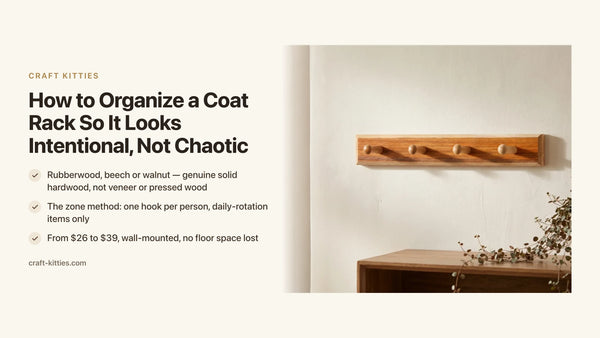
- Solid rubberwood, beech or walnut — real hardwood, not MDF
- 2 to 6 hooks, configurable to the wall and the household
- From $26.00 to $39.00, entryway-ready from day one
A wall hook rack is one of the quieter decisions in a home. It lands in the entryway before anything else, it takes every coat and bag thrown at it before the shoes are off, and it stays there for years. Most people inherit one from whoever lived there before — a metal strip, a plastic peg board — and never think about it again until the day a guest arrives and the entrance looks exactly like what it is: unconsidered.
Switching to a wooden wall hook rack changes the calculation. Not dramatically, not expensively — but clearly. Wood reads as furniture rather than hardware. A well-chosen rack in solid rubberwood or beech makes the entryway feel intentional in a way that four plastic pegs never will, regardless of the house behind them.
The practical question is which rack for which room. The minimalist appeal of wood breaks down quickly if the proportions are wrong, the hook count is off, or the finish fights the wall color. This guide covers the criteria that matter — wood species and veneer, hook format and count, room placement, installation — then presents the racks from our studio with real prices, a comparison table, a decision matrix, and answers to the questions we hear most.
At a glance
- Solid rubberwood, beech or walnut — real hardwood, not MDF
- 2 to 6 hooks, configurable to the wall and the household
- From $26.00 to $39.00, entryway-ready from day one
What "modern" actually means in a wall hook rack
The word appears in every product title in this category. It rarely means anything useful. What distinguishes a rack that reads as modern rather than merely contemporary is the combination of three things: material honesty, proportional restraint, and functional logic.
Material honesty means the rack looks like what it is. Solid rubberwood with a Brazilian veneer face looks like real wood because it is real wood — the veneer is a decorative hardwood layer bonded to a solid rubberwood core, not a printed film over particleboard. Solid beech with walnut inserts has the two-tone contrast only possible in real hardwood. MDF and composite pieces imitate wood grain at arm's length; under handling — a daily hook load, the occasional knock — the distinction shows.
Proportional restraint means the rack does not try to fill the wall. A four-hook strip at the right width hangs as an object in the room, not a shelf system. The racks in our lineup read as a single element on the wall: the back panel is purposely minimal so the hooks and the wood species do the visual work.
Functional logic means hook count and hook shape match actual use. A rack where coats fall on each other or bags knock into the wall is not modern — it is a failed design in a clean finish. The boot-profile hook, the hook depth relative to typical coat thickness, the spacing between hooks: these are the details that let a rack function well year after year rather than just photograph well once.
Rubberwood, beech or walnut: reading the species

The species question is primarily a color question. All four racks in our lineup are solid hardwood with durable finishes; the daily performance in terms of hook strength and wall mounting is comparable across them. What differs is the tone on the wall.
Rubberwood with Brazilian veneer delivers a warm, medium brown — neither as pale as natural beech nor as deep as black walnut. The Brazilian veneer (a tropical hardwood face) gives the surface a distinct, open grain that catches light well without demanding attention. It is the most versatile finish in the lineup: works against white, cream, warm grey, or taupe walls without fighting any of them.
Rubberwood with cherry veneer shifts the palette toward a richer red-brown. Cherry veneer grain is tighter and more uniform than Brazilian, which gives the rack a quieter, more refined face. It suits rooms with warm earth tones or darker paint — a kitchen entryway, a living room corner, a bedroom wall where the existing furniture leans warm.
Beech with walnut two-tone is the Scandinavian option. Natural beech is light, almost blond, with a fine grain that stays present without overwhelming. The walnut elements add contrast — darker inserts or details that break the uniformity. It is the rack for light, airy rooms: white walls, linen upholstery, oak floors. It is also the rack for buyers who want to configure from 2 to 6 hooks, since this is the most flexible model in the lineup.
Solid walnut with boot-profile hooks is the statement piece. Black walnut grain is deep brown with subtle figuring; it reads like furniture on the wall. The boot-profile hook — an elongated arm that extends further from the panel than a standard peg — handles thick coats and bags without crowding. If the room already has walnut accents, this rack extends the material language precisely. If it does not, it introduces one piece that sets a direction.
Hook count and hook format: the decisions that determine daily use

Hook count is where most buyers underestimate. The instinct is to count people and buy that many hooks. The more reliable calculation is to count people, add two, and round up. That buffer absorbs guests, seasonal coats that live in the entryway for three months, and the bag that never quite makes it to a dedicated spot.
For a household of two using the rack as the primary entryway piece, four hooks is the practical minimum: two for coats, two for bags or scarves. For a family of four — especially with children, who generate more layers per person than adults — six hooks is the baseline, not the premium option.
Hook format matters as much as count. A standard rounded peg works well for lightweight items: scarves, light jackets, hats. For thick winter coats, for school backpacks, for tote bags that carry a week's worth of items, the boot-profile shape is more practical: the longer arm keeps items hanging clear of each other and away from the wall, which means they actually come off cleanly rather than requiring a two-handed retrieval.
The two-tone beech and walnut rack offers a configuration advantage: it is available from 2 to 6 hooks, which makes it the right choice when the wall width is limited or the hook count may change as the household does. Start with four, add two when the need arrives, without replacing the rack.
The racks from our studio
Four models, chosen to cover the range from the most flexible entry-level piece to the unambiguous statement rack. All solid hardwood. No MDF cores, no printed wood-effect panels.

Description
The Brazilian veneer rack is the one we point to when the wall color is uncertain or the room is still in progress. The warm mid-brown tone of Brazilian hardwood veneer reads well against a wide range of neutrals. The rubberwood core is a dense, durable tropical hardwood — heavier than pine, resistant to daily impact. Available with 4 or 6 hooks; the spacing between hooks is sized for coats and bags without crowding.

Description
Cherry veneer over the same rubberwood core shifts the palette into richer territory. The grain is tighter and more uniform, which gives the rack a more understated face — it does not catch the eye the way open-grained woods do. This is the pick for rooms where the rack should blend rather than stand out: a hallway with warm paint, a kitchen entryway, a home office wall. Comes in 4 or 6 hooks, at $37.00 — the most affordable rack in the lineup while still being solid wood throughout.

Description
The beech and walnut two-tone rack is the lightweight member of the lineup in visual terms — not in strength. Solid beech is a dense, fine-grained hardwood; the light body with walnut-tone contrast elements is the combination that reads as Scandinavian modern. It is also the most configurable: from 2 hooks for a bedroom or bathroom corner to 6 hooks for a full entryway. Starting at $26.00, it is the entry point to solid hardwood in the lineup without sacrificing the material quality that separates wood from composite.

Description
The walnut coat rack is the rack for people who have decided that the entryway should look as deliberate as the rest of the house. Solid black walnut — not walnut veneer, not walnut stain on pine — with the deep brown grain and quiet figuring that only real walnut delivers. The boot-profile hooks are sized for winter coats and loaded bags: the extended arm holds items clear of the wall and of each other, so the rack functions well even when all four hooks are in use. At $28.80 for a 4-hook row, it is the most affordable solid walnut piece in the lineup.
Comparison table
| Model | Price | Wood | Hooks | Best for |
|---|---|---|---|---|
| Brazilian veneer rack | $39.00 | Solid rubberwood + Brazilian veneer | 4 or 6 | Versatile neutral rooms |
| Cherry veneer rack | $37.00 | Solid rubberwood + cherry veneer | 4 or 6 | Warm-toned rooms, understated finish |
| Beech & walnut two-tone | $26.00 | Solid beech + walnut details | 2, 4 or 6 | Light rooms, Scandinavian style, flexible count |
| Walnut boot-profile rack | $28.80 | Solid walnut | 4 | Statement entryway, heavy coats and bags |
Decision matrix — which rack for which room
| Your situation | The right pick |
|---|---|
| White or warm neutral walls, want a wood tone that works without risk | Brazilian veneer rack — $39.00 |
| Warm-toned room, prefer a quieter, more refined wood face | Cherry veneer rack — $37.00 |
| Light Scandinavian or minimalist interior, want to configure hook count | Beech & walnut two-tone — from $26.00 |
| Entryway as a statement, thick coats and bags daily, walnut already in the room | Walnut boot-profile rack — $28.80 |
| Budget under $30, first upgrade from plastic pegs, light items | Beech & walnut two-tone — from $26.00 |
| Housewarming gift or home renovation gift | Brazilian veneer rack — $39.00 paired with a matching shelf |
Placement: entryway, hallway, bedroom, bathroom
A wall hook rack is not entryway-only. The same object solves different problems depending on where it lands in the house, and the best racks in the lineup are proportioned to work in more than one context.
Entryway is the primary placement. The rack absorbs everything that comes off the body at the door: coats, bags, keys (if the hooks sit low enough), dog leashes, umbrellas. For this use, 4 to 6 hooks is the right count, and hook depth matters — the boot-profile walnut rack or the 6-hook rubberwood versions handle the layered load of a busy entryway without items falling against each other.
Hallway is a secondary entryway: lighter use, usually two to four people passing through intermittently. The two-tone beech rack in a 4-hook configuration fits well here without overwhelming a narrow wall. The cherry veneer rack in the same count blends into a warmer hallway palette.
Bedroom is where a 2-hook configuration earns its place. The two-tone beech rack at its smallest size takes the bedside wall or the door-adjacent wall for tomorrow's outfit, a robe, or a bag that does not belong in the closet. It reads as intentional rather than improvised in a way that a single plastic hook never does.
Bathroom is the least obvious placement but a practical one. A 2 to 4-hook rack above the towel bar handles robes, towels and loofahs without requiring a towel ring for each. The rubberwood core in the lineup is dense enough to handle ambient bathroom humidity; the limitation, as with any wood in a bathroom, is extended direct water contact — splashes are fine, a rack positioned directly above a shower is not.
Installing a wall hook rack: four steps that prevent common mistakes
1 — Find the studs first. Every other decision follows from this. A rack mounted only into drywall will hold scarves; it will not hold a loaded winter coat and a backpack on adjacent hooks over time. Use a stud finder or knock-and-listen before marking. If studs are not where the ideal rack position requires, use appropriate wall anchors rated for the load — the hardware included with each rack is sized for typical coat-and-bag weight, not for drywall alone.
2 — Set the height to the user, not to the room. The common guideline — 60 to 66 inches from the floor — works for most adults. The practical check is faster: stand at the wall with a coat in hand and note where the arm naturally extends to hang it. If children use the rack regularly, mount a second strip at 40 to 45 inches rather than lowering the adult-height rack. Two strips at different heights require two sets of holes; one poorly-positioned single strip requires the same two sets of holes when you rehang it.
3 — Level before drilling. A rack that is one degree off reads as crooked every time someone looks at it, because the hooks hang vertical regardless of the rack angle and the visual tension is obvious. Spend the thirty seconds with a level. It is the step most skipped and most regretted.
4 — Leave one hook open. Once the rack is up and in use, resist filling every hook immediately. An open hook is a visual signal that the rack is organized, not overwhelmed. It also provides the practical buffer that means the rack never becomes "the pile" rather than the solution.
The solid wood argument, applied to hooks
The case for solid wood over composite in furniture is well established. In a wall hook rack specifically, the argument has one dimension that matters more than the others: repetition.
A coat rack takes impact at the same points every single day. The hook loads, the panel absorbs the weight, the finish handles hands and sleeves. Over five years that is several thousand interactions at the same locations. MDF and composite panels develop micro-damage at those points — a slight give in the surface, a chip at the hook mount, a discoloration at the most-touched areas — because the material cannot distribute stress the way grain can.
Solid rubberwood, solid beech and solid walnut distribute stress along the grain. A dent on the surface of solid rubberwood is a surface mark; the structural integrity of the panel beneath it is unchanged. The same impact on a composite panel risks delamination at the stress point over time. This is not a theoretical distinction in a bathroom shelf; in a coat rack that takes a full backpack every evening for years, it is the practical reason solid wood outlasts composite in this specific application.
The finish compounds this. A wax or lacquer coat on solid hardwood can be spot-maintained: a dry cloth removes most marks, and an occasional pass of furniture wax restores the surface without requiring sanding or refinishing. A printed wood-effect film on composite panels cannot be touched up — once the surface is compromised, it stays compromised.
Mistakes that reduce a good rack to a bad one
Choosing the species from the product photo rather than from the wall. Studio photography shoots wood against neutral or white backgrounds, which makes every tone read at its best. A cherry veneer that glows in product photos can disappear against a terracotta wall. Before ordering, hold something in the same color family against the actual wall at the actual light level at the time of day you will see the rack most. Contrast between wall and wood is what makes the rack read as an object rather than a panel.
Under-counting hooks and accepting it. Four hooks sounds like enough until the fifth coat arrives in November. The marginal cost of upgrading from a 4-hook to a 6-hook rack — or of choosing the configurable beech two-tone model from the start — is small. The cost of a crowded rack that stops functioning as a rack is replacing it entirely, which means two sets of holes in the wall.
Mounting into drywall and trusting the result. Drywall anchors rated for 50 lbs sound reassuring until the rack takes three heavy coats plus bags plus the daily impact of items being hung and pulled and the anchor slowly loosens its grip. Studs when available, quality anchors when not — and never assume that a rack holding on day one will hold in the same way on day 365 with a drywall-only mount.
Mixing wood tones without intention. Rubberwood with Brazilian veneer next to a pine shelf and a dark-stained oak floor reads as accidental rather than curated. If the room already has a dominant wood tone, match it or contrast it deliberately — not as a default. Our wall hook rack collection is organized by finish family to make this easier.
FAQ — modern wooden wall hook racks
1 — What wood species is best for a modern wall hook rack? It depends on the room's palette. Rubberwood with Brazilian veneer gives a warm, medium-brown tone that suits most modern interiors. Cherry veneer reads richer and darker. Beech is lighter and pairs naturally with Scandinavian or minimalist rooms. Walnut is the most dramatic — deep brown grain that stands out against a white or light wall. All four are solid hardwood; the veneer layer is a decorative face applied to a solid rubberwood or beech core, not particleboard.
2 — How many hooks do I need for an entryway? A household of two manages comfortably with 4 hooks: two for daily coats and two for bags or scarves. A family of four should look at 6 hooks minimum. The two-tone beech and walnut rack is configurable from 2 to 6 hooks, which makes it the right call when hook count may change as the household does.
3 — Can a wooden wall hook rack hold heavy coats? Yes, when the rack is mounted into studs or with appropriate anchors. The rubberwood and beech racks are solid hardwood; the limiting factor in any coat rack is the wall anchor, not the wood. For winter coats and loaded bags, drive anchors into studs or masonry — not just drywall.
4 — What is the difference between rubberwood with Brazilian veneer and solid walnut? Rubberwood is a dense hardwood; Brazilian veneer is a decorative hardwood face bonded to it, giving a warm mid-brown color and distinct open grain. Solid walnut is the wood through and through — darker, finer grain. Both hold coats reliably. Rubberwood with veneer is typically more affordable; solid walnut is the premium statement option.
5 — How high should a wall hook rack be mounted? Around 60 to 66 inches from the floor covers most adults. If children use the rack regularly, a second strip at 40 to 45 inches gives them independence. The most practical check: stand at the wall with a coat in hand and mark where your arm naturally hangs.
6 — Will a wooden hook rack work in a bathroom or humid room? The solid rubberwood and beech cores handle ambient bathroom humidity well. Keep water from pooling on the surface long-term — wipe splashes and the finish maintains itself. Avoid positioning directly above a shower or bathtub where continuous steam contacts the wood.
7 — What is the boot-profile hook shape? A boot-profile hook has an elongated, slightly curved arm that extends further from the wall than a standard peg. That extra depth keeps bulky items — thick coats, backpacks, heavy bags — hanging clear of the wall and away from each other. It is the hook shape on the solid walnut rack, sized for entryway use.
8 — Do the racks need waxing or oiling? No regular oiling ritual is required. The racks leave our studio with a protective wax or lacquer finish that handles daily handling and light humidity. A dry cloth wipe is all the maintenance needed. If the wood looks dry after years of use, a single pass of furniture wax restores it.
9 — How do I choose between 4 and 6 hooks? Count the people who will use the rack daily, then add two. That buffer handles guests, seasonal coats and the bag that never quite finds another spot. If the wall space allows, 6 hooks is almost always the right call — a half-empty rack costs nothing, a crowded one means nothing hangs where it should.
10 — Is a modern wooden wall hook rack a good gift? It is one of the more considered home gifts: useful every day, visible in the entryway, and long-lasting. For a housewarming, pair it with a piece from the same wood family — a shelf or storage piece in matching rubberwood or walnut — so the room reads intentional from the first nail. Our studio has shipped over 243 verified reviews on Etsy from buyers who found the rack through a gift search first.
Where to go next
A rack in solid rubberwood or walnut is rarely the last piece of wood in an entryway. Our wall hook rack collection gathers the full lineup — from the configurable beech and walnut two-tone rack at 2 to 6 hooks to the rubberwood rack with Brazilian veneer that suits most neutral rooms — organized by finish and hook count so the next piece answers the first rather than contradicting it.
One rack, one decision, one finished wall
If this guide leaves you with one method: choose the species by contrast with your wall, pick the hook count as people-plus-two, and mount into studs rather than drywall alone. The Brazilian veneer rack is the answer for most rooms at $39.00; the beech and walnut two-tone opens solid hardwood at $26.00 with the flexibility to configure hook count; and the solid walnut boot-profile rack settles the statement-piece question at $28.80. Three paths, one outcome: an entryway that finally looks as deliberate as the rest of the house.