The first impression a home makes happens in the three seconds between the front door opening and the decision whether to keep walking or stop and drop everything on the nearest surface. In a narrow entryway, that surface is often the floor — because there is no other option.
The conventional answer, a console table or a bench with baskets, stops working the moment the hallway is under 48 inches wide. Add a console to a 38-inch corridor and you have created a single-file obstacle course. The real solution is vertical: move every storage function off the floor and onto the wall, and choose pieces small enough in profile that the walkway remains a walkway.
This guide is about doing that with solid wood — specifically wall-mounted bars, double-layer racks, and hooks built from red oak, walnut, and beech. The argument for real wood in an entryway is not aesthetic alone. It is practical: a wax-finished hardwood bar that gets bumped by a bag every morning for five years will still look like a deliberate design choice. A veneered MDF rail will not. The pieces covered here are the ones from our studio that work best in restricted horizontal space, from $22.
At a glance
- Wall-first, floor-zero: all storage moves to one wall
- Red oak, walnut or beech — sealed hardwood, not veneer
- Double-layer bar at 60 in. handles coats AND bags in the same footprint
- From $22
Why floor clearance is the only metric that matters
A narrow entryway feels narrow because of what is on the floor, not what is on the walls. Two chairs and a coat tree in a 40-inch hallway create a physical and visual bottleneck; the same hallway with nothing on the floor and four wall hooks at eye level reads as minimal, even airy.
The research on this is straightforward: human perception of corridor width is primarily determined by the unobstructed width at hip height, not the total wall-to-wall dimension. A slim console table at 10 inches deep — well within what gets marketed as "space-saving" — still reduces a 40-inch hallway to 30 usable inches. That is below the comfortable passage threshold for an adult wearing a coat.
The practical corollary: every entryway solution that touches the floor is a tradeoff, and in hallways under 44 inches wide, the tradeoff is almost never worth it. The only truly neutral pieces are wall-mounted — they extend into space you were not using anyway.
Vertical zones: how to assign the wall

A single wall section can hold everything a household drops at the door — if the storage is organized into three height bands rather than scattered randomly.
The high zone (66–72 inches from the floor) is for items rarely touched on a daily basis: a narrow floating shelf for mail, keys in a small dish, or seasonal hats. Because people do not reach here habitually, it can be shallower than it looks — 4 to 6 inches of depth is enough and keeps the profile from encroaching on the corridor.
The active zone (48–66 inches) is where daily use lives. Adult coats hang at this height; bags loop over a bar or hook at shoulder level. A wall-mounted towel bar or double-layer rack installed here handles the heaviest daily load — coats, tote bags, backpacks — in a 24-inch-wide wall section that a freestanding coat tree would take up entirely.
The lower zone (36–48 inches) serves kids' hooks, shorter bags, and accessories. In households without children, this zone can remain empty, which reinforces the visual openness of the floor-level view.
The rule for all three zones: keep the footprint of each piece under 4 inches in depth. Beyond that, you begin to trade walkway width for storage — a deal that narrows by the inch in a small hallway.
Choosing the right wood for a high-traffic zone
The entryway is arguably the harshest environment in a home for furniture. Doors bring in temperature swings and humidity; bags and coats drag along the surface at the same spots every day; the wall mounting points absorb real load from hanging items.
Red oak (Quercus rubra) is the most practical choice under these conditions. At 1,290 lbf on the Janka hardness scale, it resists the denting that comes from repeated bag impact better than most species in the same price range. Its bold, open grain also hides incidental marks well — a minor surface scuff disappears into the grain pattern rather than standing out against it. On a white or light hallway wall, red oak's honey tone creates a warm contrast without overpowering a small space.
Beech (Fagus sylvatica) is equally hard (1,300 lbf) with a finer, tighter grain that reads more refined. It takes a wax finish particularly well and presents a consistent tone across the surface — ideal when the entryway piece is the first object a guest notices and you want it to look intentional from the doorway.
Walnut (Juglans nigra) is softer at 1,010 lbf, but still far more durable than any veneered alternative. Its deep brown tone suits narrow hallways with light walls more naturally than the other species, because the contrast between wall and wood reads as depth — the hallway appears to have more dimension than it does.
All three take a wax or wax-oil finish that seals the surface against the moderate humidity and temperature variation a hallway sees. The finish, not the species, is what makes a wood entryway piece hold up rather than warp or stain over years.
The five pieces that do the most in the least space

The four products from our towel bar collection below were selected specifically for how little wall depth they claim relative to what they hold. Each profile stays under 4 inches from the wall — critical in a narrow corridor where every centimeter of protrusion changes the usable walkway width.

Description
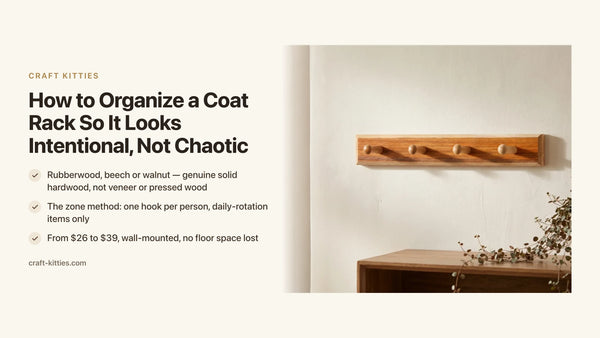
The square hardwood towel bar is the most space-neutral piece in the lineup. Its bracket depth is minimal; the bar itself extends no further than the depth of a book from the wall. Installed at coat height — typically 60 to 64 inches from the floor — it functions as a slim coat rail for adults. The wax seal protects the surface against the inevitable condensation a frequently opened door brings in. Available with brass or matte black hardware to match existing door fittings. At $24, it is the right starting point for a first wall-mounted setup.

Description
The wood and brass set pairs real hardwood with aged brass hardware that stays warm rather than developing the green tarnish of cheaper alloys. The combination — natural grain plus warm metal — works particularly well against white subway tile or painted brick, both common in apartment entryways. It holds the same load as the square bar and installs identically; the hardware choice is purely tonal. At $22, it is the lowest price in the lineup without any compromise on the material under the finish.

Description
Where the square and set pieces are explicitly utilitarian, the arc-bracket bar is the option for hallways that are also part of the home's visual introduction. The arc form — cut from the same solid hardwood as the bar — gives the bracket a sculptural quality that makes the piece readable as intentional design from three feet away. The wall depth is identical to the other bars; the difference is entirely in what the piece communicates about the space around it. At $24, the premium over the brass set is negligible.

Description
The double-layer bar is the piece for households where one rail is not enough. Two hardwood bars, one above the other in the same wall footprint, create separate hanging zones: typically coats on the upper bar and bags or accessories on the lower. The total wall depth remains the same as the single-bar version. In a hallway where you cannot add a second mounting location — wall too narrow, door too close — this doubles capacity in the existing anchor points. At $24, it is the highest-value piece in the lineup for any household with more than two regular users.
Comparison table — four bars for narrow entryways
| Model | Price | Hardware | Layers | Best for |
|---|---|---|---|---|
| Square hardwood bar | $24.00 | Brass or black | Single | Clean, minimal baseline |
| Wood & brass set | $22.00 | Aged brass | Single | Warm hardware tone, entry price |
| Arc bracket bar | $24.00 | Brass or black | Single | Visual statement, design-forward |
| Double-layer bar | $24.00 | Brass or black | Double | Families, multiple categories of items |
Decision matrix — which setup for which hallway
| Your situation | The right pick |
|---|---|
| Solo or couple — one coat, one bag per person | Square hardwood bar at 62 in. — simple, flush, done |
| Light, neutral hallway — you want warm metal | Wood & brass set — lowest price, warmest hardware at $22 |
| Entryway doubles as design statement | Arc bracket bar — sculptural bracket, same profile depth |
| Family, roommates, or you always run out of hooks | Double-layer bar — doubles capacity, same two anchor points |
| Rental — no damage to walls | Wood & brass set with heavy-duty adhesive strips (no drilling required) |
| Gift for a housewarming or new apartment | Arc bracket bar — distinct enough to be noticed, practical enough to be used daily |
How to install a bar in a narrow hallway without mistakes
The installation itself takes under 20 minutes. The decisions you make before drilling — or before applying adhesive — take longer and matter more.
Step 1 — Identify your anchor wall. In a narrow hallway, you typically have one good wall: the long wall opposite the door, or the wall immediately adjacent to the door frame. The opposite wall is ideal because coats and bags hang away from the door arc. The adjacent wall works when the hallway is an L-shape. Never mount behind the door swing — the vibration from the door is enough to stress anchor points over months.
Step 2 — Mark the height empirically. Reach toward the wall while wearing a coat you expect to hang there, and mark where your hand naturally falls. That mark, not a guideline from a chart, is your mounting height. For a bar used as a bag rail, add 2 to 4 inches — bags hang lower than the bar and you want them off the floor. For a double-layer bar, the upper bar goes at coat height and the lower bar 8 to 10 inches below.
Step 3 — Find the stud or choose the right anchor. Solid hardwood bars with coats and bags on them carry meaningful load — especially in a household where heavy winter coats and leather bags are the norm. A stud mount is always preferable. Where the stud spacing does not align with the bar's bracket width, use toggle anchors rated for at least twice the expected load. For adhesive installation in a rental, use heavy-duty double-sided mounting strips rated for 10+ lbs per side, and degrease the wall surface before application.
Step 4 — Level before you commit. A bar 2 degrees off level looks wrong from the door every single morning. Use a level before tightening; on smooth walls, a 24-inch spirit level works better than a phone app because the floor is rarely truly flat and apps inherit that error.
Step 5 — Add hooks above the bar. The bar handles long items; hooks at 66 to 70 inches handle hats, short bags, and scarves. The combination — bar plus hooks 6 to 8 inches above — creates a complete entryway station in a 24-inch-wide, 4-inch-deep wall slice.
The four mistakes that make a narrow entryway worse
Buying a piece without measuring the door arc. The most common mistake: choosing a mounting location that puts the bar or hooks directly in the path of the door when it opens. Measure the door arc with the door fully open before committing to any wall section. A bar hit by a door every day will eventually work loose from its anchors.
Underestimating load. A down coat plus a leather backpack is 15 to 18 lbs. Multiply by the number of household members and the bar needs to hold 30 to 50+ lbs without flex. Solid hardwood at the bar level is not the weak point — the wall anchor is. Always use anchors rated for more than the expected load and, where possible, hit a stud.
Mixing species and hardware tones. A walnut bar with black brackets next to a beech hook with brass fittings reads as accidental in a space too small to absorb the contradiction. In a narrow hallway, every piece is visible simultaneously. Commit to one wood tone and one hardware finish across all pieces — the result reads as a considered setup rather than a collection of clearance purchases.
Filling every zone at once. The temptation in a small space is to maximize from day one. The better approach is to start with one bar and one hook strip, live with it for two weeks, and identify which items end up on the floor or on the bar's bracket ends — those are the gaps to fill next. Adding storage incrementally prevents the overcrowded look that makes the hallway feel smaller than it is.
Where to go next
The pieces described in this guide form the core of a wall-mounted entryway — bars and racks for the daily load. Our Wall Mounted Wood Towel Bar Holder — Square Hardwood Design is the simplest starting point at $24; the Wood & Brass Towel Rack Wall Mounted Set adds warmth for $22; and the double-layer bar is the right next step when one rail stops being enough.
The same solid red oak, walnut, and beech construction runs across the full towel bar collection — so adding a bathroom piece after the entryway gives you material continuity across two rooms with no additional planning. Over 243 customers on Etsy have picked up these pieces for exactly that reason — a cohesive look that travels from room to room.
Conclusion — less on the floor, more on the wall
The narrow entryway only needs one rule: nothing touches the floor. One solid wood bar at coat height, one strip of hooks above it, and a small shelf at 70 inches handles every daily-use category a household drops at the door — without claiming a single inch of walkway. The Wood & Brass Towel Rack at $22 is the cleanest entry point; the double-layer bar is the right answer for larger households at the same $24 price. Both are solid hardwood, both are wax-sealed, and both will still look intentional five years from now.
FAQ — narrow entryway ideas for small spaces
1 — What is the best storage solution for a very narrow entryway? Wall-mounted pieces that claim zero floor space — a wood bar or double-layer rack at coat height, topped with a set of hooks at mid-height. The combination holds coats, bags, scarves, and keys on one wall section without taking a single inch of walkway.
2 — How wide does a hallway need to be to feel comfortable? Building codes in the US put the minimum at 36 inches, but most people find 42 to 48 inches comfortable when passing through with a coat or bag. In hallways under 40 inches, wall-flush pieces with no protruding shelf edges are mandatory — every inch of protrusion matters at that width.
3 — Can I use a towel bar as a bag holder in the entryway? Yes, and it works exceptionally well. A solid wood towel bar mounted at 60 to 65 inches acts as a coat rail: tote bags and handbags hang from their handles, scarves drape over, and everything stays at the same plane rather than piling up on a hook cluster.
4 — What wood species holds up best in an entryway? Red oak (Quercus rubra) and beech (Fagus sylvatica) both rank around 1,290 to 1,300 lbf on the Janka hardness scale and resist the denting that comes from daily bag impacts. Walnut (Juglans nigra) is softer at 1,010 lbf but handles normal household loads comfortably and reads more refined on a light hallway wall.
5 — How high should hooks and bars be mounted in an entryway? Adults' coats hang best from hooks at 60 to 66 inches from the floor; kids' hooks should sit at 36 to 42 inches. A towel bar used as a bag rail works at 58 to 62 inches. Leave at least 12 inches of vertical clearance between the top of a bar and any shelf above it so bags can be lifted off without catching.
6 — Is real solid wood worth it for an entryway piece? In a high-traffic zone where pieces get bumped and dragged over the same surface every day, the difference between solid hardwood and veneered MDF shows up fast. MDF edges chip at the first bag impact; solid red oak or beech develops character instead. The initial cost difference is small — the durability gap is measured in years.
7 — How do I prevent a narrow entryway from feeling cluttered? Confine storage to one wall and keep the floor entirely clear. On that wall, work in vertical bands: hooks at mid-height, a bar or rack for bags above, a narrow shelf at eye level for keys and mail. Matching the wood species and hardware tone across all pieces makes the collection read as a single intentional unit rather than a random assembly.
8 — What is the difference between single-layer and double-layer bars? A single bar handles one category of things — coats or bags, not both effectively. A double-layer bar doubles the hanging capacity in the same wall footprint: bags on the lower bar, coats or scarves on the upper. In a very narrow hallway where you cannot spread horizontally, the double-layer is almost always the right choice.
9 — Can I install a bar without drilling if I rent my home? Yes. Heavy-duty adhesive mounting strips rated for 10+ lbs per side hold a wood bar carrying coats and bags reliably, provided the wall surface is smooth and properly degreased before application. The wood and brass set is the most common choice for rental installations because the hardware tone suits most painted walls.
10 — Does a wood entryway piece make a good gift for a housewarming? It is one of the more practical housewarming gifts precisely because it solves an immediate problem — the pile that forms by the door from the first day in a new place. The arc bracket bar works particularly well as a gift: distinctive enough to be noticed, standard enough in its function that it will actually be used rather than decoratively shelved.