At a glance
- Solid beechwood, walnut and red oak — real hardwood, not composite
- Wood decor works in every room when species and form are chosen with intention
- From $16.99 — pieces that are functional first and beautiful because of it
Natural wood home decor has become one of the most searched terms in the home space — and one of the most misunderstood. Most of what appears under that label in stores and on marketplaces is not wood at all: it is MDF with a wood-look foil, or composite board with a printed grain that fades and chips within a year of daily contact. The search for genuine warmth ends up landing on its imitation.
This guide is about the real thing. Solid beechwood, walnut and red oak: hardwoods that are cut, turned, sanded and finished — not pressed, laminated or veneered. The difference matters not just for longevity but for how the piece reads in a room. A ring holder cone turned from beechwood catches and holds light differently than a printed surface. A walnut tray develops a subtle patina with use instead of revealing a grey core at the first scratch. These are materials that age into the room rather than aging out of it.
What follows is a room-by-room guide to where natural wood decor adds the most, which species and forms work in each context, which mistakes dilute the effect, and which pieces from our studio are built to the standard that makes the approach worth pursuing.
At a glance
- Solid beechwood, walnut and red oak — real hardwood, not composite
- Wood decor works in every room when species and form are chosen with intention
- From $16.99 — pieces that are functional first and beautiful because of it
Why solid wood decor outlasts every trend

The interior design cycle is relentless. What was trending in home magazines three years ago now reads as dated. Solid wood is one of the few materials that has held its ground across every cycle, for a structural reason: it does not perform warmth. It is warmth — a material that is literally a living thing, slowed down, finished, and stabilized for use in a home.
Beechwood is the workhorse of high-quality small objects. Pale blond to cream in tone, with a fine and very uniform grain, it is one of the hardest European woods — which is why it has been used for turned objects, tool handles and kitchen equipment for centuries. In home decor, that hardness means edges that stay crisp and surfaces that resist the nicks and dents that age cheaper materials prematurely. Its neutral color makes it extraordinarily versatile: it reads warm next to white and cream walls, and it does not compete with bolder palette choices.
Walnut sits at the premium end of the hardwood palette. Deep, dark brown with a fine and slightly flowing grain, it is the wood that interior designers reach for when they want something to read as furniture rather than accessory. Against a light wall or a pale linen surface, a walnut piece immediately signals intention. The grain is quiet enough that the form of the object — a cone, a tray, a geometric base — reads clearly rather than getting lost in texture.
Red oak is the most characterful of the three: light honey to amber in tone, with a bold, open grain that you can read from across the room. It brightens a space, which makes it particularly effective in smaller or darker rooms where walnut's depth would add visual weight. It pairs naturally with brushed gold and warm metal hardware.
All three share one critical property: they are solid all the way through. There is no composite core to swell at the edges, no printed layer to chip at the first repeated contact. A scratch on solid wood can be buffed; a scratch on veneer or foil reveals grey particleboard. That is the practical case for the material — and the reason our studio works exclusively in solid hardwoods.
The bedroom — where wood decor has the highest return
The bedroom surfaces that most people look at more than any other — the nightstand and the dresser top — are also the surfaces most likely to be chaotic. Keys, rings, coins, a phone, earbuds, a watch: all the objects that get removed at the end of the day, placed wherever the hand reaches first, and found by searching at the start of the next morning.
A well-chosen wood piece does two things at once on these surfaces. It gives each category of object a fixed address, which eliminates the search. And it makes the surface itself look intentional — the difference between a surface that looks kept and one that looks used.
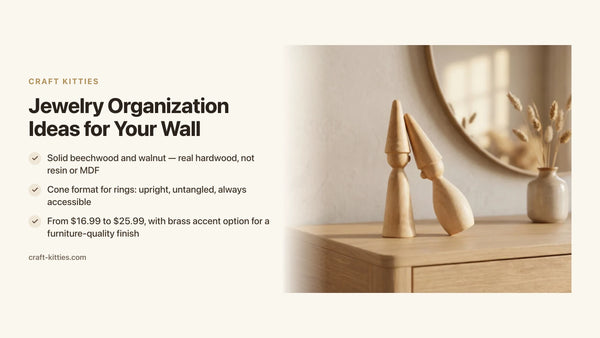
The ring holder is the highest-leverage bedroom piece, because rings are the object most consistently placed incorrectly. A cone form is the oldest and most ergonomic design for ring storage: the ring slides onto the taper and sits visibly, at an angle that makes retrieval effortless. It is a form that has not improved in a century, because it does not need to.

Description
The beechwood cone set is the piece we point to when the question is "where do I start". Solid beechwood — one of the hardest hardwoods used for small objects — turned on a lathe, finished with a matte wax coat that protects without adding gloss. Two cones at different heights, so rings can be organized by size or by person on a shared nightstand. The weighted base means neither cone shifts when you slide a ring on or off in the dark. At $16.99, it is the least expensive entry into the category and the one that changes a surface's character most visibly.
The second function of the dresser top — daily-carry organization — is served best by a low-profile tray. Keys in one spot, a watch in another, coins in the corner: a walnut or oak tray turns a scattered surface into a system without requiring drawers or boxes.
The living room — texture without clutter
The living room is where natural wood decor is most visible to other people, and where the errors are most legible. The common mistakes are easy to identify in retrospect: too many wood objects in too many different tones, or forms that are decorative but not functional, which means they get moved and eventually disappear into a drawer.
The reliable approach is the same regardless of style — modern, Scandinavian, traditional, eclectic. One wood species, two or three objects, one zone. A walnut tray on the coffee table holds remotes, a candle and a coaster — three things in one place means the table surface can be cleared in five seconds. A solid oak bowl or tray on a shelf gives the shelf an anchor so that the books and plants around it read as arranged rather than stacked.
The grain of wood is the key material contrast in a white or grey living room. Paint is flat; upholstery has pattern; glass is reflective. Wood's grain is none of those things — it is a fine organic texture that grounds the eye without competing. One walnut piece on a coffee table can shift the entire room's perceived warmth, which is why it is one of the fastest and most cost-effective interventions in interior design.
The entryway — the room that sets the tone
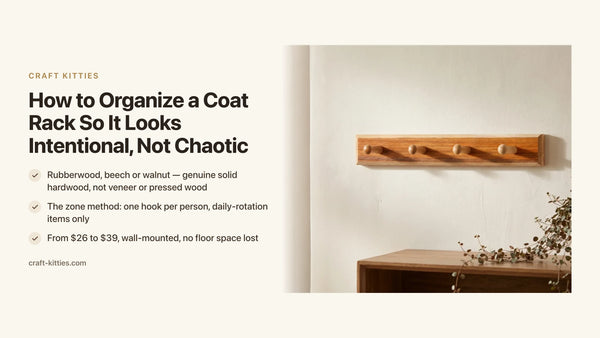
The entryway is the first and last room every household member passes through, and it is almost universally the least considered. The objects that end up there — shoes, bags, keys, mail — arrive in a rush and get deposited without thought. A wood piece that gives each category a fixed spot is the infrastructure that makes an entryway work.
A narrow tray or a small bowl near the door is the key drop — the spot where keys, wallet and phone go the moment the door closes. Made from solid walnut or oak, this piece is functional enough to justify its presence and attractive enough that it becomes part of how the entryway reads. Guests see it; it signals that the space is considered.
The entryway is also where species choice and metal pairing are most visible. If the door hardware is brushed gold, a walnut piece with brass accents reads as intentional. If the hardware is matte black, red oak with black metal maintains the palette. The investment in matching is small; the perceptual reward is significant.
The home office — wood as a focus cue
In a home office, the desk surface is the room. Everything else — the chair, the bookcase, the wall color — exists to support or detract from the quality of attention that the desk makes possible. Natural wood decor on a desk does something specific: it marks the work zone as intentional.
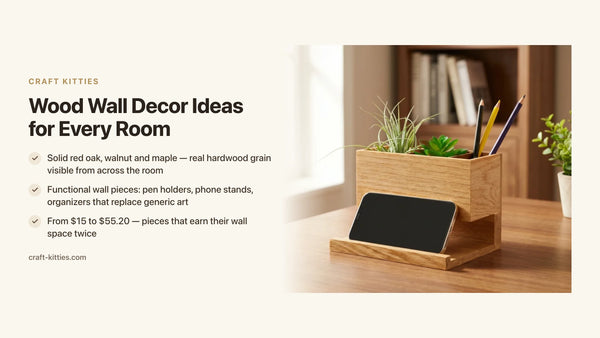
A wood pen holder, a wood phone stand, a wood tray for documents: objects that define the desk's zones. The brain processes a surface with defined zones differently from a surface where everything sits arbitrarily. The first reads as a workspace. The second reads as a storage area. The material choice matters because wood is heavy enough to look permanent — it signals that the zone is fixed, which is a subtle but real support for attention.
The other function of wood on a desk is acoustic. Hard objects on a hard desk — metal on metal, ceramic on glass — generate sharp, distracting sounds. Wood absorbs impact. A phone placed on a walnut tray makes a quieter sound than the same phone placed on a glass desk, and in a room where quiet matters, that difference is not trivial.
Choosing species for your room: the contrast principle

The most common error in natural wood home decor is choosing a wood that disappears into the room. A walnut piece in a dark-walled room blends in; a beechwood piece in a cream room is barely visible. The result in both cases is a piece that reads as an afterthought rather than a choice.
The contrast principle resolves this without effort. Light rooms — white, cream, light grey, pale linen — need a dark wood to stand out. Walnut is the answer: its deep brown reads immediately against pale surfaces. Dark or heavily saturated rooms work with the opposite logic: beechwood's pale tone lightens the visual weight and adds an element the eye rests on. Red oak sits between the two and works in both contexts, though it is most effective in rooms where you want warmth — amber tones, terracotta, sage, warm white.
The secondary variable is hardware. If a piece comes with metal accents, the metal should match the dominant metal in the room. Brushed gold and warm brass pair naturally with walnut and beechwood in neutral rooms. Matte black and gunmetal read as modern and industrial, pair cleanly with red oak and work in higher-contrast settings. The combination of wood species and hardware is what makes a piece look like it belongs rather than looks borrowed.
The three pieces with the highest room-transformation value
If the question is where to put the first wood piece in a room, three forms consistently have the highest return on surface area and visual impact.
The cone ring holder is the nightstand and dresser piece. Its vertical form is visible at a glance; its function — storing rings in a visible, fixed spot — means it is handled every day and earns its place. In solid beechwood or walnut, it reads as an object with intention rather than a trinket.
The flat tray is the horizontal anchor for any surface: coffee table, nightstand, entryway console, desk. It groups the objects that already live on that surface and makes the grouping look deliberate. In walnut, even a simple rectangular tray will change how a surface reads within thirty seconds of being placed.
The paired set — two cones at different heights, or a tray alongside a single cone — is the most efficient decor move because it introduces repetition of material. Two beechwood cones on a nightstand form a still life. One cone on a nightstand is a ring holder. The difference in visual impact between one and two pieces in the same material is significant.
The full ring holder range from our studio
Our ring holder collection is built around solid hardwoods and one guiding principle: the object should be worth seeing every day, because it will be. Every piece in the range is turned or shaped from beechwood, walnut or a combination, finished with a protective wax coat, and weighted to stay in position during daily use.
Description
The beechwood set is the starting point: two cones, pale and fine-grained, at heights that let you stack rings by size or separate his and hers on a shared surface. The matte wax finish protects without adding gloss, and the weighted bases hold the cones in position even on smooth surfaces. At $16.99, the set replaces a decade of rings on the windowsill.

Description
The walnut and brass piece is where the collection becomes something you mention to a guest. Solid walnut — the darkest, most furniture-like wood in the range — set on a base of solid brass. The form is simple: a cone on a weighted disk. The material combination, dark wood against warm gold metal, is the combination that interior photographers reach for because it photographs as intentionally as it reads in person. At $25.99, it is the single piece that most changes what a dresser or nightstand communicates.

Description
The walnut cone set brings the two-piece principle to the darker end of the palette. Both cones in solid walnut, at coordinated heights, with the same matte wax finish. If the room already has walnut furniture or warm wood tones, this set integrates rather than contrasts — which is the right call in a room that already has warmth and needs coherence rather than a statement.
Description
Beyond the bedroom, the walnut and brass ring holder works equally well on an entryway console — a single piece that grounds the surface and gives rings a fixed spot when the door closes. The brass base adds enough visual weight that the piece holds its own next to a lamp or a small plant without being lost on a wider surface.
Comparison: which ring holder for which room and intention
| Piece | Price | Wood | Metal accent | Best for |
|---|---|---|---|---|
| Beechwood Cone Set | $16.99 | Solid beechwood | — | Light rooms, first wood piece, shared nightstands |
| Walnut + Brass Base | $25.99 | Solid walnut | Solid brass | Statement piece, gift, rooms with warm or gold metal |
| Walnut Cone Set of 2 | $18.99 | Solid walnut | — | Rooms with existing walnut tones, darker palettes |
Decision guide: which piece for your situation
| Your room and goal | The right pick |
|---|---|
| Light bedroom, you want the nightstand to read as considered | Walnut + Brass — dark wood on pale surface = immediate contrast |
| Shared nightstand or dresser, two people's rings | Beechwood Set of 2 — two heights, one address each |
| Room already has walnut furniture or warm wood tones | Walnut Set of 2 — integrates the palette rather than contrasting it |
| Looking for a gift — rings or no rings | Walnut + Brass — the unboxing lands, and the piece earns its spot on a dresser |
| First natural wood piece, neutral room, no strong palette yet | Beechwood Set at $16.99 — versatile, easy to build around |
Four mistakes that dilute natural wood decor
Mixing species across one surface. Three wood objects in three different tones — pine, walnut, bamboo — on the same shelf read as collected rather than chosen. The room feels like it accumulated rather than that someone made decisions. One species per surface, two at most per room.
Choosing decorative over functional. A carved wooden bowl that no one uses gets moved within a month and ends up in a drawer. A walnut ring holder that gets used every single morning earns its spot because it serves a purpose. The pieces that stay on a surface long-term are invariably the ones that earn their right to be there. Choose functional first, and the decorative quality comes along for free.
Ignoring the hardware palette. A walnut piece with brushed gold next to a lamp with a chrome base and a mirror in a black frame: the metals conflict, and the eye reads it as unresolved. Before placing a wood piece, look at the metals already in the room. Match the hardware of the new piece to the dominant metal already present.
Over-scaling the pieces. A large statement tray that covers half the nightstand leaves no room for the lamp, the book or the phone. Wood decor works at scale relative to the surface. On a nightstand, a ring holder cone and a small tray are typically the right footprint. On a coffee table, one tray and one small bowl. Restraint in surface coverage is what makes the pieces read as additions rather than impositions.
FAQ — natural wood home decor ideas
1 — What type of wood is best for home decor? Beech, walnut and red oak are the three strongest choices for home decor objects. Beechwood is pale, tight-grained and very hard — it holds fine details well and ages without yellowing. Walnut is deep brown with a fine, quiet grain that reads like furniture the moment it enters a room. Red oak is lighter, with a bolder, more visible grain that brightens a space. All three are solid hardwoods: they do not chip, swell or warp the way veneered or composite materials do.
2 — How do I style natural wood decor without making it look rustic? The key is material contrast. Place solid beechwood or walnut next to matte metal — brass, brushed nickel or black powder-coat — and the wood reads as modern rather than rustic. Keep forms clean and geometric (cones, cylinders, flat trays) rather than knotted or bark-edge slabs. And limit the wood objects in one zone to two or three pieces in the same species so the surface reads as curated, not collected.
3 — Where should I put natural wood decor in a bedroom? The nightstand and the dresser top are the two highest-return spots. A wood ring holder cone on the nightstand gives rings a fixed home and adds warmth at eye level when you wake up. A walnut tray on the dresser corrals daily-carry items so the surface never looks scattered. Both placements benefit from the same wood species so the room reads as one coherent palette.
4 — Is natural wood decor difficult to maintain? No. Solid hardwood finished with a wax or oil coat needs only a dry or barely damp cloth to stay clean. No polish, no sanding cycle, no special products. The finish deepens slightly with use, which is character rather than damage. The one rule: do not leave standing water on the surface.
5 — Can natural wood decor work in a modern or minimalist interior? It is one of the best materials for minimalist interiors. Wood introduces warmth and organic texture without adding visual noise — it reads as one material, not a pattern or a print. The condition is restraint: choose pieces with clean lines, limit yourself to one or two species across a room, and pair wood with white, cream or grey surfaces.
6 — What is the difference between beechwood and walnut for home decor? Color and grain character. Beechwood is pale blond to cream with a fine, uniform grain — it reads light and neutral and suits white or light-painted rooms. Walnut is deep brown with a slightly more flowing grain — it reads warm and rich, and works best as a contrast piece in lighter interiors. Both are very hard, stable and long-lived. The choice is entirely aesthetic.
7 — How many wood pieces should I have in one room? A reliable rule is two to four objects in the same species, placed in one zone. More than that in a single surface risks looking collected rather than considered. If you want wood across the whole room, vary the forms (a cone, a flat tray, a geometric holder) while keeping the species consistent.
8 — Are wooden ring holders practical, or just decorative? Both, and the combination is the point. A ring holder cone gives rings a fixed address on the nightstand or dresser — you remove them before washing hands, before sleeping, before working out, and they always go back to the same spot. That habit prevents the drawer-search ritual and protects the ring from accidental knocks.
9 — Does wood decor work in a bathroom or kitchen? Yes, as long as the piece is finished correctly. Solid hardwood sealed with a wax or oil coat resists ambient humidity and occasional splashes without issue. Do not leave standing water on the surface. In a bathroom, wood soap dishes, ring holders and small trays all work well in this framework.
10 — What wood decor piece has the most impact for the least cost? A ring holder cone set in beechwood or walnut consistently has the highest visual return per dollar in the bedroom. At $16.99 for a set of two, it changes what a nightstand communicates more than any other single piece at that price point — and it is used every day, which means it earns its place rather than gathering dust.
Where to go next
The ring holder is often the first natural wood piece in a bedroom — rarely the last. Our ring holder collection gathers the full range in beechwood, walnut and combinations, from the accessible Beechwood Cone Set at $16.99 to the Walnut and Brass Ring Holder that doubles as a statement piece.
Over 243 customers have found the ring holder they were looking for through our Etsy store — the reviews there give a good sense of how the pieces read in real bedrooms across different palettes and styles.
Conclusion — one material, every room
If this guide leaves you with one method: choose species by contrast with your dominant wall color, keep one species per surface, and start with a functional piece rather than a decorative one. A wood ring holder on a nightstand is used every morning and seen every night — it earns its visual presence through daily usefulness. The Beechwood Cone Set opens the collection at $16.99; the Walnut + Brass Ring Holder is the piece that makes the most immediate difference when contrast and warmth are the goal. Natural wood home decor does not require a renovation or a stylist. It requires the right piece in the right spot — and the discipline to stop before the surface is full.