At a glance
- Room-by-room reset using solid red oak, walnut and beech — not a declutter binge
- Start with the bathroom: one wall-mounted towel bar changes the whole morning routine
- Carry the same wood family through every room so the result looks planned, not assembled
January has a particular quality of light — flat, honest, a little unforgiving. The holiday decorations are down, the extra layers of coats and bags and gifts have nowhere to go, and the house shows exactly what it is without all the seasonal cover. For most people, this is the moment the urge to organize arrives: not a vague resolution, but an actual recognition that the current system is not working.
The trap is ambition. Most January organization projects collapse under the weight of doing everything at once — renting a dumpster, buying forty matching containers, attacking three rooms on the same Saturday. What survives is the project that starts with one room, finishes it, and uses that visible result as the engine for the next.
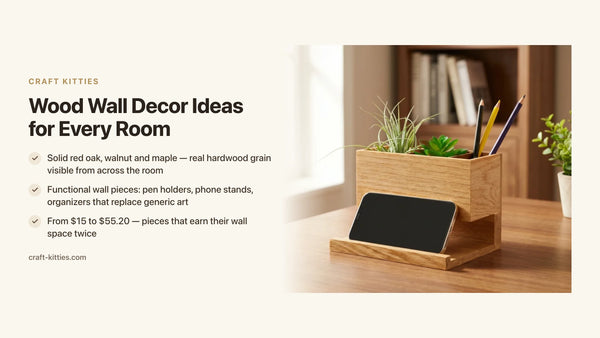
This guide takes a room-by-room approach with a clear point of view: solid wood accessories — red oak, walnut, beech — are the most durable and most visually coherent way to organize a home that will still feel organized in December. Not because wood is a trend, but because it ages like furniture rather than like hardware, and because one material carried through multiple rooms creates the kind of quiet visual thread that makes a home feel finished rather than furnished.
Why the bathroom is the right room to start
The bathroom is the best first room for a reason that is rarely stated plainly: it is the smallest finished room in the house, and finishing a small room quickly gives you the confidence to continue. An afternoon in the bathroom — a towel bar, a toilet paper holder, a soap dish in the same wood family — and you have a room that looks intentional. That visible result is worth more than a half-finished living room reorganization.
The bathroom also has the clearest functional brief of any room. Towels need to hang and dry. The toilet paper roll needs a fixed home. Soap, hand cream and a candle want a surface. These three needs can be met with three wall-mounted pieces in the same material, and the room reads as organized at the level of someone who made deliberate choices, not someone who grabbed whatever was on sale at the hardware store.
The secondary reason: the bathroom is used by every person in the house, every single morning, before anything else happens in the day. An organized bathroom does not just look better — it sets a calmer tone for the first twenty minutes of every day, which compounds in ways that are easy to underestimate.
The towel bar — the most used and least considered object in the bathroom

Most people own a chrome towel bar they did not choose. It came with the apartment, it came with the house, and it has been there long enough that it stopped registering — until January, when you notice that two towels fight for the same bar, neither dries properly, and the whole thing has a utilitarian pallor that does not belong in a room you use twice a day.
A solid wood wall-mounted towel bar is the simplest possible upgrade to that situation. The material difference is substantial: machined chrome is cold, uniform, and impossible to distinguish from any other chrome fitting in any other bathroom. Solid red oak or walnut has grain, warmth, and specificity — it reads as an object someone chose, not something that came standard.
The functional question is single versus double. A single bar at the right height works for one person or in a bathroom where towels genuinely have time to dry between morning and evening. A double-layer bar solves the two-person problem permanently: two towels hang side by side, separated, each exposed to air on both surfaces. They dry faster. The bathroom looks less crowded. The morning argument about whose towel is whose ends.
The hardware question is brass versus matte black. Brass is warmer and reads as quietly luxurious in bathrooms of any size; matte black is more graphic and suits Japandi or industrial-leaning rooms. Neither choice is wrong. The rule is to match whatever metal already appears in your bathroom fixtures — the faucet, the showerhead, the mirror frame.

Description

Description

Description
Carrying the wood family through the bedroom
The bedroom's organizational challenge is different from the bathroom's. The bathroom has a clear functional brief; the bedroom is where all the objects that lack a home in other rooms end up — the watch, the earrings, the hair tie, the phone, the book, the reading glasses. The nightstand surface accumulates, the dresser top accumulates, and by mid-January both look like a lost-and-found counter.
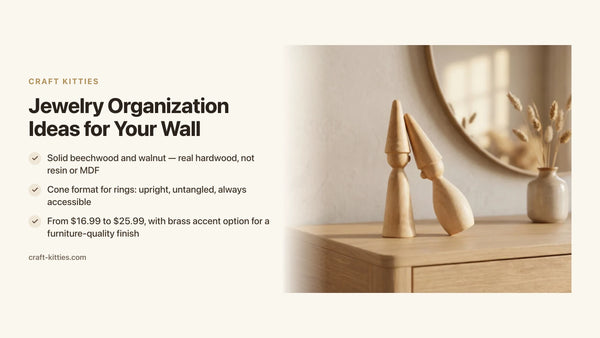
The solution is not more containers — it is designated surfaces with a defined capacity. A catch-all tray on the nightstand holds the watch and the earrings and nothing else, because the tray's edges define the limit. A ring dish on the dresser takes the jewelry. A pen holder on the desk takes the pens. Each piece is small and specific; together they establish a system where every object has a named place and returning it there is the path of least resistance.
The wood-family rule applies here as directly as in the bathroom. If you are using walnut in the bathroom, carry walnut into the bedroom. The human eye registers material continuity as intentional design; it registers material inconsistency as accident. A bedroom that shares a wood species with the bathroom a door away feels like a home someone furnished deliberately, not room by room over years.
The brass or matte-black hardware question travels with it. Pick whichever metal you chose for the bathroom — and use the same one on any wall hooks, mirror frame, or lamp base in the bedroom. Two materials is a system. Four is a collection of purchases.
The entryway — the room that determines everything that follows

The entryway sets the organizational tone for the entire home. When the entryway is clear, the rest of the house tends to stay clearer; when it collapses into a pile of coats and shoes and bags, that chaos leaks into the next room. It is the first surface every person in the household touches when they come in, which means it is also the first system they will either use or abandon.
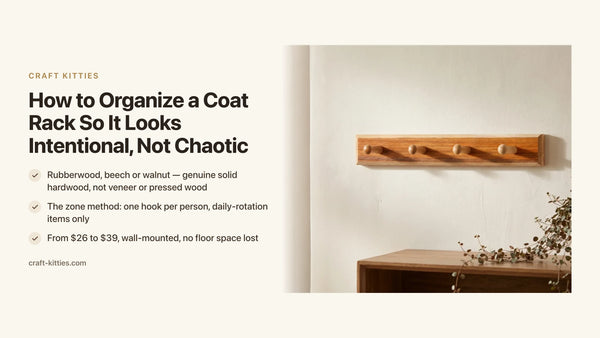
An effective entryway organization has three components. The first is wall hooks at the right height — 60 to 66 inches from the floor so that an adult coat hangs without dragging. The second is one hook per person: not a rack with twelve hooks and no assignments, but a specific hook for each person, which is what converts a fixture into a habit. The third is a small surface near the door — a shelf, a tray, a bowl — where keys and wallet go every time. Not occasionally. Every time.
Solid wood hooks carry more visual weight than chrome or plastic, and that weight is part of what makes them work. An object with presence tends to be used; a chrome hook that blends into the wall becomes invisible and gets skipped. A walnut or red oak hook rack is something you notice and engage with. That is not a decorative argument — it is a behavioral one.
The desk — organization that works with how you actually think
The desk is the room most people approach backwards. They buy a large desk organizer, fill it with everything on the surface, and create a contained clutter instead of a clear surface. The more useful approach is to ask what actually needs to be within arm's reach during work and what only needs to be accessible — then organize those two categories separately.
Within reach means a pen holder, a notepad surface, and the device you use most. That is the inner ring. Accessible but not crowding means the stapler, the charger cables, the spare batteries — these live in a drawer or on a shelf, not on the working surface.
For January, the task is audit, not acquisition. Before buying any organizer: remove everything from the desk surface, clean it, and put back only what you reached for in the last week. What did not come back does not need to be there. What came back gets a designated holder so it has a place to return to after each use. The organizer is the last purchase, not the first.
The principle behind lasting organization: material continuity
There is a reason some homes look organized and some homes look like they were organized — the distinction lives in whether the organizing system has a logic that can be read at a glance. A room where every accessory is a different material, a different finish, a different period of design, reads as accumulated, even if each individual piece is perfectly placed. A room where three or four pieces share a material and hardware finish reads as composed.
Solid wood is the easiest anchor material to carry through an entire home because it reads differently in different rooms without losing its identity. Walnut in the bathroom and walnut in the bedroom and walnut in the entryway are three different objects performing three different functions, but they share a material language that makes the home feel like one place rather than a collection of separate decisions.
The implication for a January reset is practical: before buying anything, choose your wood species and your hardware finish, and do not deviate. Red oak with brass. Walnut with matte black. Beech with brushed steel. Then buy everything in that combination, even if it means ordering from one place and waiting, rather than buying immediately from three.
Room-by-room checklist for a January organization reset
The sequence matters. Start where the result is fastest and most visible; use that room as evidence that the system works before moving on.
Bathroom first. Wall-mounted towel bar, toilet paper holder, soap and ring dish. Same wood, same hardware. Time: one afternoon. Result: a room that looks finished.
Bedroom second. Catch-all tray on the nightstand, ring dish on the dresser, hook on the door or wall for tomorrow's outfit. Same wood family as the bathroom. Time: one morning. Result: a morning routine that does not begin with searching.
Entryway third. Hook rack at the right height, one hook per person, a small shelf or tray for keys. Same wood as the rooms inside. Time: one Saturday. Result: a front door that does not apologize.
Desk fourth. Audit before buying. Remove, clean, return only what you used. Then a pen holder, a cable tray, a wrist rest if you type for hours. Same wood. Time: two hours. Result: a surface you want to sit at.
Storage rooms last. Closets and storage areas are the natural end of this sequence, not the beginning. Once every active surface is organized, storage becomes about what you are keeping, not about hiding what you have not dealt with.
What solid wood does that plastic containers cannot

Description
The storage container market in January is enormous, and the containers themselves are not the problem. The problem is that a clear plastic container filled with miscellaneous objects still reads as miscellaneous. Organization is about giving objects a designated category, not a designated box.
Solid wood accessories approach this differently. A wood towel bar is not a container — it is a defined place for a specific object, with enough visual presence to make using it feel like a decision rather than a convenience. A walnut catch-all tray on the nightstand does not organize everything; it organizes the four objects that fit in it, which is exactly the right scope. The material does some of the behavioral work that willpower cannot sustain over twelve months.
The durability argument is also real. The plastic bins and mesh organizers that fill shelves in January tend to crack, discolor, or warp within two or three years. Solid hardwood sealed with wax or wax-oil ages in the opposite direction: it develops character, it does not degrade, and it does not need to be replaced. A red oak towel bar purchased in January 2026 will still look like a decision made on purpose in January 2030.
Installing a wood towel bar in less than an hour
The installation concern that stops most people from switching from chrome to wood is unfounded. A wall-mounted solid wood towel bar installs with two anchors in drywall and one level check. The full process takes under an hour and requires no special tools.
Step 1 — Choose the wall and height. The towel bar should sit on the most accessible wall, at a height between 48 and 54 inches from the floor for standard use. In a small bathroom, the back wall behind the door works if the side wall is occupied.
Step 2 — Mark the anchor points. Hold the bracket plate against the wall at the target height, level it, and mark the two screw positions with a pencil. Tap gently to locate a stud; if none aligns, use drywall anchors.
Step 3 — Mount the brackets. Drill pilot holes at the marked points, insert anchors if needed, and screw the brackets flush to the wall. Check level again before tightening fully.
Step 4 — Attach the bar. Slide the wood bar into the brackets and tighten the set screws. Hang the first towel, step back, and look at the wall. This is what an organized bathroom feels like.
Caring for solid wood in a humid room
Solid red oak, walnut, and beech are not fragile in a bathroom when they are properly sealed. The finish — typically a wax or wax-oil coat applied at the studio — makes the surface moisture-resistant and easy to wipe clean. Ambient humidity, steam, and the occasional water splash do not penetrate a sealed surface.
The maintenance is minimal. A dry or barely damp cloth removes any residue; no chemical cleaners, no reapplication of oil or wax on any regular schedule. The one thing to avoid is standing water left in direct contact with the surface — a puddle under a soap dish or a perpetually wet sponge resting on the bar. Remove it and the wood does not know it was there.
The finish also means these pieces age better than chrome fittings, which oxidize unevenly over time. A solid walnut towel bar that has lived in a bathroom for five years looks like a piece of furniture that has been there for five years — intentional, settled, character-bearing. That is the opposite of most hardware, which ages badly and needs replacement.
The January mindset that makes organization last
Most January organization projects fail by February not because the system was wrong but because the behavior was not anchored to the object. You need the physical object to be compelling enough to engage with every day. A hook that blends into the wall gets skipped; a walnut hook rack that stands out from the wall gets used. The aesthetic quality of the object is not vanity — it is the behavioral trigger.
The second thing that makes organization last is specificity. A "miscellaneous" drawer will be a miscellaneous drawer in twelve months. A ring dish for the three pieces of jewelry you wear every day will still be a ring dish in twelve months, because its scope is narrow enough to succeed. January is not about creating more storage — it is about creating more specific storage that requires less maintenance.
The third is not trying to finish in January. An organization reset done over two or three weekends, one room at a time, sticks better than one done in a single manic Saturday. The bathroom this weekend. The bedroom next weekend. The entryway the weekend after. By February the whole active area of the house has a system, and none of it cost the effort of a full-weekend marathon.
Towel bar comparison — four models, one decision
| Model | Price | Wood | Hardware | Best for |
|---|---|---|---|---|
| Square hardwood towel bar | $24.00 | Solid hardwood | Brass | Modern and transitional bathrooms |
| Wood & brass rack set | $22.00 | Solid wood | Brass | Bathroom + kitchen in one set |
| Arc design towel bar | $24.00 | Solid walnut or red oak | Minimal | Spa-style and Scandinavian rooms |
| Double-layer towel bar | $24.00 | Solid wood | Minimal | Two-person bathrooms |
Which model for which situation — the decision matrix
| Your situation | The right pick |
|---|---|
| Modern or transitional bathroom, one person | Square hardwood towel bar |
| You want bathroom and kitchen to match in one order | Wood & brass rack set |
| Spa or Scandinavian bathroom, softer profile | Arc design towel bar |
| Two people sharing one bathroom | Double-layer towel bar |
Where to go next
The pieces that anchor this kind of reset are in our wooden towel bar collection — solid red oak, walnut, and beech, finished with wax in our studio, with brass and matte-black hardware options for both aesthetic directions. The wall mounted wood towel bar is the bathroom starting point; the double-layer version solves the two-person problem in one installation.
If you are reading this on Etsy, our studio has 243 reviews from customers who have been through exactly this process — a bathroom or a bedroom or an entryway that needed one solid piece to feel finished.
Conclusion — one room, one weekend, one material
The January organization impulse is real and worth acting on. The method that works is the opposite of what the container stores suggest: not more storage, but more specific fixtures in one coherent material, installed room by room, starting where the result is fastest. A solid wood towel bar in the bathroom on Saturday morning. A catch-all tray on the nightstand by Sunday afternoon. Two rooms that look finished, in the same material, by the end of the first weekend of the year. That is a start that actually carries.
FAQ — new year home organization tips
1 — What is the best way to start a home organization project in January? Start room by room rather than tackling the whole house at once. The bathroom is the easiest entry point — it is small, used daily, and a single wall-mounted accessory like a solid wood towel bar visibly transforms the space in under an hour. Once you see a finished room, the momentum carries to the rest.
2 — What should I organize first in the new year? Prioritize the spaces you use every morning: the bathroom, the entryway, and the bedroom nightstand. These are the areas that set the tone for the rest of your day, and organizing them first delivers the most immediate return on your effort.
3 — Are wooden bathroom accessories durable enough for a humid environment? Yes, when the wood is solid and properly finished. Solid red oak, walnut, and beech sealed with a wax or wax-oil coat resist ambient humidity, occasional splashes, and daily use. What fails in bathrooms is bare wood or veneered particleboard — not sealed solid hardwood.
4 — How do I choose between a single and a double-layer towel bar? A single bar works for one person or in a bathroom where towels dry between uses with no competition for space. A double-layer bar is the practical choice for two people sharing one bathroom, or any room where two towels need to hang simultaneously — the layered design keeps both towels exposed to air so they dry properly.
5 — What wood species should I choose for a bathroom towel bar? Red oak is light-toned with a bold, open grain — it brightens white and neutral bathrooms. Walnut is deep brown with a finer, quieter grain — it reads like furniture against a light wall. Beech sits between the two: creamy white to pale honey, tight grain, a clean Scandinavian feel. All three are sealed hardwoods with comparable durability; the choice is purely aesthetic.
6 — How do I maintain a consistent look when organizing multiple rooms? Anchor every room to the same wood species and hardware finish. If you use solid walnut with brass in the bathroom, carry walnut and brass into the bedroom and entryway. Your eye reads the repetition as intention, not coincidence, and the home feels curated rather than assembled piece by piece.
7 — Can I install a wooden towel bar without drilling? Some models in our studio install with strong adhesive, no drilling required — an important feature for renters or anyone who wants a reversible installation. Screw-mounted models are more permanent but equally straightforward: two wall anchors and about ten minutes of work.
8 — How many pieces does it take to make a bathroom feel organized? Usually two or three. A wall-mounted towel bar handles the most visible daily need; a toilet paper holder clears the floor of any freestanding unit; a small shelf or ring dish gives soap, hand cream and a candle a designated place. Three pieces in the same wood family transform a bathroom that felt cluttered into one that feels deliberate.
9 — Should I declutter before buying organization accessories? Yes, always. Buy nothing until you have removed everything from the surface, cleared what you do not use, and confirmed what actually needs a designated place. Accessories give objects a home — they do not decide which objects deserve one. That step belongs to you before the first purchase.
10 — Is solid wood more expensive than chrome or plastic organizers? The entry price for a solid wood towel bar from our studio starts at $22, which is comparable to mid-range chrome options. The difference is longevity: solid hardwood sealed with wax does not corrode, discolor, or warp over years. The cost per year of use tilts substantially in wood's favor over any three-year period.