At a glance
- Pale solid wood, linen, candlelight and objects chosen on purpose — the 12 principles that make Nordic style feel lived-in rather than staged
- Beechwood and walnut over plastic and resin: material honesty is the shortcut that makes everything else easier
- A solid beechwood ring holder from $16.99 is one of the quietest and most permanent specialementsions of the style
There is a reason Nordic home decor ideas have stayed relevant for thirty years while most interior trends have cycled in and out in three. The style is not a mood board — it is a set of choices rooted in climate, craft tradition and a particular relationship with winter light. When those choices are understood rather than mimicked, the result looks calm and inevitable rather than assembled.
This guide covers 12 concrete ideas for bringing Nordic character into a room: the palette logic, the material priorities, the lighting approach and the small objects that hold the style together day to day. The ring holder section sits in the middle for a reason — it is often the clearest example of the difference between understanding the style and merely copying its surface aesthetics.
What makes Nordic decor Nordic — and why it matters to know

Before the twelve ideas, the underlying logic. Nordic interior design emerged in a specific context: long winters with very little daylight, a craft tradition that favored locally available natural materials, and a cultural preference for restraint over display. Three design philosophies codified these instincts — Danish hygge (coziness and togetherness), Swedish lagom (the right amount, not too much or too little), and Finnish sisu (functional resilience in the face of difficulty). Together, they produce a style that is quiet, warm, honest about its materials and deeply functional.
The five principles that follow from this context give each of the twelve ideas below its rationale.
Maximized light. A pale palette is not about looking clean — it is about amplifying whatever light enters the room. In a Nordic winter, white walls, light linen and pale solid wood do the work that paint and mirrors do elsewhere.
Natural materials over simulation. Solid beechwood, solid walnut, linen, wool, undyed cotton. Not wood-effect laminate, not polyester-blend throws. The tactile difference matters more than the visual one: natural surfaces feel different to the hand, and the hand notices every day.
Restraint as discipline, not austerity. Every object in a well-edited Nordic room was chosen. Nothing is there by default or because it was cheap to fill a surface. This is not minimalism's "nothing" — it is something closer to "only the right things."
Warmth through texture. Chunky wool, a linen curtain that pools on the floor, a sheepskin on a chair, a grouping of candles. The eye reads warmth from surface quality and material variety, not from the count of objects present.
Form follows function honestly. A wooden cone ring holder is a cone because the geometry solves the problem cleanly. A shelf is where it is because that wall needed it. Nordic design objects rarely apologize for being useful, and rarely pretend to be only decorative.
Idea 1: Start with the palette — warm white, not bright white
The Nordic palette is not simply white. It is a family of off-whites, warm greys, pale sands and muted sage greens that interact with natural light throughout the day. True white can read as clinical under northern winter light; warm white feels like fresh linen. The difference is a few degrees of undertone — cream, warm grey, or the faintest sage — that keeps the room from tipping into sterile.
Against this neutral base, Nordic rooms introduce one or two accent tones at low saturation: dusty terracotta, slate blue, forest green, mushroom brown. Never primary, never saturated. The logic is that in a pale room, a muted accent reads like a considered decision. A saturated accent reads like noise against quiet walls.
If you are repainting, pick your neutrals from the daylight side of the chip fan. Hold the strip against the wall mid-morning in natural light, not under overhead bulbs. The undertone shifts significantly between artificial and natural light, and the room will live in both.
Idea 2: Introduce pale solid wood — beech first, walnut as accent
Wood is not decoration in Nordic rooms. It is structure: floors, furniture, objects, shelving. The wood species that defines the style is beech — pale honey tone, fine and even grain, smooth to the touch. Light ash and birch occupy the same visual register. Against white walls, a solid beechwood piece reads as warm without pulling the palette toward rustic or teak-heavy character.
Walnut introduces a different note: deeper brown, fine tight grain, more furniture-forward. Used as a solo accent or paired with brushed brass hardware, solid walnut gives a Nordic room a quietly elevated register. The combination — beechwood as the dominant material, walnut as a single considered statement — is particularly effective in bedrooms and living rooms.
What does not fit: heavily figured exotic woods, deeply red or orange-toned timbers, or wood-look alternatives that replicate the visual appearance without the tactile truth. Nordic design's insistence on natural materials is not aesthetic snobbery. It is the recognition that simulation undermines the sensory coherence of the space — and that the hand always knows.
Idea 3: Choose the ring holder form first — cone or tray
Before choosing species, the more fundamental question for jewelry display is form: cone or flat tray?
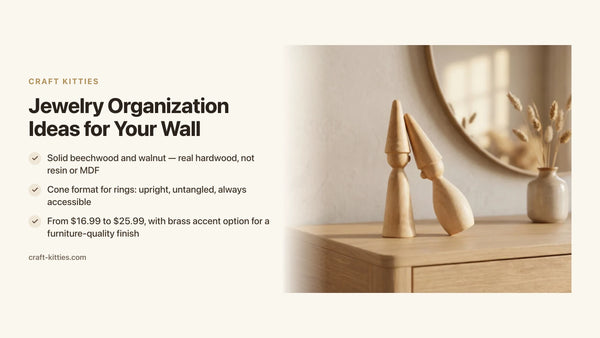
A cone solves the ring problem geometrically — rings slide on and stack cleanly, no tangling, easy to lift one without disturbing the others. The cone occupies a small footprint, reads as a considered object rather than a storage solution, and is immediately at home on a Nordic dresser or nightstand. It is the right form for one to four rings used daily, which covers most bedrooms.
A flat tray handles more volume: earrings, bracelets, small watches, stud backs. It offers more surface but more exposure — objects slide, and dust settles on everything equally. For a bedroom where jewelry is displayed rather than cycling in and out daily, the tray is the right answer. For a nightstand where rings come on and off twice a day, the cone wins on both function and form.
The decision matrix later in this article covers both axes in detail.
Idea 4: Solid wood versus resin versus veneer — material honesty is non-negotiable
This section applies to ring holders specifically but the logic extends to every object in a Nordic room. The style asks one question of each object: is it honest about what it is?
Solid beechwood and solid walnut are cut from real timber throughout. Run a finger across the edge — the same material, all the way through. The surface can be lightly sanded and oiled if it marks. The grain pattern continues consistently from face to end grain. Both species age toward character, not failure.
Veneer is a thin slice of real wood over a substrate — usually particleboard or MDF. It looks correct in a product photo. On a ring holder, the edges reveal the substrate at the join line. Over time, in a bedroom where humidity cycles seasonally, the veneer lifts at corners. The cost savings are immediate; the disappointment arrives in the second year.
Resin (often described as "ceramic-look" or "stone-effect") dominates the low end of the ring holder market. It is lightweight and cheap to mold. Against a pale Nordic palette, a resin cone reads as plausible at a distance. At arm's reach — where a ring holder always sits — the material tells the truth: cold, hollow-sounding when set down, visually uniform in a way no real wood ever is.
For a style explicitly built around material honesty, placing a resin substitute on a carefully edited dresser is a contradiction in object form. The solid wood options below exist precisely to close that gap.
Idea 5: The ring holders from our studio, in detail

Description
Beechwood holds its pale, fine-grained character for years. It does not darken significantly with handling; it develops a gentle patina that reads as more settled over time, not worn out. The set includes two cones, making it the most natural choice for two people sharing a dresser — which describes most bedrooms. At $16.99, it is also the clearest entry point into solid-wood Nordic decor.

Description
Walnut and brass is the warm-accent pairing that appears throughout well-edited Nordic interiors: the brass is quiet enough not to compete, the walnut grounds it in natural material. This holder works best in a bedroom that already has one brass element — a lamp base, a candle holder, a picture frame — and needs a small object to complete the material thread without adding a new one.

Description
The walnut set of two covers the case where the room already has warmth and the couple wants a matching pair that sits together as one considered object rather than two unrelated items. The tight grain of solid walnut rewards close inspection in a way mass-market resin alternatives cannot.
Description
For gifts, beechwood is the palette-safe default: pale enough to work against white walls, warm white, grey or muted sage without risk of clashing with existing decor. The recipient does not need to have a Nordic room for it to feel at home — the cone form and natural material earn their place in almost any considered bedroom.
Description
Idea 6: Comparison and decision tables
| Model | Price | Wood | Set or single | Best Nordic fit |
|---|---|---|---|---|
| Beechwood Cone Set | $16.99 | Solid beech | Set of 2 | Cool or neutral palette, shared dresser |
| Walnut + Brass Base | $25.99 | Solid walnut | Single | Warm palette, one brass accent already present |
| Walnut Cone Set of 2 | $18.99 | Solid walnut | Set of 2 | Warm palette, couple, no metal accent |
| Your situation | The right pick |
|---|---|
| White or pale grey walls, neutral dresser, want warmth without pulling toward brown | Beechwood Cone Set — $16.99 |
| Warm palette — sand walls, natural linen — one brass lamp already on the dresser | Walnut + Brass — $25.99 |
| Shared nightstand or dresser, both partners need a ring spot, no brass accent in the room | Walnut Set of 2 — $18.99 |
| Gift for someone whose décor you do not know — safest choice across any Nordic palette | Beechwood Cone Set — pale, works anywhere |
| Premium gift for a couple — warm aesthetic, design-conscious, housewarming or anniversary | Walnut Set of 2 — $18.99, matching pair |
| The bedroom is nearly complete, needs one last object to feel finished | Walnut + Brass — the accent that closes a room |
Idea 7: Light every zone — no overhead fluorescents

Lighting is where Nordic interiors do the most work with the least obvious investment. The principle: layer, and keep each layer warm.
Overhead lighting in Nordic rooms is ambient and indirect — a pendant with a white or linen shade that diffuses rather than projects. Bare bulbs, cool-white LEDs and recessed spot grids are the opposite of the intended effect. If the only light in a room comes from directly above, the room will always feel either overlit or underlit, with no middle ground.
Table lamps provide the reading layer: one on each nightstand in the bedroom, one beside the sofa in the living room. Bulb temperature matters more than wattage. The target is 2700K — the warm end of the spectrum — not 4000K, which reads as office light regardless of the shade's material.
Candles are the finishing layer and the most distinctively Nordic element. Not seasonal decoration — daily practice. A grouping of three votives on a coffee table, a single taper on a dining table, a pillar candle on a bathroom shelf. The light they cast is irreplaceable by any electric source: warm, low, directional. Danish homes burn more candles per capita than any country in the world, and the statistic feels accurate to anyone who has spent a winter evening there.
Natural light is treated as a material in its own right. Curtains in Nordic rooms are usually light linen or pale cotton — diffusing rather than blocking. Heavy blackout curtains belong in the bedroom for sleep; in living areas, the goal is to shape daylight, not eliminate it.
Idea 8: Texture before volume — the Nordic approach to softness
The common mistake when attempting Nordic style is stripping out color and then finding the room feels bare rather than calm. The correction is not to add more objects — it is to add texture.
A chunky knit wool throw on a sofa does more for the perceived warmth of a room than three additional throw pillows. A sheepskin draped over a wooden chair back introduces three tactile qualities simultaneously: the natural fiber, the animal texture, and the contrast with the solid wood beneath it. A linen duvet cover reads differently than a cotton-polyester blend at every point of contact, and the difference is legible to any guest who touches it.
The texture hierarchy for a Nordic bedroom: linen or cotton-percale bedding as the base layer; one heavy knit or wool throw at the foot of the bed; one or two linen cushions, un-pressed and slightly rumpled; a sheepskin or braided wool rug on the floor beside the bed; and on the dresser, a small solid wood object that the hand reaches for without thinking. Every layer serves both function and the room's warmth.
Idea 9: Bare surfaces and the objects that earn them
One of the more counterintuitive ideas in Nordic design: a bare surface is not a problem to solve. An empty nightstand in a Nordic bedroom is a feature — it communicates that everything in the room was chosen rather than accumulated by default.
The objects that earn a place on a Nordic surface tend to share a few traits: they are touched daily, they are made from natural materials, and they look like the result of a deliberate choice rather than a default fill. A hardcover book with a minimal spine. A small ceramic vessel with a single cut branch. A candle. A solid beechwood ring holder.
What does not earn a surface in a Nordic room: plastic containers, synthetic flowers, objects that perform no function and were placed to fill a visible gap. The Nordic approach is not ascetic — it is selective. The test is not "does this spark joy" but "did I choose this?" The distinction matters because one question is retrospective and the other is prospective.
Idea 10: The dresser top as a complete Nordic composition
The dresser is often the most worked surface in a bedroom and the clearest specialementsion of whether Nordic principles have been genuinely applied or merely referenced. A well-edited Nordic dresser holds four to six objects maximum, each visible in its own right, none crowding the others.
A functional structure that works consistently: a small framed print or mirror at the back, a candle or small ceramic to one side, a tray or wooden surface organizer toward the center, and in the front position where the hand naturally lands, a solid wood ring holder where jewelry lives permanently. Nothing accumulated without a decision. Nothing left on the surface because it was easier than putting it away.
The palette rule extends to the dresser surface. The objects should share a material language: beechwood and white ceramic; solid walnut and brushed brass; dark walnut and matte black. Three materials is the comfortable maximum. Four reads as a collection of things; three reads as a composition.
Idea 11: Nordic lighting and the kitchen counter
Nordic kitchens operate on a principle distinct from the everything-behind-doors approach: objects in daily use are displayed because they are daily used, and the display itself is considered. Wooden cutting boards propped at the back of the counter. A simple ceramic bowl with seasonal fruit. Cast iron hanging from a rail because it is used every week, not once a month.
The organizing principle is honesty about use. Nothing decorative that is not also functional. Nothing functional that is hidden unless it is genuinely unsightly. The result is a counter where the cooking tools are part of the aesthetic because they were deliberately chosen to be.
For a Nordic kitchen counter: keep three to five items permanently visible. Everything else in a cabinet or drawer. Choose the permanent five by identifying what you touch every single day — those objects earn the counter. Everything else does not.
Idea 12: Nordic style as a daily practice, not a renovation
The final and most sustainable idea: Nordic decor is less a fixed arrangement than a habit of choosing. The style is not achieved by buying a specific furniture set or painting all the walls white. It is built by repeatedly asking "does this belong here, and is it made from a material worth living with?" until the room answers the question without prompting.
A solid wood ring holder at $16.99 is a concrete specialementsion of this habit at the smallest possible scale — an object used every day, made from real beechwood, designed to look right rather than just to work. It is also the easiest place to start for a bedroom that is not yet Nordic but whose owner wants it to be. Small moves, made honestly, in the right material, compound over time into a room that feels considered rather than decorated.
Mistakes that undermine a Nordic room
Buying everything in one session. Nordic rooms are assembled over time. A style that values restraint and considered choice does not translate well to a single afternoon at a large home goods retailer. Buy one piece, live with it for a week, then decide what the room still needs and why.
Confusing pale with cold. A white room with no textile warmth, no solid wood and no candles is a cold room. The pale palette requires material warmth — beechwood, linen, wool — to stay on the right side of the distinction between calm and clinical.
Over-indexing on plants. One or two plants in a Nordic room ground it in the living. Six plants are a plant collection, which is a separate and legitimate aesthetic project but not Nordic decor. The Nordic plant is a quiet participant, not the dominant feature of the room.
Choosing wood-look over real wood. A laminated shelf or a synthetic-finish dresser delivers the visual approximation from across the room. At the scale of daily living — touching the surface, hearing the sound when you set something down, noticing the edge quality — the simulation fails. Natural materials in Nordic decor are not optional; they are the mechanism by which the style produces its characteristic effect.
FAQ — Nordic home decor ideas
1 — What makes Nordic decor different from Scandinavian decor? The two terms are used interchangeably in interior design. Nordic refers to the broader geographic region — Denmark, Sweden, Norway, Finland, Iceland; Scandinavian covers the first three. Both describe the same principles: light palettes, natural materials, restraint and warmth. The distinction is more geographic than aesthetic, and in practice either label applies to the same living room.
2 — What are the core colors in a Nordic interior? White, warm white, pale grey and soft sand as the foundation — they amplify daylight and keep rooms feeling open. Against that neutral base, one or two quiet accents: dusty sage, muted terracotta, slate blue, forest green. Saturated primaries are rare. The palette is calibrated for winter light, where a white wall reflects every available photon.
3 — Is beechwood right for Nordic style? Beech is arguably the most characteristic wood of Nordic interiors. Pale honey tone, fine even grain, smooth surface. It holds its character for years without darkening significantly. It works against white walls, pale linen and muted sage equally. Paired with brushed brass, it leans warm and quietly elegant — the pairing you find in a well-edited Scandinavian bedroom.
4 — What wood species fit Nordic style best? Solid beech, light ash and birch for cool or neutral palettes. Solid walnut as a warm accent or statement piece, especially paired with brass. The contrast logic: pale wood against pale walls reads as warm without being heavy; walnut against a pale wall reads as a considered focal point. Avoid deeply red or heavily figured woods — they pull toward other aesthetics.
5 — What is hygge and how do you create it at home? Hygge is a Danish concept for coziness, togetherness and the pleasure of simple moments. In interior terms: warm lamplight and candles rather than overhead fixtures, soft natural textures, wood surfaces that invite touch, and fewer objects so the room feels restful rather than busy. It is an intention behind the objects you choose, not a product category you can buy directly.
6 — How do you avoid a Nordic room feeling cold or bare? Add texture before adding more objects. A chunky knit throw, linen curtains, a sheepskin on a wooden chair seat. The eye reads warmth from surface quality, not from object count. One solid beechwood piece on a bare dresser does more for the room's warmth than ten plastic accessories arranged on the same surface.
7 — Can Nordic style work in a small apartment? It is arguably the most practical style for small spaces. The light palette expands perceived volume; furniture with visible legs lets the floor breathe and read as continuous; the discipline of choosing fewer visible objects keeps rooms from feeling crowded. Nordic style and compact apartments share the same underlying constraint — limited space, maximized quality — which is why the aesthetic developed alongside dense urban living.
8 — What does a solid beechwood ring holder add to a Nordic bedroom? It contributes what the style asks from every object: natural material, considered form, daily function. A resin cone undermines the material honesty that makes the style coherent. The cone geometry is particularly Nordic — simple, clean, a form that emerged from solving a problem correctly rather than decorating a solution. At $16.99, it is the most accessible entry into solid-wood Nordic decor that stays on a surface permanently.
Where to go next
The ring holders in this guide are part of our ring holder collection — solid beechwood and walnut pieces chosen for exactly the kind of room this article describes. The Beechwood Cone Set is the starting point for most Nordic bedrooms: pale, paired, used twice a day. The Walnut Brass Base is the answer when the room already has warmth and needs one completing accent rather than a new material. Our studio has built a consistent body of work in this direction, and 243 reviews reflect buyers who were looking for exactly this combination of material honesty and considered form.
The short version
Nordic home decor is not a product range or a specific palette. It is a set of choices — light walls, natural materials, warmth through texture, objects chosen on purpose — applied consistently until the room feels inevitable rather than put-together. The twelve ideas above each represent one of those choices, scaled from a full-room intervention (palette, furniture, lighting system) down to a single object on a dresser top: a solid beechwood cone ring holder that costs less than a candle set and earns its place every morning.
The Beechwood Ring Holder Cone Set is the lowest-friction entry into this way of furnishing a room. Real solid beechwood, two cones, pale Nordic character, used twice a day without thinking. If you are starting somewhere, that is where to start.