At a glance
- Red oak: warm honey grain, Janka 1290, the brighter choice
- Walnut: deep chocolate brown, fine grain, Janka 1010, the bolder accent
- Both solid hardwood — your wall or desk decides which one wins
Walk into any home-goods store and you will find two wood species that dominate everything from cutting boards to credenzas: red oak and walnut. Side by side on a shelf the difference is obvious — one is warm and honey-toned, the other a deep, quiet brown. In a photo, or in a product description, the choice is less clear. And when you are about to commit to a piece that will sit on your desk or entry table every day, "I like the darker one" is not quite enough to go on.
This guide puts oak and walnut on the same table across every criterion that actually matters: color, grain, hardness, aging, finish, maintenance, price and styling. The goal is to give you one useful method — choose by contrast with what you already own — and a clear answer for the specific case of solid wood desk accessories and entryway organizers, which is where the comparison lands most often for our buyers.
One foundation to establish before going further: this guide concerns solid hardwood. Red oak and black walnut are both genuinely dense, durable species that respond to finish, age gracefully and can be maintained at home without specialist tools. The properties described below apply to solid pieces, not to veneered or laminated boards that borrow the name but not the material.
Color and grain: what you see first and what you keep noticing
The first thing most people notice is color, but the second is grain — and grain is what makes solid wood interesting to live with long-term rather than just interesting at first glance.
Red oak sits in the honey-amber range of the palette. It is not yellow, not orange, but a warm neutral that reads as bright without being loud. Its grain is open and bold: the cathedral arches are large enough to see clearly across a room, the medullary rays that run perpendicular to the grain create a secondary texture that catches light. It reads as active, characterful wood — the kind of surface that gives a minimal desk setup something to look at.
Walnut — specifically black walnut, the North American species used in fine furniture — is a different register entirely. Its color sits in the deep chocolate-to-espresso range, with subtle purplish undertones in fresh-cut wood that settle into a rich brown over time. The grain is finer than oak's, tighter, with gentler figuring. It reads as a quieter material: the statement it makes is about depth rather than pattern.
In practical terms: oak brightens a room, walnut anchors it. Against a white or light-gray wall, oak blends toward warmth; walnut pops as a deliberate accent. Against a dark surface, oak holds its own; walnut can get swallowed by its surroundings.
Hardness and durability: what the numbers actually mean for daily use

The Janka hardness scale measures the force required to embed a steel ball halfway into a wood sample — a proxy for how well a species resists dents and scratches under real-world use. Red oak registers 1290 pounds-force; black walnut, 1010. Oak is harder.
What that gap means in practice is narrower than the numbers suggest. A valet tray or desk organizer is not a floor or a countertop: it does not take heel strikes, knife impacts or years of rolling chair pressure. The stress it faces is keys dropping in from a few inches, glasses setting down, hands reaching in and out. Both species handle that load comfortably and indefinitely. A 280 lbf difference becomes significant on a heavily trafficked surface; on a tabletop object, it is essentially invisible.
The durability argument that actually matters for desk accessories is stability — how much a piece of wood moves with seasonal humidity changes. Red oak has slightly larger pores and therefore a bit more movement than walnut; neither is dramatic in a temperature-regulated interior. A well-dried, well-finished board of either species will stay flat and stable for decades on a desk or entry table.
Aging: how each species changes over time
Solid wood is a living material in the sense that it responds to light and time in ways that finished photographs cannot capture. Understanding how each species ages is worth a few lines because the piece you buy today is not quite the piece you will have in five years — and usually it is better.
Red oak deepens and ambers with age and UV exposure. The honey tone takes on more warmth, and the grain can become even more pronounced as the surface develops character. Under a wax or oil finish, this change is slow and pleasant rather than dramatic.
Walnut goes the other direction: it lightens. Fresh walnut is the darkest it will ever be — that deep chocolate brown fades gently toward a warm medium brown over several years. This surprises people who expected the color to deepen, and it is worth knowing before you choose: if you fall in love with very dark walnut, understand that the long-term look will be somewhat lighter. The change is graceful rather than jarring, and a quality finish slows it considerably.
Both species develop a natural sheen with regular use — the oils from hands, lightly distributed over time, produce a patina that manufactured finishes cannot replicate. It is the main reason people who own solid wood pieces do not go back to veneered alternatives.
Finish compatibility: oil, wax or lacquer?
Both red oak and walnut accept all standard woodworking finishes, but they respond differently to each.
Oil finishes (linseed, tung, Danish oil) penetrate the grain and enhance color depth without adding surface film. On walnut, an oil finish deepens the brown to near-black in the first hours, then stabilizes into a rich, flat sheen. On red oak, oil brings out the grain contrast dramatically — the darker grain lines pop against the lighter fields. Both outcomes are striking; the choice depends on whether you want a film-free, low-sheen surface that can be refreshed without stripping.
Wax finishes sit closer to the surface, provide gentle water resistance and give a soft, touchable feel. They are the easiest to maintain at home: a once-a-year reapplication with paste wax is the full maintenance routine. Our pieces are finished with a wax or wax-oil coat that balances protection with the natural texture of the wood — the surface does not feel plastic or coated, which is the failure mode of thick lacquer on fine grain.
Lacquer and polyurethane produce the most protective, most durable film but also the most artificial feel. On walnut, thick lacquer flattens the depth that makes the species desirable. On red oak, the same treatment can make the bold grain look more like a printed pattern than real wood. For home objects that are handled daily, wax or oil is the better choice — easier to live with and easier to renew.
Which wood for which room and surface

The most reliable rule for choosing between the two species is contrast. Pick the wood that reads clearly against the dominant surface it will sit on or hang near.
Light desks — white, light maple, pale laminate. Walnut creates immediate, deliberate contrast. A walnut valet tray on a white desk does not blend in; it anchors the composition the way a dark picture frame anchors a print. It signals intentionality. Oak on the same surface reads more harmoniously — pleasant, but less of a statement.
Dark or mid-tone desks — walnut veneer, dark oak laminate, charcoal surfaces. Red oak introduces warmth and lightness that prevents the setup from reading as uniform and flat. The bold grain provides texture that visually separates the accessory from the surface it rests on.
Mixed environments — glass desks, metal-and-wood combinations, gray or cool-toned offices. Walnut's brown-warmth bridges the gap between cold materials and organic texture without competing. Its fine grain does not clash with the geometric lines of modern office furniture.
Entryways with natural and warm tones — hardwood floors, beige or cream walls, rattan or linen details. Both species work; red oak tends to integrate more seamlessly because its amber tone is close to many floor species. Walnut makes a stronger standalone statement if the entry is otherwise minimal.
The two-second test: hold a color swatch of each species against the surface where the piece will live. The one that creates the more visible contrast, without clashing, is the right choice.
Our solid wood valet trays and desk organizers
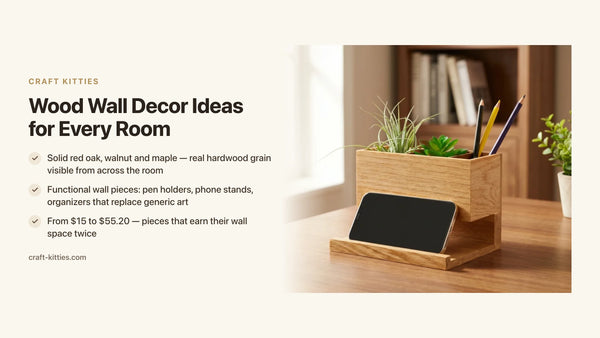
Three pieces from our studio, each in genuine solid hardwood, designed for the desk or entry table in daily use.

Description
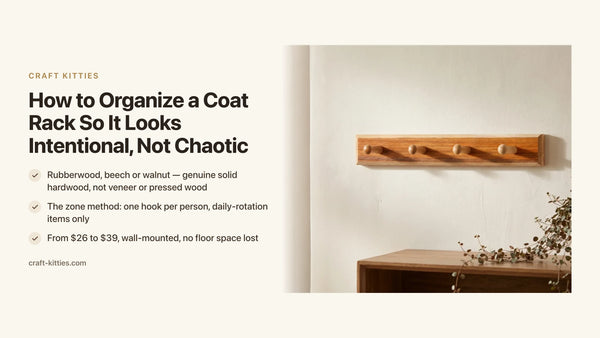
The Hardwood Valet Tray & Key Rack is the piece we recommend first for anyone looking to bring solid wood into an entryway without committing to a large format. It combines two functions in one footprint — a tray for the objects you empty from your pockets and a key rack so nothing disappears into the bottom of a bag. Available in maple, beech or walnut at $29.99, it gives you a choice of species at the most accessible price in the lineup. The beech version has the tightest grain of the three — almost imperceptible figuring, a very clean, quiet surface. The walnut version is the one most buyers photograph for their desk setups.

Description
The Hardwood Valet Tray Desk Organizer offers more interior volume — deep enough for a phone, wallet, watch and keys without stacking, in a profile that fits naturally beside a keyboard or on a nightstand. At $47.20, it is the piece most of our buyers use as their primary everyday carrier dump: one object, one gesture, everything organized. The walnut option in this format is particularly strong because the depth of the tray shows more of the end-grain, which reads beautifully in walnut's tight, fine structure.

Description
The Solid Wood Valet Tray Desk Organizer is the largest format in the lineup: generous proportions that give the surface room to breathe, suited to a standing desk, a large home office desk or an entry console with space to spare. At $55.20, this is the piece buyers choose when they want something that reads as furniture rather than an accessory — a statement in solid hardwood that holds its own on a large surface. In red oak, the bold grain reads clearly at this scale; in walnut, the wide base shows the full depth of the species' color.
Comparison table: oak, walnut and beech for valet trays
| Criterion | Red oak | Black walnut | Beech |
|---|---|---|---|
| Color | Warm honey-amber | Deep chocolate brown | Pale cream to light tan |
| Grain | Open, bold, visible cathedral | Fine, tight, quiet figuring | Very fine, nearly uniform |
| Janka hardness | 1290 lbf — high | 1010 lbf — very good | 1300 lbf — high |
| Aging direction | Deepens, ambers slightly | Lightens toward warm brown | Warms slightly, stays pale |
| Best pairing | Dark or cool surfaces | Light, white or pale surfaces | Any surface — neutral |
| Price tier in our lineup | From $29.99 | From $29.99 | From $29.99 |
Decision matrix: which product for which buyer
| Your situation | The right pick |
|---|---|
| Light or white desk, want a dark accent | Hardwood Desk Organizer in walnut |
| Dark walnut or mid-tone wood desk, want warmth | Hardwood Desk Organizer in maple or beech |
| Entryway, key rack + tray combined | Hardwood Valet Tray & Key Rack — from $29.99 |
| Large desk or console, want a statement piece | Solid Wood Valet Tray — full size, $55.20 |
| Gift — recipient's desk surface unknown | Hardwood Desk Organizer in beech — neutral on any surface |
| Minimalist setup, quietest grain possible | Hardwood Desk Organizer in beech or full-size in walnut |
Price: what drives the difference between species
At the lumber level, black walnut commands a higher price than red oak — typically 30 to 60 percent more for clear, wide boards. Walnut grows more slowly, the supply of large knot-free pieces is more limited, and the species has been in sustained demand across fine furniture, gunstock and specialty woodworking for more than a century. Those pressures keep the price elevated.
In a finished piece — a valet tray, a desk organizer, an entryway rack — the raw lumber is only one component of the cost. Milling, finishing, quality control and the labor of making joints clean and surfaces smooth account for most of what you pay. The result is that the gap between oak and walnut in a finished piece is usually far smaller than the lumber gap would suggest: often $5 to $15 on a piece priced under $60.
Red oak is the more accessible entry point if the species choice is genuinely flexible. Walnut is the upgrade pick when the buyer specifically wants the dark tone — or when the piece is a gift and the darker, more dramatic color reads as more considered.
Mistakes that buyers make when choosing between the species
Choosing from the product photo, not from the wall. A walnut tray photographed in studio light against a neutral background can look dramatically different sitting on your actual desk under your actual lighting. Before ordering, look at the dominant color and material of the surface where the piece will live. The contrast rule is more reliable than any photo.
Confusing "wood-tone" finishes with solid wood. Much of what is marketed as "walnut" or "oak" in mass retail is printed paper laminate over MDF or particleboard. The visual is convincing in photos; the hand feel, weight and aging behavior are completely different. Solid wood is identifiable at the edge: continuous grain through the full thickness, no paper layer, uniform density throughout.
Treating aging as a flaw. The lightening of walnut or the ambering of oak over time is not a defect — it is the material behaving like the organic substance it is. Buyers who understand this in advance tend to find that their piece looks even better at year three than it did on day one. Buyers who expected a static color can be surprised. The honest answer is that solid hardwood changes; it does not degrade.
Applying the wrong care product. Oil soap, furniture polish and all-purpose cleaners are designed for furniture in the traditional sense — large surfaces, lacquered or polyurethane-coated. A waxed hardwood desk piece needs nothing more than a dry cloth and an occasional re-wax. Using an oil soap on a waxed surface can strip the wax; using a spray polish can leave a residue that traps dust. The simpler the care, the better the result.
How to care for a solid hardwood valet tray or organizer
Solid red oak and solid walnut are easy to maintain by any reasonable standard. The routine is the same for both species, and it is short.
Daily: a dry microfiber cloth removes dust and fingerprints without introducing moisture. If something spills, wipe immediately with a slightly damp cloth and dry right away. Neither species tolerates pooled liquid indefinitely — the wax finish handles ambient humidity and brief contact, not a glass left sitting for hours.
Monthly: a visual check for any dull patches or areas where the wax has worn. On a desk piece that is handled daily, light wear is normal and easy to address.
Annually: a thin application of paste wax, buffed in with a soft cloth and polished off. This restores the protective layer, deepens the sheen and refreshes the surface without any stripping or sanding. The piece looks noticeably better after the re-wax, which takes less than ten minutes.
Never: abrasive cleaners, steel wool, water submersion or extended moisture contact. Solid hardwood is durable but it is not impervious — it asks for the same basic respect as any quality natural material.
The third option: why beech deserves more attention
Most oak-versus-walnut comparisons treat beech as an afterthought, if they mention it at all. It is worth a paragraph of its own.
European beech is a very hard, very fine-grained species — Janka hardness around 1300 lbf, tight uniform grain that is almost free of visible figuring, and a pale cream-to-light-tan color that reads as deliberately neutral. It does not compete with the surface it sits on; it exists alongside it. For buyers with a mixed-material desk — glass and metal, dark wood and white — beech is often the most harmonious choice precisely because it does not make a strong color statement.
Beech also accepts stain unusually well: the tight, uniform grain takes pigment evenly, which is why stained-beech furniture often looks cleaner than stained oak (which can absorb pigment unevenly in the open pores). For natural finishes, it produces a clean, quiet, almost Scandinavian aesthetic that works in a broad range of interiors.
Our solid wood valet tray collection includes beech options alongside maple and walnut precisely because the choice between species is rarely as simple as "lighter or darker."
Where to go next
The material question is one side of the decision; the form is the other. Our solid wood valet tray collection covers the full range of formats — key rack combined with tray, standalone deep-dish tray, full-size desk organizer — so the species you choose from this guide can be matched to the size and function that fits your actual surface. The Hardwood Valet Tray & Key Rack is the most versatile starting point at $29.99; the Hardwood Valet Tray Desk Organizer at $47.20 is the most requested for desk setups specifically.
If you have questions about which species reads best with your specific desk or wall color, the species images on each product page are shot under neutral studio light to give you an honest read — not a flattering one.
Our pieces have earned over 243 reviews on Etsy from buyers who live with them daily; the feedback that comes up most consistently is that the piece looks better in person than in photos, and that the grain becomes more interesting, not less, over time.
FAQ — oak vs walnut wood
1 — Is oak or walnut harder? Red oak rates 1290 on the Janka hardness scale; black walnut sits around 1010. Oak is harder. For a desk accessory or entryway organizer — where stress is gentle daily contact rather than heavy traffic — both species are more than durable enough for indefinite use.
2 — Does walnut darken or lighten over time? Walnut lightens with age and UV exposure, moving from deep chocolate toward a warm medium brown. Red oak ambers slightly. Both changes are gradual under a quality wax or oil finish. Understanding the aging direction in advance means the change reads as the material maturing rather than as a surprise.
3 — Which wood looks better on a desk? Neither is objectively better — the right answer depends on your desk surface. Walnut's deep brown creates deliberate contrast on light desks; red oak's warm honey tone brightens darker setups. Apply the contrast rule: the species that reads most clearly against what you already own is the right choice.
4 — Is walnut more expensive than oak? At the lumber level, yes — walnut grows more slowly and the supply of clear wide boards is more limited. In a finished piece like a valet tray, the difference is usually $5 to $15, which is why it is rarely the deciding factor.
5 — Can a solid wood valet tray scratch a glass or lacquered desk? Not if the base is finished, which ours are. For extra caution on a lacquered or glass surface, a small felt pad under the tray resolves the question in thirty seconds.
6 — Which wood is easier to maintain? Both require the same routine: dry cloth daily, re-wax once a year. Neither needs sanding, specialist products or stripping. The honest answer is that solid hardwood is one of the lowest-maintenance materials you can bring into a home — it just needs to be kept dry.
7 — What is the difference between red oak and white oak? Red oak has an open grain, warm pink-honey tone and larger pores. White oak has a tighter grain with distinctive ray fleck, a cooler grey-beige cast and closed pores that make it more moisture-resistant. For desk accessories and home organizers, both work well; the choice is visual. Our pieces use red oak, which offers a bolder, more readable grain.
8 — How do I know if something is solid wood or just veneer? Look at the edges and corners. Solid wood shows continuous grain through the full thickness. Veneer stops at the edge, revealing a different material underneath. Weight is a secondary signal: solid hardwood is noticeably heavier than a veneered board of the same dimensions.