At a glance
- Solid red oak, beech and walnut — genuine hardwood, not veneer or MDF
- Single hooks from $5 to $12; boot-profile, magnetic and swivel options
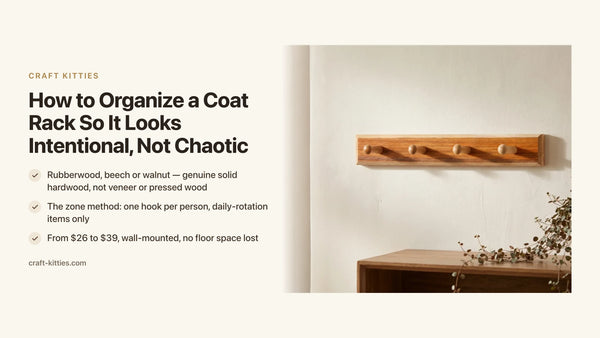
- 2-hook walnut-beech row at $26 for the most-requested entryway piece
A wall hook earns its keep through repetition. You put something on it in the morning, take it off, come back in the evening. Multiplied by everyone in the household, across every season. Which means the object that takes that punishment day after day needs to be made of something real — and that is the case for solid hardwood wall hooks in a way that no injection-molded plastic bracket, no hollow-core casting, and no veneered chipboard hook can match.
Red oak is the species most associated with that kind of durability. It is a genuine hardwood, dense, with an open grain that reads as texture rather than pattern — bold enough to register on a wall without competing with the rest of the room. Beech, the other hardwood throughout our wall hooks collection, sits a shade lighter with a finer grain: quieter, more Scandinavian, equally tough. Walnut adds depth and contrast as a two-tone accent. This guide walks through the reasons those distinctions matter, how to read the options from our studio, how to install them correctly, and which hook fits which situation.
One thing to clarify before everything else: when this guide says "solid wood," it means the full thickness of the hook is cut from a single piece of real timber. Not a wood veneer applied over a composite core, not a wood-effect print on plastic. A solid hardwood hook, properly finished and correctly mounted, does not loosen at the joint over time, does not chip at the edges, and does not reveal bare grey particleboard if it catches a coat buckle.

Red oak, beech and walnut: reading the grain before choosing
The three hardwoods in this lineup divide along two axes: how much visual grain character they carry, and how warm or cool their natural tone runs.
Red oak is the most visually assertive. Its open grain — large pores running in parallel rays — creates a texture you can see and feel. The color sits in the honey-to-amber range, warming a light wall without overpowering it. On a white painted entryway, a red oak hook reads as a deliberate material choice; on a natural linen or stone wall, it recedes into the palette. Hardness-wise, red oak scores 1290 on the Janka scale — harder than pine, harder than poplar, in the same tier as American black cherry. It dents under sustained sharp impact but shrugs off the accumulated pressure of coats and bags without surface fatigue.
Beech is the near-invisible hardwood. The grain is fine enough that from a few feet away the surface reads almost like a smooth, warm plastic — which is a compliment in the Scandinavian tradition, where beech furniture disappears into the architecture. Up close you can read the faint ray pattern. The color is lighter than red oak, closer to ivory-blond with a slight pinkish warmth. European beech scores 1300 on the Janka scale: marginally harder than red oak, meaningfully harder than most softwoods sold as "wood" hooks. In a white, grey or pale-green entryway, beech hooks look intentional without competing.
Walnut appears here as the accent species in the two-tone row: dark brown, tight-grained, unmistakably premium. Used in combination with beech — lighter panel, darker hooks — the contrast is the design. It is the right choice when the entryway already has a dark-and-light scheme, or when the room has other walnut elements to echo.
The working rule is contrast. Light walls pair best with the darker species (walnut, darker-grain red oak); rooms that already have warm, busy tones pair better with beech's quieter presence.
Fixed, swivel and magnetic: the mechanism question
Beyond species, every hook carries a second specification that matters as much for daily use: whether it moves.
Fixed hooks are the simplest and the strongest. The arm is rigid, the load transfers directly to the wall anchor, and there is nothing to wear out mechanically. They project from the wall at a set angle — typically 30 to 45 degrees upward — and hold without any user interaction. The limitation is physical: in a corridor under 36 inches wide, a projecting fixed hook at head height becomes a genuine hazard. The more loaded the hook, the further the coat or bag swings into the passage.
Swivel hooks solve that problem. The arm rotates on a central pin so it folds flush against the backing plate when not in use. In a narrow entryway, a swivel hook in its resting position is essentially invisible from the side. Loaded, it extends to hold the coat. The mechanism adds two components — the pin and the plate — and over many years of use, a cheap pin will loosen. Solid wood swivel hooks with a brass or steel pivot hold their action for years; hollow or plastic equivalents tend to wobble within months.
Magnetic hooks add a layer of functionality: a concealed magnet in the wooden body holds metal objects — keys on a steel ring, small metal clips, a thin keycard — independently of the hook arm. In an entryway, that means keys do not disappear into coat pockets and bags. The magnet is embedded during fabrication, not surface-mounted, so it does not rust or snag.
The practical rule: choose fixed for hooks that always hold something heavy (thick winter coat, canvas grocery bags), swivel for hooks in narrow passages or rooms where a clean wall matters more than load capacity, and magnetic for the one spot nearest the door where keys and small metal items need a dedicated home.
The five hooks from our studio
Five pieces that span the full range of entryway needs — from a single-function key hook at the entry price to a two-person coat row with a two-tone hardwood finish.

Description
The boot-profile hook is the most structurally satisfying design in a simple hook format: the silhouette follows the outline of a boot, which gives the arm a natural upward curve that holds coats and bags without slipping. The body is solid beech — continuous grain through the full thickness, no laminate joints — finished with a natural wax coat. At $12, it is the entry into a piece that will still be straight and tight in ten years. The arm is fixed, the projection is sized for a heavy coat, and the back plate mounts with two screws for a firm, rattle-free installation.

Description
At $6.90, this is the most task-specific hook in the lineup. The beech body is machined to house a flush-set magnet that holds a steel key ring — no bowl, no ledge, no separate key organizer. The hook arm handles the coat or bag. The result is the type of object that solves a small, daily friction so cleanly that you stop thinking about it. Installation is two screws, the same back plate format as the boot-profile model.

Description
The rustic swivel hooks are the answer for narrow hallways and rooms where the wall needs to read clean when the hooks are empty. The wood is solid, finished by hand with a carved-texture surface treatment that gives each piece a slightly individual character — consistent category, not identical assembly line. The swivel arm moves on a steel pivot and folds flat when not in use. At $9 for the set, it is the least expensive route to a genuinely functional and visually considered swivel hook in real wood.

Description
The entry price of the collection — $5, one hook, solid wood, swivel arm — is the right answer when the need is simple and the wall already has a lot of visual information. It does not compete. It holds the coat, folds flat, and disappears when not in use. The wood is real; the grain is visible; the finish is protective. The only difference from more elaborate models is fewer elements. Which, depending on the room, is exactly the point.

Description
The two-hook row at $26 is the two-tone beech and walnut coat hooks — the piece most often chosen when an entryway needs to hold two people's daily coats, bags and scarves on a single wall panel. The horizontal board is solid beech, light-toned and fine-grained; the two hook arms are solid walnut, deep brown, projecting at the angle that keeps coats from sliding. The contrast between species is the design: it reads as furniture rather than hardware. At 24 inches, the panel gives each hook enough clearance that coats do not overlap. Mounting is four screws — two per hook arm — for a stable, zero-flex installation.
Comparison table
| Model | Price | Wood | Mechanism | Best for |
|---|---|---|---|---|
| Boot-profile beech hook | $12.00 | Solid beech | Fixed | Daily coat + bag, one person |
| Magnetic beech hook | $6.90 | Solid beech | Fixed + magnet | Keys + coat on one hook |
| Swivel rustic hooks | $9.00 | Solid wood | Swivel | Narrow hallways, clean wall look |
| Single swivel hook | $5.00 | Solid wood | Swivel | Minimal need, busy wall |
| Two-tone 2-hook row | $26.00 | Beech + walnut | Fixed | Two-person entryway, statement piece |
Decision matrix — which hook for which situation
| Your situation | The right pick |
|---|---|
| You lose your keys every morning | Magnetic beech hook — $6.90 |
| One person, one coat, one hook | Boot-profile beech hook — $12 |
| Narrow hallway, hooks must fold flat | Swivel rustic hooks — $9 |
| Busy wall, minimal visual weight needed | Single swivel hook — $5 |
| Two people sharing one entryway wall | Two-tone 2-hook row — $26 |
| Gift for a new home or apartment | Two-tone row or boot-profile hook — both read as intentional, not generic |
What makes red oak the hardest-wearing grain

The grain of red oak is large-pored and open in a way that is both its most visible quality and its most practical one. Large pores mean the wax finish penetrates rather than sitting on the surface — the wood drinks the protective layer in, distributes it through the cellular structure, and holds it. The result is a finish that does not sit on top like a lacquer film that peels, but rather lives inside the wood. When the surface eventually shows wear, a light re-waxing with a cloth restores it; no sanding, no stripping, no regret.
Hardness is the second reason. A Janka score of 1290 puts red oak meaningfully above common softwoods — pine comes in around 870, poplar around 540 — and in line with the domestic hardwoods that have been used for flooring, furniture and structural elements for centuries. A hook made of this material does not dent when a brass buckle swings into it or a bicycle handlebar rests against it; it shows the kind of patina that furniture develops over time, not the kind of damage that plastic shows within months.
The final property worth understanding is seasonal movement. All wood expands and contracts with changes in indoor humidity. Red oak moves predictably — it expands across the grain in humid conditions, contracts in dry winter air — but the amplitude is modest in a properly dried, wax-finished piece. For a hook mounted flat to the wall with two screws, that seasonal movement is absorbed without loosening the fasteners. It is not a reason to avoid wood; it is the reason to choose a piece that was properly kiln-dried before finishing, which is the standard our studio applies.
Beech behaves similarly in all three respects — comparable hardness, comparable grain depth for wax absorption, comparable seasonal movement. The difference is entirely visual: where red oak reads bold and warm, beech reads quiet and pale. The durability story is the same.
How to install a solid wood wall hook correctly
The hook is only as good as its installation. A $5 swivel hook anchored into a stud will outlast a $50 hook toggle-anchored into soft drywall with no support.
Step 1 — Find the stud. Use a magnetic stud finder or tap the wall and listen for the change in resonance from hollow to solid. Mark the stud center lightly in pencil. Most residential studs are 16 inches apart center-to-center.
Step 2 — Mark the height. The standard entryway hook sits 60 to 72 inches from the floor — around shoulder height, high enough that a long coat clears the baseboard with room to spare. If you are installing a row of hooks, establish the horizontal line first with a level. Two hooks at different heights is the most common installation mistake and the easiest to prevent.
Step 3 — Pre-drill. Drive a pilot hole slightly smaller than the screw diameter. Hardwood back plates are dense enough that skipping the pilot hole risks splitting the wood at the edge. The pilot hole takes 30 seconds; repairing a split back plate takes considerably longer.
Step 4 — Drive the screws. For studs: 1.5-inch wood screws are standard. For drywall anchors: follow the anchor manufacturer's rating and choose one rated for the expected load plus a safety margin. Tighten until the back plate sits flush and firm — not until the screw strips.
Step 5 — Test before loading. Hang a heavy bag for 24 hours. The hook should not rotate, shift or loosen. If it does, the anchor is insufficient and needs to be upgraded before daily use begins.
Mistakes that undermine a solid wood hook
Mounting into drywall without checking the load rating. A coat hook in the hallway can see 10 to 15 pounds of repeated daily load — wet wool coat, a canvas bag and a scarf. A standard plastic drywall anchor holds 10 to 25 pounds at rest; under the repeated shock of someone dropping a bag onto a hook, that rating degrades faster. Either hit the stud or use a toggle bolt with an adequate rating.
Spacing hooks too close. Coats are wider than they look on a hanger. Three hooks at 4-inch centers will hold three coats that overlap so much that retrieving the middle one means moving the others. Six to eight inches between centers is the minimum for easy daily use; eight to ten if anyone in the household wears a heavy winter coat regularly.
Choosing a small hook for a heavy load. The boot-profile beech hook is designed for the weight of a coat and bag combined; the magnetic hook is designed for lighter objects — keys, thin scarves, a canvas tote. Hanging a wet wool peacoat and a laptop bag on the magnetic hook every day puts more torque on the pivot than the piece was designed to take. Match the hook's arm geometry to the expected load, not just to the available wall space.
Letting moisture accumulate at the back plate. In a damp entryway — basement-level door, front entrance with rain exposure — moisture can wick behind a flat-mounted back plate and into the wall. Sealing the edge of the back plate with a thin bead of clear silicone before mounting eliminates that path. It also means the hook can be removed cleanly years later without wall damage.
Caring for a waxed hardwood hook
The maintenance protocol for a waxed solid wood hook is the simplest possible: do nothing, then occasionally do one thing.
Under normal use — coats, bags, keys, ambient humidity of a lived-in home — the wax coat handles everything without intervention. The wood develops a slight sheen from repeated contact; the grain becomes more visible over time rather than less. This is the right direction for aged solid wood, not a sign of wear.
When the surface eventually looks dull or dry — typically after one to three years of daily use in a busy entryway — buff a small amount of natural wood wax into the surface with a cotton cloth, let it sit for ten minutes, and buff off the excess. The wood absorbs what it needs and the surface firms up. No stripping, no sanding, no specific product required beyond a standard natural beeswax or carnauba wax suitable for wood furniture.
The one active care rule: do not leave wet items in prolonged contact with the hook. Hanging a dripping umbrella directly on the wood for hours at a time, or leaving a soaked coat against the back plate, will eventually work through the wax coat. Shake the umbrella before hanging it, use a separate umbrella stand if the household generates heavy wet outerwear traffic, and the wood will stay in good condition without any additional protection.
Where to go next
The hooks in this guide are the starting point for an entryway that works as well as it looks. Our full wall hooks collection includes additional configurations — longer rows, combination coat-and-shelf units, and finishes suited to different wall palettes — organized so that pieces from the same wood family answer each other.
If you found these pieces on Etsy — where our studio has 243 reviews from buyers across the US — the selection here is the full lineup, with all configurations and current stock.
Conclusion — hardwood holds what others do not
The argument for solid oak, beech or walnut wall hooks is not aesthetic first. It is structural: a hook that holds daily coats and bags through every season, year after year, without loosening at the joint, denting at the arm, or showing the substrate underneath a failing finish. The material makes that possible in a way that composites, veneers and plastics do not.
The boot-profile beech hook at $12 is the answer for a single-user entryway that needs a reliable, good-looking fixed hook. The magnetic model at $6.90 solves the key-disappearance problem. The two-tone walnut-and-beech row at $26 is the piece for an entryway that two people share and that needs to read as furniture rather than hardware. Install any of them correctly — pilot hole, stud or rated anchor, screws flush — and the conversation about what to put on the wall is finished for a long time.