At a glance
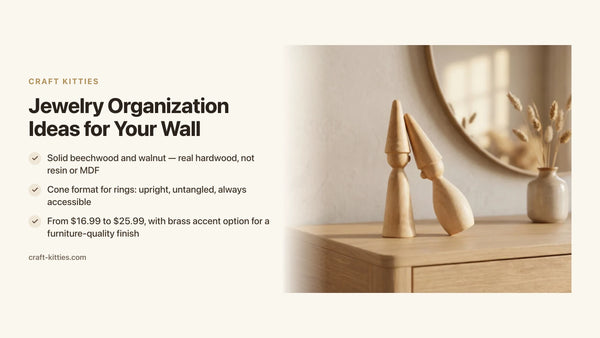
- Solid beechwood ($16.99) or walnut with brass base ($25.99) — real hardwood that ages instead of fading
- Cone for a man with a ring, set of two when you want the gift to feel considered
- Stays on the dresser permanently: the test that separates a good gift from a forgettable one
The most honest test for any Father's Day gift is deceptively simple: will he still have it on the dresser in three years? Not boxed away in a drawer, not re-gifted, not sitting in the garage — actually out, used daily, still where you put it. Most gifts fail that test within a year. A solid wood ring holder, chosen well, clears it easily.
The reason is behavioral. A man who wears a wedding band or a watch removes it every night. Without a designated spot, the ring migrates — kitchen counter, bathroom ledge, the loose-change bowl by the door. A cone or flat-tray holder gives that ring a fixed address. Once it is there, it stays there, because the habit that forms around it is the easiest possible habit: lift, place, done. The object earns permanent residency on the dresser by making a nightly ritual frictionless.
That is the practical argument. The visible argument is simpler: a small sculptural piece in solid beechwood or walnut sits on a dresser and every guest who comes through the room sees it. It does not disappear the way a gift card or a sweater does. It is present, daily, with his initials or without them, for years.
This guide covers what makes a wood ring holder worth giving — solid wood versus resin, cone versus tray, species choice, the brass question — and presents the three pieces from our studio with their prices, a comparison table, a decision matrix, and answers to the questions buyers ask most.
Why the gift has to stay out: surface residency as the real criterion
Most Father's Day gifts get used once or twice and then find a quiet corner to retire in. The category is full of items that are appreciated in the moment and forgotten by August: specialty foods consumed, gadgets charged once and shelved, grooming kits that duplicate what he already has. Wood jewelry display pieces work differently because they solve an actual daily friction point rather than adding a new object to manage.
The test is surface residency. Does the gift earn a permanent spot on the dresser, the nightstand, or the bathroom counter? Or does it move to a drawer within a month? Solid wood cones pass this test for three reasons: they are small enough to fit anywhere without claiming real estate, they look good enough that no one wants to hide them, and they are useful enough every single night that removing them from the surface would create a gap. The gift becomes infrastructure. That is unusual for a Father's Day present, and it is why it is worth buying carefully.
The implication for choosing: optimize for daily use first, aesthetics second. A piece that looks beautiful but is awkward to use — too tall, base that tips, ring that does not slide off cleanly — gets moved to a shelf within weeks. The pieces in our lineup are designed with the nightly remove-and-replace motion as the primary constraint: cone diameter, base weight, taper angle, surface smoothness.
Solid wood versus resin versus veneer: the material question

The ring holder category is split between three material tiers, and knowing which is which changes the gift entirely.
Resin and plastic cones dominate the low end of the market. They can be molded into the cone shape at minimal cost, colored, and sometimes printed with a wood-grain texture. They do not age — they yellow slightly over years, the surface develops micro-scratches that dull the finish, and the printed grain stays printed until it chips. For a gift intended to last a decade on someone's dresser, resin is the wrong choice.
Veneer is the middle trap. A piece with a veneer surface has a thin layer of real wood — sometimes as thin as 0.6mm — bonded over a particleboard or MDF core. It looks like solid wood in photographs. In practice, the edges reveal the layered construction, and repeated daily contact, along with ambient humidity in a bedroom, causes the veneer to lift and chip at corners within a few years. Veneer furniture can be well-made and long-lasting; veneer on a small cone that is handled daily, removed and replaced in a single motion hundreds of times a year, is not.
Solid hardwood is cut from a single piece of timber. There is no core, no bonding, no risk of delamination. A solid beechwood or walnut cone develops a patina over years of contact — a slight deepening of grain, a warmth that increases rather than diminishes. The surface weathers touch the way any quality wood object does: better with age, not worse. This is the correct material for a Father's Day gift that is meant to still be on the dresser in ten years.
Beechwood or walnut: choosing the species
The two wood species in our lineup differ first to the eye, then in the way they read in a room. Knowing the distinction makes the choice easier than any style quiz.
Solid beechwood (Fagus sylvatica) is pale, almost cream-toned, with a very fine and tight grain that stays subtle even at close range. On a dresser it reads as quiet and architectural — it does not compete with whatever else is on the surface, and it suits light, neutral, and Scandinavian-leaning bedrooms particularly well. Beechwood is also the most dimensionally stable of the common European hardwoods, which is why it is the species of choice for precision woodworking. In a ring holder context, that stability means the taper of the cone holds its geometry over years without any drift in fit.
Solid walnut (Juglans nigra) is the species for rooms that already have warmth. Deep brown with a fine, quiet grain, walnut reads as furniture-quality rather than decorative — it sits on a dresser the way a well-made leather wallet sits in a pocket, understated and assured. The walnut ring holder with a solid brass base is the piece in our lineup most likely to look intentional in a room that was already styled: the walnut + brass pairing is one of those material combinations that flatters virtually every warm-toned décor direction.
The contrast rule that works across both: if his bedroom walls and furniture are light — whites, grays, pale wood — pick walnut for the contrast. If the room already has dark wood or warm tones, beechwood lightens without clashing. And if you genuinely do not know his bedroom, beechwood is the safer default: its pale, fine grain reads as neutral in a way that walnut, with its strong character, does not.
Cone versus flat tray: the right form for the right man

The cone and the flat tray are both ring holders in the category name, but they solve slightly different problems and suit different habits.
A cone ring holder is a tapered post, wide at the base and narrowing at the tip, that holds a ring upright. The motion of use is a single gesture: ring slides down the cone when he takes it off, slides back up when he puts it on. The cone takes up almost no surface space — the footprint of the base is smaller than a coaster — and it reads as a small sculptural object rather than a utilitarian item. It is the right choice for a man who wears one or two rings and wants a dedicated spot for them without claiming any significant real estate on the dresser. The set-of-two format is particularly suited to couples: both cones sit side by side, same species, same height, and the visual pairing is part of the appeal.
A flat tray works differently. The shallow surface catches everything he empties from his pockets at night: ring, watch, money clip, keys. It functions as a valet station — a single place where the end-of-day ritual happens. The tray asks for a slightly larger footprint on the dresser but returns that space investment by eliminating the scattered-items problem entirely. It is the right choice when the goal is not just a ring spot but a whole nightly-unload system.
For Father's Day gift purposes, the cone has a stronger visual impact. It is clearly a chosen object rather than a container. It looks like a piece the giver selected deliberately rather than something that could have been grabbed from a general home-goods shelf. The flat tray is the practical choice; the cone is the considered one.
The pieces from our studio
Three pieces, all in real solid hardwood, chosen to cover the three profiles that come up most when buying this kind of gift: the one who wants the most versatile option, the one buying for a couple, and the one who wants to give something premium with a signature material accent.

Description
The beechwood cone set is the piece for couples, and for anyone who wants the gift to read as deliberate. Two cones in the same solid beechwood, same taper, same base — placed side by side on a dresser they occupy barely more surface than two candles. The pale, fine grain of beechwood suits virtually every bedroom palette: it is the safe choice that does not gamble on his room's color story. At $16.99 for the pair, it is the entry point to solid hardwood in our lineup, and it offers arguably the best gift-signal-to-price ratio of the three: a set of two is harder to give by accident than a single piece, and that effort reads.

Description
The walnut with solid brass base is the premium pick. Deep brown walnut, tight grain, finished to a surface that rewards close inspection — and a base in solid brass rather than resin-cast or painted metal. The walnut-and-brass pairing has a long history in furniture and object design precisely because the two materials share a warm, low-saturation character that is not trend-dependent. This piece will not look dated in five years the way chrome-and-pine combinations sometimes do. At $25.99, it is the gift for a dad who has a bedroom he is already proud of, and for whom an object that looks like it was bought from a design shop lands better than one that looks like it was bought from a gift store.

Description
The walnut set of two carries the same couple-oriented logic as the beechwood pair, but in a deeper, richer species. If the bedroom already has walnut furniture, a dark wood floor, or warm textile tones, this set integrates rather than contrasting. Two matching cones in the same solid walnut — the gift for the couple whose room already has a visual thread you want the present to join rather than interrupt. At $18.99 for the pair, it sits between the beechwood set and the brass-base solo piece.
Comparison table
| Model | Price | Wood | Format | Best for |
|---|---|---|---|---|
| Beechwood cone set of 2 | $16.99 | Solid beechwood | 2 cones | Couples, any palette, entry price |
| Walnut + solid brass base | $25.99 | Solid walnut | Single cone | Premium gift, designed bedroom |
| Walnut cone set of 2 | $18.99 | Solid walnut | 2 cones | Couples, warm or dark-toned rooms |
Decision matrix — which piece for which situation
| Your situation | The right pick |
|---|---|
| You do not know his bedroom décor — safe default needed | Beechwood cone set — pale grain reads neutral in any room |
| His bedroom has dark wood furniture or warm tones | Walnut cone set — the species integrates rather than contrasts |
| Gift for both parents — want it to read as intentional for two | Beechwood cone set or walnut set — two cones signal the giver thought about both |
| Dad has a styled, design-conscious room — premium piece needed | Walnut + brass base — furniture-quality material combination |
| Budget matters — solid wood for under $20 | Beechwood cone set at $16.99 — two pieces, real hardwood, entry price |
| Gift for him specifically — single statement piece for a solo dresser | Walnut + brass base — reads as chosen, not grabbed |
What to write on the card
This is the part most guides skip, and buyers consistently say it is the part they find hardest. A wood ring holder does not have an obvious card message the way a book or a bottle of wine does. The object is small, the gift is intimate, and the card has to bridge that gap without being either too sentimental or too flat.
Three lines that work for this gift:
For the couple set: "Something for the dresser — so you both always know where to put it." Short, functional, unpretentious. It describes what the object does without trying to make it into a metaphor.
For the premium solo piece: "Found something that looked like it was made to sit on your dresser. Thought the same about you." Warmer, without being overwrought. The second sentence earns the first one.
For a more minimal card: "For the ring. For the dresser. For every night." Three lines, one per object of the gift, and it stops before it becomes too much.
The rule with gift cards for useful objects: name the daily use, not the occasion. "For Father's Day" is implicit. What the card can do that the occasion cannot is connect the object to the habit it will create. That is what turns a gift into something he associates with the person who gave it.
Mistakes that cost the gift its permanent spot
Choosing by photograph without thinking about contrast. A walnut cone photographed against a white studio background looks beautiful and reads darker than it will in a room that already has dark wood. Before ordering, look at the dominant tone of his dresser or nightstand — contrast decides. Beechwood against dark furniture, walnut against light walls.
Ordering personalization from a seller who prints rather than engraves. Printed text on wood fades in months. Laser engraving is cut into the wood and deepens in character as the surface develops its patina. If personalization is important, verify the method before ordering — not all "personalized" sellers use the same technique.
Giving a cone to someone who needs a tray. A cone is the right pick for a man with one or two rings. If he wears a watch, carries a money clip, and generally empties six things from his pockets at night, a cone solves one item of that problem. A valet tray solves all of it. Know which problem you are solving before choosing the form.
Choosing the smallest size thinking it will fit anywhere. A cone that is too small for his ring will not sit on the ring properly — the taper will be wrong, the ring will perch loosely rather than settle. Our pieces are sized for standard adult ring diameters; do not optimize for footprint at the expense of fit.
FAQ — personalized wood Father's Day gifts
1 — What wood is best for a Father's Day ring holder gift? Solid beechwood and solid walnut are the two best choices. Beechwood is pale with a fine, tight grain — a safe default that suits any bedroom palette. Walnut is deep brown with a quiet, furniture-quality character — the premium pick for a dad who already has a styled space. Both are solid hardwood, not veneer, so they will not chip, swell, or discolor over time.
2 — How do I personalize a wood ring holder for Father's Day? The most durable personalization on solid wood is laser engraving: a name, a date, a short line of text cut into the wood rather than printed on it. Ink-printed personalization fades; engraving deepens in character as the wood ages. Order from a local engraver after receiving the piece, or look for sellers who offer engraving at checkout.
3 — Is a ring holder a good Father's Day gift for a man? Yes, particularly for a man who wears a wedding band or a watch daily. Most men have no designated spot for their ring at night — it ends up on the kitchen counter, the bathroom ledge, or floating in a bowl of miscellaneous items. A cone holder gives that ring a fixed address. It sits on the dresser permanently, which means every guest who sees the room sees the gift.
4 — What is the difference between a cone ring holder and a flat tray? A cone holds rings upright on a tapered post: easy to slide on and off one-handed, takes up almost no surface area, and reads as a small sculptural object on a dresser. A flat tray organizes multiple items — ring, watch, keys, small change — in a single shallow surface. The cone is the right pick for a man with one or two rings; the tray works better when the goal is a dedicated spot for everything he empties from his pockets.
5 — What is the price range for a solid wood ring holder gift? Solid wood ring holder cones start at $16.99 for a beechwood set of two, and reach $25.99 for a walnut piece with a solid brass base. That range sits well under the typical Father's Day gift budget while delivering an object that will be used daily for years — the cost-per-use over a decade is negligible.
6 — Will a solid wood ring holder look out of place in a modern bedroom? No. Solid beechwood and walnut are among the few materials that sit comfortably in every design direction — Japandi, mid-century modern, Scandinavian minimal, farmhouse and traditional alike. A cone in particular is small enough that it reads as a neutral object rather than a style statement. The brass base on the walnut model adds a warm accent that flatters both warm and cool-toned rooms.
7 — Can I give a ring holder set for both parents? Yes, and it often lands better as a couple's gift than as a solo gift. A set of two cones placed side by side on the dresser signals that the giver thought about both people. The beechwood cone set ($16.99 for two) is designed for exactly this use case: two matching pieces, same wood, same height, meant to sit together. It is one of the clearest signals that the gift was chosen rather than grabbed.
8 — Does a wood ring holder need maintenance? No. Solid beechwood and walnut cones are sanded smooth and finished at our studio; they require no oiling, no waxing, no special care. A dry cloth if dust settles. The wood will develop a patina over years of daily contact — a slight darkening and deepening of grain that is characteristic of solid hardwood aging naturally.
Where to go next
The ring holder is often the first piece that introduces solid wood to a dresser — and it is rarely the last. Our ring holder collection gathers the full lineup of cone and display pieces in beechwood and walnut, all cut from solid hardwood at our studio and finished without shortcuts. If you want to see the individual pieces in detail before deciding, the beechwood cone set and the walnut ring holder with brass base each have their own product page with close-up photography of the grain and finish.
For customers who found us through Etsy — where our ring holders have earned 243 reviews — the same pieces are available here directly, with the same quality and the same hardwood.
Conclusion — one object, a permanent spot
The gift that stays on the dresser beats the gift that was appreciated once. Solid hardwood — beechwood pale and neutral, walnut deep and furniture-forward — ages instead of fading, takes up almost no space, and earns its permanent address through daily use. The beechwood cone set at $16.99 is the clearest choice when you want to give something for two people without knowing their room; the walnut with brass base at $25.99 is the piece for a dad whose space was already styled and who will notice the difference between a real material and a dressed-up alternative. Either way, what goes on the dresser on Father's Day has a good chance of still being there on the next one.