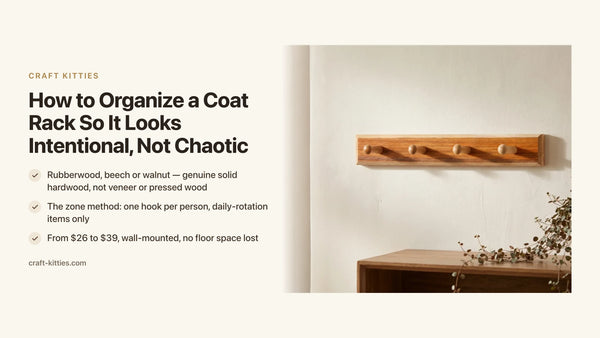
At a glance
- Reclaimed wood = character and history — solid new beech or walnut = uniform grain and clean finish
- Swivel hooks fold flat when empty; fixed hooks cost less but jut out permanently
- From $5.00 to $26.00 for solid hardwood, all wall-mounted
The coat hook is the first object you touch when you come home and the last one you touch when you leave. It is also, consistently, one of the most underchosen pieces of hardware in any entryway — picked for the screw count and not the wood, replaced when it breaks rather than when it no longer suits the room. The result is most entryways accumulating a chrome peg from the previous tenant, a plastic hook from a hardware store and, eventually, a pile on the nearest chair.
Switching to a solid wood coat hook does not solve the pile problem on its own, but it does solve the everything-else problem: a hardwood hook that is properly mounted, the right depth and the right tone for the wall behind it looks intentional. And intentional is the thing most entryways are missing.
This guide addresses the question that comes up most in this category: reclaimed wood or freshly milled solid wood? The answer is not one-size-fits-all. It depends on the character you are building in the space, the consistency you need across pieces and — practically — what level of variation you are willing to live with. After that, there are four other decisions worth making carefully: species, mechanism, size and mounting. Each is covered below, with the five hooks from our studio organized around those criteria.
At a glance
- All five hooks in this guide are solid hardwood — beech or walnut — not veneer, not MDF, not reclaimed composite
- Prices: $5.00 – $26.00 depending on mechanism and configuration
Reclaimed wood coat hooks: what the appeal is, and what the tradeoffs are

Reclaimed wood coat hooks have genuine appeal: the timber has already spent decades in a barn, a factory floor or a warehouse beam, and that history shows. The grain is compressed, the surface holds marks and patina, and no two pieces read the same. For a farmhouse entryway, an industrial loft or a studio that is deliberately assembling a curated-salvage look, that variation is the point.
The tradeoffs are real, though, and worth naming plainly. Reclaimed wood is heterogeneous by definition: the tone shifts piece to piece, nail holes may be visible, and the surface treatment needed to stabilize it tends to be heavier than what a freshly milled hardwood needs. If you are building a coordinated entryway — hooks that read as a set alongside a console, a mirror and a bench — reclaimed wood requires more editorial effort to hold together visually. Freshly milled solid beech or walnut, by contrast, offers predictability: the grain is consistent within a batch, the finish is even, and the piece looks exactly like what it is intended to look like.
On structural performance, the distinction matters less than the aesthetics conversation suggests. Reclaimed timber that has been properly cleaned, stabilized and finished performs as well as new wood for coat hook applications. The wood is not what gives way under a heavy coat; the anchor is. Both approaches deliver genuine solid wood — neither is veneer over particleboard, neither is a wood-look print on MDF.
The practical recommendation: if the character of wear and variation is something you actively want, reclaimed is the more interesting choice. If you want the entryway to look deliberate and clean from day one, freshly milled solid beech or walnut is the more reliable path. The five hooks in this guide are all new solid hardwood — beech and walnut — because consistency across a household's set of hooks is easier to maintain that way.
Beech wood or walnut: the species decision
The two species in this lineup behave differently on the wall, and the choice matters more than it might seem in a product photo.
Solid beech is pale, almost honey-toned, with a fine and relatively uniform grain. It is the Scandinavian option: light, quiet, approachable. Against a white, off-white or light grey wall it reads clean without disappearing; against a dark accent wall it contrasts sharply. Beech is also one of the hardest temperate hardwoods — its Janka hardness rating of roughly 1,300 lbf means it resists surface marks from bags and coat zippers without needing a thick lacquer coat. The Boot-Profile Hook and the Swivel Hook in this guide are both solid beech.
Solid walnut is the richer, more assertive option. The tone is deep brown, the grain tighter and more varied, and the overall presence is warmer and more furniture-like. Against a light wall it reads as a deliberate accent. Against a warm-toned wall in terracotta, sage or dark linen it blends in naturally without disappearing. Walnut's Janka hardness (approximately 1,010 lbf) is slightly lower than beech but still well above what daily coat-hook use requires. The Two-Tone set pairs solid beech and solid walnut in a single piece — useful if neither species alone gives you the right tension with the wall.
The reliable method for choosing: do not decide from the product photo. Look at the wall where the hook will go. Light, cool-toned wall — walnut adds warmth and contrast. Warm, dark or saturated wall — beech lightens it. If the wall is a true neutral and you are genuinely undecided, the two-tone set sidesteps the choice entirely.
Swivel vs. fixed: the mechanism decision

A swivel hook rotates outward — typically 90 degrees — to receive a coat, then swings flush to the wall surface when nothing is hanging on it. On an empty day, a swivel hook is nearly invisible: it adds depth only when it is being used. In a narrow entryway or a hallway where the hook is at shoulder height, that fold-away behavior matters. The alternative, a fixed hook that juts out at all times, creates a consistent obstacle at exactly the height where foreheads and shoulders pass.
A fixed hook is simpler and typically costs less. The arm is stationary, the mounting is straightforward, and there is no pivot mechanism to wear over time. For a utility room, a back-door mudroom or a spot where the hook will always be loaded and the entryway is wide enough that the projection is not an issue, fixed is the right call. There is no reason to pay for a swivel mechanism if the hook will never actually need to fold flat.
The single vs. double question is related but separate. A single hook anchors with one or two screws and holds exactly one item well. A double-hook set — like the two-tone beech and walnut two-hook row — anchors with four points, which distributes the load across more of the wall and dramatically reduces the risk of the whole piece torquing out over time under a heavy winter coat plus a bag. A two-hook row also allows for some visual organization: coat on one side, bag on the other, keys on a magnetic hook below.
Sizing the hook to the load
The question buyers rarely ask before buying, and always think about after: how deep is the hook? The answer determines whether a padded winter coat stays on or slides off, and whether a structured tote bag hangs cleanly or tips forward at a precarious angle.
A hook that is too shallow — under one inch of usable projection — holds lightweight items but sheds anything with a heavy collar or a wide strap. A hook at 1.5 to 2 inches of projection handles most coats and bags reliably. The Boot-Profile hook in this guide uses a silhouette shaped to the curve of a boot shaft precisely because that profile — narrow at the base, wider at the tip — catches a collar better than a straight peg does at the same projection.
The depth also affects how the hook reads visually. A short, shallow hook reads minimal and disappears against the wall. A longer, more pronounced arm is more visible but more capable. For a working entryway that takes heavy winter coats, err toward depth. For a summer bedroom door where the hook will hold a light robe, minimal is fine.
The five hooks from our studio

Description
The Boot-Profile Hook is the one we recommend first for a single-hook entryway install. The silhouette is carved to echo the profile of a boot shaft: narrow where it meets the wall, wider and curved at the tip. That geometry is not decorative — a coat collar or bag strap settles into the curve rather than sliding toward the wall, which means things stay where you put them. Solid beech throughout, natural finish, wall-mounted with two screws. At $12.00, it is the most considered single hook in the lineup.

Description
The Magnetic Hook solves a specific problem: keys that dangle from a peg or get lost in a bowl. The recessed neodymium magnet holds a standard key ring flat against the solid beech face — no clinking, no hunting. The hook itself handles a light jacket or a bag. At $6.90, it is the entry price for the lineup and the right pick for a second hook in any row that already handles the coat load with another piece.

Description
The Swivel Hook is the narrow-hallway answer. Solid wood with a hand-carved rustic surface, the pivot mechanism rotates a full 90 degrees outward to receive a coat and folds flat when the entryway is empty. If your hooks sit at shoulder height in a corridor less than four feet wide, the swivel is the only mechanism that does not become a consistent obstacle. At $9.00, it is also the most cost-effective way to add a functional hook without permanently projecting from the wall.

Description
The Solid Wood Swivel Hook at $5.00 is the building-block piece for anyone assembling a multi-hook row rather than buying a fixed rack. Each hook mounts independently with two screws, which means the spacing is yours to decide — 8 inches for a compact row, 12 inches for coats that need more room between them. The swivel mechanism is the same fold-flush behavior as the rustic model; the surface treatment here is cleaner and more contemporary.

Description
The Two-Tone Set is the statement piece and the practical anchor for a coordinated entryway. Solid beech on one side, solid walnut on the other, joined in a single two-hook row that mounts with four screws — more anchor points mean less torque, which means the set handles two full coats plus bags without flexing over time. At $26.00 it is the highest price in the lineup, and the right pick when you want one piece that reads as wall décor as much as functional hardware. The two-tone construction also sidesteps the beech-versus-walnut decision: you get both in one row.
Comparison table
| Hook | Price | Wood | Mechanism | Best for |
|---|---|---|---|---|
| Boot-Profile Hook | $12.00 | Solid beech | Fixed, curved profile | Single-hook entryway, coats + bags |
| Magnetic Hook | $6.90 | Solid beech | Fixed + neodymium magnet | Keys + light jacket, second hook in a row |
| Rustic Swivel Hook | $9.00 | Solid wood, rustic carved | Swivel 90°, fold-flush | Narrow hallway, shoulder-height mounting |
| Solid Wood Swivel Hook | $5.00 | Solid wood | Swivel, contemporary finish | Building a custom row, budget-first |
| Two-Tone 2-Hook Set | $26.00 | Solid beech + solid walnut | Fixed, 2-hook row, 4 anchors | Statement piece, two-coat household |
Decision matrix: which hook for which situation
| Your situation | The right pick |
|---|---|
| Single hook, coats + bags, most entryways | Boot-Profile Hook — $12.00 |
| Keys keep disappearing; need a coat hook too | Magnetic Hook — $6.90 |
| Narrow hallway, hooks at shoulder height | Rustic Swivel Hook — $9.00 |
| Building a row with custom spacing, tight budget | Solid Wood Swivel Hook — $5.00 each |
| Two coats, want one statement piece, indecisive on species | Two-Tone 2-Hook Set — $26.00 |
| Looking for a gift with daily usefulness | Two-Tone 2-Hook Set — $26.00 or Boot-Profile Hook — $12.00 |
How to mount a wood coat hook correctly
Installation is where most coat hooks fail — not the wood, not the mechanism, but the two screws going into the wrong part of the wall. A solid wood hook is only as good as what it is fixed to.
1 — Find the anchor point. A wall stud is the ideal fix: a screw driven into solid timber behind the drywall holds 50+ pounds without question. Use a stud finder or the knock method — a hollow sound means no stud, a dull thud means you found one. If no stud is within range of your chosen spot, use a toggle bolt or a hollow-wall anchor rated for at least 20 pounds. Do not use a standard drywall screw with no anchor in a hollow-wall location — it will pull through under a loaded winter coat.
2 — Mark and pre-drill. Pencil the hole location, then drill a pilot hole slightly narrower than the screw diameter. On hardwood mounting plates, skipping the pilot hole risks splitting the wood at the face even with a coarse thread screw. Take the thirty seconds.
3 — Angle the screw slightly upward. A screw driven at 5 to 10 degrees upward — rather than dead horizontal — resists the downward pull of a loaded coat more effectively. The physics are simple: the load vector is down, and a slight upward angle creates resistance against that pull rather than aligning with it.
4 — Level before the second screw. For a two-hook set, place a spirit level across the top of the piece before driving the second anchor screw. A hook that is visibly un-level is noticed every morning. A hook that is level reads as correct without anyone consciously registering why.
5 — Load test before trusting it. Hang a coat and a bag from the hook for two minutes and check that nothing has moved before committing to daily use.
Five mistakes that make a good wood hook look wrong
Picking the species from the product photo rather than from the wall. A pale beech that glows against a white studio background can read almost invisible on a warm linen wall. Stand at your entryway, look at the actual wall color and decide by contrast — not by the photo.
Mounting at the same height as the old peg. Previous hooks are rarely at the right height — they are at whatever height the previous owner drilled. Redo the measurement. The right height for a coat hook is slightly above shoulder height for the shortest regular user of the space: high enough that coats clear the floor, low enough that nobody has to reach.
Spacing hooks too close together. Eight inches between hook centers is the practical minimum for two coats hanging without touching. Six inches means the second coat ends up on top of the first. If you are building a row, measure the coats first, not the wall.
Using a single hook where two coats consistently compete. A single hook invites the pile. If there are consistently two coats to hang, use two hooks — either the two-hook set or two independent swivel hooks. The pile does not form when there is a designated place for each item.
Mixing wood species with no connecting thread. A pale beech hook next to a dark walnut console and a teak mirror reads as accidental. If you are combining species, do it intentionally — like the two-tone set — or pick one species and hold to it across the pieces in that space. Our wall hooks collection is organized to make that coordination easier.
FAQ — reclaimed wood coat hooks and solid wood wall hooks
1 — Is reclaimed wood actually stronger than new solid wood for coat hooks? Not necessarily stronger, but reclaimed timber that has survived decades of structural use is typically very well-seasoned — meaning it has already shed the moisture it will ever shed, and movement is minimal. That stability is genuine. The tradeoff is that reclaimed wood carries marks, nail holes and tonal variation that are part of its identity. Freshly milled solid beech or walnut offers a cleaner, more uniform appearance with equivalent structural strength. For a coat hook, both perform reliably; the choice is about aesthetic character, not load-bearing capacity.
2 — What weight can a solid wood coat hook hold? A correctly wall-anchored solid wood hook handles a heavy winter coat, a bag and a scarf without strain — typically 15 to 25 pounds depending on the anchor used and the wall type. The limiting factor is almost always the wall anchor, not the wood or the hook mechanism. Use the right anchor for your wall material: toggle bolt for drywall with no stud, screw into stud for maximum load.
3 — Swivel hook or fixed hook — which is more practical for an entryway? A swivel hook rotates outward to receive a coat, then swings flush to the wall when not in use — it keeps the entryway from feeling crowded on light days. A fixed hook is simpler and cheaper but juts out permanently. If your entryway is narrow or the hooks are at shoulder height, swivel is the more considered choice. For a utility room or back door where appearance matters less, fixed works fine.
4 — Can a magnetic wall hook hold keys reliably? Yes. The Beech Wood Magnetic Wall Hook uses a recessed neodymium magnet strong enough to hold a standard key ring flat against the wood face — no dangling, no dropping. It works for keys, small scissors, a Swiss Army knife or anything with a steel component. It is not designed for coats: for those, pair it with a swivel or fixed hook on the same row.
5 — How do I mount a wood coat hook without damaging the wall? Mark the stud or anchor point, pre-drill a pilot hole slightly narrower than the screw, and drive the screw at a slight upward angle — this resists the downward pull of a loaded coat better than a perpendicular mount. For a two-hook set, use a level before driving the second screw. If you must avoid holes entirely, heavy-duty adhesive strips rated for 15+ lbs can work on smooth painted drywall, though they are not appropriate for textured or porous walls.
6 — Will beech or walnut coat hooks scratch easily? Both beech and walnut are hard enough to resist casual contact without marking. Walnut (Janka hardness ~1,010 lbf) and European beech (~1,300 lbf) are comparable to or harder than many furniture timbers. Light surface marks can be buffed out with a small amount of furniture wax. Neither species requires a rigid care routine — an occasional dry wipe is the extent of the maintenance.
7 — What is the difference between beech and walnut for coat hooks? Beech is pale honey-toned with a fine, relatively uniform grain — it reads light and Scandinavian, and works well in bright entryways or against white and grey walls. Walnut is darker, richer brown with a tighter and more varied grain — a warmer presence that suits natural-palette interiors. Both are solid hardwood with comparable durability. The choice is purely aesthetic: contrast the hook against your wall.
8 — How many coat hooks do I need for an entryway? One hook per regular user of the space is the practical minimum — typically two to four for a household. Beyond that, the question is wall width: hooks placed 8 to 10 inches apart give each coat enough room to hang without overlapping. A two-hook set in a narrow hallway is often more useful than a six-hook rack because it keeps the entryway feeling open.
Where to go next
A coat hook is usually the first piece of an entryway that gets chosen deliberately — and rarely the last. Once the wall has one solid wood hook that works, the question of a coordinated console, a mirror at the right height or a small bench underneath tends to follow naturally. Our wall hooks collection covers the full range of mechanisms, species and configurations so the next piece in the space can answer the first without guessing.
If you are starting with a single hook and want the most functional option for a standard entryway, the Boot-Profile Wall Hook is where we would point you at $12.00 — the curved profile keeps things on the hook rather than sliding off it. For keys that need a dedicated spot alongside a coat hook, the Magnetic Wall Hook at $6.90 pairs with any of the others on the same row. And if you want one piece that settles the two-coat and the species question at once, the two-tone beech and walnut set does both.
A few of these hooks are also available on Etsy — where 243 reviews document the experience of customers who have been using them as daily-use hardware rather than décor.
Conclusion
The reclaimed vs. new solid wood question turns out to be mostly an aesthetic one: both are genuine wood, both handle daily load without issue, and both look better on a wall than a chrome peg. What differs is character — reclaimed wood brings visible history and variation; freshly milled beech and walnut bring uniformity and a cleaner start.
Beyond that, the decisions that actually shape the daily experience are mechanism (swivel if the entryway is narrow, fixed if it is not), species (beech for light walls, walnut for warm ones, two-tone to sidestep the question), and anchor (into a stud, always, when possible). Get those three right, and a $9.00 swivel hook will serve a household better than an expensive reclaimed statement piece mounted in the wrong spot with the wrong screw.