At a glance
- Solid red oak, walnut and maple — real hardwood, not MDF or veneer
- Wood-and-iron vs pure wood: both work, but for different rooms and different desks
- From $15 to $55.20 for a handmade desk organizer that outlasts office supply store alternatives
The phrase "rustic wood and iron wall decor" gets typed into search bars thousands of times a month, and for good reason: the combination of raw grain and dark metal hardware has become one of the defining visual moves of the last decade in interior design. You see it on entryway hook boards, bathroom shelves, kitchen pot racks and, increasingly, on desks — pen holders with iron bands, phone stands with cast hardware brackets, organizers where the metal does half the visual work.
The comparison worth making is not between wood-and-iron pieces and cheap plastic. It is between wood-and-iron and pure solid wood — and it is not obvious which one wins on a modern desk. Both make sense in the right context. Both fail in the wrong one. This guide maps the decision clearly: what the iron-and-wood combination does well, what it does less well, which wood species hold up in each approach, and how five solid hardwood pen holders from our studio stack up as the pure-wood alternative for desks that are already visually busy.
What "rustic wood and iron" actually means — and where the term gets diluted
Genuine rustic wood-and-iron pieces share a specific construction logic: real solid wood (often reclaimed or rough-sawn) married to wrought or cast iron components — brackets, bands, hooks, couplings — through mechanical joints, not adhesive. The iron is structural or near-structural, not merely decorative. The look it produces — warm grain against cold metal, organic texture against industrial precision — carries weight precisely because each material is doing real work.
What the market has done to the category since 2016 is predictable: most "wood and iron" products on major retail platforms today use MDF or pine with a printed wood-grain film and stamped tin hardware glued on. The photo reads rustic; the object reads disposable at close range. Neither the wood nor the metal is what it appears to be. The distinction matters if you are buying something for a desk you look at for eight hours a day.
For wall applications — a hook board in the entryway, a pot rack above the stove — the aesthetic does most of the work and the construction tolerances are forgiving. For a desk organizer that you pick up, set down, and fill with objects daily, the construction tolerance is everything.
The case for the wood-and-iron look on a modern desk

There are desks where the wood-and-iron vocabulary lands well. A standing desk in a loft with exposed brick, black steel windows and concrete floors is the obvious example — the iron hardware on the organizer rhymes with the architecture. A home office built around an industrial aesthetic, with raw wood shelving and metal filing cabinets, asks for the same material language on the desk surface.
In these rooms the visual logic holds. The metal hardware is not an accent; it is a structural element of the room's design language, and the desk organizer carrying it feels intentional rather than forced. The rustic character of the wood (typically red oak with open, pronounced grain, or reclaimed pine with visible history) amplifies rather than fights the surroundings.
The practical advantages are real too: a well-made iron bracket is more rigid than a wood joint under lateral load, which matters for taller pieces — a pen holder over six inches relies on its structural geometry to stay upright without wobbling when heavy objects are pulled out. Iron hardware provides that rigidity efficiently.
Where the iron starts to work against the desk
The problem with iron-forward organizers appears the moment the room moves away from the farmhouse-industrial vocabulary. A desk in a Japandi or Scandinavian room — pale wood, clean lines, muted color, no exposed hardware anywhere — reads the iron as noise. It is too assertive, too textured, too competing-with-everything-else.
More practically: metal hardware on a desk surface accumulates micro-scratches and shows fingerprints on a schedule that wood does not keep. A dark iron bracket beside a laptop, a ceramic mug and a set of keys looks intentional on day one and worn by month three. Solid wood, by contrast, develops a light patina with handling that reads as character rather than wear.
The second problem is acoustic. A pen holder with iron bands or a metal base rings when you drop a pen into it. That is not a trivial complaint in a quiet home office or a shared workspace — the sound is hard and carries. A wooden cup absorbs the impact and is nearly silent.
Red oak, walnut and maple: the species question in wood-and-iron versus pure-wood contexts

Wood species is where the two design approaches diverge most clearly in practice.
Red oak is the natural partner of iron hardware in rustic-industrial pieces. Its grain is open and pronounced — you can read each ray and medullary line from eighteen inches away. Against dark iron, the contrast is immediate and legible. Red oak also takes oil and wax finishes well, and its light honey-amber tone ages toward a warm caramel over years of light exposure. It is solid hardwood, cut from the actual tree, not a composite.
In a pure-wood context, red oak is equally at home. Its boldness works wherever you want the grain to carry visual weight — a single red oak pen cup on a white desk surface needs nothing else to look considered. The grain is the design.
Walnut is the most sophisticated choice in either context. Dark chocolate-brown, with a tight, flowing grain that reads as quiet confidence rather than statement-making. In wood-and-iron pieces it tends to soften the industrial character — the darkness of the walnut and the darkness of the iron compete rather than contrast. In pure-wood organizers it is the dominant choice for modern, Japandi and Scandinavian rooms because it provides warmth without rustic character.
Maple is the third species in our lineup, used primarily in two-tone spliced pieces alongside walnut. Its tight, nearly uniform grain and pale straw tone read as contemporary-minimal. A walnut-maple splice — dark-and-light alternating — is its own aesthetic category: craft-modern, studio-made, closer to fine furniture than to farmhouse hardware. It does not belong in a rustic-iron context; it belongs on a desk that already has a clean, thoughtful setup.
The five solid wood pen holders, in detail
Each of the five pieces below is solid hardwood — red oak, walnut, maple or a combination — finished with oil or wax. No MDF, no veneer, no printed film. Prices are fixed; no permanent discount markup.

Description
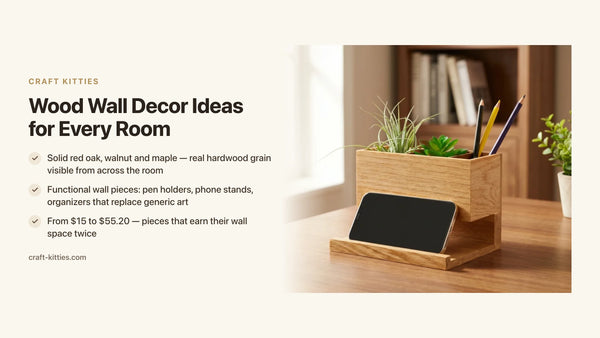
The Red Oak Plant Pod Pen Holder is the most complete object in the lineup: three compartments for pens and scissors, an open tray for flat items, and a circular pod sized for a small succulent or trailing plant. Everything in real red oak, finished in oil, sitting on felt feet that protect the desk surface. At $55.20 it is not the cheapest entry point, but it is the only object in the lineup that replaces four separate purchases — pen cup, plant pot, catch-all tray, scissors holder — with one cohesive piece. The grain is prominent and warm, which makes it the pick for desks with a natural or earthy color scheme.

Description
The Walnut & Maple Spliced Wood Pen Holder is the most visually distinctive piece in the lineup. Alternating strips of solid walnut and solid maple, edge-glued and finished flush — the seam lines run through the piece cleanly, producing a two-tone pattern that is the organizer's design. Two compartments: one deep for pens and markers, one wider for rulers and frequently grabbed items. At $36, it lands in the mid-range without asking you to compromise on material or craftsmanship. The right pick for Scandinavian or Japandi desks where you want the organizer to read as a made object rather than a found one.

Description
The Walnut & Red Oak Pen Holder at $15.99 makes the case that the entry price for solid hardwood desk organization is lower than most people expect. This is a single-compartment pen cup in walnut and red oak, handmade with clean angles — no frills, no extra hardware, no superfluous surface area. It keeps pens upright and off the desk, which is the job. The contrast of the two species — walnut's dark brown beside red oak's amber — provides enough visual interest that the piece does not need metal accents to feel intentional. The right pick for a first solid-wood desk upgrade or a desk that is already well-organized.

Description
The Wooden Pen Holder & Phone Stand solves two desk problems with one object: it holds pens and also props the phone at a comfortable reading or video-call angle, eliminating a separate phone stand from the surface. At $35, it is the practical pick for anyone whose phone sits on the desk as a working tool rather than a distraction — the phone is present and visible without lying flat and occupying a full phone-sized footprint. Solid wood throughout; no metal stand components that catch light and create visual noise beside the screen.

Description
The Wooden Pen Holder — Geometric Pencil Cup is the most minimal object in the lineup: $15, one compartment, geometric form, solid wood grain. It does exactly one thing, without apology. For a desk that is already organized and needs only a single cup to hold the pens that drift across the surface, this is the answer. The geometric silhouette reads as a considered design choice rather than a found object from the supply closet.
Comparison table: five solid wood pen holders side by side
| Model | Price | Wood | Compartments | Best for |
|---|---|---|---|---|
| Red Oak Plant Pod | $55.20 | Solid red oak | 3 + open tray + plant pod | Full desk organizer in one piece |
| Walnut & Maple Spliced | $36.00 | Solid walnut + maple | 2 | Japandi / Scandinavian desks, craft aesthetic |
| Pen Holder & Phone Stand | $35.00 | Solid wood | 1 + phone slot | Desks where phone is a daily work tool |
| Walnut & Red Oak | $15.99 | Solid walnut + red oak | 1 | First solid-wood upgrade, any desk |
| Geometric Pencil Cup | $15.00 | Solid wood | 1 | Minimalist desk, single clean cup |
Decision matrix: which piece for which desk and room
| Your situation | The right pick |
|---|---|
| Industrial-farmhouse room, exposed brick or raw materials, iron accents throughout | Red Oak Plant Pod — the bold oak grain holds its own against metal |
| Japandi or Scandinavian room, clean lines, no exposed hardware | Walnut & Maple Spliced — two-tone craft reads as studio-made, not rustic |
| Desk already has monitor, peripherals and visual noise — needs calm | Walnut & Red Oak — single-compartment, no competing elements |
| Phone stays on the desk as a working tool all day | Pen Holder & Phone Stand — removes a separate stand from the surface |
| Already organized desk, just needs one pen cup | Geometric Pencil Cup — $15, nothing extra, solid wood grain |
Why solid wood ages differently from MDF, veneer and iron-heavy composites
The material question is worth being precise about, because the market conflates three very different objects under the "wood" label.
MDF with wood-grain film is the most common material in affordable desk organizers. Under consistent handling — pen insertion, movement, thermal cycling — the film lifts at the edges and the MDF core compresses and swells. A pen cup built on MDF has a visible life expectancy of roughly one to two years in daily use before it begins to look worn rather than aged.
Plywood and veneered particleboard are a step up in structural integrity but share the same failure mode at the edges and corners — the veneer delaminates where the core is exposed to repeated contact. They are fine for cabinetry behind doors; for objects handled daily on a desk, they reveal their construction faster than expected.
Solid red oak, walnut and maple do not delaminate because there is no laminate. The surface you handle every day is the wood itself, the same material all the way through. A scratch on solid red oak is a scratch in the grain; a light sand or wax touch-up blends it in. A scratch on a printed film surface is permanent damage. Over five years of daily use, solid hardwood develops a quiet patina — the finish deepens slightly, the grain opens gently — that reads as a well-used material object rather than a deteriorating one.
The iron question is related: the challenge with iron hardware in desk organizers is not the iron itself but the joint. Mechanical joints — threaded inserts, through-bolts, fitted sleeves — hold over years of use. Adhesive joints fail under the vibration and thermal expansion of a desk environment. A wood-and-iron piece where the iron is glued rather than mechanically fixed is not a durable piece; it is a decorative piece with a use-by date.
How to choose between rustic-industrial and pure wood for your specific room
The clearest heuristic is not aesthetic — it is behavioral: look at what is already on the desk and wall surfaces in the room and identify the dominant material language.
If exposed metal is already doing structural or visual work in the room — pipe shelving, wire pendant lights, metal window frames, a cast iron radiator — a wood-and-iron desk piece reads as consistent with the room's vocabulary. The iron accent on the organizer is one instance of a recurring motif; it feels at home.
If the room is primarily textiles, ceramics, plants and wood — no exposed hardware, no industrial references — introducing iron hardware on the desk creates contrast rather than coherence. In that room, a pure solid-wood organizer in walnut or red oak continues the material story the room is already telling.
A second heuristic is the scale of the rustic-iron application. On a wall — a large hook board six feet across, a pot rack spanning a kitchen alcove — the iron hardware is scaled appropriately. The pieces are big enough that their weight and visual mass is justified. On a desk, where every object competes for a limited surface area, iron hardware at the scale of a pen holder or small organizer tends to feel heavier than the function warrants. Pure wood is lighter in both mass and visual register.
The sounds and textures of daily use — a detail that matters more than expected
One dimension of the comparison that photographs cannot convey: the acoustic and tactile difference between a wood-and-iron organizer and a pure solid-wood one.
Solid wood is nearly silent. Dropping a pen into a wood cup produces a short, soft knock. The same action in a cup with iron bands or a metal inner sleeve produces a ring that carries across a quiet room. In a home office used for calls or focused work, this is not a trivial difference. Solid wood absorbs the impact; metal amplifies it.
The tactile difference is equally direct. A waxed solid red oak or walnut surface is warm to the touch — literally, because wood does not conduct heat the way metal does. An iron band on the same organizer is room temperature or cooler. When you reach for the desk organizer dozens of times a day, the material under your fingers is part of the experience of the desk. Warm grain registers differently from cold hardware.
Neither is right or wrong. But it is worth knowing which one you are choosing.
Common mistakes when buying rustic wood decor for a modern desk
Ordering from a photo taken against a white studio background. Red oak reads very differently against a warm wood desk than against studio white. Before ordering, look at the dominant surface color where the organizer will sit — the grain needs contrast to read.
Conflating "wood and metal" listings with solid-wood construction. The majority of "wood and iron" desk accessories on retail platforms are MDF with applied metal accents. Check the material description: it should name the wood species (red oak, walnut, pine) and the metal type (cast iron, powder-coated steel). "Wood-look" or "wood grain finish" in the description means it is not wood.
Adding an iron-accented organizer to a desk that already has too many competing materials. A desk with a white monitor frame, aluminum laptop, ceramic mug, leather mousepad and woven cable organizer does not need one more material vocabulary. In a visually complex desk environment, a single-material solid wood object creates calm; an iron-accented piece adds another layer of visual information.
Underestimating the multi-piece purchase. A pen holder at $15 is not the end of the desk organization question; it is the start. Most desks benefit from a pen holder plus a catch-all tray plus something to prop the phone. Buying those three as unrelated objects produces a desk that reads assembled rather than considered. Buying the Red Oak Plant Pod once solves the same problem more cleanly.
Where to go from here
Our full pen holder collection covers every point in this lineup and several additional pieces suited to specific desk setups — from the compact geometric pencil cup for minimal desks to the multi-compartment all-in-one organizer for desks that need real structure. Each piece is solid hardwood, finished in our studio, and described accurately: we name the species, we name the finish, we do not mark prices up to discount them back down.
If you are working on a Japandi or Scandinavian desk setup, the Walnut & Maple Spliced Pen Holder and the Walnut & Red Oak Pen Holder are the natural starting points. If the room carries rustic-industrial energy and you want the desk to follow suit, red oak is the species that holds its own against iron hardware — start with the Red Oak Plant Pod as the anchor and build outward.
Customers who find us on Etsy (243 reviews) often come back for a second piece once the first one settles on the desk — the grain does its work, and the surface reads differently once one object on it is real wood.
FAQ — rustic wood and iron wall decor versus pure solid wood
1 — What exactly is rustic wood and iron decor? A combination of real or reclaimed solid wood with wrought or cast iron hardware — brackets, bands, hooks or frames — that produces a farmhouse-industrial aesthetic. The defining quality is the contrast between warm wood grain and cool dark metal, and the fact that the iron is load-bearing or near-structural rather than purely decorative.
2 — Is a wood-and-iron desk organizer durable enough for daily use? It depends entirely on the joint. Mechanically fitted iron components — through-bolted or sleeve-fitted — hold for years. Adhesive-mounted iron accents on desk objects typically fail within six to eighteen months of daily handling. Before buying, check how the metal is attached to the wood, not just what it looks like.
3 — Which species works best for rustic-industrial pieces? Red oak is the standard choice: open grain, honey-amber tone, maximum contrast against dark iron. Walnut reads more refined than rustic. Maple is best suited to contemporary-minimal or Japandi rooms, not industrial-farmhouse.
4 — Can a pure solid-wood pen holder work in a rustic room? Completely. A solid red oak pen cup with pronounced grain carries the rustic character without needing iron hardware to announce it. In a desk environment where you want calm over visual statement, the pure-wood version is often the better call.
5 — How do I match the wood to my existing desk decor? Match by contrast first: walnut (dark) against light desks and white walls; red oak (honey) against dark or warm-toned surfaces. Then match by material vocabulary: if the room uses iron accents elsewhere, an iron-detailed piece on the desk reads coherent; if the room is all-organic, pure wood continues the story.
6 — What separates solid wood from wood-look desk organizers? Solid wood is the actual material all the way through — red oak, walnut or maple cut from the tree and finished with oil or wax. Wood-look organizers use MDF or particleboard with a printed film surface. The printed surface delaminates at edges and corners under daily use; solid wood develops a patina instead.
7 — Are spliced two-tone organizers rustic or modern? Modern. A walnut-maple splice is a craft-aesthetic choice closer to contemporary furniture design than to farmhouse character. For genuine rustic, use a single species with bold, open grain — red oak is the right call.
8 — How do I care for a solid wood desk organizer? A dry or slightly damp cloth for daily use. An occasional wax or oil application every six to twelve months if the surface appears dry. Keep it out of prolonged direct sunlight, which grays the grain over time. No harsh cleaners, no dishwasher, no standing water.
9 — From $15 to $55 — what does the price range mean in practice? At $15 you get one compartment in solid wood — honest and sufficient. At $35–36 you get either a two-species spliced design with two compartments or a combined pen holder and phone stand. At $55.20 you get the all-in-one Red Oak Plant Pod: three pen compartments, a catch-all tray and a plant pod in one piece. The price reflects what the object does, not a markup on perceived quality.