At a glance
- Decision rule: if you wouldn't buy it today, it leaves
- Jewelry you can't see becomes jewelry you forget — then buy again
- One-in, one-out is the only system that survives past the first purge
There is a specific kind of mess that survives every cleaning session. Not the dishes in the sink or the shoes by the door — those move. The mess that stays is the one made of objects you have decided not to decide about: the ring you stopped wearing three years ago, the kitchen gadget you kept because it was expensive, the box of things you are "sorting later" that has moved through two apartments and is now in a closet you do not open.
This guide is about that mess, and about what it actually takes to clear it. Not the motivational version where decluttering is a weekend of liberation and a donation bag at the door — but the slower, more honest version where the hard part is not the garbage, it is the borderline objects you have convincing arguments for keeping, and the guilt that tends to surround anything sentimental or given as a gift.
The methods here are blunt by design. They address the specific cognitive traps that keep reasonable people living with too much stuff for too long. They also address what comes next: because decluttering without a structure to maintain the cleared space is a temporary fix, and temporary fixes tend not to hold.
Why you have kept things this long
Before the methods, the honest diagnosis — because most decluttering advice skips it, and that is why the pile comes back.
The objects that survive purge after purge are almost never there because you love them. They are there because of three reliable traps. The first is the sunk cost. You spent money, and throwing the object out feels like admitting the purchase was a mistake. It was a mistake. Keeping the object does not recover the money; it only extends the mistake across your floor and your attention.
The second trap is hypothetical future use. "I might need this." The honest version of that sentence is almost always "I have not needed this in three years, but I am afraid of the scenario where I need it next month and I threw it away." That scenario exists, statistically, for a very small fraction of the objects you are keeping for it. Everything else is managed anxiety stored in a closet.
The third is identity attachment. Some objects document a version of yourself you no longer are — the runner, the person who cooks elaborate dinners, the collector of a thing you stopped finding interesting. Releasing them feels like releasing a part of who you were. It is. That is the point. You are not erasing that self; you are acknowledging that you have moved.
Understanding which trap is holding each object makes the decision faster. The categories below are sorted by trap type, not by room.
Start with the decisions that require no courage
The decluttering process breaks when people begin with the hardest category — photographs, inherited objects, sentimental pieces. Start there and decision fatigue sets in within the first hour.
Start with the categories that require zero emotional processing: expired products, broken items, things that belong in the trash but somehow ended up somewhere else, duplicates (the six wooden spoons, the four phone chargers, the three versions of the same kitchen tool bought when the previous one was misplaced). These move fast because there is nothing to feel about them. The point of this first pass is not the volume cleared — it is the decision-making momentum built.
Clothes that no longer fit in any realistic near-term scenario follow. Not "I used to be this size" — whether you can put them on and wear them to something this year. Books you have not opened and would not recommend to a person you respect. Kitchen appliances used zero times in the past twelve months. These categories are not sentimental; they are just large, which is why they feel harder than they are.
By the time you have cleared these, you have practiced saying "this goes" a hundred times on things that did not cost you emotionally. That practice matters when you reach the harder pile.

The jewelry problem: why it accumulates faster than anything else
Jewelry is the category most people underestimate. It is small — each individual piece takes almost no space — so it accumulates without triggering the visual alarm that a pile of boxes or a full closet would. The result is a drawer that looks manageable from the outside and contains, under inspection, forty-seven pieces, eight of which you actually wear.
The jewelry decluttering question is not "is this pretty?" It is: did I reach for this in the past six months? If no, the secondary question is whether there is a specific occasion coming for which it is exactly right. If no again, it leaves. This is not ruthless — it is realistic about how many necklaces a person wears on rotation in actual daily life, which is usually three to five, not forty-seven.
The harder sub-problem is the jewelry you kept because of who gave it to you. A ring from a relationship that ended, earrings from a grandmother, a bracelet from a friend you are no longer close with. The object has become a vessel for the relationship, and releasing the object feels like releasing the relationship. But the relationship already is what it is — keeping a ring in a drawer does not preserve it. A photograph of the piece before it goes is enough to acknowledge the memory without storing the object indefinitely.
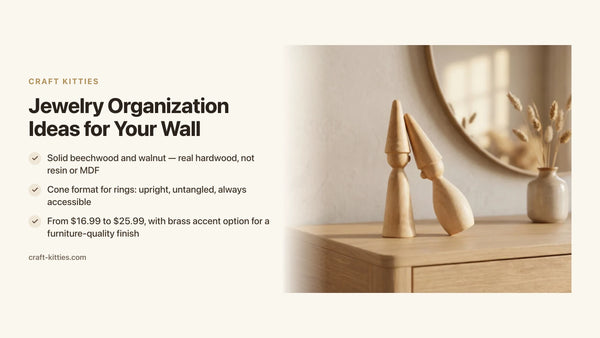
The moment jewelry is decluttered to what you actually wear, it deserves to be visible. Hidden jewelry is forgotten jewelry — which is the precondition for buying duplicates. A solid wood ring holder on the nightstand or dresser makes the real collection visible at a glance and naturally limits growth: when the cones are full, you know you have reached the actual capacity of what you wear before adding anything new.

Description
The Beechwood Ring Holder Cone Set is built for couples and for anyone who wants a shared display without two separate objects. Three solid beechwood cones sit on a unified base: each cone holds several rings without tangling them, and the set keeps your everyday pieces where you can see them rather than buried in a drawer. Beechwood is a tight-grained hardwood with a warm, pale tone that works against light and dark surfaces equally. At $16.99, it is the entry point to displaying what you kept, not just storing it.
The "just in case" object: how to apply a decision rule that holds
Every household has a "just in case" pile. The spatula that is worse than the main spatula but kept as backup. The extension cord that mostly does not work. The piece of furniture bought for an apartment that no longer fits this one. The camping gear for camping trips that have not happened in six years.
The honest "just in case" decision rule is this: if you would not buy it again today, at full price, knowing what you know about how often you use it, it leaves. Not "could I imagine a scenario where I need this" — that bar keeps everything. Not "does it have value" — perceived value and actual usefulness are different things. The question is: if you encountered this object for the first time in a store right now, would you spend money on it?
For most "just in case" objects, the answer is no. And if the answer is no, you are keeping something you would not choose. The space it occupies has a cost too, even if it does not show up on an invoice.
The one legitimate "just in case" category is emergency and safety items — a first aid kit, a flashlight, a spare key, a basic toolkit. These stay because the scenario where you need them and do not have them is genuinely disruptive. Everything else claiming "just in case" status is almost always managed anxiety, not genuine preparedness.
Handling inherited objects and gifts without guilt
These are the hardest category, and they deserve their own method rather than the same decision rule applied to a spatula.
Inherited objects carry weight because releasing them can feel like disrespecting a person who is no longer around. Gifts carry guilt because someone chose them for you. Both traps have the same logic error: the object's presence in your home does not honor the person or relationship. What honors it is the memory, which does not live in the drawer.
The practical method is to give yourself permission to photograph before releasing. Before donating, selling or discarding an inherited object or a gift you are not keeping, take a close photograph of it. Not a quick snapshot — a proper image that records the detail, the texture, what made it particular. This takes two minutes and creates a version of the object that does not require physical space. The photograph can live in a dedicated folder, labelled with the name of the person and a sentence about the context. The object can leave.
For inherited objects that have real value — furniture, jewelry, china — the preferable exit is another family member who will actually use them. The second-best is a donation with a specific destination: a charity shop that sells vintage furniture, a shelter that takes housewares, an organization that matches the object's original purpose. A deliberate exit matters more than a fast one.

Description
For the jewelry you kept — the pieces that passed the honest six-month test, or the one ring from a grandmother that you genuinely wear or genuinely treasure — the Walnut Wood Ring Holder with Solid Brass Base gives it the display it deserves. Solid black walnut, one of the densest and most visually striking North American hardwoods, paired with a solid brass base that adds genuine weight and stability. At $25.99, it is the choice for a single meaningful piece or a small collection of keepers. The contrast between dark walnut grain and warm brass reads like furniture, not a jewelry stand.
The system that prevents the refill
Decluttering without a maintenance system is renovation without waterproofing — the underlying problem returns. Most homes refill within eighteen months of a full purge because the habits that produced the original clutter were never addressed, only the accumulated result.
The maintenance system that holds is structurally simple: one in, one out, applied the day after you finish. Nothing new enters the home without something leaving. A new ring means one ring from the display goes to donation. A new sweater means one leaves the drawer. The rule does not require discipline on an ongoing basis — it only requires that you apply it at the point of acquisition, which is the one moment when the decision is easy.
The second layer is visible storage for the categories that accumulate fastest. Jewelry you cannot see is jewelry you forget you own, which is the precondition for buying duplicates and the precondition for a drawer that fills back up within a year. A ring holder on the dresser that shows exactly what you own makes the collection's natural size visible and self-limiting. When the display is full, you know — before you buy — that something would have to leave to make room.

Description
The Wooden Ring Holder Set of 2 in solid walnut handles the couple's nightstand or the shared dresser without requiring a single shared piece. Two individual cones in solid black walnut — the same dense, tight-grained hardwood that develops a deeper tone over years of handling. At $18.99 for the pair, the set is organized around the actual use pattern: each person's everyday rings, visible, untangled, on their side. When both cones are full, the set provides its own natural constraint before anything new is added.
Comparison — three ring holder approaches for the newly decluttered dresser
| Model | Price | Wood | Cones | Best for |
|---|---|---|---|---|
| Beechwood Cone Set | $16.99 | Solid beechwood | 3 cones, unified base | Couples, shared display, entry price |
| Walnut Cone Set of 2 | $18.99 | Solid walnut | 2 individual cones | Two sides of a nightstand, couples who want separate pieces |
| Walnut with Brass Base | $25.99 | Solid walnut | 1 cone, brass base | One meaningful piece, premium display, dark-wood aesthetic |
Decision matrix — which approach fits your situation
| Your situation | The right pick |
|---|---|
| Shared dresser, two people, budget-conscious | Beechwood Cone Set — 3 cones, single object |
| Two nightstands, each person wants their own piece | Walnut Set of 2 — individual cones, same family |
| One ring or a small collection of keepers, display over storage | Walnut with Brass Base — the piece for what matters most |
| Light-toned bedroom, want visible contrast | Walnut with Brass Base or Walnut Set of 2 |
| Warmer bedroom, want the display to blend rather than contrast | Beechwood Cone Set — pale, warm grain |
The mistakes that undo a good purge
Organizing before decluttering. The most common one. Buying bins, dividers and holders for the full pile is not organization — it is tidied clutter. The rule is declutter first, then organize only what remains. The right storage for the decluttered space is almost always smaller and simpler than anything bought for the full pile.
Deciding by room instead of by category. When you declutter room by room, you do not see the full scale of any single category. Clearing every piece of clothing across the whole house at once reveals that you own twelve black sweaters; doing the bedroom closet alone only reveals the bedroom's twelve. Category-by-category forces the reckoning that room-by-room delays.
Setting aside a "maybe" box without a deadline. The maybe box is the "just in case" pile with better branding. It works only with a hard expiration: thirty days, sealed, in a specific place. If you have not opened it to retrieve anything by day thirty, it leaves without being reopened. The reopening is the trap — once you see everything again, the decision restarts.
Thinking the system ends at donation day. Decluttering is not a state; it is the moment before a new state begins. The state requires maintenance, and maintenance requires the one-in, one-out rule applied consistently from the day you finish. Without it, the same surface pressure — sunk cost, "just in case," identity attachment — recreates the same pile within a year.

The emotional dimension that practical guides skip
The objects most people struggle with are not the expensive ones or the large ones. They are the ones that carry guilt, obligation or grief — and those operate on a different system than the sunk-cost objects.
The guilt object is the gift you do not love, kept because discarding it would mean admitting you do not love it. The obligation object is the thing that belonged to someone who is gone, kept because releasing it feels disloyal. The grief object is the thing that was part of a life that no longer is — a relationship, a period of your life, a version of yourself.
None of these objects are holding the emotion. You are holding the emotion, and the object has become a proxy for it. Releasing the object does not release the memory, the person or the relationship — memory is not stored in things. It is stored in you.
The practical technique that helps is the deliberate exit: deciding where the object goes rather than just that it goes. An inherited ring to a cousin who will wear it. A gift from a relationship that ended to a thrift store outside your neighborhood. A childhood object to a school or community program. The deliberateness of the exit converts a loss into a choice, which is the difference between grief and resolution.
What the cleared space should look like after
A decluttered space that gets organized correctly has two properties. First, everything in it is in use — not could theoretically be used, actually used with some regularity. Second, everything is visible or findable without searching. Hidden objects accrue a kind of invisible cost: the low-level uncertainty about what you own and where it is, the duplicate purchases made because the original was forgotten, the time spent looking for things you cannot locate.
Visible storage is the mechanism for the second property. Not display-for-its-own-sake, but storage that lets you see what you own at a glance. A shelf for books you are reading now, not a bookcase for every book you have ever owned. A ring holder for the jewelry you actually wear, not a jewelry box for everything you have accumulated.
The reason visible storage has a structural advantage over closed storage is that it imposes a natural limit. When the ring holder has four cones and they are full, you know — before buying another ring — that something would need to leave. Closed storage expands to absorb whatever you put in it. Visible storage reflects the actual volume back to you.
Our ring holder collection is built around exactly this principle: solid wood pieces — beechwood, walnut, red oak — that hold what you actually wear and make the limit of your collection visible without requiring you to count anything.
FAQ — ruthless decluttering and what comes next
1 — How do I know if I should keep something or let it go? The most reliable test is not how you feel about the object but how you use it. If you cannot remember the last time you reached for it, and if you would not buy it today at full price, it belongs in the outgoing pile. Sentiment is real, but it should attach to a few meaningful things, not to everything you have ever owned.
2 — What is the best order to declutter a house? Start with the categories that carry no emotional weight — expired products, broken items, things that belong in the trash, duplicates. Build momentum there before moving into sentimental territory. Clothes, books and jewelry typically follow. Photographs and inherited objects come last, when your decision-making muscle is already trained.
3 — How do I stop feeling guilty about getting rid of gifts? The gift completed its purpose when it was given and received. Its job was never to occupy drawer space indefinitely. Letting it go is not ingratitude — it is making room for the life you actually live now rather than the one documented in your clutter. A photo before donating is enough to honor the memory without storing the object.
4 — How long does it take to declutter a whole house? A realistic estimate for a lived-in three-bedroom home is four to eight focused sessions of two to three hours each — spread over three to six weeks so you have time to process decisions emotionally and practically. A single weekend sprint works for people ready to move fast, but most find the staged approach produces decisions that stick.
5 — What should I do with sentimental items I cannot keep? Photograph them before they leave. Give to family members who will use them. Donate to a specific organization where the object is likely to be used — a childhood game to a school, a wedding gift to a shelter needing household items. The key is a deliberate exit: choosing where something goes matters more than whether it goes.
6 — Why do I keep buying organizers before decluttering? Because organizing feels productive without requiring any hard decisions. But organizers cannot fix volume — they can only structure it. Declutter first; organize only what remains. The right storage for a decluttered space is usually far simpler and smaller than anything you would have bought for the full pile.
7 — How do I keep a decluttered home from filling back up? Apply a one-in, one-out rule from the day after you finish: nothing new enters without something leaving. Visible storage helps too — when the jewelry on display fills a ring holder, you know you have reached the natural limit before adding more. The constraint of a physical object is more reliable than any resolution.
8 — What is the best way to declutter jewelry? Lay every piece flat on a neutral surface and make three piles: wear regularly, wear occasionally, never wear. The third pile leaves. For the first two, invest in a holder that keeps pieces visible and untangled — jewelry you cannot see becomes jewelry you forget you own, which is the first step back toward clutter.
Where to go next
The ring holder is one of the organizing steps that actually matters after a real purge — because it holds the result visible. You can browse our full ring holder collection to find the piece that matches the dresser or nightstand you just cleared. If you want to start with the entry price, the Beechwood Ring Holder Cone Set at $16.99 is the straightforward choice for a shared surface. If you want the piece that makes a single ring the room's detail, the Walnut Ring Holder with Solid Brass Base does that in solid black walnut and real brass.
On Etsy, our studio has 243 verified reviews from customers who took the same step — clearing what accumulated and then choosing one well-made object for what remained.