At a glance
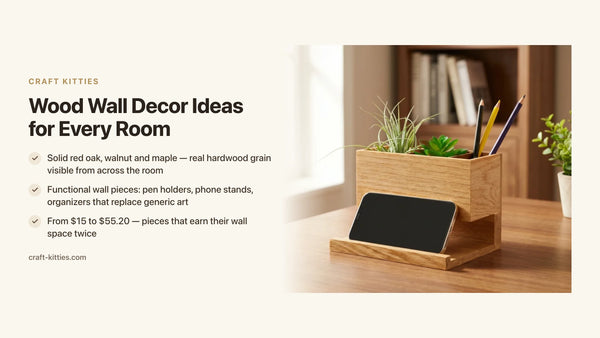
- Solid red oak, walnut or maple — real hardwood, not plastic
- The right system has fewer zones, not more bins
- From $15.00 to $55.20, with models that hold pens and a phone together
Every September, the desk gets organized. By October, it does not look organized. That is not a discipline problem — it is a system problem. Most desk organization attempts fail for the same three reasons: too many containers for too few items, materials that warp or tip within weeks, and a reset ritual that takes longer than the mess is worth. The fix is simpler than most guides suggest: fewer zones, better materials, and a 60-second end-of-session habit.
This guide covers what actually works for a student desk, starting with how to think about surface zones before buying anything, then moving through the five solid wood pen holders and desk organizers from our studio that form the backbone of a system worth keeping. The comparison table and decision matrix at the end make it possible to match an organizer to the desk, the workflow, and the budget without second-guessing.
One thing to establish before the product section: every organizer listed here is solid hardwood — red oak, walnut, maple, or a combination. Not plastic, not MDF with a wood-printed surface, not veneer over particleboard. The distinction matters because a desk organizer that holds its shape through four years of school is one purchase, not four.
Why most school desk organization systems fail within weeks
The core mistake is treating organization as a storage problem when it is actually a retrieval problem. The question is not "where can I put this?" but "how fast can I get to this when I need it?" A system that requires opening three lids and sorting through two bins to find a red pen is not a system — it is a slow version of the pile.
The second failure is overbuilding the surface. The desk surface is not a display shelf; it is a working surface. Every object that lives there permanently is competing for the space where a textbook, a notebook, and a laptop need to coexist during homework. The tighter the surface constraint, the easier the habit.
The third failure is buying objects that degrade quickly. A plastic pen holder that bends when loaded, a mesh cup that collapses under a full set of markers, a fabric bin that slumps sideways — these require constant re-sorting to look acceptable. Solid wood objects do not have this problem. A red oak pen holder placed on the desk in September looks the same in June, holds the same load, and does not need straightening.
The three-zone framework for a student desk

The most useful desk organization framework has exactly three zones, each with one container. More zones produce more decisions about where things go, which is the opposite of a system.
Zone 1 — Active writing tools. One pen holder, positioned at the back corner of the desk on the dominant hand's side. It holds pens, pencils, highlighters, scissors, and a ruler. Nothing else goes on the desk surface unless it is actively being used for the current task.
Zone 2 — Active papers. One vertical file, a clipboard on a hook, or a single folder on the desk. The key word is "active" — only what is needed for the current assignment or week. Completed assignments go into a binder in a bag or shelf immediately after they are done. The paper zone is not a holding area; it is a staging area for what is in progress right now.
Zone 3 — Everything else. Drawer, shelf, bag, or locker. Reference books that are consulted less than once a week. Spare stationery. Backup chargers. The desk surface does not need these objects to be visible. Retrieval from a drawer takes five seconds; the benefit of a clear surface applies for every hour of work.
Once the three zones are set, the reset habit is simple: at the end of each session, return every object to its zone. If something does not have a zone, it does not live on the desk.
Red oak, walnut or maple — choosing the wood for a desk organizer

The three species in our pen holder lineup read differently on a desk, and the choice is worth making deliberately rather than defaulting to whichever looks lightest in a product photo.
Red oak is warm and honey-toned with an open, pronounced grain that you can read across the room. On a white or light desk it adds warmth without competing with the surface. In a room with a lot of natural wood already — flooring, bookshelves, a wooden chair — red oak blends in. It is the most versatile species across different desk setups and the starting point for most students choosing a wood organizer for the first time.
Walnut is the other end of the palette: deep brown, tight grain, quietly architectural. On a light desk it reads like a piece of furniture that chose the desk rather than the other way around. Against a darker surface — an espresso-stained desk, a dark room with moody lighting — it can be harder to see as a distinct element, which is why the pairing with maple in spliced models is so effective: the contrast of dark walnut and pale maple resolves both the aesthetic question and the visual clarity question simultaneously.
Maple, used in combination with walnut in the spliced pen holder, is pale and fine-grained — a clean, Scandinavian note. It never dominates, always clarifies. The walnut-maple combination is the most visually dynamic option in the lineup: the two-tone blade through the cup is immediately noticeable on any desk color.
On practical terms the species are comparable: all three are real hardwood, all are finished to resist surface marks from daily desk use. The choice is entirely about what the desk looks like before the organizer arrives.
The pen holders and desk organizers from our studio
These five models cover the full range of student desk needs, from the simplest single-cup to an all-in-one organizer that holds pens, a plant and phone accessories in one footprint.

Description
The Red Oak Plant Pod Pen Holder is the organizer for students who want one object to handle everything. Solid red oak with a natural oil finish, it combines a deep pen compartment, a recessed plant pod for a small succulent or air plant, and a discreet cable-management slot so the charging cable stays out of the way without disappearing into a drawer. The all-in-one footprint means the desk holds one object instead of three — pen holder, plant, cable anchor — which directly reduces the surface area consumed. At $55.20 it is the premium option in the lineup, and the one most likely to stay on the desk for the full duration of school rather than being replaced when it wears out, because solid red oak does not wear out.

Description
The Walnut & Maple Spliced Pen Holder is for the desk that does not need to look like a typical student setup. The horizontal splice line between the dark walnut and the pale maple is a genuine woodworking detail — two hardwoods joined cleanly so the grain flows continuously across the seam. The result is a pencil cup that looks like a design object first and a stationery holder second. At $36.00 it is the mid-range option with the most visual impact per dollar. It holds the standard load — 12 to 15 pens and pencils, highlighters, scissors — and the two-tone profile stands out on any desk color precisely because neither species disappears against any background.

Description
The Walnut & Red Oak Pen Holder is where solid wood starts in the lineup: two hardwoods, one compartment, no extras. At $15.99 it is the entry price for real hardwood — not a veneered MDF alternative, not a composite that flexes under load, but actual walnut and red oak cut and finished by hand. The form is deliberately simple because the function is straightforward: every pen, pencil, highlighter and pair of scissors the desk needs within reach, in an object that will not tip, warp, or discolor. It is the first piece most students should buy, and it pairs naturally with a second organizer later if the workflow expands.

Description
The Wooden Pen Holder & Phone Stand solves the specific problem of the phone on the desk during a study session. The integrated angled slot holds the phone at a readable angle — useful for a timer, a music app, a reference image or a video tutorial — without the phone lying flat and becoming a distraction magnet. The pen compartment holds the standard load. The combination footprint is smaller than a pen holder and a separate phone stand placed side by side, which matters on a student desk where screen, notebook, and textbook are already competing for surface space. At $35.00 it fills a gap the single-compartment holders leave open, and it is the natural pairing for students who use their phone as a study tool rather than trying to hide it.

Description
The Wooden Pen Holder Geometric Pencil Cup is the most compact option in the lineup. The angular cut removes unnecessary bulk while keeping the interior wide enough for a full set of pens and pencils. At $15.00 it is the lowest entry point in the collection, and the one for students whose desk is genuinely small — a dorm desk, a corner table, a bedroom setup where every inch matters. The solid wood construction means it holds its shape and weight on the desk rather than sliding around when someone reaches across. It does the one thing it needs to do, in the smallest possible footprint, in real hardwood.
Comparison table — five pen holders for a school desk
| Model | Price | Wood | Compartments | Best for |
|---|---|---|---|---|
| Red Oak Plant Pod | $55.20 | Solid red oak | Multi + plant pod + cable slot | All-in-one, design-conscious desk |
| Walnut & Maple Spliced | $36.00 | Walnut + maple | Single, generous | Maximum visual impact |
| Walnut & Red Oak | $15.99 | Walnut + red oak | Single, clean | Entry price to solid wood |
| Pen Holder + Phone Stand | $35.00 | Solid wood | Pen compartment + phone slot | Phone integrated in workflow |
| Geometric Pencil Cup | $15.00 | Solid wood | Single, compact | Small desk, tight surface |
Decision matrix — which organizer for which student setup
| Your situation | The right pick |
|---|---|
| You want one object to replace three items on your desk | Red Oak Plant Pod |
| Design is a priority, you want something that looks intentional | Walnut & Maple Spliced |
| First real desk organizer, solid wood under $20 | Walnut & Red Oak at $15.99 |
| Phone stays on the desk during study sessions | Pen Holder + Phone Stand |
| Small desk or dorm — every square inch counts | Geometric Pencil Cup at $15.00 |
| Back-to-school gift that will be used for years | Walnut & Maple Spliced or Red Oak Plant Pod |
How to set up a school desk that stays organized
The setup takes about twenty minutes and the payoff is a system that resets itself in sixty seconds at the end of every session.
Step 1 — Clear the surface completely. Everything off. This is not a dramatic gesture; it is the only way to see what actually needs to be there and what has accumulated by habit. Most desk surfaces hold at least four objects that do not need to be there at all.
Step 2 — Define the three zones before anything goes back. Place the pen holder at the back right corner (or back left, if left-handed). Identify the paper zone — one spot, one layer deep. Decide where the screen goes relative to the viewing angle. These three positions decide everything else.
Step 3 — Put back only what is used daily. Pen holder gets pens, pencils, scissors, one highlighter per color. Paper zone gets the current assignment and nothing else. Screen, lamp, and the pen holder are the only objects that live on the surface permanently. If an object does not appear in the three zones, it goes in a drawer, a shelf, or out of the room.
Step 4 — Anchor the pen holder. Solid wood organizers do not slide the way plastic ones do, but placing the pen holder at the corner rather than the center of the desk matters: it stops being something you push aside and starts being a permanent fixture. Once the anchor position feels right, it rarely changes.
Step 5 — Run the 60-second reset. At the end of every session: every pen goes back, every paper goes to its folder or the paper zone, the surface clears. Sixty seconds. The reason most organization systems collapse is that the reset becomes a weekly project. Sixty seconds daily never becomes a project.
Common mistakes that undo a good desk setup
Adding more containers to fix a system problem. When the desk feels cluttered, the instinct is to buy another bin or divider. In most cases the desk is cluttered because the wrong things are on it, not because the right things lack containers. The three-zone framework clears this up before buying anything: identify what is on the desk that should not be, and remove it.
Choosing materials based on the photo rather than the use case. A translucent acrylic organizer looks clean in a product photo and shows every pen it holds within six months of use — which means it always looks full and slightly disorganized. A solid wood organizer looks the same at month one and month eighteen, which means the system continues to feel intentional rather than provisional.
Organizing the whole desk at the start of the year and never maintaining it. Organization is not a one-time event. The setup takes twenty minutes; the maintenance is sixty seconds per day. If the sixty seconds does not happen, no setup survives a full semester. The container that makes the sixty-second reset fastest is the right container, regardless of how it looks in a photo.
Letting the paper zone expand. The paper zone is the most common point of failure. One sheet becomes a stack, the stack becomes the desk surface, and the pen holder becomes the only thing that actually works. The rule is one layer: only the active assignment, and everything else moves to a binder or folder immediately after it is done.
What to look for when buying a school desk organizer
The criteria that matter for a school desk organizer are different from those that matter for a home office. Students use the desk intensively in short sessions — homework, studying, projects — then leave it completely for hours. The organizer has to hold a full load without adjusting, clear quickly at the end of a session, and survive the casual handling of daily student life.
Weight and stability. A solid wood pen holder stays where it is placed because it has mass. Plastic and mesh alternatives slide, tip when loaded unevenly, and require repositioning regularly. The stability question is especially relevant for narrow desks where objects at the edge are at risk.
Compartment size vs. object variety. Most students carry more types of writing tools than they think: ballpoints, pencils, mechanical pencils, a highlighter or three, a pair of scissors, and often a ruler. A compartment that fits only pencils misses the variety. The models listed above — especially the multi-compartment Plant Pod and the generously sized Walnut & Maple Spliced — are sized for actual student loads, not minimalist editorial setups.
Finish durability. The desk organizer gets handled constantly: pens pulled out and replaced dozens of times per day, scissors dropped in sideways, the occasional highlighter cap dropped from three feet up. An oil or wax finish on solid hardwood absorbs minor impact and can be lightly sanded and re-oiled if a deep scratch appears. A plastic laminate or painted finish chips at the first impact and does not recover.
Longevity vs. season. Most plastic desk organizers last one school year before some element — a compartment wall, a leg, a finish layer — starts to fail. A solid wood organizer bought at the start of middle school should still be on the desk at the end of high school. At $15.99 for the entry-level solid wood option, the cost over four years is less than $4 per year, which is a different calculation than four $8 plastic replacements.
FAQ — school desk organization ideas
1 — What is the best way to organize a school desk? Assign a fixed zone to each category — tools in a pen holder, active papers in one defined spot, everything else in a drawer — and end every session with a 60-second reset. The system has to be faster to use than the alternative of leaving things anywhere. A single solid wood pen holder at the back corner of the desk handles most of the daily work for most students.
2 — How do I keep my desk organized all year? The habit is the system: one 60-second reset at the end of every session, not a weekly declutter. What makes the habit stick is having a home for every object that belongs on the desk. If the pen holder is within arm's reach and has room for everything that needs to be within reach, the reset is physically easy. Materials also matter — a wood organizer that holds its shape does not require re-sorting every few weeks the way a bent plastic cup does.
3 — What should actually be on a student desk? Pen holder, lamp, screen (if applicable), and whatever is being actively worked on. Nothing else needs to live on the surface permanently. Books consulted less than daily go on a shelf. Spare supplies go in a drawer. The smaller the permanent footprint, the easier it is to use the desk for large projects, spread-out notebooks, or textbooks.
4 — Is solid wood better than plastic for a desk organizer? For long-term use, yes, clearly. Solid red oak, walnut and maple hold their shape, resist surface marks, and do not crack or discolor after a year of daily use. A $15.99 solid wood option from our pen holder collection bought once is a different proposition than a $10 plastic organizer bought three times.
5 — What is the difference between red oak and walnut? Red oak is honey-toned with an open, visible grain — warm and casual on any desk. Walnut is deep brown with a finer, tighter grain — quieter, more furniture-forward. Both are hardwood and structurally comparable. The choice is aesthetic: red oak for lighter desks and warmer rooms, walnut against surfaces where the contrast reads cleanly.
6 — Can a pen holder hold a phone too? Some are designed for it. The Wooden Pen Holder & Phone Stand combines a pen compartment with an angled phone slot, which is useful for a timer, music, or a reference image during a study session without taking up a second footprint on the desk.
7 — How many pens fit in a wooden pen holder? Comfortably 12 to 15 ballpoints or pencils in a single-compartment model, plus scissors and a highlighter. Multi-compartment models like the Red Oak Plant Pod hold more and allow sorting by type — useful when switching quickly between tools during exam sessions.
8 — Is a wooden desk organizer a good back-to-school gift? It is one of the more practical options precisely because it is used every day and lasts for years. Solid wood stays presentable through high school and into college. The Walnut & Maple Spliced Pen Holder at $36.00 paired with a set of quality pens is a complete, useful gift that is not duplicated by anything most students already own.
Where to go next
The pen holder is usually the first piece of a solid wood desk setup — rarely the last. Our wooden desk accessories collection brings together the pieces that answer each other: pen holders, phone stands, wrist rests and trays in the same red oak, walnut and maple language, finished in our studio with the same care. Customers who found us through our pen holder collection on Etsy — where we have 243 reviews — often come back for a second piece once the first one changes how the desk feels to work at.
Conclusion — one organizer, one habit, a desk that stays clear
If this guide leaves you with one method: choose the three zones before buying anything, pick the pen holder that fits the desk size and the daily load, and run the 60-second reset at the end of every session without exception. The Red Oak Plant Pod at $55.20 is the answer for students who want one piece to replace three; the Walnut & Red Oak Pen Holder at $15.99 opens solid wood at the entry price; the Geometric Pencil Cup at $15.00 works on desks where space is the binding constraint. Three paths, one outcome: a school desk that is still organized in June.