At a glance
- Natural materials, three colors, one object per surface
- Real wood in red oak or walnut anchors the seasonal palette all month
- From $15 to $55 — pieces that stay useful past January
There are two kinds of Christmas rooms. The first is crowded: every flat surface covered, every window framed, garlands on the stairs, ornaments in clusters, a color palette that spreads from gold to red to silver with no clear logic. The second is edited: a few well-chosen objects, natural materials with some breathing room between them, light that works harder than quantity. The second kind photographs better, feels more comfortable to live in, and requires a fraction of the time to put together and take down.
This guide is about the second kind. Not minimal in the sense of cold or sparse, but restrained in the sense of deliberate — knowing what to add and, more importantly, what to leave out. The argument here is that simplicity in Christmas decor is not a concession; it is the thing that makes a room look good from the first of December through the last.
At a glance
- Natural materials, three colors, one object per surface
- Real wood in red oak or walnut anchors the seasonal palette all month
- From $15 to $55 — pieces that stay useful past January
Why simple Christmas decor works better than full
The case for restraint in seasonal decorating is not aesthetic snobbery — it is practical. A room decorated with too many objects asks the eye to process each one simultaneously, which means none of them register. Contrast is what makes objects visible: an ornament on a full shelf disappears; the same ornament on an otherwise bare surface is seen.
There is also the question of the room itself. Most living spaces have a character that took time to establish — a rug, a lamp, a piece of furniture that the owner loves. Christmas decorations, applied without editing, have a way of covering that character entirely and replacing it with a generic version of the season. The rooms that look most intentional at Christmas are the ones where the decoration amplifies what was already there rather than overwhelming it.
The practical upside of simplicity is real too. A room decorated with restraint takes less than an hour to set up and less than twenty minutes to undo. There is nothing stored in six boxes in the attic, no argument about where the extra garland goes, and no gradual accumulation of broken or outdated pieces that somehow never get thrown away.
The three-color rule — the fastest way to look intentional

Color is the single most powerful variable in how a decorated room reads, and the most common source of the visual noise that makes rooms look cluttered. The fix is simple: choose three tones and hold to them.
The first color is already in your room. If you have wood furniture, wood floors, or wood accessories, you already have a warm anchor — honey, chestnut or deep brown. That tone does not need to be added; it needs to be supported. Red oak has a honey warmth with visible grain that catches candlelight naturally; walnut is deeper and quieter, more furniture-like. Both are solid hardwoods that look better against seasonal greenery and off-white linen than any painted or lacquered surface.
The second color is your accent. Forest green, burgundy and navy are the three that work reliably with natural wood tones at Christmas — each sits in the cool-to-deep range that contrasts without clashing. Choose one. A wreath, a cluster of candles, a table runner: whatever carries this color, one pass through the room is enough.
The third color is your neutral. Off-white and cream do the job of separating the wood and the accent color without adding visual weight. Linen ribbon, beeswax candles, dried cotton stems, unbleached paper: all land here naturally.
Metallics earn a place as a fourth note — a small one. Brushed gold against walnut is quiet and warm; silver against red oak reads colder and requires more intention to work. The rule is that metallic appears in small quantities, on surfaces rather than in structures: a ribbon edge, a candle holder, one or two ornaments at the most.
Natural materials — what to reach for and what to leave on the shelf
The materials that hold up through December are the ones with no synthetic component: solid wood, fresh or dried eucalyptus and spruce, pinecones, dried orange slices, beeswax candles, linen and cotton textiles, stoneware. What they have in common is that they age gracefully — eucalyptus dries rather than wilting, pinecones need no maintenance, real wood develops a deeper warmth as it sits near candles.
What tends to look worse over time is anything with a plastic base, a printed grain or a lacquered finish. Faux greenery yellows under artificial light and collects dust; ornaments with printed metallic coatings chip at the first scratch. The useful test is whether an object looks better or worse on the last day of December than it did on the first — natural materials pass that test consistently.
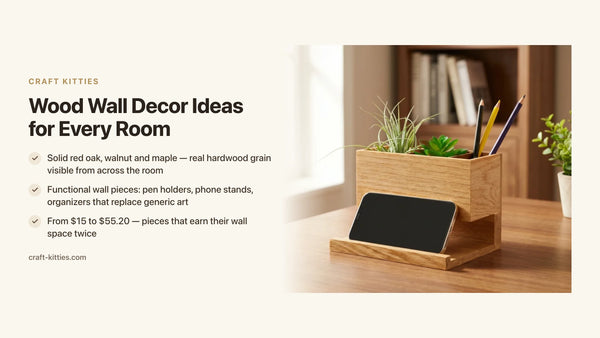
Solid wood in particular is an underused anchor. A red oak or walnut pen holder, a wood tray, a turned wooden bowl: these are objects that live in the room year-round and simply need a sprig of rosemary or a votive candle placed beside them to read as seasonal. They do not need to be moved into storage on January 6. That is the logic of building Christmas decor around materials you already use — the decoration cost is close to zero, and the result is a room that looks coherent rather than temporarily transformed.
One object per surface — the rule that prevents visual noise
The single most practical principle of edited Christmas decor is this: one anchor object per surface. One piece per shelf. One focal point per mantle zone. One centerpiece per table.
This sounds restrictive and feels liberating in practice. When a surface has one object, the eye knows exactly what to look at, and the object looks more considered for it. When a surface has eight objects, none of them land. The issue is not the quantity of objects owned but the quantity placed at once: a beautiful wooden desk organizer surrounded by four other pieces disappears; the same organizer with a small candle on one side and a clipping of fresh eucalyptus on the other becomes a vignette.
The rule of one applies to light sources too. A cluster of candles at different heights reads as a single intentional arrangement; the same candles spread across a room at identical heights read as an afterthought. Gather light rather than distributing it evenly, and the room feels warmer without any additional objects.
How to anchor each room — a space-by-space approach
The most edited Christmas interiors make each room self-contained rather than treating the whole house as a continuous installation. This is both more manageable and more effective: each room has its own logic, its own anchor, its own pace.
The living room does the heavy lifting. One tree — real or a high-quality alternative — is enough. The decorations on it should use the three-color palette: if your room has red oak and off-white, the ornaments in forest green and cream will do more than a full rainbow. The mantelpiece takes a second focal point: a cluster of candles and a garland, or a wooden tray with pinecones and a pillar candle. Those two surfaces — tree and mantle — are the room's full seasonal decoration. Everything else stays as it normally is.
The dining table benefits from a centerpiece that stays functional: a long wooden tray with two or three pillar candles and some dried botanicals leaves enough room for plates and glasses. Taper candles in a walnut holder add height without mass. The key is that the centerpiece can stay in place during the meal rather than being moved to a corner to make room for dishes.
The entryway sets the tone for the whole house at a fraction of the effort of the living room. A wreath on the door is sufficient for the exterior. Inside, a wooden tray near the entry with a candle and a small branch of fresh greenery signals the season without adding clutter to a space that already manages coats, shoes and bags. Our pen holder collection includes pieces in red oak and walnut that function naturally on a console table, styled with a seasonal twig or a small ornament alongside.
The desk or home office is often the most neglected room at Christmas, and the easiest to get right: swap nothing out. Add one small natural object — a pinecone, a votive candle, a sprig of something green — next to whatever is already on the desk. A solid wood desk organizer becomes part of the seasonal palette without moving an inch.

Description
The lighting principle — why warmth beats quantity

Lighting is the variable that most consistently separates a room that feels festive from one that merely has decorations in it. The relationship is direct: warm, low, gathered light produces the feeling; bright, flat, evenly distributed light cancels it regardless of what objects are present.
The temperature rule is non-negotiable for natural-materials interiors: warm white at 2700 Kelvin or lower. Cool-white string lights — the kind that reads blue-white — make natural wood look flat and greenery look artificial. Warm white makes the grain of red oak glow and picks up the honey tones in raw wood that ambient daylight often misses.
The geometry of light matters as much as its color. A cluster of three candles at different heights on a tray — one tall pillar, one medium, one small votive — creates more depth than six candles spread at the same level across a mantle. Height variation adds shadow, and shadow is what makes a room feel dimensional rather than stage-lit.
The practical protocol for the living room is this: turn off the overhead light, turn on the tree, light three candles near the mantelpiece or the coffee table, and add one additional warm lamp if the room is large. That is the full setup. What most rooms need is not more light sources but a different arrangement of the ones already present.
Wood as year-round decor that earns its Christmas role
The strongest argument for solid wood in seasonal decor is that it does not need to be taken down. A red oak pen holder or walnut desk organizer that sits on a surface year-round becomes part of the Christmas palette simply by what you place beside it — a twig, a candle, a ribbon — rather than by being removed from storage each December.
This changes the economics of the whole approach. Instead of buying seasonal objects that live in boxes for eleven months, the investment goes into a piece of real wood that earns its place on the surface every day of the year. The seasonal rotation is a styling decision, not a purchasing one.
Red oak and walnut are the two species that work most naturally in Christmas palettes. Red oak's honey grain and warm undertone pair directly with candlelight and deep green; it lightens a surface that might otherwise read heavy in winter. Walnut's deep brown is richer and quieter — it anchors rather than brightens, and it reads elegantly against cream and off-white. Both are genuine solid hardwoods: no veneer, no particleboard base, no finish that chips or fades after a season under a heat vent.

Description

Description
The gift logic — objects that outlast the season
Christmas is the point in the year when gift-giving converges with home decoration in a way it rarely does at other times. The gifts that perform best in both roles — useful enough to be kept, beautiful enough to be displayed — are consistently the ones made from materials that age well.
A solid wood piece works as a gift for exactly this reason. It is used daily, seen daily, and looks better with time as the wood develops character rather than wearing out. A walnut pen holder given in December sits on a desk in July, no longer seasonal but still appreciated. A red oak organizer integrates into the home rather than being cycled out with the tree.
The practical guide for gift selection at Christmas is this: choose objects that would be bought for the home any other time of year, then wrap them with materials that reinforce the palette — natural kraft paper, linen ribbon, a sprig of eucalyptus tucked under the bow. The wrapping is seasonal; the gift is permanent.

Description
Comparison table — five solid wood desk organizers for a simple Christmas
| Model | Price | Wood | Key feature | Best for |
|---|---|---|---|---|
| Red Oak Plant Pod | $55.20 | Solid red oak | Built-in plant pod + compartments | Statement piece, sideboard or mantle |
| Walnut & Maple Spliced | $36.00 | Solid walnut + maple | Dual-tone grain contrast | Design-conscious desks and consoles |
| Walnut & Red Oak | $15.99 | Solid walnut + red oak | Handmade, entry price | First solid wood piece, tight budget |
| Pen Holder + Phone Stand | $35.00 | Solid wood | Dual-function: pens + phone | Practical gift, home office |
| Geometric Pencil Cup | $15.00 | Solid wood | Geometric silhouette | Minimal desks, stocking-stuffer gift |
Decision guide — which approach for which situation
| Your situation | The right move |
|---|---|
| You want maximum impact with minimum purchases | Rearrange what you own, add one candle cluster and one natural accent per surface |
| Your home already has warm wood tones | Build on them — add eucalyptus, linen and candlelight; the wood is already your palette anchor |
| You want a gift that doubles as seasonal decor | Red Oak Plant Pod ($55.20) or Walnut & Red Oak ($15.99) |
| Small space, limited surfaces | One surface well done — a tray with candles and a solid wood piece — beats five half-done surfaces |
| You want decor that works before and after Christmas | Invest in a solid wood piece; strip the seasonal accent in January and the piece stays on the desk |
| You are decorating a home office or desk | Pen Holder + Phone Stand ($35.00) — one object, two functions, works year-round |
Mistakes that make simple Christmas decor look cheap rather than edited
Buying "placeholder" ornaments to fill a space. The impulse to add when a surface looks bare is almost always wrong. Bare surfaces are not a problem; they are the contrast that makes the objects you do place visible. A shelf with two well-chosen pieces and empty space between them reads as curated; the same shelf with eight ornaments of uneven quality reads as the clearance aisle.
Mixing material families without a thread. Plastic ornaments next to a real wood piece and a faux-greenery garland have no visual logic holding them together. Natural materials mix easily with each other — wood, stone, linen, wax and fresh greenery all speak the same language. Synthetic materials tend to isolate themselves, which is why they require higher quantity to read as intentional.
Choosing warm-gold metallics and cool-white lights. The combination — brushed gold ornaments under blue-white LED strings — produces a visual discord most people feel without being able to name. Warm-white lights (2700 K) with natural-tone metallics; cool-white lights with silvers and grays. Match the temperature of the light source to the temperature of the metallic surfaces.
Decorating every room to the same intensity. A house where every surface in every room has a similar density of seasonal objects has no pacing — there is no moment of arrival, no room that surprises. Let one room lead (usually the living room), let the others be quieter. The contrast between the decorated and the undecorated is part of the experience.
Leaving the tree in a corner where no one walks past it. The most common placement error for a Christmas tree is backing it into a corner to save floor space. This means it is only ever seen from one angle. A tree placed where people move around it — near a sofa rather than behind it, in a spot that is passed going from the kitchen to the living room — earns its space in a way that a corner tree never does.
Caring for natural Christmas materials through the season
Natural materials require almost no maintenance and a little attention to moisture. Fresh eucalyptus and spruce dry in place rather than rotting — leave them and they become a dried arrangement. Beeswax candles drip less than paraffin and leave no discoloration on wax plates or wood surfaces. Dried orange slices keep for months in a dry room and can be packed and reused the following year.
Solid wood needs only a dry or slightly damp cloth to clean. The finish — whether wax or oil — handles ambient humidity and the occasional wipe; it does not need to be re-applied between seasons. What it does not tolerate is standing water from a wet branch or a condensing candle, which is worth keeping in mind when styling a plant pod organizer near fresh greenery that might drip after watering.

Description
Where to go next
The five pieces in our pen holder collection span red oak, walnut and maple in solid hardwood — each crafted in our studio and finished to sit naturally in the kind of interior this guide describes. The Red Oak Plant Pod is the piece we point to first for a desk or a console styled for the season; the Walnut & Red Oak Pen Holder at $15.99 is the entry point to real wood without concession on material.
If you prefer to browse first, our buyers on Etsy (243 reviews) consistently note that the grain and finish of these pieces look better in person than in photos — which is the right direction for a piece you are going to live with past January.
The short version
Simple Christmas decor is not about having less. It is about placing each object with enough space around it that it can be seen. The method is consistent: three colors, natural materials, one anchor per surface, light gathered rather than spread. Add to that one piece of real solid wood — red oak for warmth, walnut for depth — and you have the palette and the anchor that make everything else around them look intentional. The Red Oak Plant Pod at $55.20 is the fullest version of that idea; the Geometric Pencil Cup at $15.00 is the most direct. Both are solid hardwood. Both are on the desk in July.