At a glance
- Slow living home decor is about intention, not minimalism — a few well-chosen objects in natural materials
- Solid hardwood (red oak, walnut) is the anchor material: it ages rather than deteriorates
- Start with one surface, one honest object, and let the rest follow
The phrase "slow living" sounds like a lifestyle brand tagline, and it is used as one so often that its meaning has nearly dissolved. But the idea underneath is specific and useful: a home decorated slowly, with intention, using objects chosen for longevity and made from honest materials — rather than a home assembled quickly from whatever was trending on the shelf that season.
This is a guide to what slow living home decor actually means in practice — the principles, the materials, the mistakes to avoid — and to the objects that make the most sense as anchors: pieces in solid wood, with visible grain and real weight, that function as well as they look.
What slow living home decor actually means
Slow living home decor is not minimalism, though the two overlap. Minimalism is a discipline of reduction — fewer objects, full stop. Slow living is a discipline of intention — objects chosen with care, used and loved, not replaced seasonally. A slow home can have books, visible craft, personal objects, warmth. What it does not have is accumulation for its own sake: the decorative item bought because it was inexpensive and then forgotten, the plastic frame that yellows after a year, the trend-object that dates itself within a season.
The aesthetic that follows from this discipline tends to read a particular way: natural textures, earth and neutral tones, visible material honesty, objects that carry their age well. But the aesthetic is a consequence of the underlying logic, not the goal itself. You can pursue the look without the logic and end up with an Instagrammable room that still feels hollow. The logic is: buy less, buy better, buy objects that will be there in ten years and look better for it.

The five principles, one by one
Intention. Each object in a slow home has a reason to be there — either it is actively used, or it is genuinely loved. The test is not "do I like this?" but "would I notice if it disappeared?" Objects that pass that test stay. Objects that do not get removed, donated, or simply not replaced when they break.
Natural materials. Solid wood, undyed linen and cotton, raw ceramics and stoneware, stone, matte metals. These materials share a trait: they reveal character over time. A solid red oak bookend after five years of use has more presence than it did new. A linen cushion softens and becomes itself. A ceramic mug acquires small marks that tell a story. None of these materials deteriorates in the way that their synthetic or composite counterparts do — they age into themselves rather than degrading.
Longevity. The economic logic of slow living is counterintuitive at first. A $36 set of solid wood bookends bought once is cheaper over a decade than three successive sets of $12 painted-MDF equivalents that chip, yellow and end up in the trash. Longevity is not just an environmental preference — it is a better financial choice and a quieter home, because you are not perpetually replacing things.
Calm. A slow living room is readable. The eye can rest on a surface without bouncing between competing focal points. This does not mean bare or cold — it means each surface is resolved: a shelf that is complete, a desk that is organized around its use, a windowsill that has one thing on it and not seven.
Function. Slow decor objects work. They hold books, organize a desk, anchor a surface. The slow living aesthetic is suspicious of purely ornamental objects — things that exist only to be looked at and then inevitably become part of the visual noise they were meant to interrupt. The best slow home objects are beautiful precisely because they do their job well and honestly.
The materials that define a slow home
Wood is the anchor material of slow living home decor, and for a structural reason: it is the most forgiving natural material in daily domestic life. Unlike stone, it is warm to the touch and relatively light. Unlike ceramics, it does not shatter. Unlike most textiles, it holds its shape. And unlike every composite alternative — MDF, veneered particleboard, plastic with a wood-effect print — solid hardwood ages in the right direction.
Red oak is the most accessible hardwood in this category. Honey-toned, with a bold grain you can read across the room, it brings warmth without demanding attention. It is light enough to pair with white walls, neutral linens, and matte metal, and it anchors a shelf or desk without visual weight becoming physical weight. Its grain is specialementsive: you can trace it with a finger and see it change in different lights. This is not a defect — it is the material being alive.
Walnut is the premium end of the solid wood family. Deep brown, with a fine and tight grain that reads as sophisticated rather than rustic, walnut adds a note of quiet authority to any surface it occupies. In a slow home context, a pair of solid walnut bookends does more decorative work per square inch than almost any other object you could place on a shelf. It connects easily to the warm neutrals, dark walls, and moody interiors that define the more considered end of slow living decor.
Beyond wood: linen in oatmeal or stone, raw ceramics, undyed cotton, and natural-finish iron or brass complete the material vocabulary. The rule of thumb is simple — if it could not have existed a hundred years ago, think twice before bringing it in.

Where to start: the one-surface method
The most common mistake in transitioning to slow living home decor is treating it as a renovation rather than a direction. People empty a room and refurnish it, spend more than they planned, and end up with a slow-aesthetic room that does not feel like theirs. The better path is incremental and slow by definition.
Pick one surface. A bookshelf is the ideal starting point — it is the most revealing surface in a home, and the one where slow living principles show most clearly. Remove everything from it. Return only what you actively use or genuinely love. Then add one material anchor in solid wood: a set of bookends that keeps the books upright and gives the shelf a resolved look at both ends.
Live with that shelf for a week before changing anything else. Notice what the shelf looks like at different times of day, whether the bookends feel right in scale, whether there is anything you put back that you regret. This is the slow part — the looking, the adjusting, the deciding. The shelf becomes a practice run for the room. From the shelf, move to the desk, then the windowsill, then the console table. The home accumulates calm gradually rather than all at once.
Solid wood bookends as a slow living anchor
A bookend is the smallest object that can make a shelf feel resolved. Two well-chosen bookends — properly weighted, in the right material — transform an overcrowded shelf into something intentional. They are also one of the least expensive ways to bring solid hardwood onto a surface, which is why they often become the first slow living object someone buys.
The criteria for a slow living bookend are specific. Weight matters: a bookend that tips when the books lean is not doing its job, and a piece that does not do its job is not a slow living object regardless of what it looks like. Material matters: solid wood holds its surface and its color; painted MDF or printed composite will chip at the first repeated contact. And scale matters: a bookend that is too small reads as a decorative afterthought; one that is correctly proportioned reads as furniture.

Description
The Red Oak Wood Bookends are the straightforward choice for a warm-toned room — honey grain, honest material, real weight. At $36 a pair, they sit in the range where solid hardwood becomes accessible without reaching the premium bracket. They work equally well on a bookshelf, a desk, or a console table, and they are the piece we recommend most often as a first slow living purchase for people who want to start with one object and see how it changes a surface.

Description
The Wooden Cat Bookends in Walnut occupy a different register: solid walnut at $19, with a cat silhouette cut into each piece. The form is restrained — not illustrative, not whimsical in a way that conflicts with the rest of the room — and the walnut grain does the visual work. These are the piece for a home that has some personality alongside its calm, or for anyone who already has warm wood surfaces and wants a darker accent to ground them.
Styling a slow living shelf: five practical rules
Odd numbers work better than even. Three objects on a shelf read as resolved; four read as a grid that wants to be a five. The rule applies to what sits between the bookends: an odd number of book spines, or a clear grouping, always lands more naturally than a symmetric split.
Height variation. A shelf where every object shares the same height reads as flat. Introduce variation — a tall vase, a stack of books lying flat, a small ceramic piece — while keeping the bookends as the grounding elements at either end. The bookends provide the frame; what happens inside the frame can breathe.
Material restraint. A slow living shelf benefits from one or two complementary materials alongside the wood — a ceramic piece, a linen-covered notebook, a stone object — but not from competing textures on every inch. The rule is: the solid wood does the main work, and the other materials support rather than compete.
Leave breathing room. The most common mistake on a slow living shelf is filling the space between the bookends completely. Leaving a few inches of visible shelf surface on either side of the book row — breathing room between the last spine and the bookend — is what makes the arrangement look intentional rather than stuffed.
Color through material, not accent objects. Instead of adding color through a bright vase or a patterned decorative piece, let the color come from the material itself: the warm honey of red oak, the deep brown of walnut, the off-white of a raw ceramic. Material color reads quieter and more permanent than accent-object color.
Slow living home decor room by room
The living room. The bookshelf is the focal point of slow living in a living room — and the surface where the principle of resolved objects is most visible to anyone who enters. Solid wood bookends anchor the shelf; a linen throw on the sofa, a ceramic bowl on the coffee table, a woven basket for storage complete the vocabulary without adding noise.
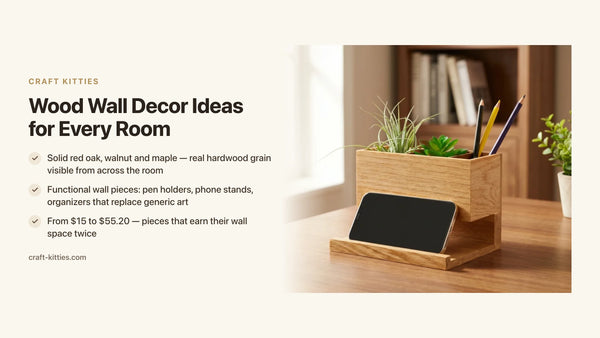
The home office or desk. A slow desk is organized around actual use. The objects on it are either in active use or have a permanent place. Wood organizers, a pen holder in ceramic, bookends that keep reference books upright — each object has a function and earns its visual presence by performing it. The Red Oak Wood Bookends are particularly well suited here: real hardwood on a desk reads as grounded, not decorative.
Description
The bedroom. Slow living in a bedroom means a bedside table that is not a storage disaster and a shelf near the window that has one thing on it. Solid wood pieces on a nightstand or low shelf — a small object in walnut or red oak — bring warmth without demanding attention. Walnut reads especially well here: its fine grain disappears into the calm of a bedroom without asking to be noticed.
The entry. The entry is the first and last surface you encounter in your home, and the one most likely to accumulate objects that have no place. A slow entry has a specific spot for keys, a narrow shelf with one intentional object, and nothing that belongs somewhere else. A small solid wood piece — even a pair of bookends holding a few books on a console shelf — signals intention from the moment the door opens.
The comparison: slow living versus fast décor
| Criterion | Slow living object | Fast décor equivalent |
|---|---|---|
| Material | Solid hardwood, ceramics, linen, stone | MDF, composite, plastic, printed veneer |
| Lifespan | Indefinite with basic care | 1–3 years before visible wear |
| How it ages | Gains character — grain deepens, patina develops | Degrades — chips, yellows, delaminates |
| Design logic | Timeless or quietly personal | Trend-dependent, dates within 1–2 seasons |
| Cost over 10 years | Bought once | Replaced 3–5 times |
The decision guide: which piece for which room
| Your situation | The right pick |
|---|---|
| Light walls, warm palette, first slow living purchase | Red Oak Wood Bookends — $36 |
| Dark or walnut-toned shelving, want a deeper accent | Walnut Cat Bookends — $19 |
| Gift for someone styling a home office or reading nook | Walnut Cat Bookends — $19 |
| Statement piece for a visible shelf in the living room | Red Oak Wood Bookends — $36 |
| Bedroom or nightstand shelf, want calm over character | Walnut Cat Bookends — $19 |
Common mistakes when styling a slow living room
Buying the aesthetic before the logic. Purchasing objects that look slow-living — natural textures, earthy tones — without asking whether they are well-made or whether they earn their place produces a room that looks like the idea of slow living rather than the practice of it. A shelf full of ceramic objects from a discount retailer in "terracotta" is not a slow home; it is a trend iteration.
Replacing everything at once. The antithesis of slow is a weekend renovation where everything changes simultaneously. The room has no time to settle, the choices have no time to be tested, and the result is typically another version of fast — fast in the opposite direction. Slow living is not a project. It is a habit.
Underestimating material quality. A painted-MDF bookend at $8 will chip within a year of actual use. A solid wood bookend at $19–$36 will not. The slow living argument for better materials is not snobbery — it is arithmetic: buy once, do not replace.
Confusing empty with calm. Removing every object from a shelf and leaving it bare is not slow living — it is abandonment. The goal is resolved, not empty. An empty shelf with two quality bookends and a short row of books is resolved. A bare shelf with nothing on it is a surface waiting for clutter to return.
Over-decorating the shelf then calling it slow. A shelf that has twenty objects arranged precisely is styled, not slow. The slow shelf has room to breathe — usually no more than three to five objects between the bookends — and it reads as calm because it is not working too hard.
FAQ — slow living home decor
1 — What is slow living home decor? Slow living home decor is an approach that prioritizes intention over accumulation. Natural materials — solid wood, linen, stone, ceramics — honest craftsmanship, and objects chosen for longevity rather than trend. The goal is a home that feels calm and livable rather than styled and stressful.
2 — What materials define a slow living home? Natural materials that age well: solid hardwood (red oak, walnut, beech), undyed or earth-toned linens, raw ceramics, stone, and matte metals. The shared trait is that these materials reveal character over time rather than degrading. A wax-finished solid wood bookend looks richer after five years than it did new.
3 — How is slow living different from minimalism? Minimalism is about quantity — fewer objects. Slow living is about quality and intention. A slow home can have bookshelves, personal objects, and layered warmth as long as each piece earns its place. Both reject clutter and disposable goods, but slow living is the warmer approach.
4 — Where do you start with slow living decor if the room feels chaotic? One surface. Clear a bookshelf, return only what you use or love, add one material anchor — a pair of solid wood bookends, a ceramic vessel. Live with it for a week before changing anything else. Slow living is a direction, not a renovation.
5 — Are wooden bookends practical or purely decorative? Both, by design. A solid wood bookend in red oak or walnut holds books firmly upright and anchors a shelf visually, giving it a grounded presence that plastic or thin-metal equivalents never achieve. In a slow home, an object that functions well and looks honest is the right object.
6 — Can slow living decor work in a small apartment? Especially well. The principles — fewer objects, natural materials, intentional placement — all fight clutter by default. A studio apartment with three deliberate surfaces reads calmer and larger than the same room filled with accumulated fast-décor pieces.
7 — How do you mix slow living decor with color? Slow living is not monochrome. The palette tends toward natural tones — warm whites, stone grays, terracotta, muted greens — but the principle is that color comes from materials rather than accent objects. The honey of red oak, the deep brown of walnut, the off-white of raw linen are all color, without ever reading as artificial.
8 — How long does solid wood decor last compared to mass-market alternatives? Solid hardwood — red oak, walnut — is indefinitely durable with basic care. A wax-finished piece will not chip, delaminate, or fade. MDF and composite equivalents typically show visible wear within one to three years. Solid wood gains character with age; composites lose it.
Where to go next
The bookshelf is usually where slow living home decor starts — and the wooden bookends collection is organized around exactly that need: solid hardwood pieces that anchor a shelf, hold books, and bring honest material weight to any surface they occupy.
Description
If you are exploring more broadly, the two pieces covered in this guide — the Red Oak Wood Bookends and the Wooden Cat Bookends in Walnut — are a reliable starting point: different woods, different price points, the same material logic.
For those who find us through Etsy, our shop has over 243 reviews from buyers who made exactly this kind of choice — one honest piece, one surface, a different room.
The short version
Slow living home decor is a practice before it is an aesthetic. It means choosing objects with intention, in materials that age rather than degrade, and placing them on surfaces that have room to breathe. The aesthetic follows from the logic: calm, natural, honest.
One pair of solid wood bookends on a cleared shelf is a reliable first step — not because bookends are inherently slow, but because they are the object that makes a shelf feel resolved. A resolved shelf is where the practice becomes visible. Start there, live with it, and let the rest of the home follow at its own pace.