At a glance
- Use walls first — bars and hooks add capacity without adding furniture
- Solid red oak, walnut or beech holds daily use and ages like décor, not hardware
- The three highest-impact moves: clear one surface, mount one bar, discipline one corner
A small bedroom does not need more furniture. It needs less of the wrong kind, and better use of the space that is already there — specifically, the walls. Most small rooms have six to ten feet of blank wall on either side of the bed, above the dresser, and beside the door, and most of that space goes entirely unused. The floor, by contrast, fills up fast: a chair that becomes a second closet, a valet stand that drifts into a pile, shoes migrating away from the mat. The result is a room that reads as cluttered even when most things technically have a place.
This guide is about flipping that equation. Every idea here either claims vertical space that was empty, disciplines a surface that was spreading, or removes an object from the floor that had no fixed home. Furniture is not on the list — if the room already has a bed, a dresser and a nightstand, adding a third storage unit almost always makes things worse before it makes them better.
The organizing thread throughout is solid wood. Red oak, walnut, and beech are the three species we work with at our studio — hardwoods that do not crack, warp or yellow under daily use, and that look like intentional décor rather than storage products. That distinction matters in a bedroom more than anywhere else: the room is the first and last thing you see in a day, and objects that look like they were chosen on purpose make the whole space feel calmer.
At a glance
- Use walls first — bars and hooks add capacity without adding furniture
- Solid red oak, walnut or beech holds daily use and ages like décor, not hardware
- The three highest-impact moves: clear one surface, mount one bar, discipline one corner
Why most small bedroom advice makes the room worse
The instinct when a bedroom feels cramped is to buy more storage. A new dresser, a bed with built-in drawers, a multi-tier shelf tower for the corner. The problem is that furniture has a floor footprint, and floor footprint is exactly what a small bedroom cannot spare. Every time you add a piece of furniture, you also add the visual weight of that piece — and the floor-to-eye sightline becomes more interrupted, which is how rooms start to feel closed-in regardless of how much is organized inside the new unit.
The smarter move is to think of the room in layers. The floor layer is the most precious: it determines whether you can move through the space comfortably, and even a few feet of clear floor can transform how a room feels. The surface layer — nightstand tops, dresser tops — is the most visible: what is on those surfaces is what you see first in the morning and what guests notice immediately. The wall layer is the most underused: it holds nothing at the moment in most bedrooms, and it is the place where every inch of capacity costs zero floor space.
Good small bedroom organization works from the top layer down, not the other way around.
The single highest-leverage move: one wall bar for daily garments

Walk into any small bedroom that feels cluttered and you will find, within ten seconds, a chair or a corner that has become the unofficial parking spot for tomorrow's outfit. It starts with one sweater, adds a jacket, collects a pair of jeans, and within a week it is a pile rather than a chair. The pile is not a willpower problem — it is a systems problem. The dresser is too deep inside the room to reach at 7am, and the closet requires full effort. The chair is just there.
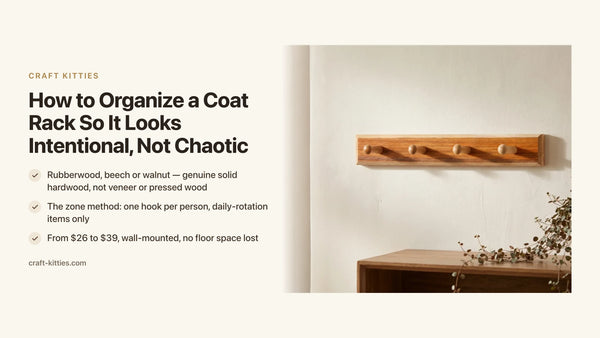
A wall-mounted wood towel bar installed beside the bedroom door, or on the wall nearest to the door, solves this structurally. It puts one fixed, intentional place for the outfit that is almost-clean, the robe in daily rotation, the extra blanket that gets pulled down on cold nights. When that place is a horizontal bar in solid red oak or walnut at 36 to 42 inches from the floor — at natural reach, below the visual horizon — it does not read as a storage workaround. It reads as a design element.
The installation requires two anchor points and about fifteen minutes. The bar sits flush to the wall and has no floor footprint at all. A folded blanket drapes over it without wrinkling; a robe hangs from one end; a tomorrow-outfit jacket hangs from the other. The chair in the corner is now just a chair, and the floor around it is clear.

Description
The square-edge solid hardwood design sits cleanly against any wall finish, from painted drywall to board-and-batten paneling. The wood is finished with a protective wax coat that wipes clean and does not yellow. At $24, it is one of the least expensive structural changes a small bedroom can make.
Surface discipline: the one-tray rule
Surfaces spread. Put anything on a nightstand and it attracts more things — the book stacks on top of the glass, the glass sits next to the phone charger, the charger shares space with lip balm and a watch. Within a week the nightstand is unusable. The same happens to dresser tops, and to windowsills, and to the top of any shelf.
The one-tray rule addresses this at the level of containment rather than willpower. One small tray or catchall organizer per surface defines a boundary: what fits in the tray belongs there, what does not goes elsewhere. The tray does not organize what is inside it — you do that — but it draws a visible line that prevents the surface from expanding outward. Objects outside the tray look obviously displaced. Objects inside the tray look contained.
For this to work, the tray has to earn its place visually. A clear plastic organizer or a cardboard box does the same functional job but reads as temporary — as evidence of the problem rather than a solution. A solid wood tray in walnut or red oak reads as furniture, as part of the room. The nightstand feels dressed, not managed.
The practical rule: one tray on the nightstand (phone, watch, a single book), one tray or a small ledge on the dresser (daily jewelry, keys if the dresser is near the door). If something does not fit on the tray, it needs a different home — not a bigger tray.
Double the hanging capacity behind the door
The back of the bedroom door is almost always empty and almost always overlooked. In a small room, it is a full door-width of vertical space that is currently contributing nothing. A double-layer wall-mounted bar installed on the wall beside or behind the door turns that space into the highest-density hanging area in the room.
The logic of two layers: the upper bar holds garments and accessories that need to stay visible — the jacket worn most often, the scarf that goes with three outfits, the bag in daily rotation. The lower bar holds what needs to be accessible but not constantly in view — a second robe, a gym bag, a folded throw. Two bars, one wall position, double the capacity, zero additional floor space.

Description
The double-layer bar in solid hardwood sits at $24 and installs at two anchor points per tier. Spacing the tiers at around 14 to 18 inches apart gives enough clearance for folded items on the lower bar without crowding longer pieces on the upper. The hardwood finish matches the rest of a room's wood tones — walnut against walnut, red oak against red oak — so the addition feels deliberate rather than improvised.
The wall strip: hooks, bars and ledges in sequence
For a bedroom wall that has more than one organizational need — garments near the door, a mirror or ledge closer to the dresser, a bar for tomorrow's outfit in between — a horizontal wall strip is the most efficient solution. Instead of deciding where each piece goes and drilling separate anchor holes across three different heights, a wall strip creates one reference line at a consistent height, and individual pieces hang from it or mount along it.
The visual result is tidier than scattered individual mounts: a room where the wall is doing work but where all that work sits on a single coherent line reads as organized rather than busy. The eye follows the line rather than jumping between unrelated objects at different heights.
The practical implementation: pick one height on the wall (typically 60 to 66 inches from the floor — below picture-rail height, above most furniture tops), mark the line level, and mount each piece along it. A bar at the near end for garments, a hook in the middle for a bag or robe, a small ledge at the far end for a plant or a framed photo. Each piece earns its place by solving one daily friction. Together they form a wall that looks edited.
Wood and brass: when the bar doubles as décor

A wall-mounted bar in solid wood with brass hardware does something a basic towel bar or command hook cannot: it becomes a design element in the room. The brass catches light in a way that matte black or chrome hardware does not, and against the warm grain of red oak or walnut the effect is the same quiet luxuriousness you see in hotel rooms where every accessory was chosen rather than defaulted to.

Description
The wood and brass set at $22 works in the bedroom anywhere a single bar would be placed — beside the bed for a robe or throw, near the dresser for tomorrow's outfit, beside the door for daily rotation. The brass finish does not tarnish under normal indoor conditions and requires no maintenance beyond an occasional wipe. Against a light linen wall it reads as warm and intentional; against a darker accent wall it provides contrast without being harsh.
Species decision: red oak has a more pronounced, bold grain and a honey-amber tone that brightens a room — it suits neutral, white or grey walls where you want the wood to show. Walnut is quieter, darker, with a fine and uniform grain that recedes into the room — it suits lighter walls where the contrast does the work, or warm-toned rooms where it harmonizes rather than stands out. When in doubt, walnut pairs with more wall finishes without effort.
The arc bar: a softer line for rooms with rounded forms
Square-edge bars suit rooms with clean lines, grid layouts and straight-edged furniture. For a bedroom with rounded forms — a circular mirror, curved headboard, oval rug, arched doorway — an arc design introduces the same organizational function with a silhouette that responds to the room's existing vocabulary.

Description
The arc bar in solid hardwood sits at $24, the same price point as the square-edge model, and installs identically: two anchor points, level marked, fifteen minutes. The difference is entirely visual. In a room where every other line is straight, the square edge belongs. In a room with soft curves, the arc holds the room together rather than introducing another angular contrast. It is a small distinction that makes a real difference in how a room reads after installation.
The practical test before ordering: stand in the bedroom doorway and look at the wall where the bar will go. If the visual context around it is primarily straight lines — window frames, baseboard, furniture edges — choose square. If there are curves in the same sightline, choose arc.
Organizing by zone, not by object
The mistake most people make when organizing a small bedroom is sorting by object type: all clothes together, all books together, all accessories together. This creates logical order but physical inefficiency — you are walking across the room to get to things that belong to the same morning routine.
Zone-based organization works differently. Instead of grouping by what things are, you group by when you need them. The morning zone clusters what you reach for between waking up and leaving: robe on the wall bar, tomorrow's outfit on the same bar or a hook nearby, shoes on a mat at the foot of the bar, watch on the nightstand tray. The night zone is the nightstand itself: book, phone charger, water. The transition zone is by the door: bag on a hook, keys in a dish on a ledge or dresser.
Once each zone is defined, the question for every object becomes not "where does this type of thing live?" but "which zone does this belong to?" Objects that do not belong to any zone are the ones that end up on chairs and floors — and they are usually the best candidates for leaving the room entirely.
Zone-based organization is also why a wall-mounted wood towel bar in the bedroom consistently works better than a free-standing valet stand: the bar mounts at the exact point where the garment zone should be, rather than being placed wherever the stand fits.
Comparison table: wood bars for small bedroom organization
| Model | Price | Wood | Hardware | Best bedroom use |
|---|---|---|---|---|
| Square hardwood bar | $24.00 | Solid hardwood | Minimal | Daily robe or outfit beside the bed |
| Wood & brass set | $22.00 | Solid hardwood | Brass | Décor-forward bar, warm lighting rooms |
| Arc design bar | $24.00 | Solid hardwood | Minimal | Rooms with curved mirrors, rounded furniture |
| Double-layer bar | $24.00 | Solid hardwood | Minimal | Maximum capacity — door area or closet wall |
Decision matrix: which bar for which room situation
| Your situation | Best pick |
|---|---|
| Clean-line bedroom, neutral walls, one focal bar | Square hardwood bar |
| Room with warm lighting and gold-tone accents | Wood & brass set |
| Bedroom with circular mirror or arched headboard | Arc design bar |
| High volume of daily garments, one wall position | Double-layer bar |
| Renter — no permanent holes in the wall | Look for adhesive-mount options in our wooden towel bar collection |
Mistakes that undo good organization
Solving clutter with more containers. Buying a new set of bins, baskets and drawer dividers before getting rid of anything is the most common organizing mistake. Containers do not create space — they formalize clutter. Subtract first: anything that has not been used or worn in six months probably does not belong in a bedroom. Then contain what remains.
Organizing vertically but mixing materials. A solid wood bar, a chrome hook, a plastic shelf bracket and a bamboo tray on the same wall read as accidental even when each piece is individually functional. Choose one material family for wall-mounted pieces in the bedroom — solid wood, or metal, but not both mixed — and the wall reads as coherent rather than assembled from leftovers.
Mounting things at the wrong height. A bar that is too high forces you to stand on your toes every morning; one that is too low creates an awkward crouch. The seated-reach and standing-reach tests both take two minutes: sit on the bed edge and mark where your hand naturally rests for a nightstand bar; stand at the door and extend your arm for the door-area bar. Those two marks are more reliable than any measurement chart.
Leaving the floor perimeter for later. Shoes migrating away from the mat, a bag that never quite made it to its hook, a gym bag that "lives" in the corner — these floor-perimeter objects are the ones that make a room feel cluttered even after every surface is clean. They are usually a symptom of a missing wall-mounted home: a hook or a bar that does not yet exist. Fix the wall, and the floor perimeter fixes itself.
Treating organization as a one-time project. A small bedroom does not stay organized — it stays organized when the system makes the organized state easier than the cluttered state. A bar near the door makes hanging the jacket easier than dropping it on the chair. A tray on the nightstand makes placing the watch there easier than setting it next to the lamp. The systems create the default behavior.
How to install a wall-mounted bar in a bedroom in four steps
1 — Choose the wall position. The wall beside the bedroom door is the highest-leverage location: it intercepts garments before they reach the chair or the floor. The wall beside the bed is the second-best position for a robe or throw blanket. Avoid the wall behind the door — it is out of sight and out of use.
2 — Test the height. Stand at the wall position and extend your arm naturally. Mark where your hand lands. That is the center height for the bar. For a double-layer bar, measure 14 to 18 inches down from that mark for the lower tier.
3 — Mark level and drill. Hold the bar bracket at your marked height and use a small level before marking the anchor holes — even a one-degree slope is visible on a horizontal bar. For solid walls, standard anchors are sufficient. For hollow drywall without a stud behind, use drywall anchors rated for at least 20 lb.
4 — Dress the bar on day one. The bar is useful from the moment it is mounted, but it reads as part of the room the moment something intentional is on it. Fold the throw blanket and drape it before you see the room the next morning. The brain registers "this belongs here" rather than "this is new," and the habit forms faster.
FAQ — small bedroom organization ideas
1 — What is the best way to organize a small bedroom? Use walls before you think about adding furniture. Wall-mounted bars, hooks and floating shelves claim vertical space that is currently empty and free the floor for movement. The second step is clearing surfaces: one tray or organizer per surface disciplines what lands there and keeps clutter from spreading. Furniture should be the last resort, not the reflex.
2 — How do I add storage to a bedroom without taking up floor space? Mount it on the wall. A wooden towel bar beside the bed holds tomorrow's outfit without a valet stand. A double-layer bar behind the door doubles hanging capacity in zero floor space. A wall hook takes a bag, a robe or a cap without requiring any floor furniture at all. Vertical solutions are consistently the highest-ROI moves in small rooms.
3 — What should I declutter first in a small bedroom? Surfaces first, then the floor perimeter. Nightstand tops and dresser tops are the highest-impact targets because they are the most visible. Clear to only what is used daily. Once surfaces are managed, address what is on the floor — items without a wall-mounted or drawer home will drift to the floor perimeter and make a room read as smaller than it is.
4 — Are wooden bedroom accessories worth the price over plastic? Yes, for two reasons. Solid hardwood — red oak, walnut or beech — does not crack, warp or break under daily use the way injection-molded alternatives do. And because it looks like a piece of furniture rather than a storage product, it does not visually subtract from the room. A good wooden wall bar or tray becomes part of the décor rather than working against it.
5 — How high should a wall-mounted bar be in a bedroom? For a robe or outfit bar beside the bed, around door-handle height — 36 to 42 inches from the floor — puts garments at comfortable reach without interfering with the visual line of the room. For a bar used to hang tomorrow's clothing laid flat, slightly lower at 30 to 36 inches works well. The reliable test is to stand naturally, extend your arm and mark where your hand rests.
6 — Can a towel bar be used in a bedroom? Absolutely, and it is one of the most versatile small-bedroom moves there is. A wall-mounted towel bar beside the bed holds a folded blanket within reach. A bar near the door carries tomorrow's outfit. A double-layer bar handles twice the load in the same wall footprint. The clean horizontal line of a hardwood bar also adds a calm visual element to the room.
7 — What is the best wood for bedroom organization accessories? Red oak, walnut and beech are the three practical choices. Red oak has a light honey tone and bold grain — it brightens a room with neutral walls. Walnut is deep brown with a tighter, quieter grain — it reads as furniture rather than hardware. Beech sits between the two in color and is the most even-grained. All three are true solid hardwood: they do not split under daily use and they age well.
8 — Does a minimalist bedroom need storage accessories? It needs fewer but better ones. Minimalism in a bedroom is not the absence of storage — it is the absence of visible clutter. A single wall-mounted bar in solid wood, a tray on the nightstand, and a hook near the door can manage daily flow invisibly. The objects disappear into the room's design rather than competing with it.
Where to go next
A bedroom organized wall-first rarely stays at one piece. The same logic — vertical space, consistent material, zones not categories — applies to adjacent rooms and adjacent needs. Our wooden towel bar collection covers the full range of bar formats and wood tones, from single bars to double-layer sets to the wood-and-brass set for rooms where the bar should double as décor.
Customers who find us through bedroom organization often explore our bathroom wall accessories next — the principles carry directly, and keeping the same wood tone across both rooms is what makes a home feel coherent rather than room-by-room. You can find the full range on our Etsy shop, where over 243 reviews reflect daily use across a range of home styles.
Conclusion — walls first, surfaces second, furniture last
If this guide leaves you with one method: pick the most useful empty wall in your bedroom, mount one solid hardwood bar at natural arm reach, and spend the first week noticing what consistently gravitates toward it. That data tells you whether to add a hook beside it, a double-layer bar in the same position, or a tray at the nearest surface. Organizations that work long-term are built one solved friction at a time, not redesigned all at once.
The square hardwood bar at $24 is the right starting point for most bedrooms. The wood and brass set at $22 is the upgrade when the bar should earn its place as décor. The double-layer bar is the move when one tier is not enough. Three paths into the same result: a bedroom where the walls are working, the surfaces are clear, and the floor is free.